Rocchetta Mattei: A Historic Castle in Grizzana Morandi, Italy
Visitor Information
Google Rating: 4.6
Popularity: Medium
Official Website: www.rocchetta-mattei.it
Country: Italy
Civilization: Modern
Site type: Domestic
Remains: Palace
History
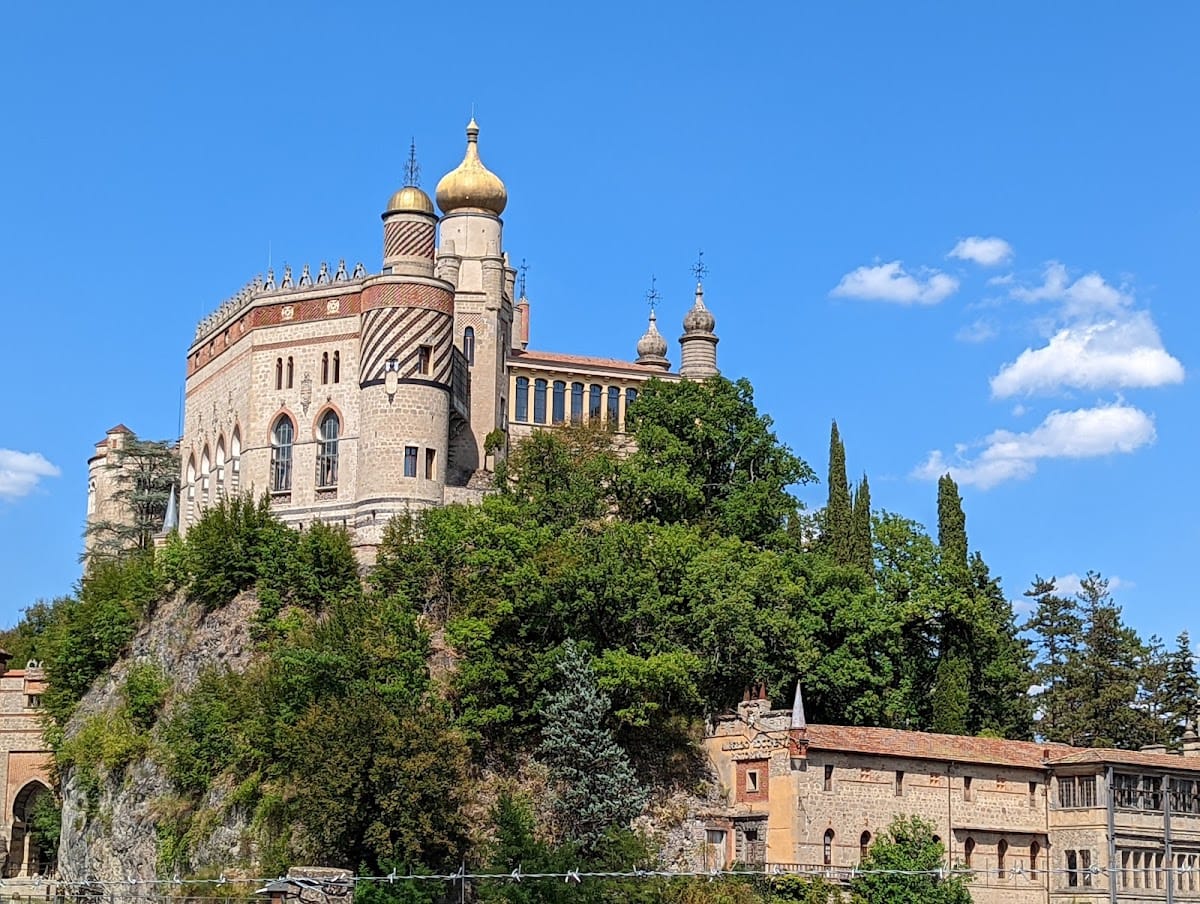
Rocchetta Mattei is situated in the municipality of Grizzana Morandi, Italy. The site occupies the remains of a medieval fortress originally constructed by imperial authorities in the Middle Ages.
The earliest fortress on this hill was built to control the strategic crossing over the Reno River. It belonged to emperors Frederick I, known as Barbarossa, and Otto IV, and later came under the jurisdiction of Matilda of Tuscany, a prominent feudal ruler of the region. The medieval fortress was guarded by the vassal Lanfranco da Savignano. However, by the late 13th century, as military defenses evolved, this fortress lost its strategic value. In 1293, after the stronghold fell to forces from Bologna, it was destroyed and abandoned in favor of a more advanced defensive line.
Centuries later, beginning in 1850, Count Cesare Mattei set about constructing a new residence on this historic site. His intention was to evoke the medieval castellan lifestyle, and by 1859, the Rocchetta was fit for habitation. Mattei, a self-taught physician and founder of the alternative medical practice called electrohomeopathy, made the castle his home and operated a sort of court, including such figures as a buffoon, reminiscent of medieval traditions.
During Mattei’s lifetime, the Rocchetta became well known to visitors seeking his treatments; among them were notable personalities such as Ludwig III of Bavaria and Tsar Alexander II of Russia. After Mattei’s death, his adopted son Mario Venturoli Mattei took responsibility for the estate, bringing Count Mattei’s ashes to the castle in 1906. The site continued to draw distinguished guests, including a formal visit by the Prince of Piedmont in 1925.
The castle endured significant interior damage during World War II due to the presence of German troops. Postwar, the last family heir, Iris Boriani, attempted to offer the Rocchetta to the Municipality of Bologna; however, this proposal did not succeed. In 1959, Primo Stefanelli acquired the Rocchetta and initiated restoration and adaptive reuse by converting a minor castle building into a hotel and restaurant, aiming to preserve the structure’s historical character.
Following Stefanelli’s death in 1989, the castle fell into neglect and was closed. A group formed in 1997 to preserve the estate from further decline. In 2000, the Archivio Museo Cesare Mattei committee established a museum in nearby Riola di Vergato dedicated to Cesare Mattei, the Rocchetta, and his electrohomeopathic practice. Later, in 2006, the Fondazione della Cassa di Risparmio in Bologna purchased and restored the castle, culminating in its reopening to public access in 2015.
Remains
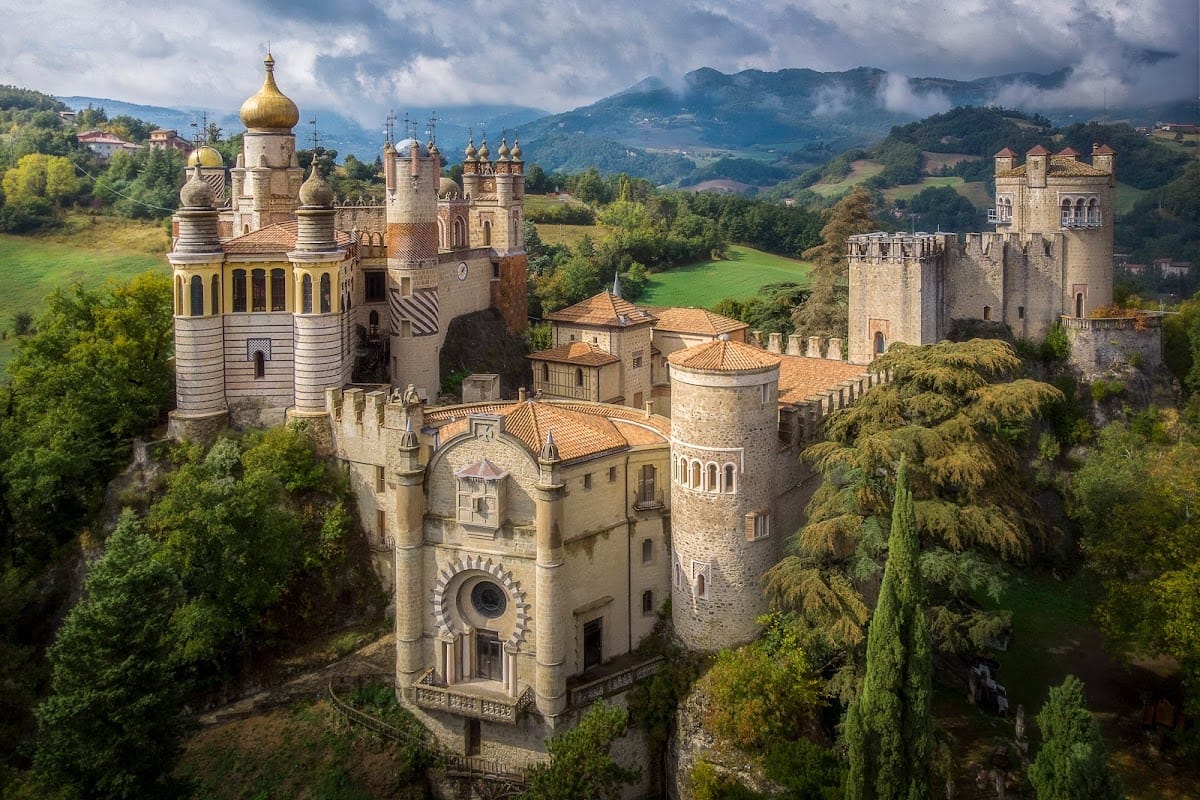
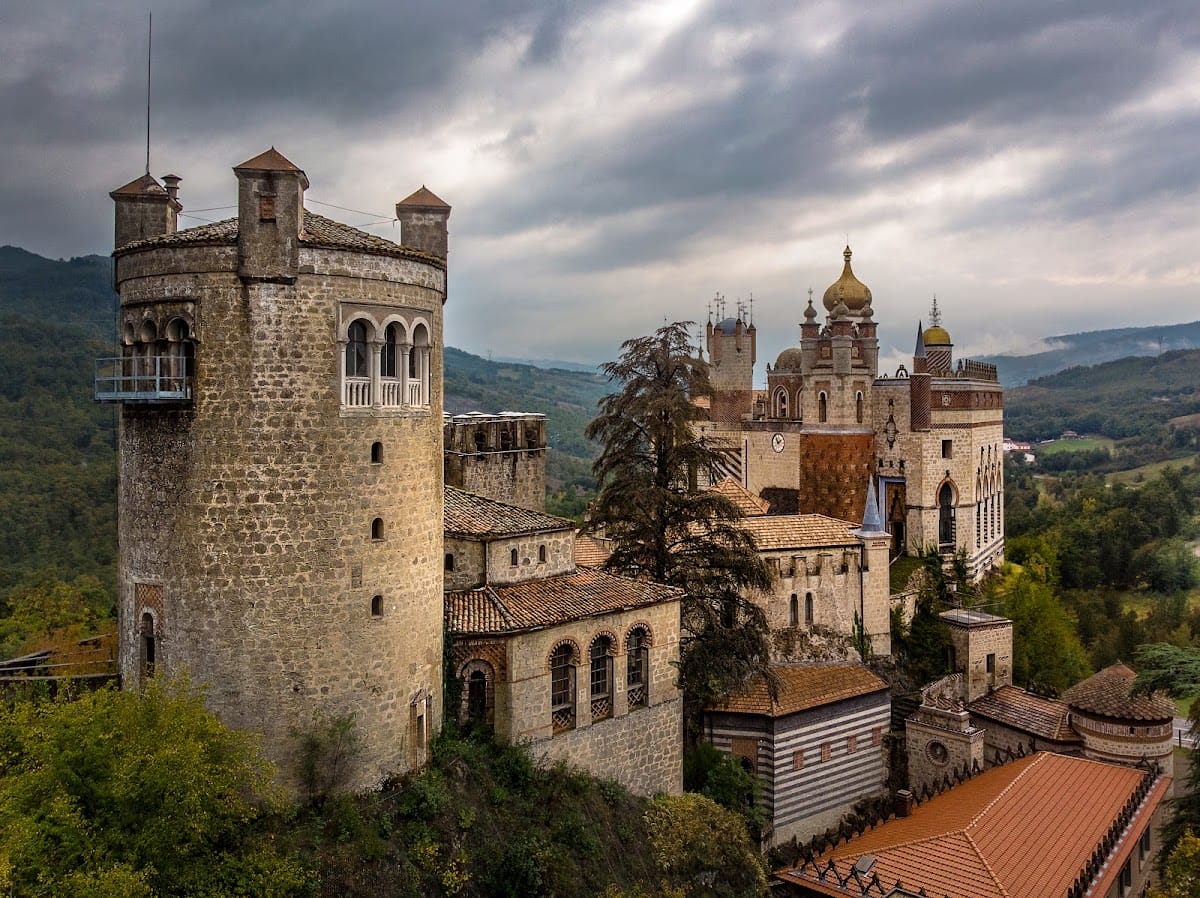
The Rocchetta Mattei crowns a hill standing at 407 meters above sea level in the locality of Savignano, where it commands views along the Strada Statale 64 Porrettana. The complex is renowned for its eclectic design, blending Moorish motifs with medieval and modern Italian architectural features.
At the main entrance, which opens onto a provincial road, an inscription commemorates Count Cesare Mattei’s foundational work and the completion undertaken by his adopted son Mario Venturoli Mattei, whose role included entombing Mattei’s ashes within the castle grounds. Visitors enter through a large staircase leading to a vestibule marked by a statue of a hippogriff, a mythical creature with the body of a horse and the head of a griffin. Beyond this lies a courtyard carved directly into the rock. Here, two caryatids shaped like gnome figures uphold a door jamb facing the entrance, contributing to the castle’s imaginative character. Centrally positioned in the courtyard is a monolithic basin that once served as a baptismal font in the parish church of Verzuno; this spot was where Mattei laid the first stone of the new construction on November 5, 1850.
From the courtyard, one may enter a stairway ascending to the Loggia Carolina, an oriental-style gallery reflecting Eastern design influences. Leading from the tower staircase via a drawbridge is Mattei’s bedroom, a small chamber featuring narrow windows and a ceiling with stalactite-like decorations. This room preserves many original furnishings, including the count’s personal pipes.
An evocative feature called the “Staircase of Visions” climbs upward beneath an allegorical vault painting expressing the triumph of electrohomeopathy over conventional medicine. Latin couplets inscribed by the abbot Giordan, a friend of Mattei, accompany this artwork. Proceeding upward, visitors reach the English Room perched atop the main tower. From the Loggia Carolina, one can access the White Room and the Turkish Room, both exhibiting stylistic diversity within the castle.
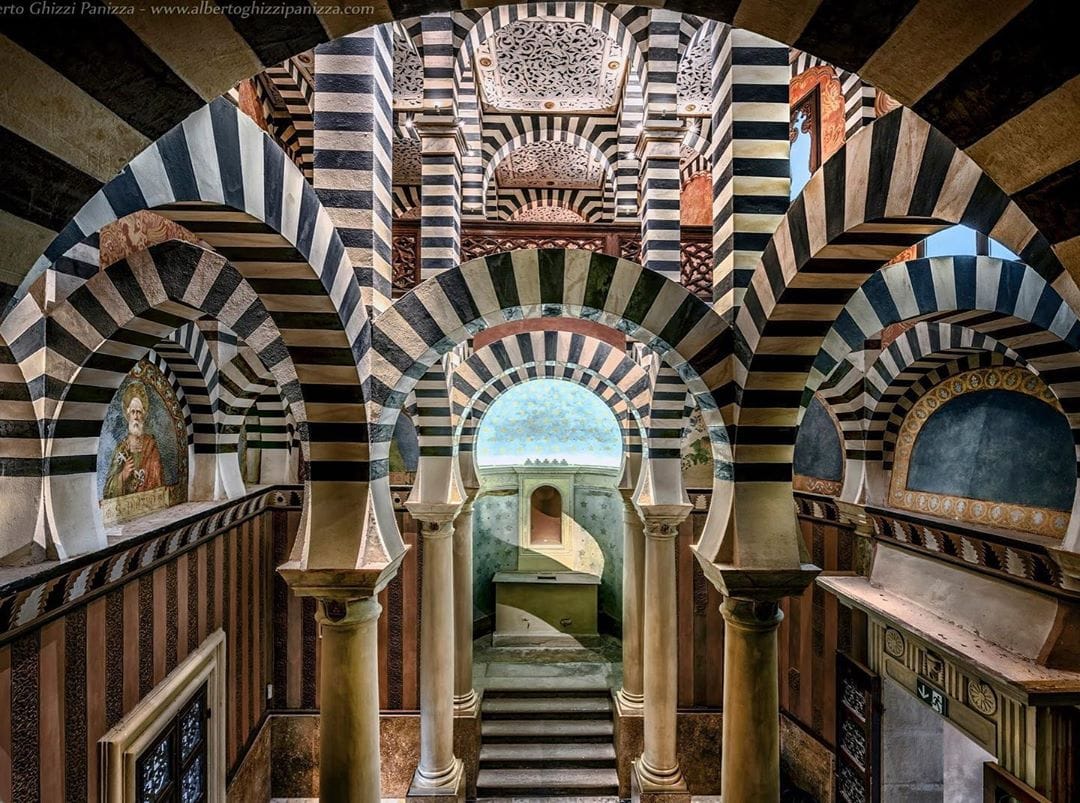
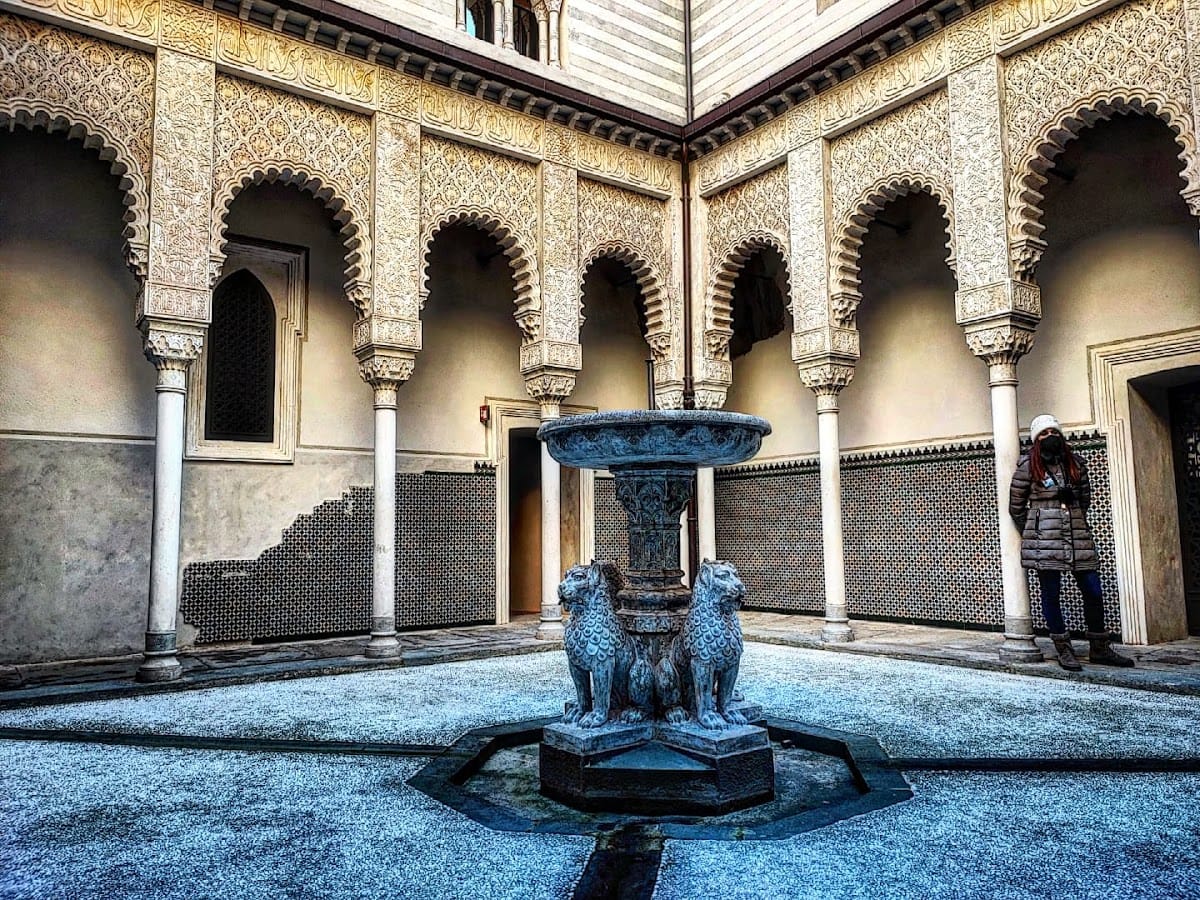
Adjacent to a balcony and an outcrop of exposed rock lies the Courtyard of the Lions, a faithful reproduction of the famed courtyard in the Alhambra palace of Granada. This area is regarded as the most successful example of the complex’s architectural synthesis. Nearby, a grand gallery resembling a choir overlooks the interior of the castle’s private church. Count Mattei’s remains rest in a majolica-tiled ark inscribed simply with the Latin phrase “Anima requiescat in manu Dei,” meaning “May the soul rest in the hand of God.”
Beyond the Courtyard of the Lions is the Hall of Peace, named to commemorate the end of World War I. Adjacent lies the Music Room inside the church, whose design draws inspiration from the Cathedral of Córdoba. Next to this space is the Room of the Ninety, intended by Mattei as a banquet hall for nonagenarians. Although Mattei passed before its completion, his adopted son successfully finished this unique chamber.
The main castle building is topped by several smaller structures that once served as utility rooms but have since been converted into standalone villas. From the park surrounding the Rocchetta, an elegant stone staircase descends to the nearby Porrettana Railway, linking the castle to the surrounding landscape and transportation routes.
Nearby sites