Pernštejn Castle: A Historic Gothic-Renaissance Fortress in the Czech Republic
Visitor Information
Google Rating: 4.7
Popularity: Medium
Official Website: www.hrad-pernstejn.cz
Country: Czechia
Civilization: Early Modern, Medieval European
Site type: Military
Remains: Castle
History
Pernštejn Castle is located in the municipality of Nedvědice in the Czech Republic. It was established during the late 13th century by the Lords of Medlov, a noble family within the medieval Kingdom of Bohemia. The branch of this family residing at the site came to be known by the name Pernštejn, derived from the German term “Bärenstein,” which means “Bear Rock,” reflecting the castle’s position atop a rocky promontory.
The castle’s earliest phase dates from approximately 1270 to 1285, when it served as a typical Gothic fortress built primarily for defense. Over the following centuries, particularly at the turn of the 15th and 16th centuries, Pernštejn underwent considerable expansion and renovation. These changes adapted the fortress into not only a military stronghold but also a significant seat of political and administrative power for the Pernštejn family, who held considerable influence in regional and national affairs. Two notable lords, William I and William II, were especially important in this period—William I was active from 1378 to 1422, and William II from 1435 to 1521. Their leadership brought both physical growth to the castle and increased prominence for the family.
During the Thirty Years’ War (1618–1648), Pernštejn Castle played an active military role. It withstood a Swedish siege in 1645, during which some upper parts suffered damage. Despite this, the fortress’s strategic function was reaffirmed, and it continued to be maintained as a regional stronghold until the mid-18th century.
After 1596, ownership passed among several noble families including the Lobkowicz, Stockhammer, and eventually the Mitrovský family, who retained control until the mid-20th century. Under the Mitrovský ownership, the castle remained largely unchanged architecturally from its Gothic-Renaissance appearance, as they refrained from the Romantic-style remodels common in the 19th century.
In the modern era, Pernštejn has been recognized as a national cultural monument since 1995. Archeological excavations have uncovered numerous inscriptions and paintings dating from the mid-16th century, recorded in Czech, German, and Latin, which provide insights into the castle’s historical function and social life. Among local traditions, the presence of a large ancient yew tree near the castle is tied to foundation legends, adding a symbolic element to the site’s history.
Remains
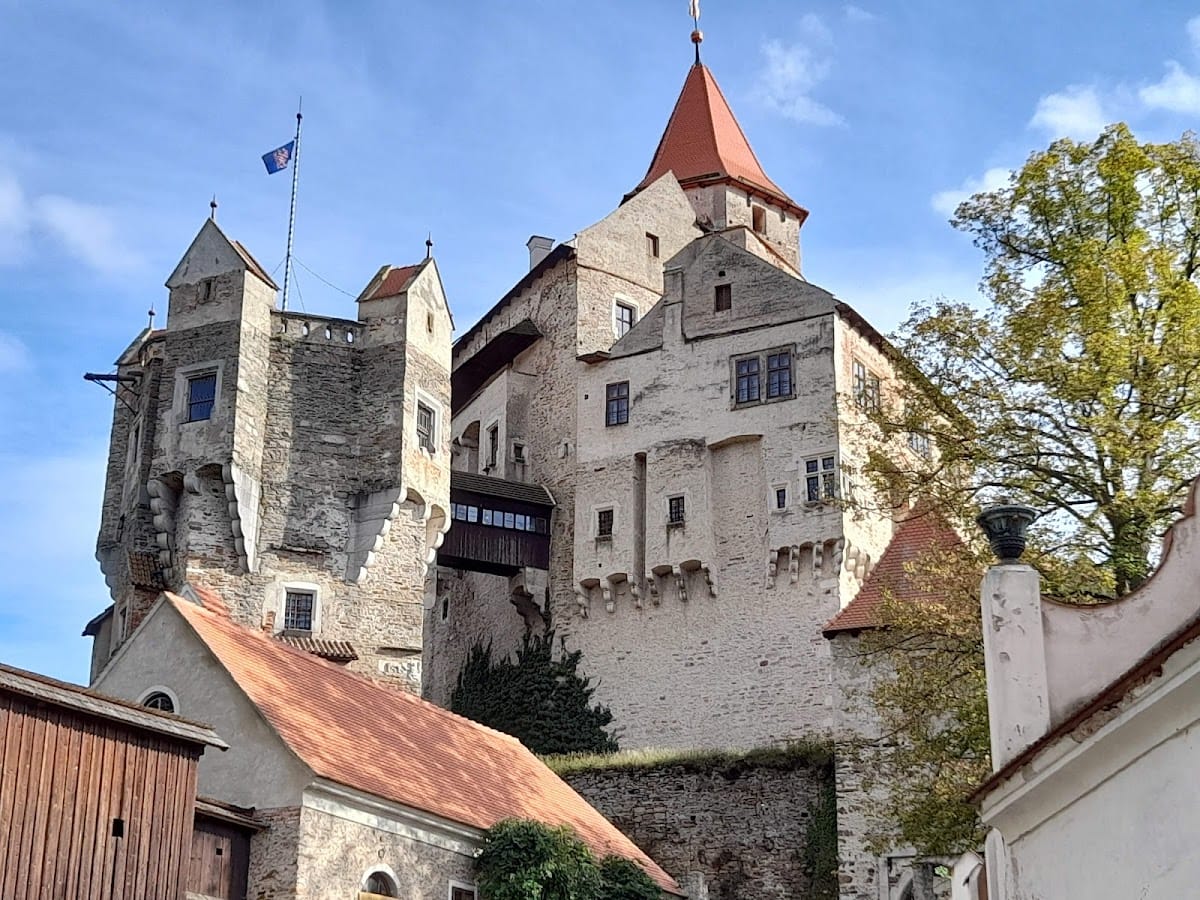
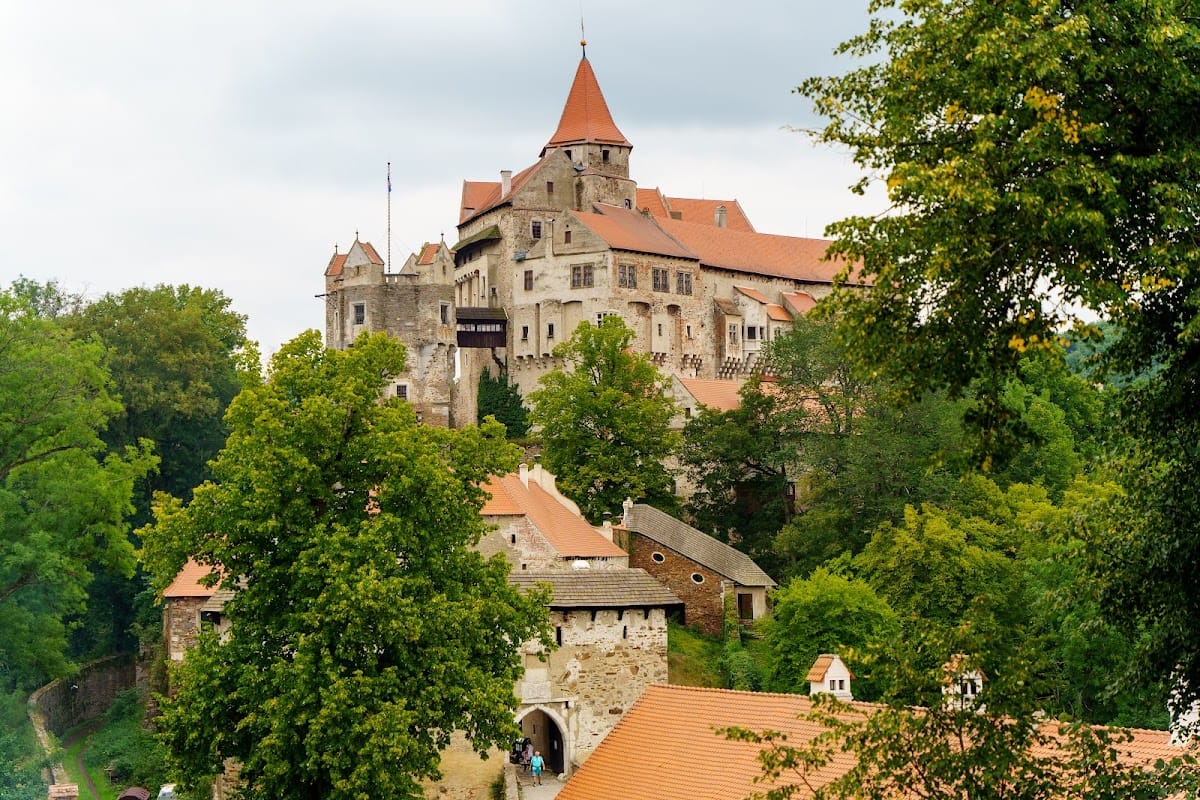
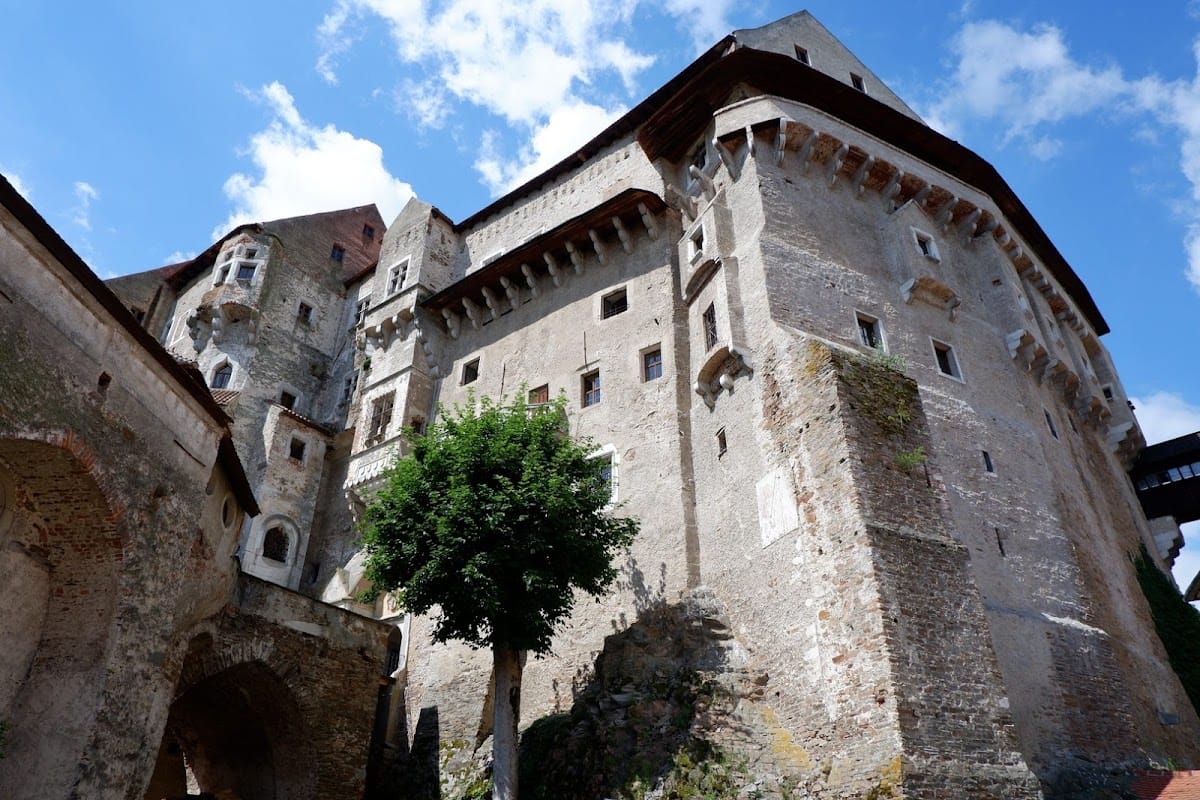
Pernštejn Castle occupies a naturally defensive rocky spur, with steep slopes on three sides that integrate directly into the castle structure up to the second floor. The fortress features five interconnected courtyards surrounded by various outbuildings, walls, gates, and bastions, forming a complex layout optimized for both residence and defense from the Gothic through the Renaissance periods.
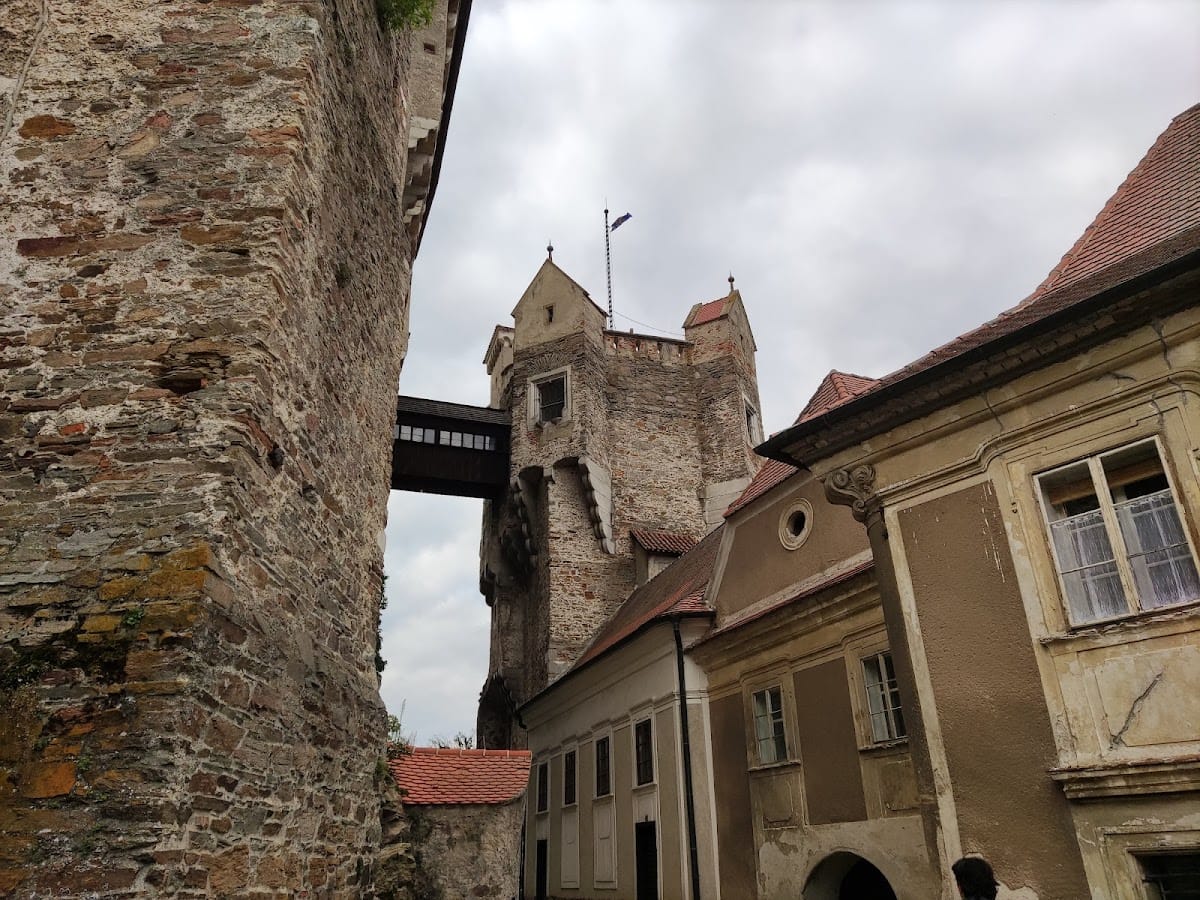
At the heart of the complex is the Barborka Tower, the castle’s original core element dating back to its founding. This five-story round bergfrit—a tall, freestanding defensive tower—has a distinctive edge facing the main access path and remains a prominent feature rising above the rest of the buildings. Surrounding the main structures are ramparts and moats crossed by several drawbridges, adding layers of defense. The narrow entrance approach is guarded by a central barbican, a fortified outwork with three-meter-thick walls equipped with crenellations designed to allow defenders to fire light firearms, and a machicolation, an opening used to drop projectiles or boiling liquids on attackers below.
The complex includes multiple gates, notably a second settlement gate highlighted by a Gothic-Renaissance marble portal. Access to a third gate involves crossing a Gothic stone bridge leading to a projecting tower. Defensive architecture extends to a semicircular Renaissance bastion guarding the northern flank, and the castle’s design incorporates a labyrinth of narrow corridors and staircases aimed at slowing invaders.
A key feature of Pernštejn is the way upper floors jut out beyond the ground floor walls through cantilevered supports known as jetties, distinctive in this castle’s design. Construction materials prominently include locally quarried Nedvědice marble, extensively used for door and window frames, which contributes to the castle’s nickname as the “Marble Castle.”
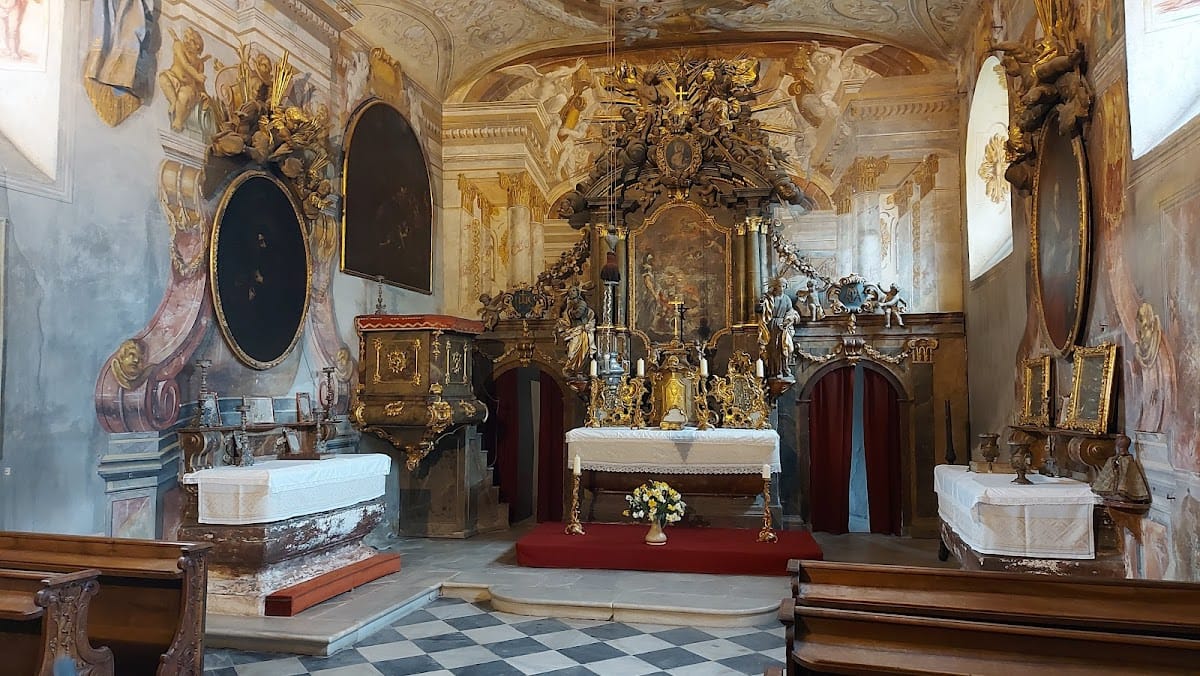
Inside, the castle still retains many historic decorative elements. The Knights’ Hall boasts Renaissance vaulting with diamond-shaped ribs and stucco reliefs dating from around 1700. Rococo paintings adorn rooms such as the bedroom and the Chinese parlour, painted in the 1760s. The Baroque-era chapel contains frescoes completed in 1716 by the artist František Řehoř Ignác Eckstein. Other notable chambers include a picture gallery on the first floor and a Renaissance palace attached to the original core, linked by a vaulted passage called the Black Gate.
Among the towers within the complex is a large round tower constructed in the mid-15th century, a Clock Tower accompanied by a Renaissance chapel, and the Tower of Four Seasons, named for its colorful glass windows. Outside the main fortifications, terraces support gardens, while an ancient yew tree nearby, remarkable for its considerable trunk circumference measuring 4.5 meters, is connected to traditional tales concerning the castle’s origins.
Despite losses sustained especially during the 1645 siege—such as original high roofs and wooden shooting galleries—the castle’s preservation remains strong. Modifications after the siege replaced damaged elements with simpler roofing forms by the late 18th century. Today, much of Pernštejn’s Gothic and Renaissance architecture is intact and offers a clear window into its historic defensive and residential functions.
Nearby sites