Craignethan Castle: A 16th-Century Scottish Fortress Near Lesmahagow
Visitor Information
Google Rating: 4.5
Popularity: Low
Official Website: www.historicenvironment.scot
Country: United Kingdom
Civilization: Early Modern
Site type: Military
Remains: Castle
History
Craignethan Castle is located near Blackwood, Lesmahagow in Scotland. It was built by Scottish craftsmen under the direction of the Hamilton family during the 16th century.
The castle’s origins trace back to around 1532 when James Hamilton of Finnart, an illegitimate son of James Hamilton, 1st Earl of Arran, undertook its construction. Hamilton of Finnart was a talented architect and military engineer holding the position of King’s Master of Works. He is credited with significant projects including Blackness Castle and Linlithgow Palace. Craignethan was designed as a showcase combining domestic comfort with the latest military defensive technology, especially featuring advanced artillery defenses. However, the castle’s fortifications were never subjected to major battle tests during his lifetime.
Hamilton of Finnart fell from grace and was executed for treason in 1540, leading to the forfeiture of Craignethan to the Scottish crown. The castle was then held by royal forces until 1542, when James Hamilton, 2nd Earl of Arran, regained possession. He expanded the castle by adding a large outer courtyard on its western side, reinforcing its defenses against potential attackers approaching from higher ground.
During the mid-16th century, Craignethan became involved in the complex and often violent political struggles of the period, especially during the Marian civil war following the abdication of Mary, Queen of Scots. Mary herself stayed at Craignethan Castle shortly before the Battle of Langside in 1568. Throughout this turbulent era, control of the castle shifted multiple times between supporters of Mary and her adversaries, with several sieges and the eventual surrender of the fortress marking its contested status.
In 1579, after the Hamilton family was outlawed for their involvement in the assassinations of two regents, Moray and Lennox, royal troops took Craignethan. To ensure it could no longer serve as a military stronghold, the government ordered the slighting of the castle, including the demolition of the northwest tower and the thick west wall, effectively disabling its defenses.
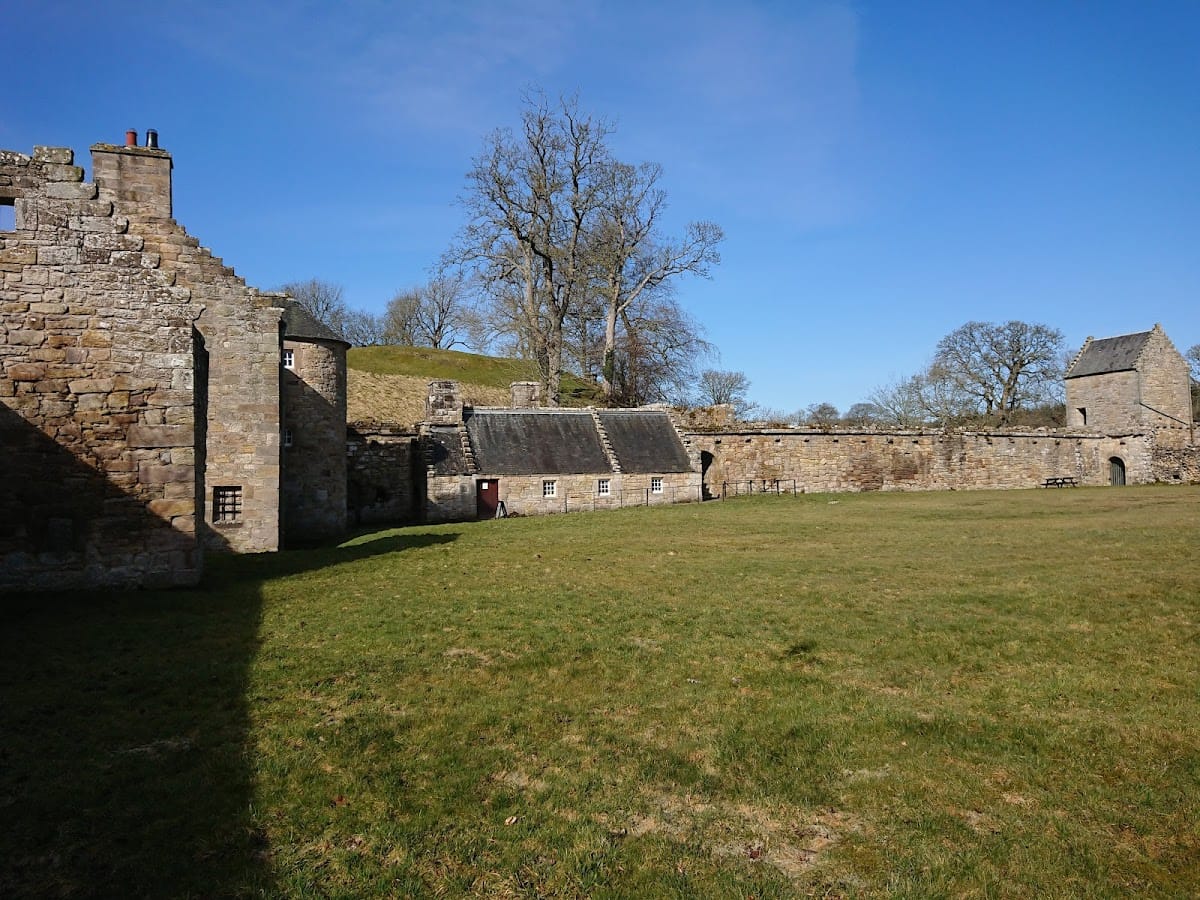
Though later returned to Hamilton ownership, the castle was sold in 1659 to Andrew Hay, who constructed a two-storey house within the outer courtyard, blending new domestic architecture with the older military remains. In 1730, ownership changed hands again to Archibald Douglas, Duke of Douglas, and eventually the castle passed to the Earls of Home. Efforts to stabilize the ruins took place during the late 19th century. The site entered state care in 1949 and is now protected as a Scheduled Ancient Monument.
Craignethan Castle also holds a literary connection with Sir Walter Scott, who visited in 1799 and associated the site with his fictional Tillietudlem Castle featured in the novel Old Mortality (1816). This link enhanced the castle’s prominence in Scottish cultural heritage.
Remains
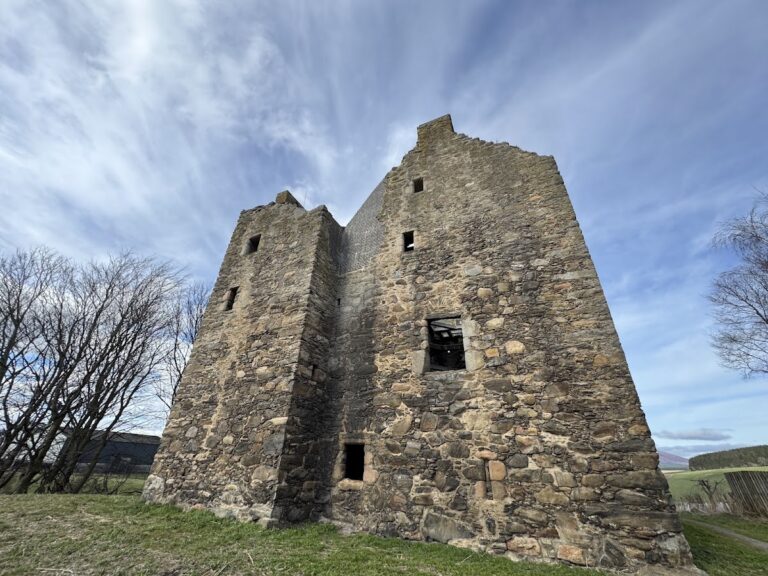
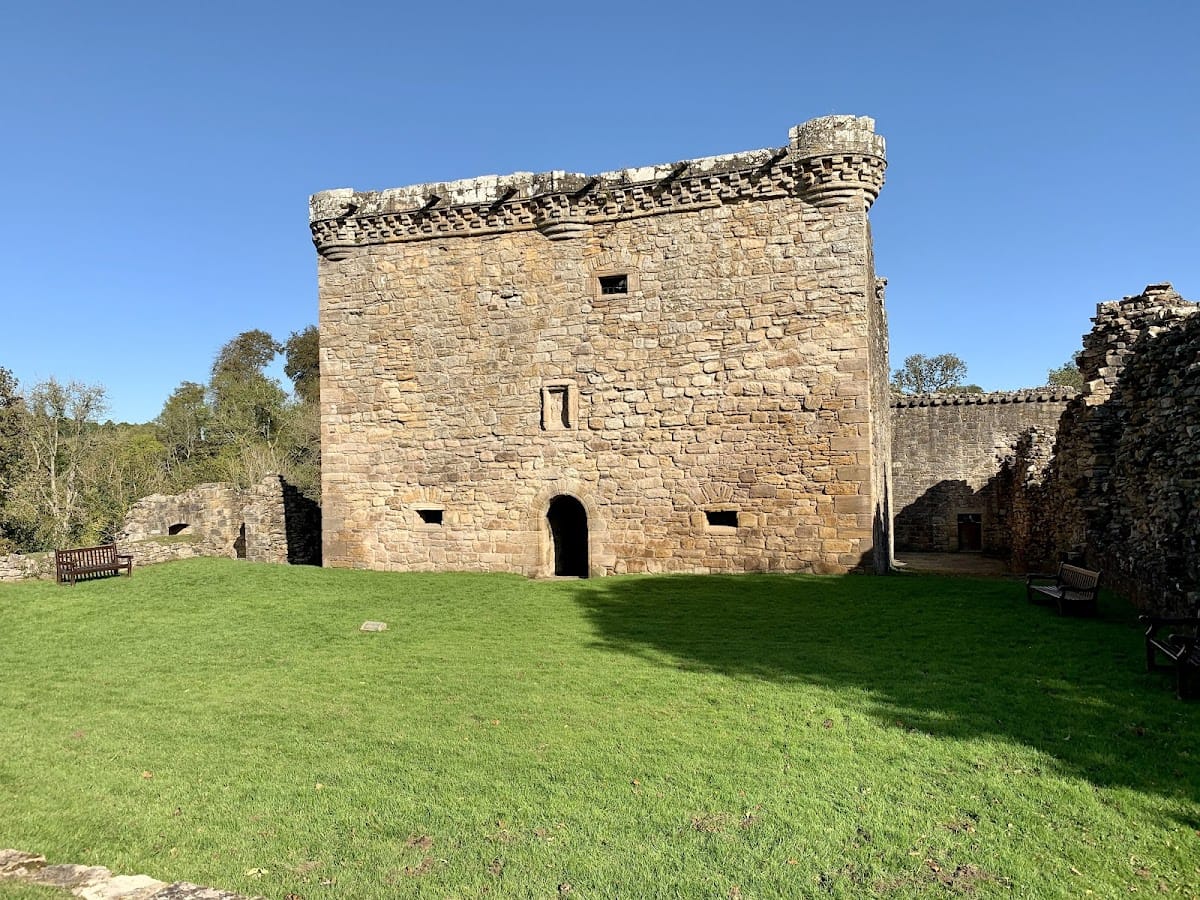
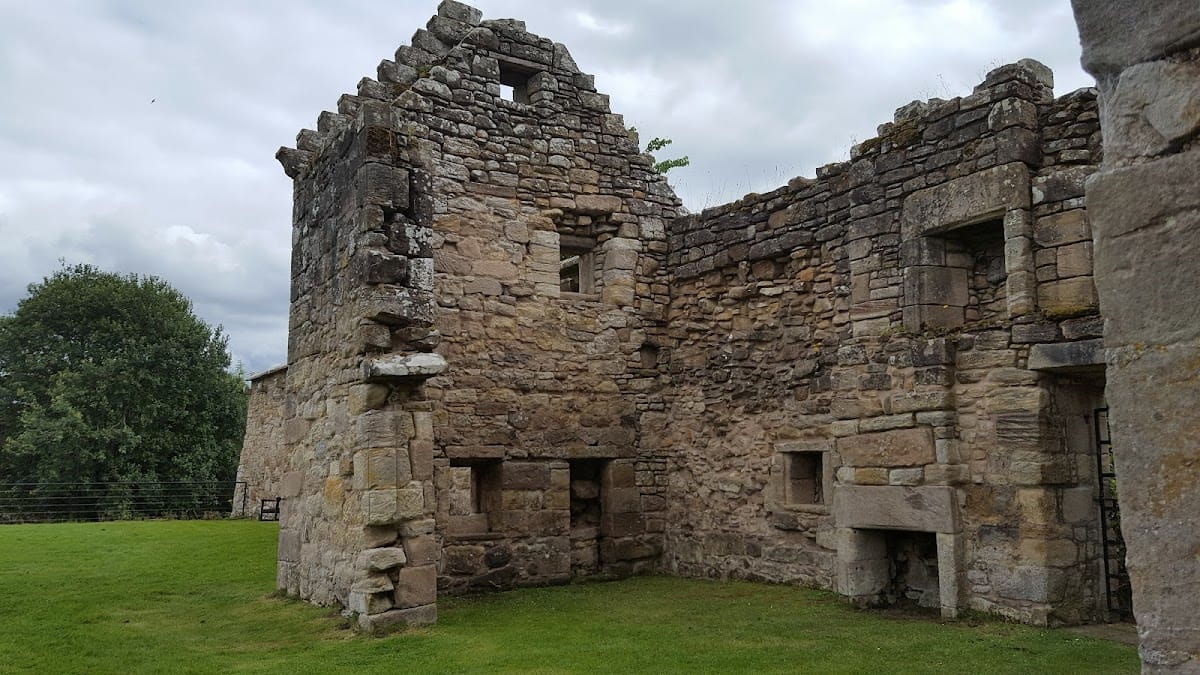
Craignethan Castle’s remains reveal a carefully planned layout integrating both residential and military functions. The castle was built primarily from locally sourced stone, forming a low rectangular keep set above a bend in the River Nethan. This elevated position provided natural defense, with steep slopes protecting the south, north, and east sides, while the western side remained the most vulnerable and thus heavily fortified.
The central structure, or keep, measures approximately 21 by 16 meters and originally rose two stories high with an attic storey above, although the roof and attic no longer survive. The stone walls still stand to the level of decorative corbels that once supported a parapet walkway. Round bartizans, or small overhanging turrets, mark each corner, and openings called machicolations defended the main entrance by allowing defenders to drop objects or fire on attackers below.
Inside the keep, the space is divided by a wall running west to east. On the ground floor, the southern section contains a hall roughly 6 by 12 meters with a high stone vaulted ceiling that spans the full height of the keep. This hall was illuminated by three large windows, featured a fireplace set into the inner wall, and included a minstrel’s gallery on the western side for musicians. The northern section housed the kitchen and a private chamber, with further rooms arranged above and in the attic. Beneath ground level lie vaulted cellars comprising four rooms used for storage, along with a prison and a well, accessible from the entrance area or kitchen.
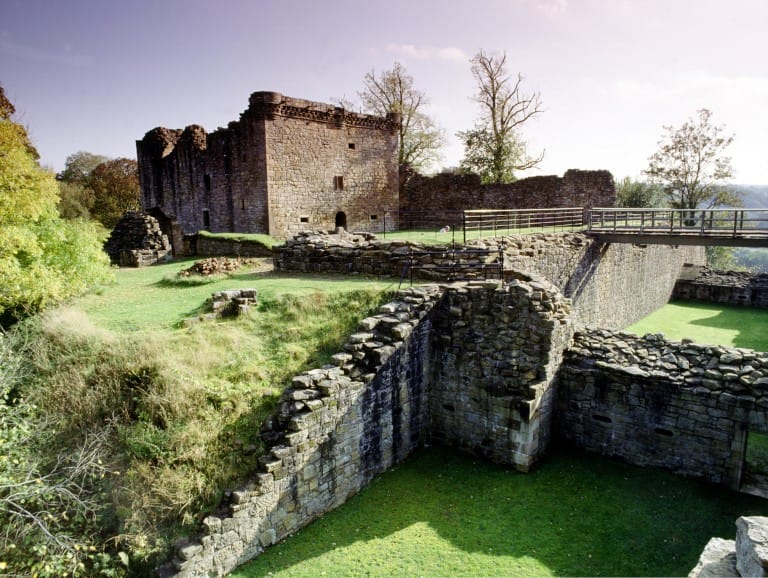
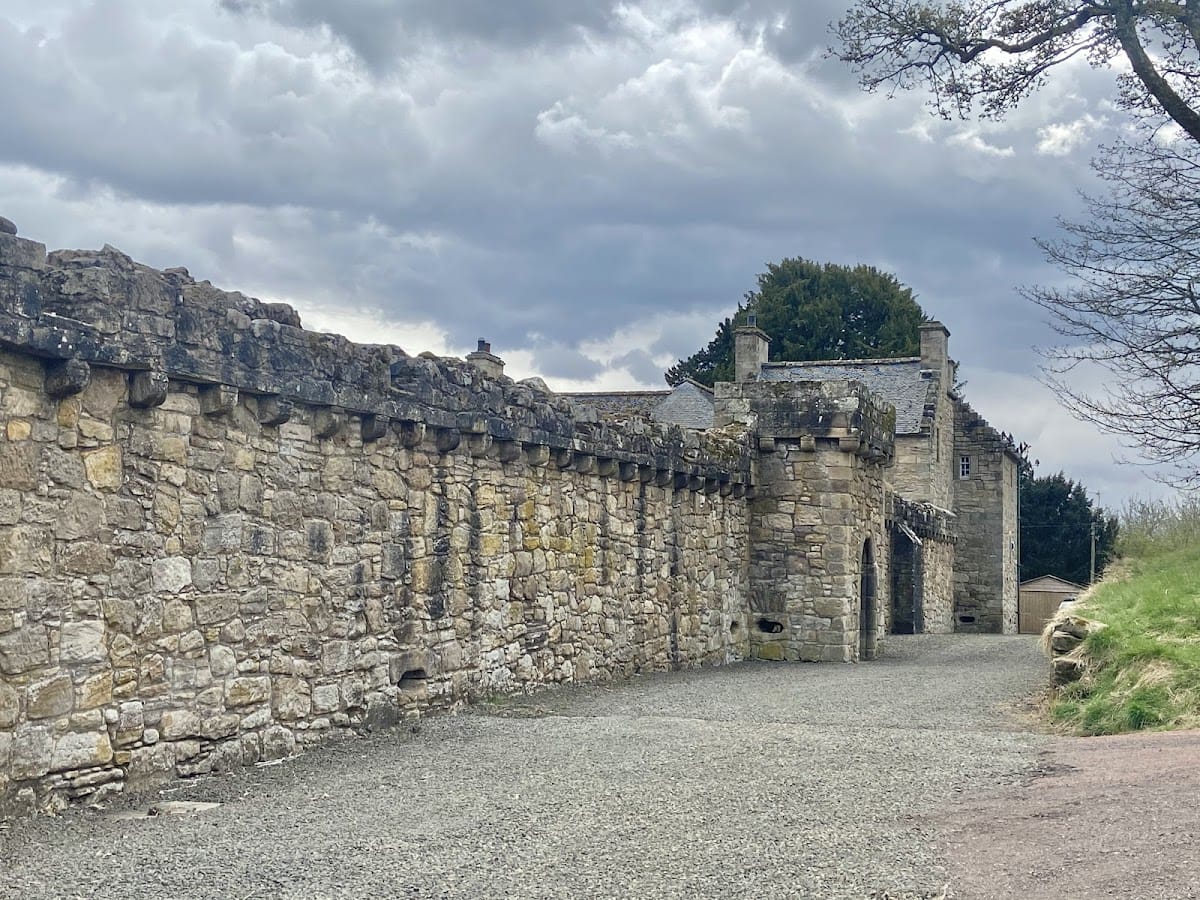
Surrounding the keep is a rectangular inner courtyard about 49 by 25 meters, enclosed by defensive walls strengthened at the corners with rectangular towers. The main entrance passes through a gated tower on the north wall, designed as a dog-leg passage creating a defensive turn against intruders. The inner courtyard’s western wall was constructed to withstand artillery attack; its thickness reached up to 5 meters, possibly matching the keep in height. This massive wall was destroyed during the slighting of the castle in the late 16th century, and only its foundations remain visible today.
Among the four corner towers, the south-east tower stands largest and best preserved. Called the “Kitchen Tower,” it consists of three stories including a vaulted subterranean chamber, and features gunloops—narrow slits through which defenders could fire guns—overlooking the eastern approach. This tower may also have served as the chapel.
At the base of the heavily fortified western side lay a deep defensive ditch measuring about 3.5 meters deep and 9 meters wide. Originally, this ditch was crossed by a drawbridge, and after the destruction of the castle’s defenses, it was filled in but later re-excavated during the 1960s.
A particularly rare defensive feature at Craignethan is a caponier located at the bottom of the ditch. This enclosed passage, accessible from the south-west tower, projected into the ditch and was equipped with gunports allowing defenders to fire along the length of the ditch, preventing attackers from approaching unseen. Craignethan is one of only two Scottish castles known to retain an original caponier, the other being Blackness Castle.
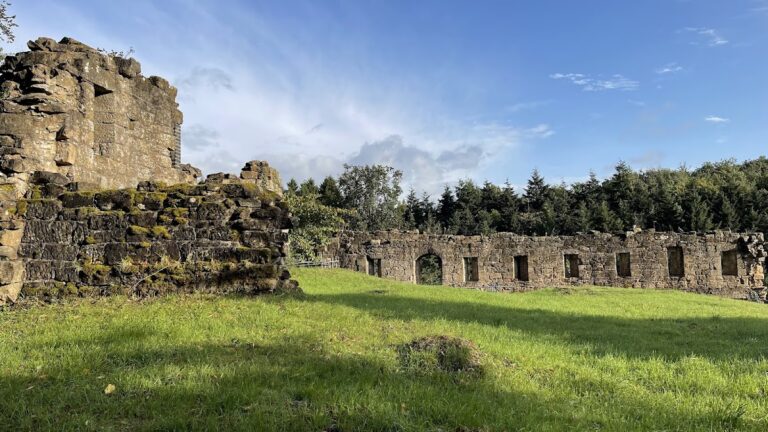
An outer courtyard was added in the 1540s by the 2nd Earl of Arran and is positioned to the west of the inner courtyard. This area is less heavily fortified and likely contained service buildings and gardens. Towers flank the north-west and south-west corners; the north-west tower includes a dovecot, a structure for housing pigeons, whereas the south-west tower became part of the 17th-century two-storey house built by Andrew Hay. Gunloops along the west wall of this outer court provided defensive coverage, and the main gate is situated roughly midway along this facade.
Overall, Craignethan Castle’s remains illustrate a sophisticated approach to fortress design blending housing needs with artillery defense, centered on protecting against threats especially from the higher ground to the west. The surviving stonework and defensive features offer valuable insight into Scottish military architecture of the 16th century.
Nearby sites