Corra Castle: A Ruined Tower House in Scotland


Site at a Glance
- Rating
- 3.9
- Popularity
- Very Low
- Country
- United Kingdom
- Primary era
- Early Modern
- External website
- Open
- Eras represented
- Early Modern
- Civilizations
- Kingdom of Scotland
- Site type
- Military
- Remains
- Castle
On this page6 sections
History
Corra Castle is a ruined sixteenth-century castle in Scotland, United Kingdom, near New Lanark. It was a fortified residence known by several names, including Corrax, Corax, and Corehouse Castle, and was formerly occupied by a branch of the Somerville family. Its position above Corra Linn was chosen for its defensive strength, with sharp cliffs surrounding the site on three sides.
Origins and uncertain dating
The castle is commonly dated to the sixteenth century, with 1572 sometimes given as its construction date. Its precise building period remains uncertain because some architectural details have been interpreted as seventeenth-century. An Irish coin bearing the portrait of Edward I, the English king who ruled from 1272 to 1307, was found at the foot of the foundations and has been used in arguments for earlier activity at the site.
A tradition also connects Corra Castle with Mary Stuart, commonly known as Mary, Queen of Scots. She is said to have spent a night at the castle while travelling to the Battle of Langside, a 1568 conflict between her supporters and those who opposed her. This association forms part of the castle’s traditional historical identity, although it does not establish the date of construction.
Later history and protection
The castle survives as a ruin within the Corehouse Estate. The surrounding lands now belong to Corehouse, a mansion dating from the 1820s. Corra Castle became a Scheduled Monument in 1967, a legal designation for an archaeological or historic site considered nationally important. It was formerly also listed as a Category A building, although that classification was later removed. The ruins are currently owned by the Scottish Wildlife Trust.
Remains
Setting and surviving structure
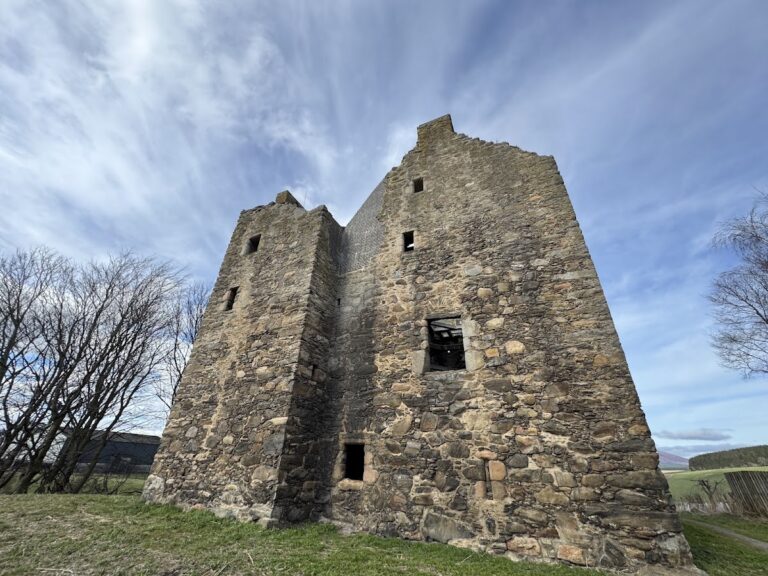
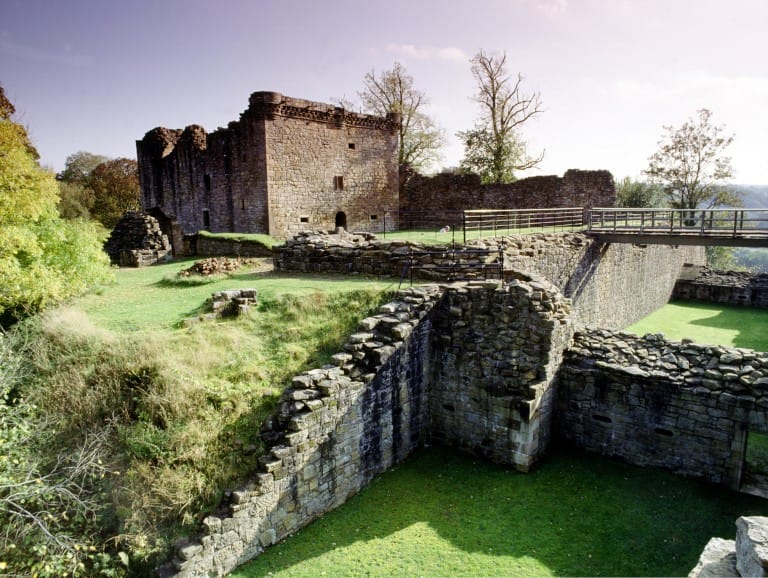
The ruins occupy an isolated position above Corra Linn, one of the four waterfalls that form the Falls of Clyde. New Lanark lies about one kilometre to the northwest, on the opposite bank of the River Clyde. The castle is a tower house, a fortified residence combining domestic accommodation with defensive features, constructed from rubble masonry. Its elongated remains measure approximately 13.7 by 4.9 metres, while the walls are nearly one metre thick.
Tower-house remains
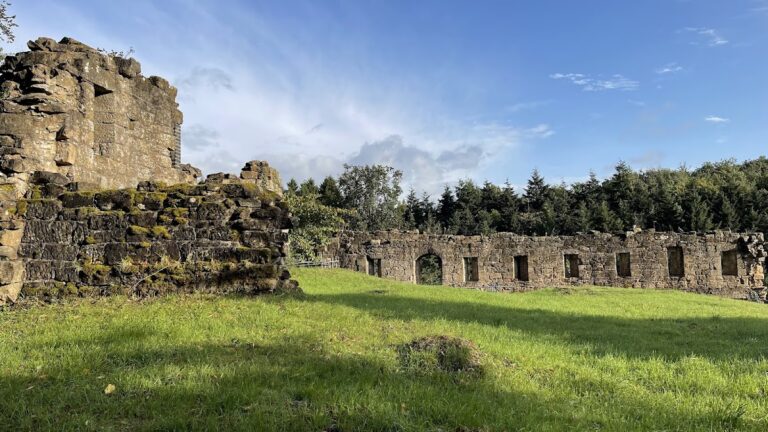
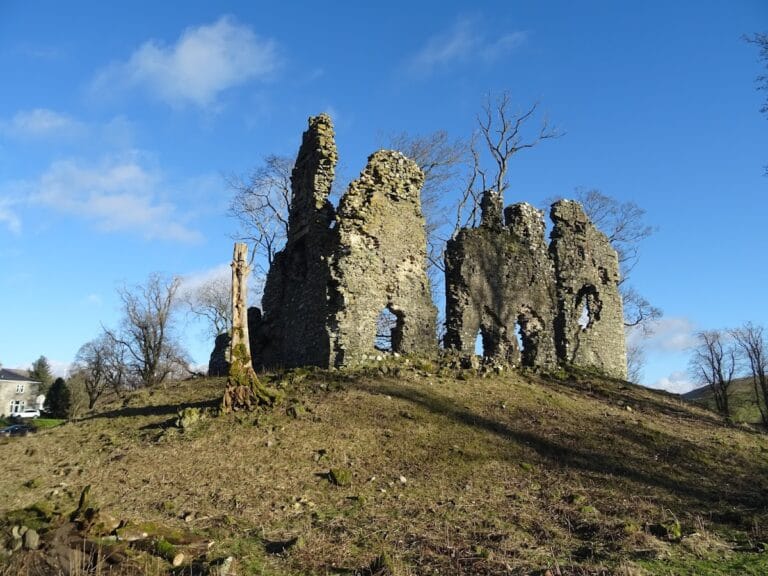
The southwest corner is the best-preserved part of the building and reaches a maximum height of about five metres. The tower house probably contained two storeys and an attic. Its north and west façades were demolished to make room for agricultural buildings, leaving the surviving masonry as a partial ruin.
The castle also incorporated a ha-ha, a recessed boundary or ditch designed to control movement while maintaining an uninterrupted view across the landscape. This feature formed part of the site’s relationship with the surrounding countryside, while the remaining tower-house walls preserve the compact defensive form of the building.