Castle of Tournoël: A Medieval Fortress in Volvic, France
Visitor Information
Google Rating: 4.4
Popularity: Medium
Official Website: www.tournoel.com
Country: France
Civilization: Early Modern, Medieval European
Site type: Military
Remains: Castle
History
The Castle of Tournoël is a medieval fortress located in the town of Volvic, France. It was constructed by the feudal lords of the region during the Middle Ages and first appears in historical records between 1076 and 1096, with Bertrand of Tournoël identified as its earliest known lord.
Initially, the castle belonged to the counts of Auvergne, a powerful noble family in the area. By the late 12th century, Guy II of Auvergne held the castle and used it as a stronghold during regional conflicts. In 1199, Guy II imprisoned his brother Robert, the bishop of Clermont, within its walls, illustrating the castle’s role in local power struggles. The castle’s strategic importance became evident during the conflict between Guy II and King Philip Augustus of France. Royal forces led by Guy of Dampierre besieged and captured the fortress in late 1212 or early 1213, an event that led to the annexation of Lower Auvergne into the French crown’s domain.
Following its capture, the castle became royal property. In 1241, it was granted to Alphonse de Poitiers, who held the title of Count of Auvergne. Alphonse stayed at the castle in 1251, but after his death in 1271, the lands returned to the French crown. In 1306, King Philip IV exchanged the castle with the heirs of Geraud Maulmont, and by 1313, ownership passed to Pierre de Maumont. Through marriage alliances, the castle came into the possession of the La Roche family during the 14th century.
Hugues de La Roche, who died in 1398, was a prominent owner known for his roles as Rector of Comtat Venaissin and Great Lord Chancellor of France. During the Hundred Years’ War, he strengthened the castle’s defenses to withstand military threats. The La Roche family maintained control throughout the 15th century. Antoine de La Roche, who married in 1448, transformed the fortress into a more comfortable residence. However, the castle remained involved in political conflicts, including a period when the Duke of Bourbon imprisoned Antoine and seized the castle in the late 15th century.
In the early 16th century, the castle passed by marriage to the d’Albon family. Jacques d’Albon, a Marshal of France, inherited the property and died in 1562 amid the Wars of Religion, a series of conflicts between Catholics and Protestants in France. Later owners included the Saint-Germain d’Apchon family in the late 16th century and the Montvallat family during the 17th and 18th centuries. The Chabrol family held the castle until the French Revolution abolished feudal privileges in 1793.
The castle continued to serve as a noble residence into the 19th century. In 2000, Claude Aguttes acquired the property and initiated extensive restoration work to preserve its historical fabric.
Remains
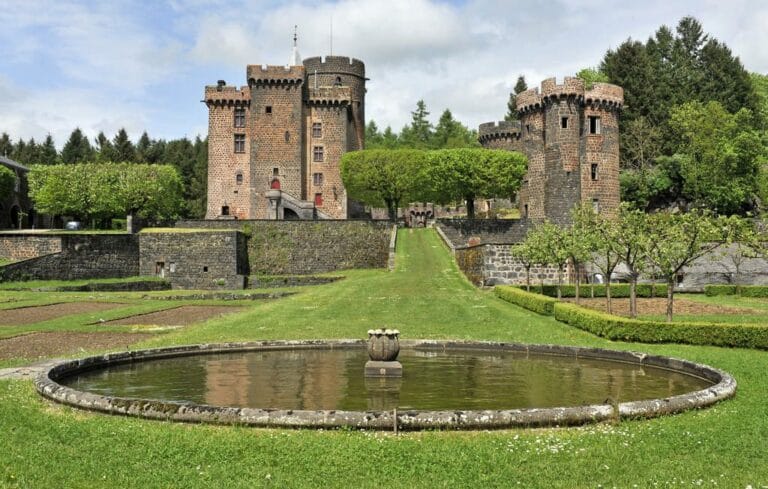
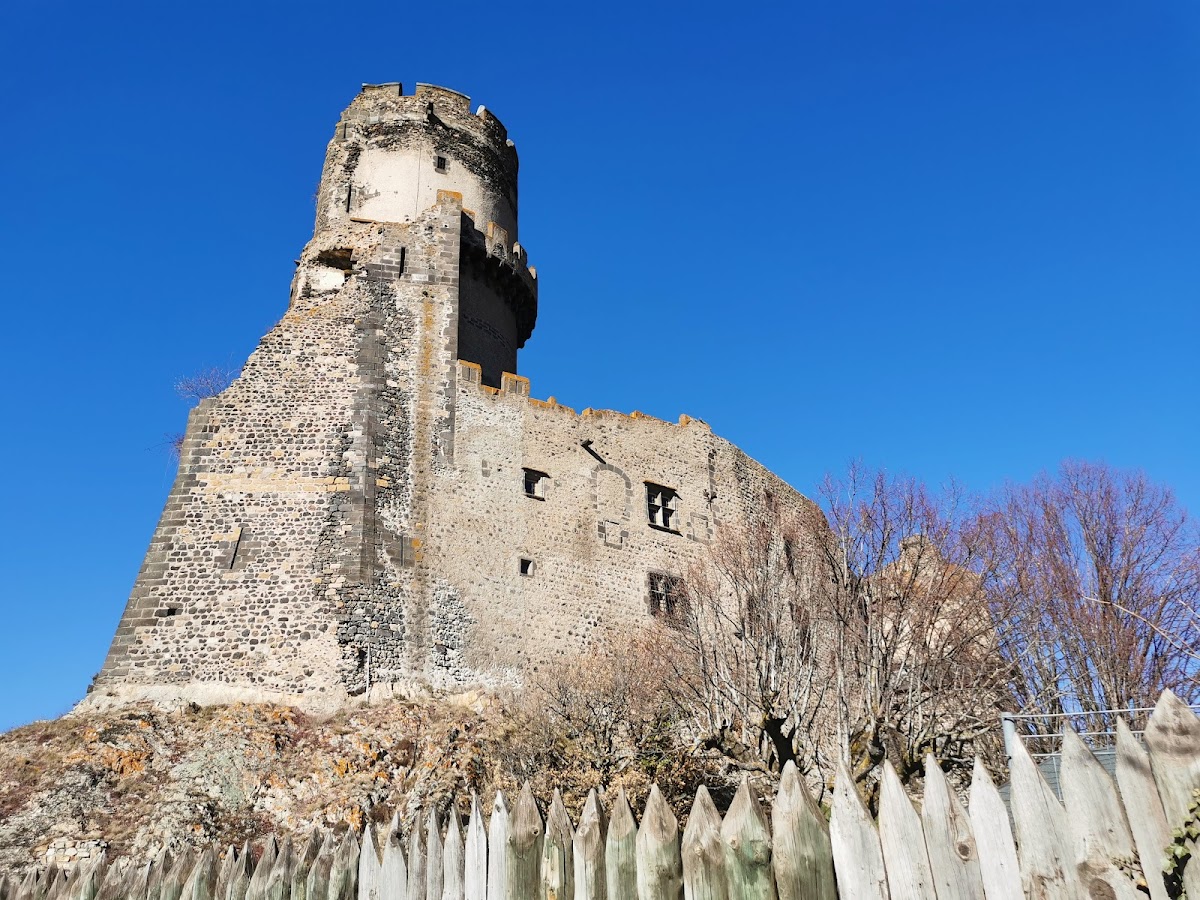
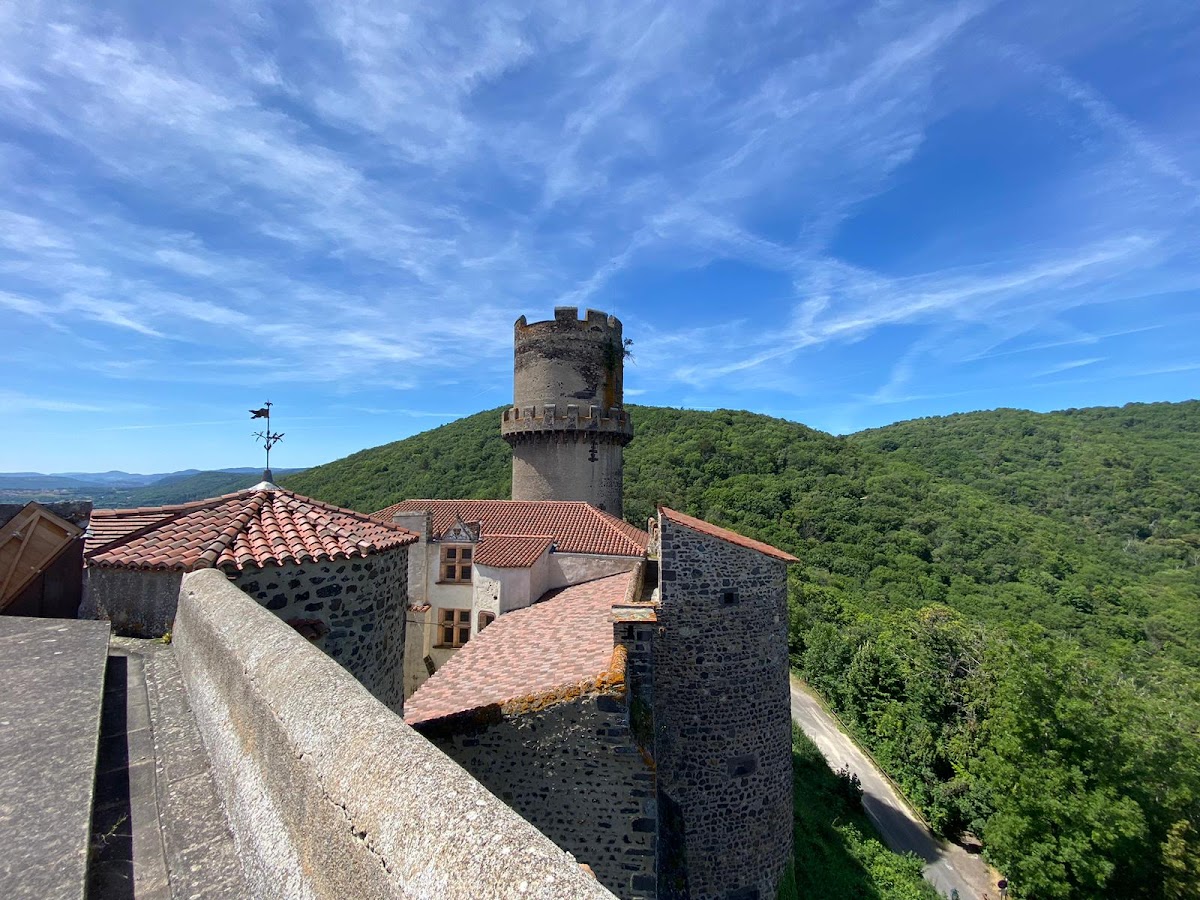
The Castle of Tournoël is perched on a rocky volcanic outcrop at an elevation of 594 meters, overlooking the Limagne plains and the nearby town of Riom. Its position on steep slopes and surrounded by deep valleys provided natural defenses that complemented its man-made fortifications. The castle’s layout includes two main enclosed areas, each featuring a central keep.
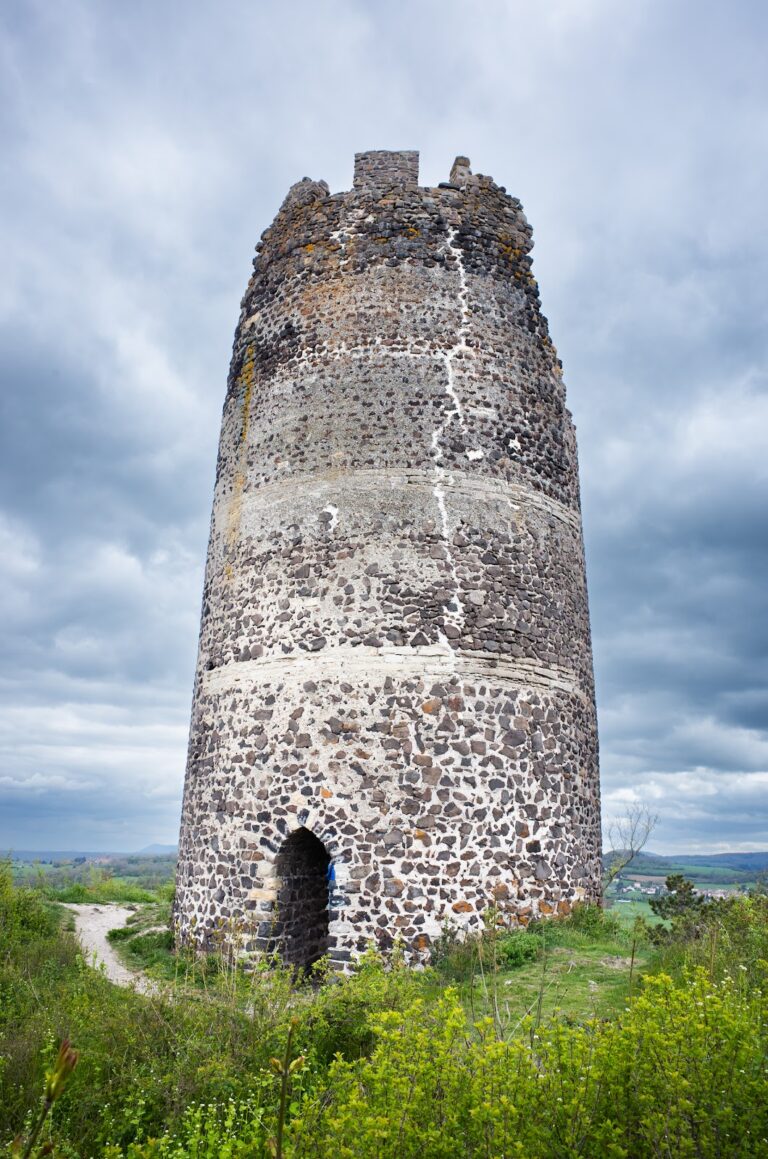
The older keep is a rectangular residential tower dating from the 12th century. Over the centuries, it underwent modernization during the 15th and 16th centuries to adapt to changing defensive and domestic needs. The second keep is a large circular tower constructed between the early 13th and early 14th centuries. This circular keep is surrounded by a pentagonal defensive wall, or enceinte, which includes a projecting spur designed to face the most likely direction of attack. This keep suffered significant damage during a siege in 1595 and now stands in ruins.
Surrounding the main enclosures is a lower courtyard, enclosed by a wall that likely dates from the 15th century. This courtyard was only lightly fortified, serving more as a space for daily activities than a defensive barrier. A notable feature from the 16th century is the “Tour de la Garde” or Guard Tower, distinguished by its rounded bossage stonework. These stones have a unique appearance, resembling cannonballs or loaves of bread, which earned the tower the local nickname “tour au miche.”
During the Hundred Years’ War, Hugues de La Roche enhanced the castle’s defenses by adding a chemin de ronde, a wall-walk for guards, about two-thirds up the height of the circular keep. This walkway was supported by machicolations—openings in the parapet allowing defenders to drop objects or pour substances on attackers—resting on stone corbels projecting from the wall. At the base of the circular keep, a protective corridor surrounds a forward-projecting defensive massif topped by a terrace, further strengthening the castle’s ability to repel assaults.
Inside the castle, traces of old plaster remain, bearing graffiti that includes scenes such as a wolf hunt and some obscene images, offering a glimpse into the lives and expressions of past inhabitants. A door lintel features a defaced relief depicting Saint George slaying the dragon, a common medieval symbol of good triumphing over evil.
Despite its military origins, the castle did not develop a surrounding village, likely due to its proximity to the town of Volvic. It remained a noble residence until the 19th century. Since 2000, restoration efforts have focused on repairing roofs, paving the courtyard, restoring windows, and consolidating masonry to preserve the structure for future generations.
Nearby sites