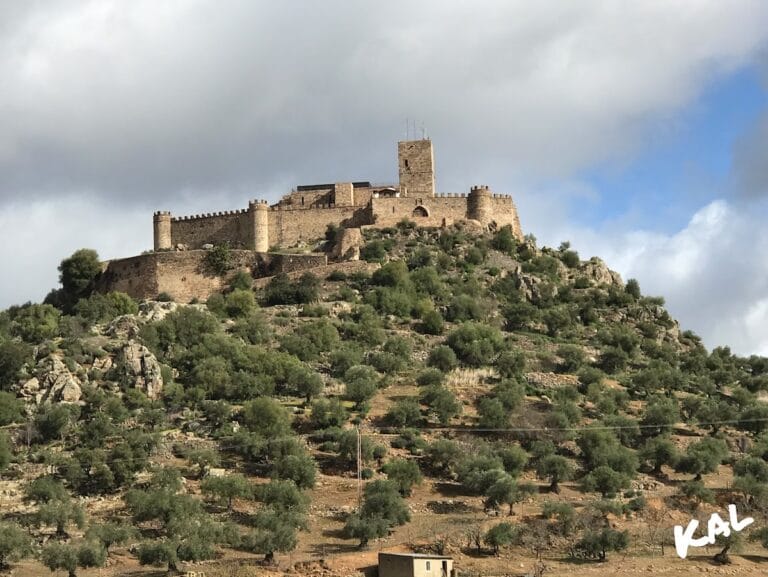
Castelo de Monsaraz: A Historic Fortress in Portugal
Visitor Information
Google Rating: 4.7
Popularity: High
Country: Portugal
Civilization: Early Modern, Medieval European
Site type: Military
Remains: Castle
History
Castelo de Monsaraz is situated in the municipality of Reguengos de Monsaraz in Portugal. This fortification crowns Monsaraz hill and was originally established within successive layers of settlement dating back to prehistoric times, including Roman, Visigothic, and Muslim occupations. The hill’s name, “Monsaraz,” comes from the Arabic word “saris” or “sharish,” referring to the abundant cistus plants that grew along the nearby Guadiana River.
During the period of the Christian Reconquista, the site changed hands several times. In 1167, Geraldo Sem Pavor, a Christian military leader, initially captured the settlement. However, this control was short-lived, as the Almohad Caliphate under Abu Yaacub Yúsuf regained it in 1173. It was not until 1232 that King Sancho II, with assistance from the Knights Templar, reconquered the area definitively. The Templars were granted the lands as a donation, marking a new phase in the settlement’s defensive and religious organization.
In 1276, King Afonso III issued a foral, or charter, to encourage repopulation and reinforce the defense of Monsaraz. Around this time, the knight Martim Anes Zagallo is credited with beginning the construction of the new fortress and the first version of the Church of Santa Maria de Lagoa. After the dissolution of the Knights Templar in Portugal in 1319, their properties, including Monsaraz, passed to the Order of Christ, with the castle becoming a commandery under the jurisdiction of Castro Marim. The keep tower was rebuilt circa 1310 under King Denis, who also expanded the town’s walls—elements that remain, albeit altered, to this day.
The late 14th century saw renewed military activity amid the 1383–1385 crisis, a dynastic conflict in Portugal. Monsaraz fell to Castilian forces in the summer of 1385 after an attack involving English archers allied to Portugal. Before the decisive Battle of Aljubarrota, loyalist troops under Nuno Álvares Pereira recaptured the castle. In 1412, the fortress was granted to the House of Braganza, beginning a new chapter of noble ownership.
King Manuel I’s reign (1495–1521) brought further attention to Monsaraz; around 1509, the town and castle were illustrated by Duarte de Armas, and a renewed foral was provided in 1512. The strategic importance of Monsaraz was again emphasized in the 17th century during the Portuguese Restoration War (1640–1656). Positioned near the Spanish border and the Guadiana River, the castle’s defenses were modernized with new bastioned walls built in the Vauban style and the construction of the Fort of São Bento. This work was overseen by military architects Nicolau de Langres and Jean Gillot.
By the 19th century, Castelo de Monsaraz had declined in military and economic relevance. The municipal seat moved to Reguengos de Monsaraz in 1840, and the fortress began to fall into neglect, with many defensive structures deteriorating. Despite this, the castle and the town’s medieval walls were officially recognized as a National Monument in 1946. A later symbolic gesture took place in 1987 when the parish of Monsaraz presented a key of the castle to Mário Soares, a notable Portuguese political figure; this key is now preserved by the Mário Soares Foundation.
Remains
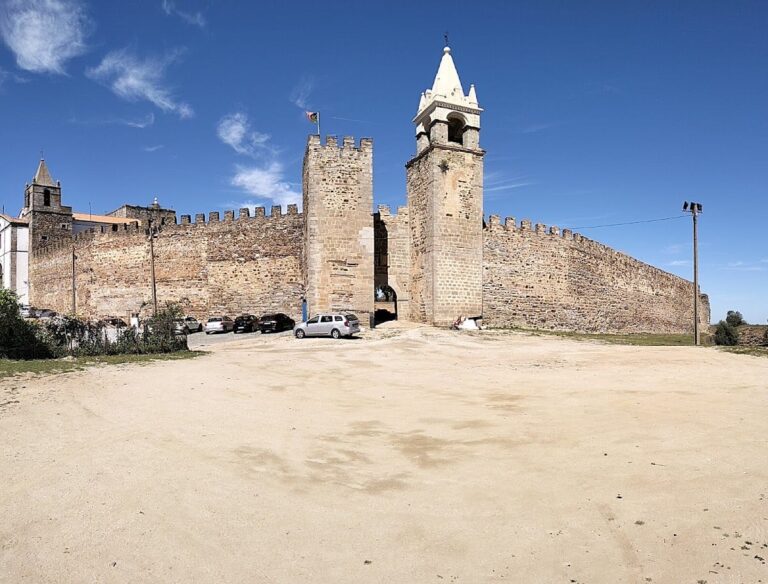
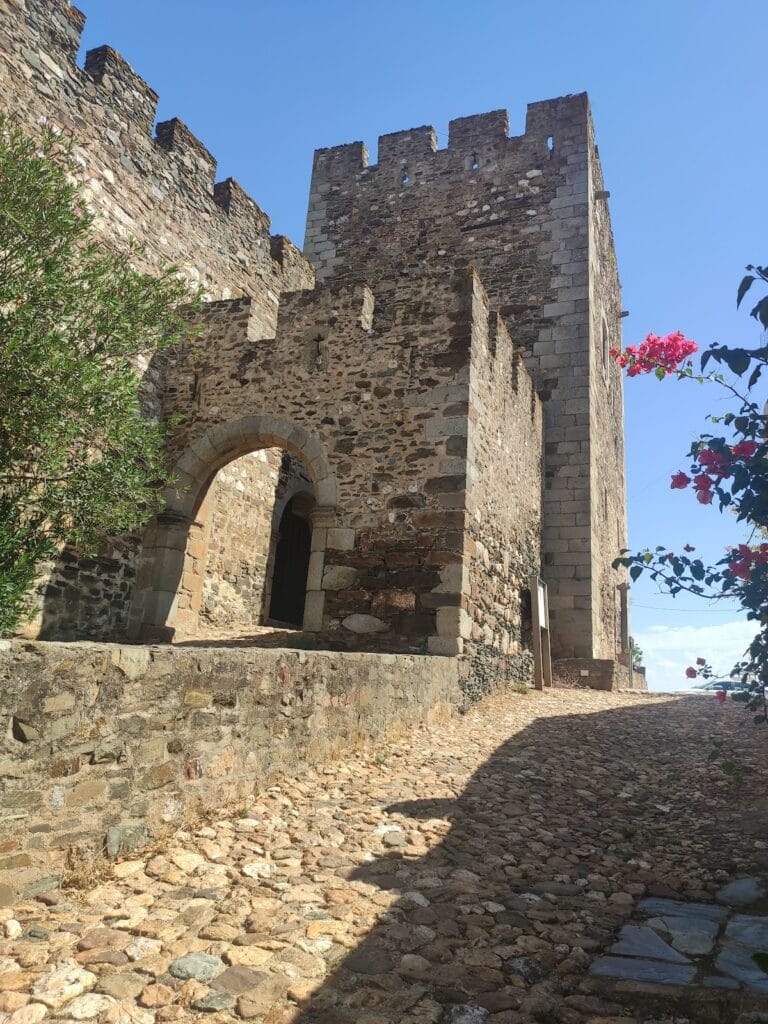
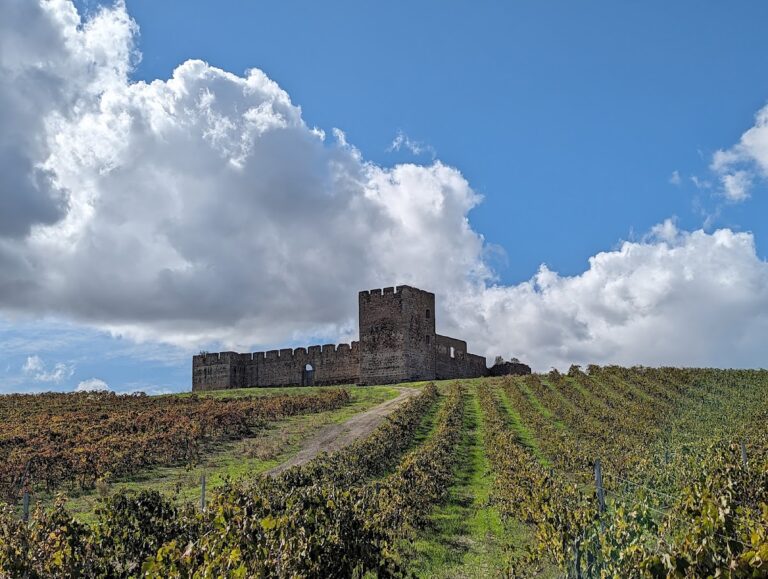
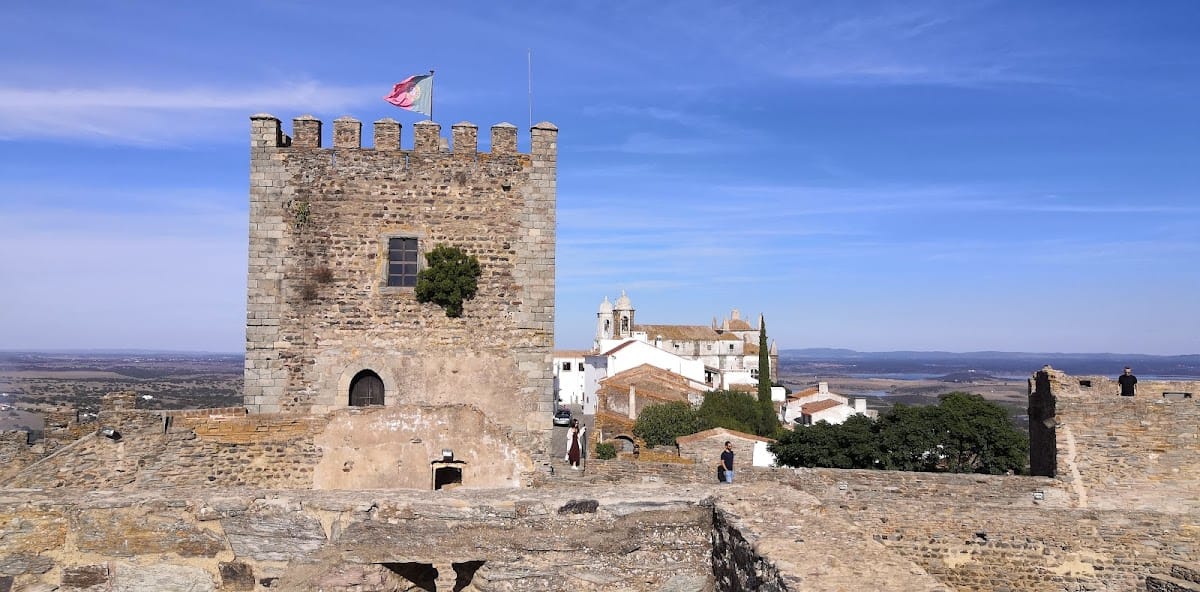
Castelo de Monsaraz occupies the highest point of Monsaraz hill and features a roughly quadrangular layout. The castle’s defensive walls are mainly constructed from schist stone bonded with lime, reinforced by towers positioned along the perimeter. Inside these curtain walls lies the castle’s main courtyard, known as the plaza de armas, which contains the central citadel structures as well as the prominent keep tower.
The fortress is accessed through four main gateways fashioned from granite. Among these portals, the Porta da Vila (also called the Évora Gate) is distinguished by its pointed, or ogival, arch—a style typical of the Gothic period. This entrance is further protected by two semi-cylindrical turrets, one of which is surmounted by a bell tower featuring whitewashed walls. The gate’s ceiling displays a ribbed vault, an architectural element that supports the stone roof, and it contains a bell dated 1692, cast by artisans Diogo de Abalde and Domingos de Lastra. Above the ogival arch, visitors can find a marble plaque that commemorates the consecration of Portugal to the Immaculate Conception during the Restoration period. Interestingly, on the reverse side of the gate’s jamb, medieval units of measurement such as the vara (a type of yard) and côvado (an old length measure) are inscribed.
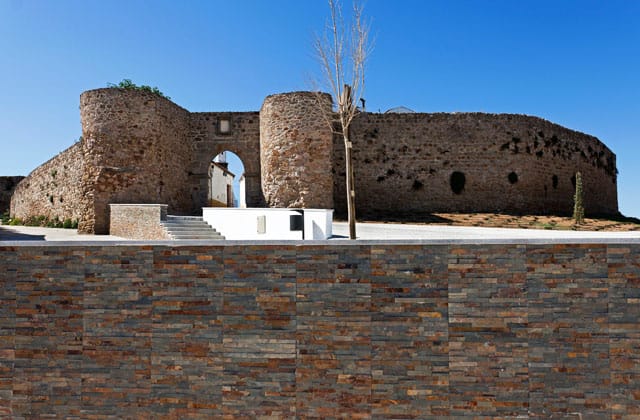
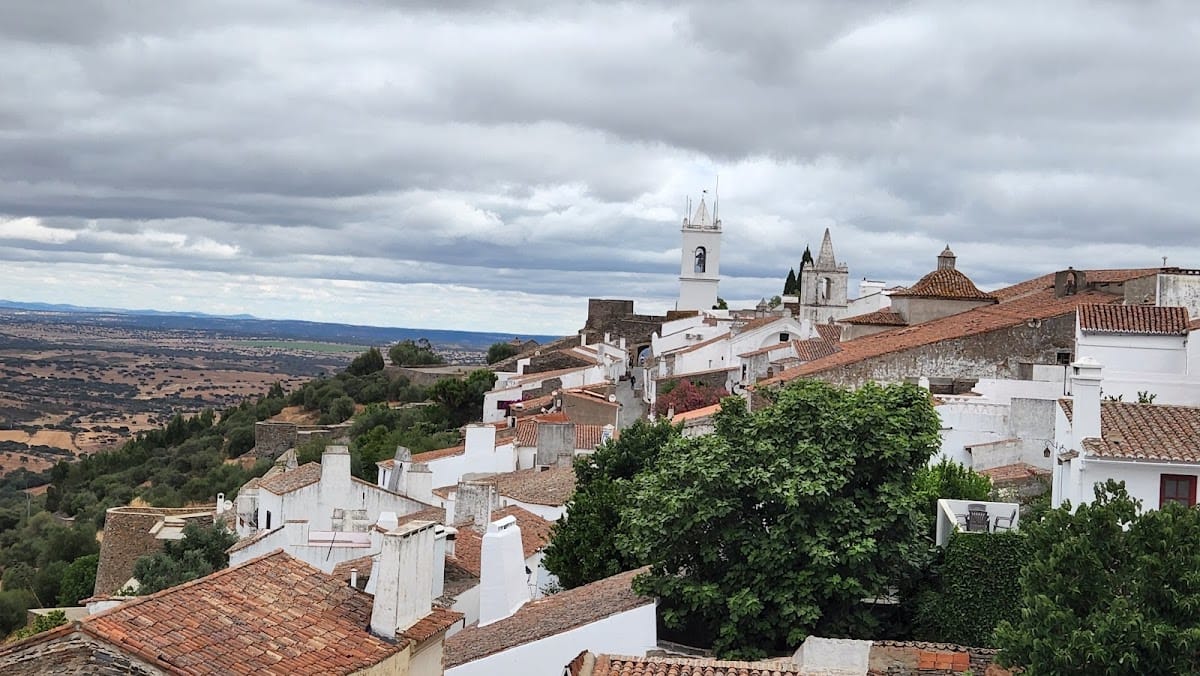
Two other gates, the Porta da Cisterna (also known as Porta do Buraco) and the Porta da Alcoba, both feature round arches and provide additional access points into the fortified enclosure. The enclosing walls form an oval shape around the town, constructed through a blend of local materials that include schist and granite stones bound with red clay mortar and lime. This combination reflects the use of readily available resources and traditional building techniques.
Extending the defensive system, the Fort of São Bento was erected in the 17th century during efforts to update the castle under the Portuguese Restoration War. Originally designed with a star-like shape common to the era’s military architecture, it was adapted to fit the natural contours of the terrain. The fort includes three bastions and a parapet—a low protective wall along the edge of the structure—and encircling curtain walls that assist in the town’s defense. Incorporated into the fortifications is the Chapel of São Bento de Monsaraz, which forms part of the defensive walls themselves, blending religious and military functions.
Some of the castle’s original materials have seen alternative uses over time; notably, in 1830 local residents reused stones from the castle’s courtyard to build a bullring for the town. Today, while parts of the fortification show signs of ruin and erosion caused by years of abandonment, significant medieval and early modern features, including the gates, towers, and sections of wall, remain visible and illustrate the historical layers accumulated across centuries at Castelo de Monsaraz.
Nearby sites