Castle of Redondo: A Medieval Fortification in Portugal

Site at a Glance
- Rating
- 4.3
- Popularity
- Low
- Country
- Portugal
- Primary era
- Medieval
- External website
- Open
- Eras represented
- Medieval, Early Modern
- Civilizations
- Portuguese
- Site type
- Military
- Remains
- Castle
On this page12 sections
History
The Castle of Redondo is a medieval fortification in Redondo, Portugal, built under the Portuguese monarchy and reconstructed in the early fourteenth century. Its construction is dated to 1319, and the castle formed part of a defensive line in the northern Alentejo alongside the strongholds of Estremoz, Monsaraz, and Portel. The settlement’s position also connected its history with regional administration, commerce, and noble authority.
Foundation and reconstruction
In 1250, King Afonso III granted Redondo a foral, a medieval municipal charter defining a settlement’s rights, obligations, and administrative privileges. He also ordered a castle to be built over the ruins of an ancient Roman fortress. The new stronghold joined the defensive network of the northern Alentejo.
King Denis I, who ruled Portugal from 1279 to 1325, reorganized and strengthened many settlements. He reconfirmed Redondo’s charter on 27 April 1318 and ordered the castle’s reconstruction. This work included the keep, the enclosing walls, and the towers, with construction dated to 1319. The castle was later donated to members of the nobility.
Royal privileges and noble rule
In 1418, King John granted privileges to the castle and directed travellers between Alandroal and Vila Viçosa to pass through Redondo. This measure encouraged commercial activity in the settlement. A medieval fair took place outside the eastern entrance, opposite the gate later known as the Ravessa Gate.
During the fifteenth and sixteenth centuries, the Alcaidaria Tower, whose name refers to the castle governor or commander, lost much of its importance. Residents petitioned the king for a new tower, and the keep was completed by the end of the fifteenth century. It then became part of the grant held by Vasco Coutinho from King Manuel I.
On 2 June 1500, Coutinho was appointed captain of Arzila, a historic coastal town in present-day Morocco, and became the first Count of Redondo. Manuel I issued a new municipal charter on 20 October 1516. The castle underwent major alterations during the Manueline period, a late Gothic Portuguese style associated with elaborate decoration. Eighteenth-century remains of the palace of the Counts of Redondo were reportedly visible around the keep.
Restoration and later use
The Directorate-General for Buildings and National Monuments began restoring the keep in 1920. Between 1940 and 1950, the keep served the Santa Casa da Misericórdia hospital as an auxiliary building and an isolation centre for patients with tuberculosis. Santa Casa da Misericórdia is a Portuguese charitable institution traditionally associated with hospitals and social care.
Repairs to the walls continued in 1943. Conservation and consolidation work from 23 to 27 April 1962 included restoration of the Ravessa Gate, while further projects in 1976 and 1986 repaired the towers. Municipal work also repaired the keep’s wooden doors and windows and reinforced the gate’s joints. Around 1961, walls beside the parish residence faced the risk of collapse. The surviving walls and keep were classified as a National Monument by a decree published on 2 January 1946.
Remains
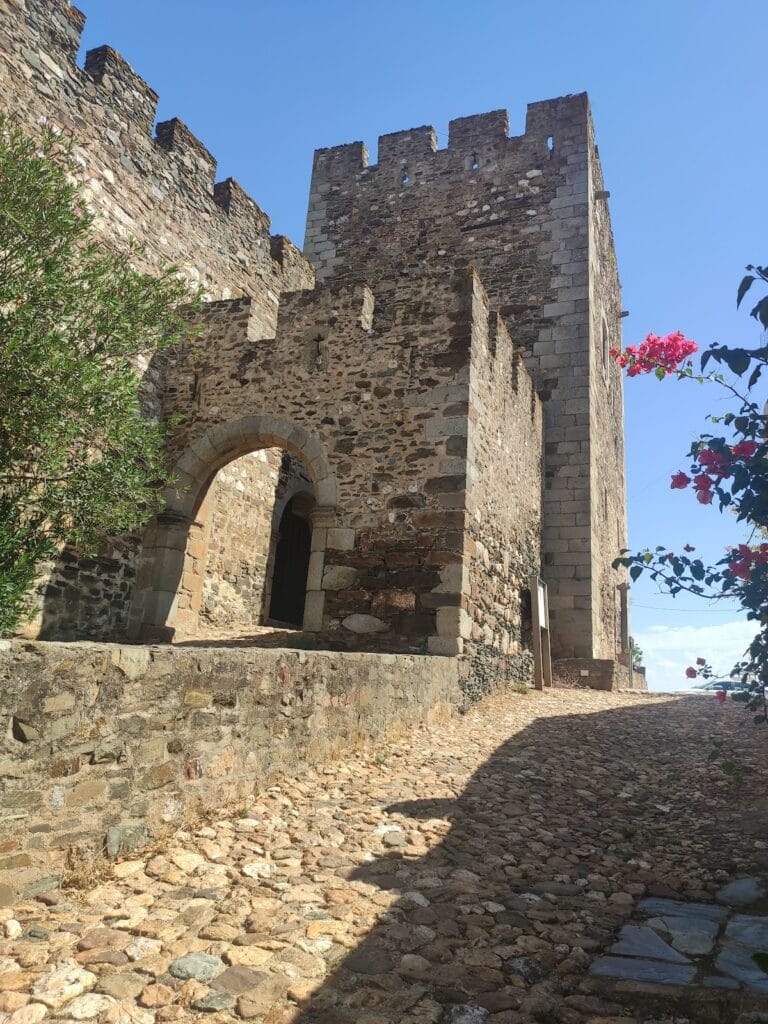
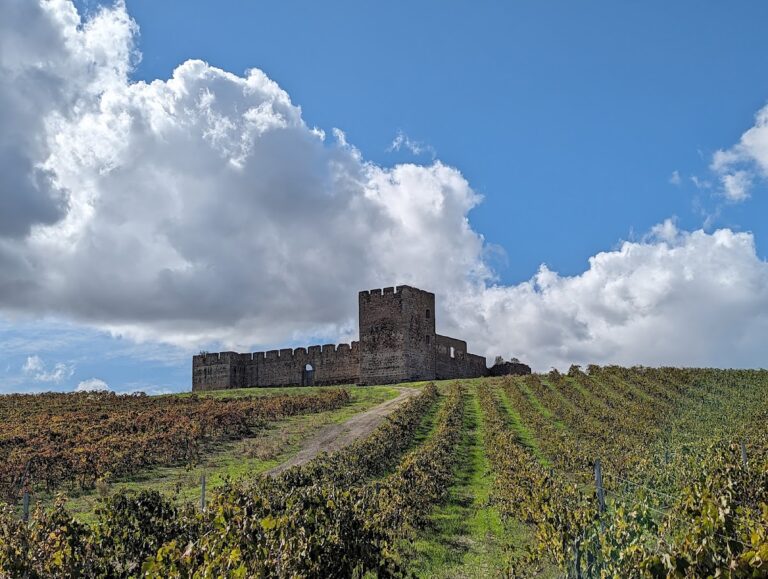
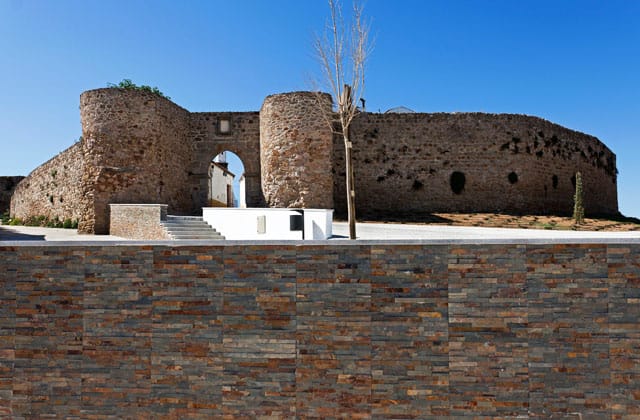
The castle occupies an urban hilltop about 300 metres above sea level on the southern slope of the Serra d’Ossa, approximately 24 kilometres southwest of the right bank of the Guadiana River. Its fortification consists of a keep, enclosing walls, towers, and gates. Part of Redondo’s residential fabric lies within the walls and along the cliffs, incorporating the stronghold into the historic town.
Fortifications and entrances
The keep
The keep is the principal fortified tower of the castle and served defensive and residential purposes. It was reconstructed under Denis I in the early fourteenth century and completed in its later form by the end of the fifteenth century. Its construction materials include masonry stone, schist, granite, limestone, wood, and marble. The tower provides views towards the Castle of Evoramonte and parts of the Serra d’Ossa to the northwest. A staircase beside the keep has a tombstone bearing an inscription.
The enclosing walls and towers
The enclosing walls and towers define the fortified area and preserve the castle’s relationship with the surrounding cliffs and urban buildings. Their repairs continued through the twentieth century, including work on the towers in 1976 and 1986. Wooden doors and windows in the keep were also repaired, while the joints of the Ravessa Gate were reinforced.
The Ravessa Gate
The Ravessa Gate survives as part of the historic urban centre and is integrated into Redondo’s town fabric. An inscription surmounted by a royal coat of arms marks the gate. Its restoration formed part of the conservation work carried out from 23 to 27 April 1962.
Buildings within the fortified area
Alentejo houses
Buildings within the walls include single-storey, whitewashed houses in the Alentejo style. They have large rectangular chimneys with ochre and blue details, providing a residential layer within the medieval enclosure.
Hospital and parish church
The Hospital of Santa Casa da Misericórdia do Redondo stands near the keep. The parish church of Nossa Senhora da Anunciação lies to the west. Together with the houses inside the walls, these buildings form part of the urban setting in which the surviving fortification remains are situated.
Nearby sites