Castell d’Espolla: A Medieval Fortification in Espolla, Spain
Visitor Information
Google Rating: 4.1
Popularity: Very Low
Official Website: www.poblesdecatalunya.cat
Country: Spain
Civilization: Medieval European
Site type: Military
Remains: Castle
History
The Castell d’Espolla is a medieval fortification situated in the municipality of Espolla, Spain. Its construction is dated to the 13th or 14th century, although the identity of its original builder and owner remains unknown. This castle emerged during a period when fortified houses were common across the region, reflecting the social and political organization of medieval Catalonia.
Historical records suggest that the castle may have had an administrative role if Espolla was part of a royal bailiwick—a district overseen by a bailiff responsible for local governance—alongside nearby Sant Climent Sescebes. In this context, the Castell d’Espolla could have served as the residence of the bailiff managing royal affairs in the area. Alternatively, its function might have been primarily residential for a noble family possessing land in Espolla, similar to Cal Marquès, another fortified house in the village linked to the Avinyó family. This ambiguity highlights the castle’s connection to either royal administration or local nobility, reflecting the dual nature of medieval territorial control in the region.
Over the centuries, the castle became integrated into the expanding urban area of Espolla, adapting to changing social and ownership patterns without clear records of military conflict or occupation. Today, the Castell d’Espolla holds official recognition as a cultural asset of national interest in Catalonia, underscoring its historical significance and enduring place in the local heritage.
Remains
The remains of Castell d’Espolla form a rectangular building with two floors that has been absorbed into the town’s urban fabric and subdivided into individual properties. This integration has resulted in an uneven state of preservation. The roof has collapsed, and defensive structures such as corner towers and battlements no longer exist, but several elements provide insight into its medieval character.
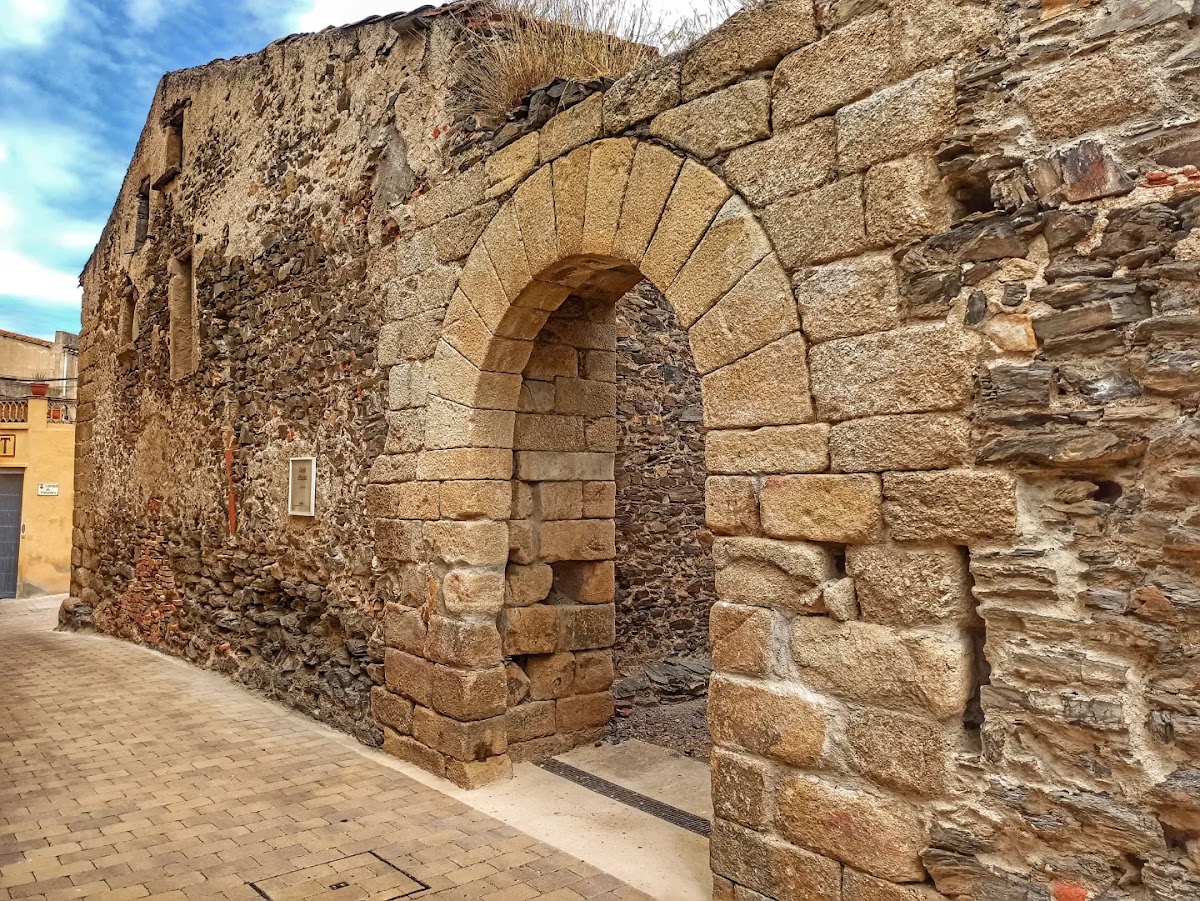
Constructed mainly from unshaped slate stones, the exterior walls are reinforced at the corners, window surrounds, and entrance portals with large, finely dressed granite blocks. This use of granite ashlar — carefully cut stone blocks — contrasts with the rustic slate masonry and demonstrates attention to structural strength and decoration in critical areas. The walls are bonded with lime mortar, with some sections later repaired using bricks.
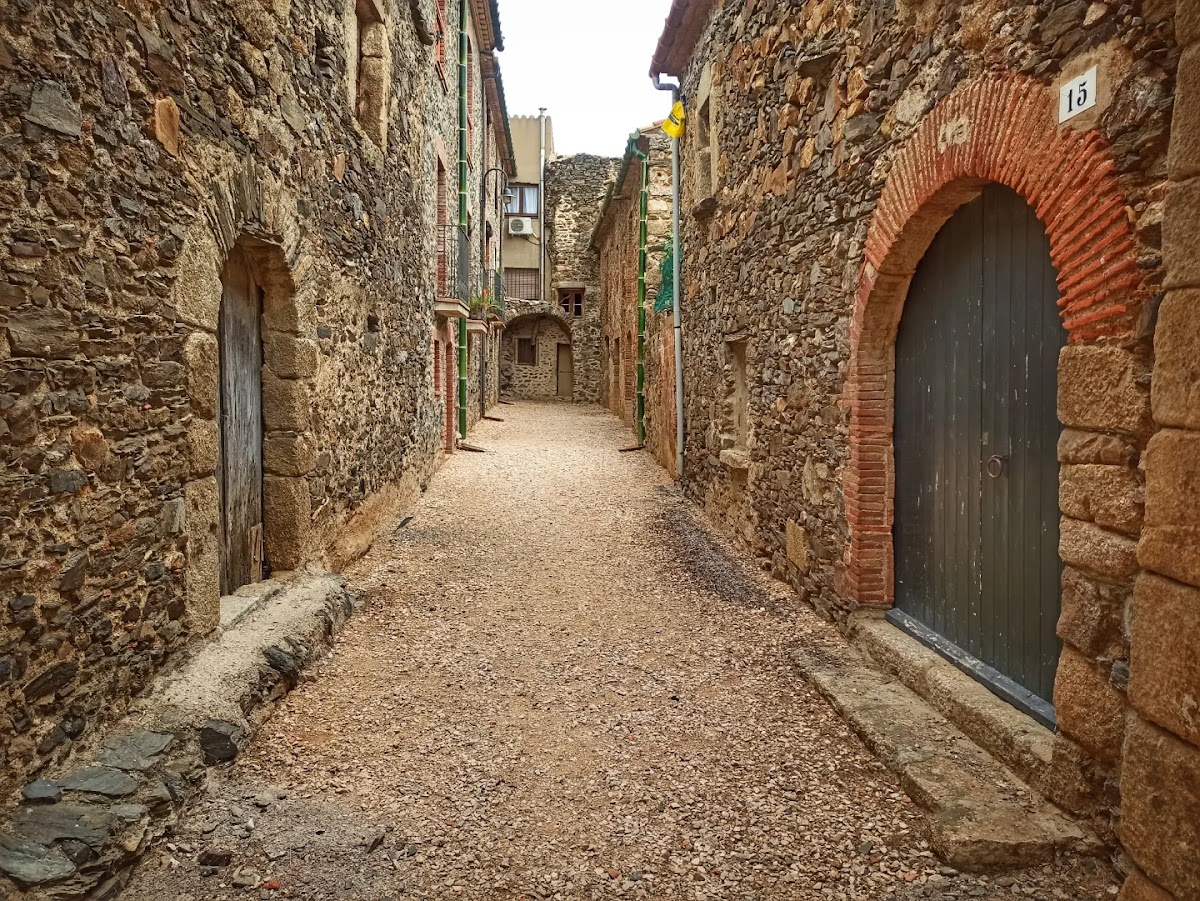
Two portals anchor the building’s access points. One is located at the eastern corner and opens onto a narrow dead-end street aligned north to south. This entrance features a semicircular arch crafted from slate slabs edged with granite jambs (the vertical supports of a door or window). Above this portal, the upper floor has two rectangular windows framed by roughly hewn granite blocks. The second main entrance is on the western side, connected to an adjoining rectangular structure once used as storage and stables. It combines a smaller semicircular arch with granite voussoirs — wedge-shaped stones forming the arch — on the outside, with a larger, lower arch inside constructed of ashlar blocks.
Inside the building, vestiges of the original walls and barrel vaults—arched ceilings formed by curved masonry—remain visible in the lower rooms now incorporated into private residences. Defensive features include loopholes dedicated for archers, such as one at the southeast corner shaped to accommodate crossbows, reflecting the building’s military functionality during its active use.
While overt defensive components like battlements have not survived, the entrance area and the courtyard, known as the patio de armas, are still accessible and preserve the historical atmosphere of the fortification’s design. These architectural and defensive remnants provide a tangible connection to the castle’s medieval origins and subsequent adaptations within the evolving landscape of Espolla.
Nearby sites