Burg Wolfsberg: A Medieval Castle Ruin in Zusmarshausen, Germany
Visitor Information
Google Rating: 5
Popularity: Very Low
Country: Germany
Civilization: Medieval European, Modern
Site type: Military
Remains: Castle
History
Burg Wolfsberg is a medieval castle ruin located near the village of Steinekirch in the municipality of Zusmarshausen, Germany. The site was established during the early medieval period, likely in the 10th century, by the Fraß family, a group of ministerials serving the bishops of Augsburg. Over time, this family adopted the name “von Wolfsperch,” reflecting their association with the castle, and their coat of arms featured a wolf, a symbol that ties them to the site’s identity.
In the late 13th and early 14th centuries, members of the Fraß family were active in local affairs; in 1292, Heinrich Fraß von Wolfsberg was recorded as a witness to a peace treaty between Bishop Wolfhart and Duke Ludwig of Bavaria. Around 1333, Ulrich Fraß was involved as a guarantor in the sale of another castle, Burg Zusameck, to the Augsburg bishopric. The Fraß family’s presence at Wolfsberg fades from historical records by about 1350, giving way to the Schwelcher family, who were formerly ministerials of the Dukes of Teck. This family appears in sources from 1374 and 1382 as occupants of the castle.
The Schwelcher tenure at Wolfsberg was marked by conflicts linked to their raids on key trade routes, particularly near the road connecting Augsburg and Ulm. Their activities led to repeated military responses, including unsuccessful sieges by Augsburg forces. During the regional conflict known as the Städtekrieg in 1388, Augsburg’s troops once again targeted Burg Wolfsberg but did not succeed in capturing it. However, by 1390, Wieland Schwelcher sold the castle to the Bavarian dukes. Shortly after, the dukes pledged the property to Friedrich von Freyberg, a practice of temporarily granting rights over a property, and by 1434, the pledge passed into the hands of the Nördlinger brothers.
On January 26, 1462, the castle met its destruction during hostilities between Duke Ludwig the Rich of Bavaria-Landshut and Emperor Frederick III. Augsburg mercenaries under the duke’s command destroyed the fortification, leading to its abandonment. Following this, the dukes sold the surrounding lordship of Steinekirch in 1508 to Philipp von Stain. His descendants later transferred the estate to the Augsburg cathedral chapter in 1589, which maintained control until secularization occurred in 1803.
In the 19th century, the ruined castle experienced partial dismantling when its stones were quarried around 1852 for construction material used in the Augsburg-Ulm railway. Nonetheless, the bergfried, or main tower, remained mostly intact because it was then under the ownership of the Historical Association of Swabia, which had acquired it in 1836. Later centuries saw new agricultural buildings erected in the castle’s main and outer baileys, dating to the 19th and 20th centuries, and after World War II, a modern residence was constructed next to the bergfried. Today, while the ruins are open to the public, the interior of the surviving tower remains private property.
Remains
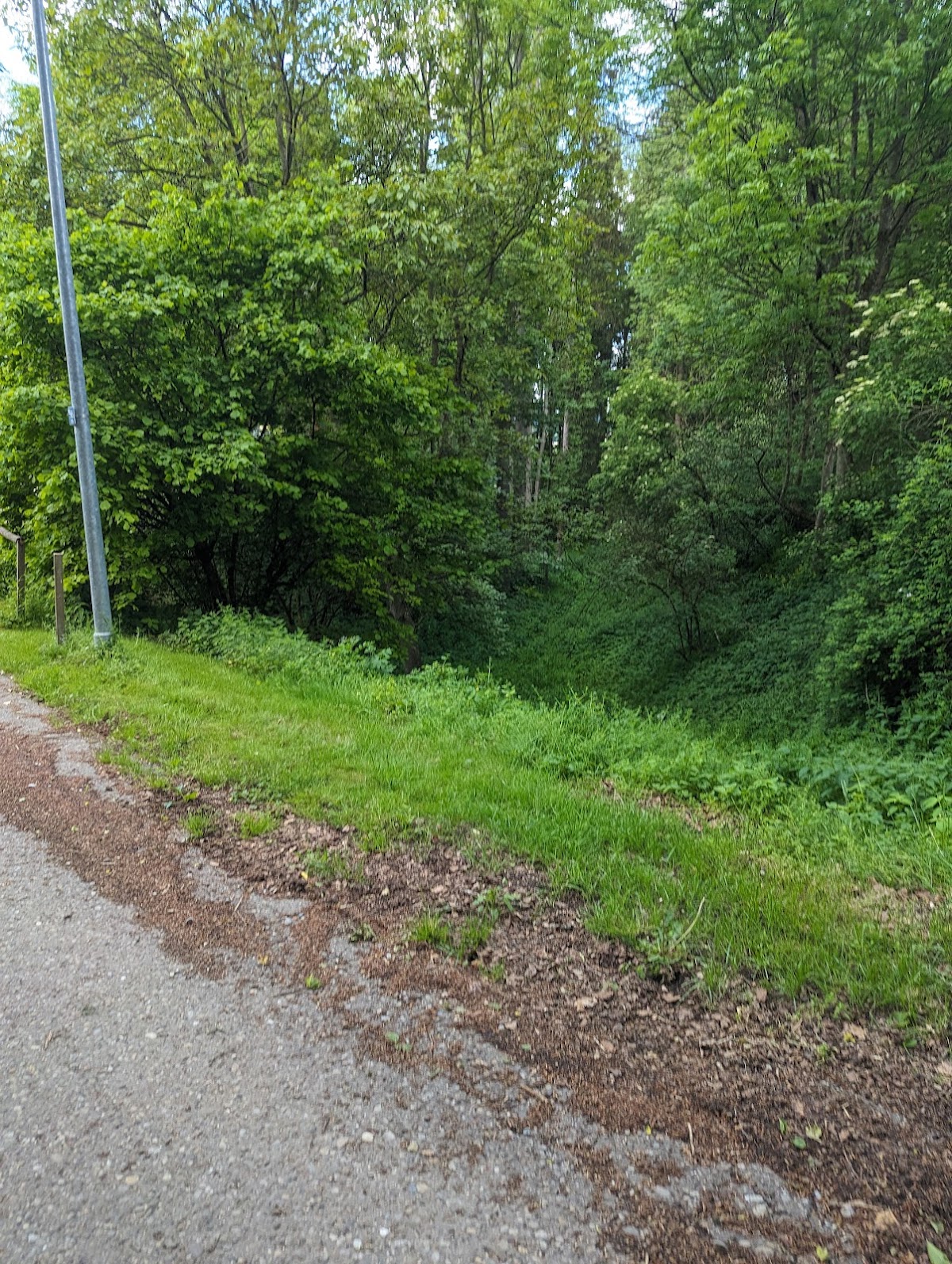
The ruins of Burg Wolfsberg occupy a wooded hill approximately 525 meters above sea level, overlooking the valley of the Zusam River near Steinekirch. Its design reflects early medieval fortification principles, featuring a core enclosed within a roughly rectangular main bailey measuring about 25 by 50 meters. Surrounding the main bailey are embankments and ditches, including a prominent neck ditch between the main and outer baileys measuring seven to eight meters in depth, which once served as a defensive barrier.
East of the core lies the outer bailey, which historically had its own entrance defended by a neck ditch about four meters deep, although this feature is now largely filled in. The ditch extended southward, ending at a curved plateau on the hillside, indicating a deliberate use of the landscape for defense. To the west of the main castle, further terraces suggest additional defensive or functional spaces. On the northern side, an outer ditch accompanied by a significant embankment remains visible, marking the castle’s early medieval origins.
Archaeological investigations conducted in 1973 uncovered a lower terrace, or berm, roughly ten meters below the main bailey. This earthwork was originally protected by wooden palisades, as evidenced by preserved postholes. Excavations identified six successive phases of embankment construction, indicating ongoing modifications and strengthening of the fortifications over time. Among the finds were fragments of sandstone, suggesting that part of the defensive perimeter may have been enclosed by stone walls, rather than earthworks alone.
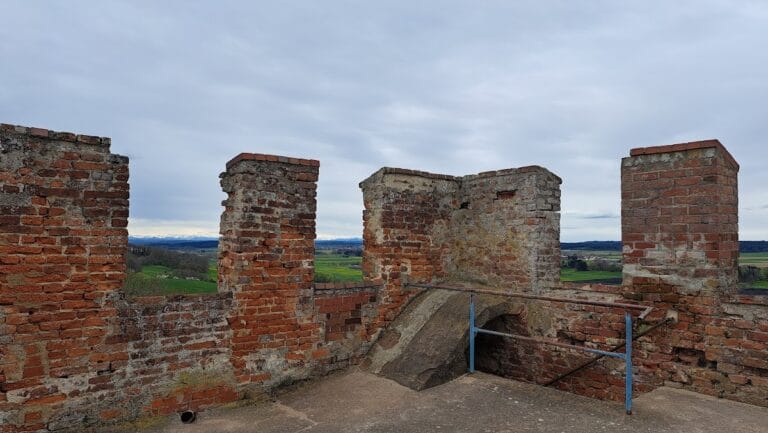
Sections of the main castle’s ring wall survive, characterized by 14th-century brick masonry incorporating roughly squared stone blocks measuring approximately 35 by 16 by 7 centimeters. These remnants represent one of the castle’s later construction phases.
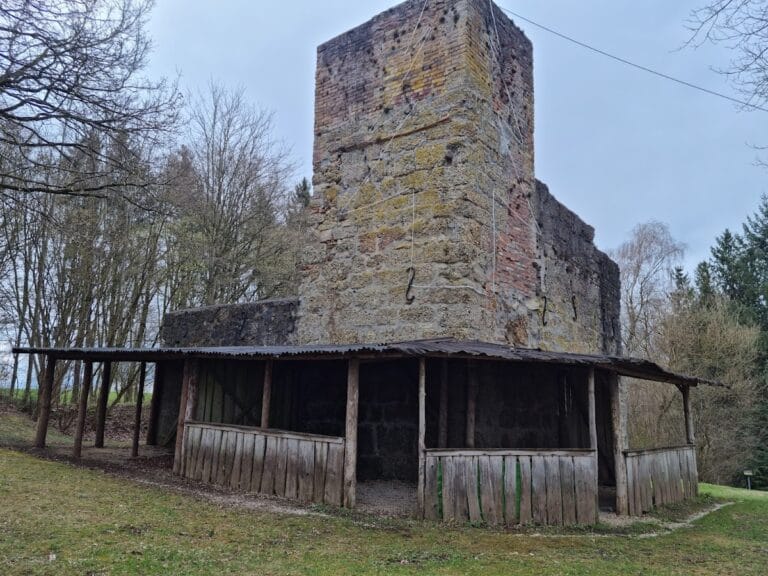
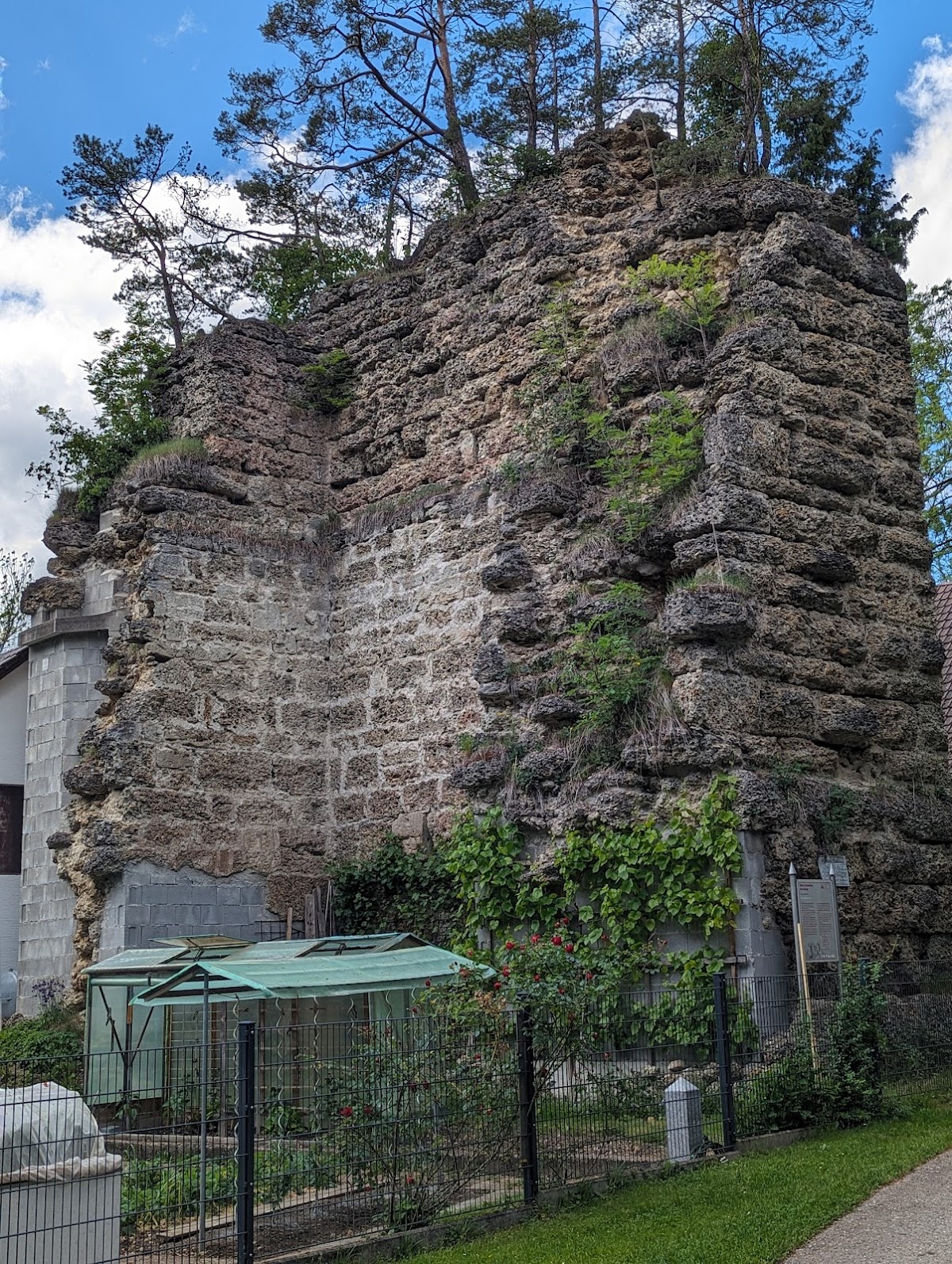
The most prominent and best-preserved structure at Burg Wolfsberg is its bergfried, or tall defensive tower, which dates back to the 12th century. This tower is notable as the only substantial medieval bergfried remaining in the Augsburg district. Its ground floor walls are remarkably thick—about four meters—and composed of large blocks of Nagelfluh, a type of conglomerate rock. These stones range in length from 60 centimeters up to 1.10 meters and are roughly 50 centimeters high, with some deliberately finished with dressed edges known as bossage to achieve a refined appearance.
The bergfried was built using a shell wall technique, meaning it consists of an inner and outer wall with a cavity filled with mortar combined with rubble and pebbles, a method known as cast masonry. The tower’s north side measures approximately 12.3 meters in length, while the west side preserves up to seven meters, and the east loses several meters, surviving at about 3.8 meters. The lower stones form a sturdy base, or plinth, and inside the tower, a ledge in the upper third marks where wooden floors once rested, as shown by beam holes and smooth ashlar stone courses.
Though partially demolished in the 19th century, the bergfried still stands about 11 meters tall, and is considered one of the most significant high medieval towers in southern Bavaria. Despite its architectural importance, the tower has not been the focus of extensive scholarly study. The surrounding agricultural buildings on the castle’s main and outer baileys date from the 19th and 20th centuries, and a modern residence built after World War II exists adjacent to the bergfried, illustrating layers of use and adaptation on the site over centuries.
Nearby sites