Burgruine Altenschönegg: Medieval Castle and Römerturm Lookout Tower


Site at a Glance
- Rating
- 4.8
- Popularity
- Very Low
- Country
- Germany
- Primary era
- Medieval
- External website
- Open
- Eras represented
- Medieval, Early Modern
- Civilizations
- Holy Roman Empire
- Site type
- Military
- Remains
- Castle
On this page6 sections
History
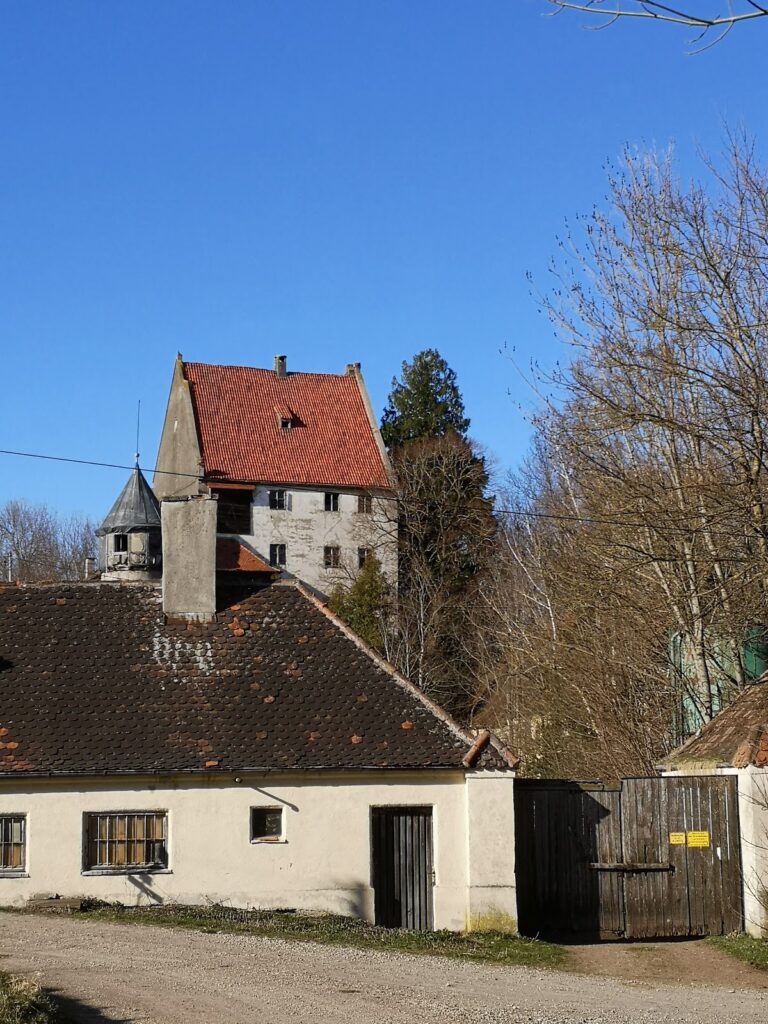
Burgruine Altenschönegg, also known as Alten-Schönegg, Altschönegg, Oberschönegg, Schönegg, Ober-Schönegg, and Römerturm, is a ruined lowland castle in Oberschönegg, Germany. Its construction dates to around 1220, when it was first mentioned, and the medieval stronghold became the seat of the important imperial ministerial family known as the Lords of Schönegg.
The Lords of Schönegg
Imperial ministerials were dependent officials who served rulers or ecclesiastical lords and could establish hereditary noble families. The Lords of Schönegg belonged to this group. In 1237, they were recorded as feudal holders of the Counts Palatine of Tübingen at Kellmünz Castle and Babenhausen Castle. In 1273, they founded the nearby Klosterbeuren women’s convent.
The castle’s early history includes two reported destructions. It was allegedly destroyed by Rudolf of Habsburg in 1281. Rudolf was German king from 1273 to 1291. Citizens of Memmingen were also said to have destroyed it in 1319. These events belong to a period in which control of fortified seats and regional lordships could be contested by rulers, nobles, and towns.
Episcopal administration and repeated destruction
After the male line of the Lords of Schönegg died out, Augsburg Bishop Marquard I of Randeck acquired the lordship of Schönegg in 1355. From that year, Altenschönegg served as a Pflegeamt, an administrative office of the Bishopric of Augsburg. A bishopric of this kind was an ecclesiastical principality in which the bishop exercised both religious authority and territorial rule.
Between 1395 and 1462, the castle was pledged to the Lords of Aichelberg and later to Stain von Ronsperg, the steward of the episcopal court. Bishop Burkhard of Ellerbach accused the Memmingen city council of destroying the castle chapel dedicated to Saint Burkhard, probably during the War of the Cities in 1388–1389, a conflict involving alliances of German towns and territorial rulers.
The castle itself suffered further destruction in 1446, when citizens of Ulm attacked it, and again in 1462 during the conflict between Emperor Frederick III and Duke Louis IX of Bavaria-Landshut. Frederick III was Holy Roman Emperor from 1452 to 1493, while Louis IX ruled Bavaria-Landshut from 1450 to 1479. Despite these repeated attacks, Altenschönegg retained its administrative role within the Bishopric of Augsburg until 1802.
Repair as the Römerturm
On 3 June 1809, Imperial Prince Anselm Maria Fugger of Babenhausen acquired the square brick keep. He had the structure repaired and opened it as a lookout tower known as the Römerturm. The nearby settlement of Weinried, described as the “village of seven hills,” was also owned by the Fugger family. Burgruine Altenschönegg is designated as an architectural heritage monument in Bavaria.
Remains
Altenschönegg stood at the edge of Oberschönegg on the route toward Babenhausen, at an elevation of 620 metres above sea level. The surviving principal feature is a square keep approximately 30 metres high. It is identified with the Römerturm, while the remainder of the castle survives as a ruin.
The square keep
The keep combines two contrasting building materials and construction phases. Its plinth storey is made from Nagelfluh ashlar blocks. Nagelfluh is a naturally cemented conglomerate formed from rounded pebbles bound in a hard matrix, while ashlar refers to blocks shaped for regular masonry. The lower part contains blocks attributed to the twelfth or early thirteenth century. The upper section is built of brick and probably dates from the fifteenth or sixteenth century. Repair in 1809 gave the surviving tower its later role as the Römerturm lookout tower.