Al-Hussein Mosque: A Fatimid Shrine and Mosque in Cairo


Site at a Glance
- Rating
- 4.8
- Popularity
- Medium
- Country
- Egypt
- Primary era
- Modern
- Eras represented
- Medieval, Modern
- Civilizations
- Ayyubid, Fatimid, Ottoman
- Site type
- Religious
- Remains
- Mosque
On this page14 sections
History
Al-Hussein Mosque is an active Shia mosque and mausoleum in Cairo, Egypt, dedicated to Husayn ibn Ali, the grandson of Muhammad through Fatimah and Ali ibn Abi Talib. Founded by the Fatimids in the twelfth century, the complex became one of Egypt’s holiest Islamic sites and stands in the historic al-Husayn district near Al-Azhar Mosque and the Khan el-Khalili bazaar.
Fatimid foundation
Husayn is a central figure in Shia Islam because of his martyrdom at the Battle of Karbala. Fatimid tradition holds that the Fatimid caliph al-Aziz Billah located Husayn’s head in 985. Another tradition places its rediscovery in 1091, during the Fatimid reconquest of the region by Badr al-Jamali, the vizier who acted as de facto regent for the caliph al-Mustansir.
As Crusader forces advanced, the Fatimid caliph al-Zafir ordered the casket associated with Husayn to be moved from Ashkelon to Cairo. It reached Cairo on 31 August 1153 and was buried there on 2 September. The Fatimids then established a Friday mosque and memorial shrine at the burial site, completing the original complex in 1154.
The burial took place in Kafuri Garden, at a location called Qubbat al-Daylam or Turbat al-Zafaran. The surrounding funerary area also contained the burials of Fatimid imam-caliphs from Abdullah al-Mahdi to al-Amir bi-Ahkami l-Lah, close to the mosque and the principal Fatimid palaces. The vizier Tala’i ibn Ruzzik later planned a mosque and shrine south of Bab Zuwayla, built in 1160, to receive Husayn’s head, but the intended transfer did not occur. Another tradition identifies him as supervising the mosque completed in 1154.
Ayyubid and nineteenth-century rebuilding
The mosque was reconstructed in 1237 under the Ayyubids, the dynasty associated with Saladin that succeeded the Fatimids in Egypt. Fire destroyed the rebuilt mosque eleven years later. Its Ayyubid minaret survived and remains the surviving element of that phase.
In 1874, Isma’il Pasha, the Khedive of Egypt, reconstructed the mosque during his modernization of Cairo. The new building brought together Gothic Revival forms, which revived features associated with medieval Gothic architecture, and Ottoman influences. This combination is described as Islamic eclecticism, meaning the use of several historical styles within one Islamic building.
Religious traditions and modern interventions
The claim that Husayn’s head was brought from Ashkelon to Cairo remains contested. Some Shias accept the Cairo shrine as the burial place, while other traditions place the head in Karbala, Medina, Damascus, Ashkelon, al-Raqqah, or elsewhere. Some scholars have regarded its location as unknown. The shrine nonetheless remains the focus of the mosque’s association with Husayn.
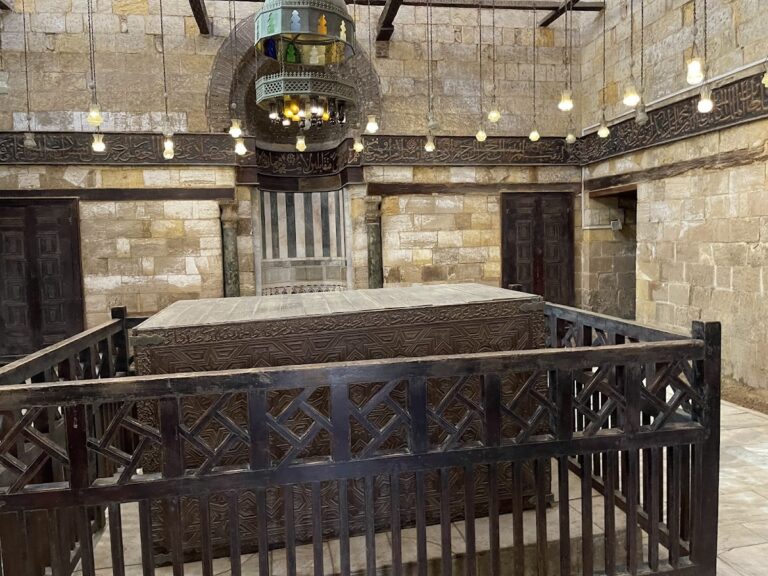
A zarih, an ornamental grille surrounding a tomb or shrine, was made in Mumbai by Taher Saifuddin, a Dawoodi Bohra religious leader, and installed in 1965. His son, Mohammed Burhanuddin, inaugurated it. A tradition says that it had first been intended for the shrine of al-Abbas in Karbala but was brought to Cairo because it did not fit there.
Water damage prompted restoration by Egypt’s Supreme Council of Antiquities in 1996. The tomb chamber underwent extensive work, including the installation of a replacement steel dome. Further renovation and rehabilitation were completed in 2022, when a new shrine enclosure was created. President Abdel-Fattah El-Sisi and Mufaddal Saifuddin, the 53rd Da’i al-Mutlaq of the Dawoodi Bohra community, inaugurated the mosque on 27 April 2022. Some observers criticized the work, alleging that ventilation pipes had been passed through the historic dome and describing this as architectural damage and a breach of conservation practice.
Remains
The surviving complex combines fragmentary Fatimid fabric, an Ayyubid minaret, and the nineteenth-century mosque rebuilt with Gothic Revival and Ottoman influences. Red stone walls define the present building, while its interior contains five rows of arches supported by marble columns. The entrances, prayer spaces, mausoleum, and relic chamber form distinct parts of an active religious complex.
Fatimid and Ayyubid remains
Bab al-Akhdar
The lower portion of the southern gate, Bab al-Akhdar, or the Green Gate, belongs to the original Fatimid complex and is its surviving original fabric. The gate is also associated with entrances beside the dome and with the history of the early mosque and mausoleum.
Ayyubid minaret
An Ayyubid minaret was added above Bab al-Akhdar in 1237. Its carved panels form arabesque patterns from overlapping lines. The minaret is the surviving architectural element of the Ayyubid mosque reconstructed in that year.
Nineteenth-century mosque
Exterior and entrances
The present mosque has three western entrances, a southern entrance, and a northern entrance that opens onto a courtyard with an ablution area. Three white-marble doors face Khan el-Khalili. Another doorway beside the dome is known as Bab al-Akhdar. Two doors beside the minbar lead toward the dome, while a third opens toward the chamber of relics.
At the southwestern corner, the cylindrical minaret follows Ottoman forms. It is divided into two stages and ends in a conical termination. Three large mechanically operated canopy umbrellas stand outside the mosque to shelter worshippers from summer sun and winter rain. Made of steel and Teflon, they follow designs used at several mosques in Saudi Arabia.
Prayer hall
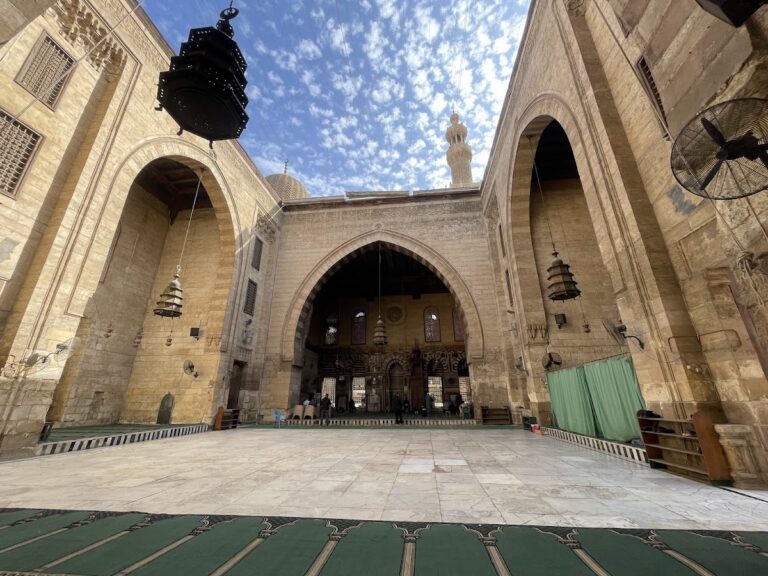
Inside, five rows of arches rest on marble columns. The mihrab, the niche indicating the direction of prayer, is assembled from small pieces of colored faience rather than marble. Beside it stands a wooden minbar, the pulpit used for sermons.
A marble slab bears a hadith attributed to Muhammad concerning Husayn, including the statement, “Husayn is of me, and I am from Husayn.” Another hadith above it is classified as hasan, meaning “good,” and is associated with al-Tirmidhi, al-Bukhari, and Ahmad ibn Hanbal.
Mausoleum and relic chamber
Husayn shrine
The mausoleum belongs to the early Fatimid phase of the complex and is associated with its completion in 1154, although it is also described as belonging to a phase preceding that date. The shrine marking the alleged burial place of Husayn’s head contains the zarih installed in 1965. A new enclosure was added around the shrine during the 2022 renovation.
Relic chamber
A crypt beside the Husayn shrine contains objects believed to have belonged to Muhammad. The associated chamber was added to the mosque in 1893. Its contents include a piece of cloth believed to come from a linen cloak worn by Muhammad, a lantern containing four strands believed to be from his hair, copper kohl attributed to him, a staff said to be the one he carried when he entered Mecca, and a sword reportedly sent to him by one of his companions.
The chamber also contains a Quran manuscript attributed to Ali ibn Abi Talib. Written in Kufic, an early angular style of Arabic writing, the manuscript is on deer skin and has 501 pages. Many Muslims regard it as the oldest surviving handwritten copy of the Quran. A large silver-and-gold door made by Mohammed Burhanuddin II was installed at the entrance to the relic chamber in 1986.
Nearby sites