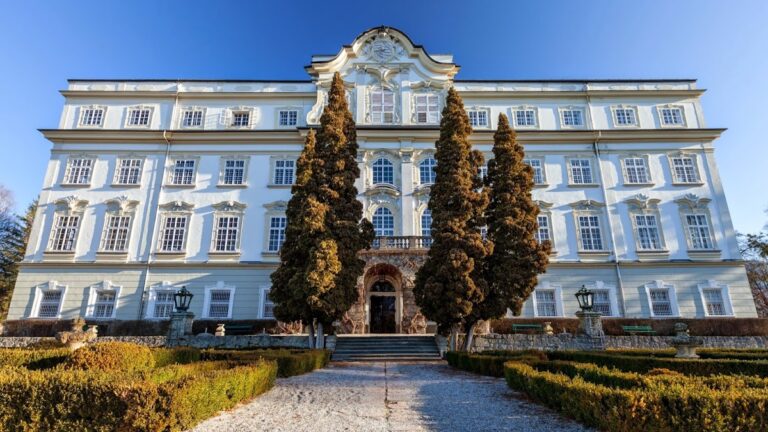
Schloss Fronburg: A Salzburg Country Palace in Austria


Site at a Glance
- Rating
- 4.5
- Popularity
- Low
- Country
- Austria
- Primary era
- Early Modern
- External website
- Open
- Eras represented
- Early Modern, Modern
- Civilizations
- Holy Roman Empire
- Site type
- Domestic
- Remains
- Elite Residence
On this page7 sections
History
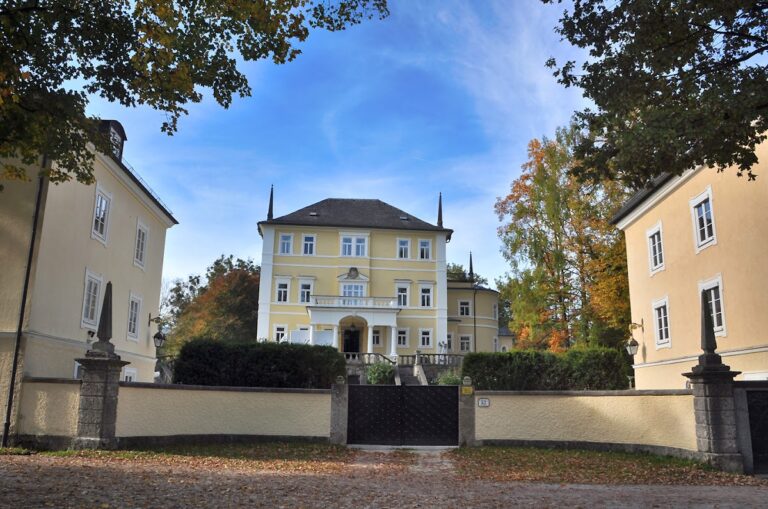
Schloss Fronburg is a country palace in Salzburg, Austria, whose present construction began in 1672 as part of the Hellbrunn landscape garden. Also known as Schloss Frohnburg, Grafenauerhof, and Schloss Kuenburg, it is a typical Salzburg country palace with a history closely connected to the Kuenburg noble family.
Early building and Kuenburg ownership
The name may come from the Old High German word frō, meaning “lord” or “master,” giving it the possible sense of “lord’s palace.” Another explanation connects it with the Froberg family, whose name appears as Fronberg in one document. Before 1618–19, Johann Georg von Tullier, Baron of Froberg, a noble councillor and chief chamberlain, built a small auxiliary structure known as a Stöckl.
In 1670, the entire property, including the Stöckl, passed to the Kuenburg counts, who retained it until 1960. Two years later, Archbishop Max Gandolf Kuenburg, a prince-archbishop of Salzburg, granted the count 14,784 Klafter of alluvial ground at the Hellbrunnerweg. Construction of the new palace began in 1672. Whether parts of the earlier seventeenth-century building were incorporated into this work remains a question for detailed investigation. Two designs for coach houses survive from 1758.
From confiscation to cultural use
After the Second World War, the buildings were confiscated by the American occupying forces. The Republic of Austria acquired Schloss Frohnburg in 1960 for the Mozarteum Academy, now the University Mozarteum Salzburg, a higher-education institution devoted to music and the performing arts. The Carl Orff Institute, associated with music education and the teaching approach developed by composer Carl Orff, also uses the site, and a student residence was later added. The palace remains part of the University Mozarteum.
Schloss Fronburg also served as the exterior setting for the von Trapp family villa in the 1965 film The Sound of Music. Proposals have repeatedly considered reviving the Eschenbach and recreating the Baroque garden, whose formal geometry, ordered axes, symmetrical planning, and ornamental water features were intended to strengthen the palace ensemble.
Remains
The palace and garden occupy an enclosed ensemble surrounded on every side by a high wall. The palace faces east toward the Salzach, while its courtyard lies to the west, toward Hellbrunner Allee and the historic access route. The surviving grounds combine the residence, formal water features, traces of a long landscape axis, and the former dairy-estate farmyard east of the palace park.
Palace entrance and enclosure
The eastern entrance portal carries a heraldic cartouche commemorating the long ownership of the Kuenburgs. On the western side, a seventeenth-century wrought-iron gate opens from Hellbrunner Allee. Porter’s and gardener’s cottages flank the gate, linking the entrance with the service and residential functions of the palace grounds.
Formal garden and landscape axis
The former Baroque garden retains two geometrically shaped ponds and a central fountain basin. Occupying soldiers probably buried the basin around 1954; it was excavated in 2000 and restored. A wall fountain depicts Amor, the Roman personification of love, riding a dolphin. The sculpture is a reproduction of an ancient work from the Farnese Collections, now held by the National Archaeological Museum of Naples. Nineteenth-century catalogues had already rejected the identification of the winged figure as Arion, while Giovanni Battista Cavalieri had earlier labelled the sculpture Alpheus in his 1593 book on ancient Roman statues.
The former tree-lined axis from the palace extended into the area called Grafenau, also known as Herrenau or Josefiau. Part of this route remains discernible, and since 2014 it has again been laid out as a fruit-tree avenue following historical models. A bridge that once crossed the Eschenbach on the palace axis is now only faintly visible, while a parking area has altered much of the surrounding landscape.
Former dairy-estate farmyard
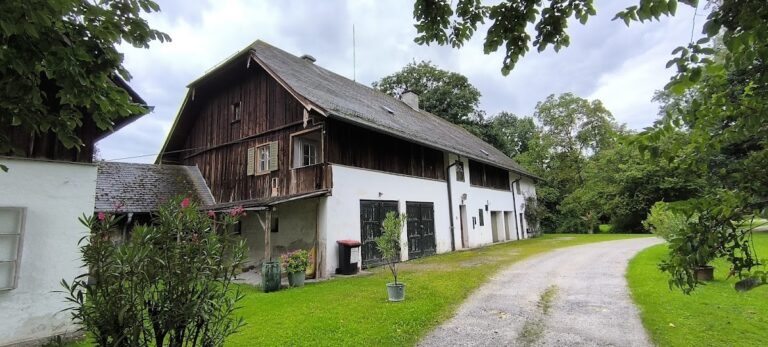
East of the palace park, the former farmyard of the Frohnburg dairy estate remains well preserved. Its buildings are now used as a Montessori kindergarten, giving the historic agricultural part of the estate a continuing institutional function.