Schloss Leopoldskron: A Baroque and Rococo Palace in Salzburg


Site at a Glance
- Rating
- 4.6
- Popularity
- Medium
- Country
- Austria
- Primary era
- Early Modern
- External website
- Open
- Eras represented
- Early Modern, Modern
- Civilizations
- German, Holy Roman Empire
- Site type
- Domestic
- Remains
- Palace
On this page15 sections
History
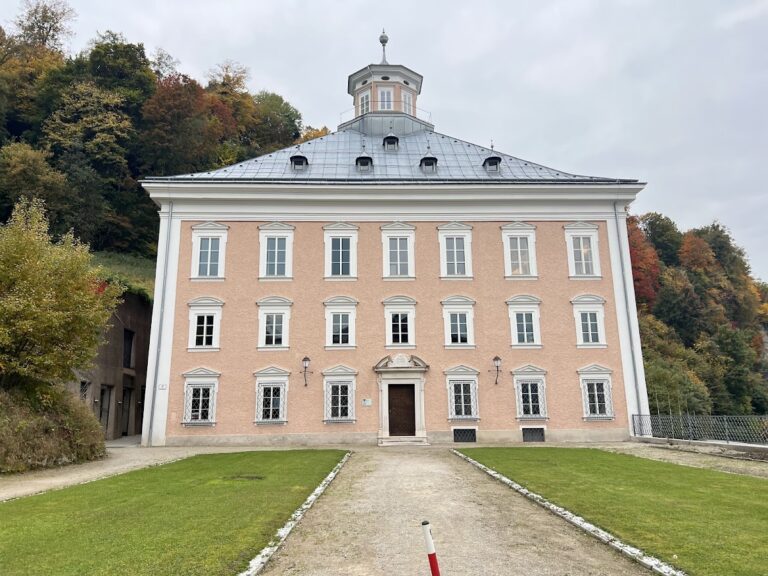
Schloss Leopoldskron is an eighteenth-century Baroque and Rococo palace in Salzburg, Austria, built between 1736 and 1740 as the summer residence of Salzburg Archbishop Leopold Anton Eleutherius von Firmian. As both the senior Roman Catholic authority and territorial ruler of Salzburg, Firmian commissioned a residence intended to pass after his death to the firstborn heir of the Firmian family. The name joins his first name with the crown shown in the family coat of arms.
Firmian Family Residence
The palace was built according to plans by the Benedictine monk and architect Bernard Stuart. Firmian died in 1744. His heart was buried in the palace chapel, while his body was interred in Salzburg Cathedral. The estate first passed to his nephew, Laktanz von Firmian, who lived there for more than forty years and assembled a collection of 571 paintings. After Laktanz died in 1786, ownership passed to his son, Leopold von Firmian.
The abolition of firstborn inheritance rights in 1816 brought repeated changes of ownership. The palace pond remained with the Firmian family until after the First World War, however. Following Leopold von Firmian’s death, the estate passed to his son-in-law, Karl Graf Wolkenstein-Trostburg.
Nineteenth-Century Changes
Georg Zierer and his wife Therese acquired Schloss Leopoldskron in 1837. Zierer sold most of the painting collection, removed ancient statues that he considered defective or unsuitable, and divided the floors into rentable summer apartments. In 1845 Friedrich Dietz and Friedrich Christian Kreh bought the palace for 45,000 gulden. They converted it into the Hotel Leopoldskron and added mud baths and a whey spa. Princess Sophie Friederike of Bavaria stayed there on 6 September 1846 while travelling to Ischl.
The hotel later became insolvent, and Zierer briefly regained the property before selling it to Salzburg mayor Heinrich von Mertens. Mertens rented rooms and apartments for accommodation, balls, and dinners. King Ludwig I of Bavaria then purchased the palace from him on 16 February 1851 for 75,000 gulden. After abdicating, Ludwig lived at Schloss Leopoldskron until 1868, using it as a summer residence with his court in alternate years.
Members of the Bavarian royal family stayed at the palace. A family celebration on 1 September 1853 was attended by Emperor Franz Joseph and his bride, Elisabeth of Bavaria, later widely known as Sisi. King Wilhelm I of Prussia visited in 1863, and Emperor Napoleon III visited in 1867. After Ludwig’s death in 1868, his grandson, Prince Leopold of Bavaria, sold the palace on 9 April 1869 to Alexander Julius Schindler, a ministerial councillor and writer who published as Julius von Traun.
Schindler hosted writers including Johann Gabriel Seidl, Ludwig Steub, and Theodor Storm. After his death in 1885, ownership was divided. The banker Karl Spängler acquired half of the palace from Schindler’s son Julius in 1890, while Schindler’s daughter retained the other half. Baron von Rüdt-Colenberg acquired both parts in 1895. His widow sold the estate in 1904 to government councillor Paul Wolf of Frankfurt am Main.
Max Reinhardt and the Salzburg Stage
The theatre director Max Reinhardt, a co-founder of the Salzburg Festival, acquired Schloss Leopoldskron in 1918. Over roughly two decades he restored the palace and used the building as an expansive theatrical setting. Audiences moved from room to room during productions, while the estate became a meeting place for writers, actors, and composers from many countries. Reinhardt also created new interior and garden spaces suited to his theatrical and cultural activities.
Reinhardt fled to New York in 1937 as the persecution of Jews intensified. On 16 April 1938, Nazi authorities confiscated his Salzburg property under the policy known as Aryanization, the forced transfer of Jewish property to non-Jewish control. That year Hermann Göring transferred Schloss Leopoldskron to Princess Stéphanie von Hohenlohe, who was assigned to develop it as a guesthouse for prominent cultural figures of the Nazi state. She extensively remodelled the palace and sent some of Reinhardt’s porcelain, silver, and other personal possessions to him in California. Her possible role as a double agent remains uncertain.
Hohenlohe fled to England when the Second World War began. For a short period, conductor Clemens Krauss occasionally occupied the palace. Schloss Leopoldskron also served as a reception venue and summer residence for Nazi Foreign Minister Joachim von Ribbentrop. Near the end of the war, a bomb exploded in the palace garden. The blast shattered windows, damaged a library chandelier, injured the wall paintings in the Chinese Room with fragments, and damaged stucco on the south facade. Architect Hilda Crozzoli repaired the palace in 1945.
Postwar Restitution and the Salzburg Global Seminar
After the Nazi regime ended, Schloss Leopoldskron was returned to Max Reinhardt’s heirs, a postwar process known as restitution. They later sold the property. In 1946, Reinhardt’s widow, Helene Thimig, offered the palace for use by Clemens Heller, Scott Elledge, and Richard Campbell, the founders of the Salzburg Seminar in American Studies. During the American occupation of parts of Germany and Austria, the seminar brought together young people from countries that had been wartime enemies and explored United States history, art, literature, and culture.
The Salzburg Seminar later developed into a global forum. Since 1947, more than 500 seminar sessions have been held at the estate on subjects covering a wide range of fields. The organization acquired Schloss Leopoldskron in 1959 and the adjoining Meierhof in 1973. Reconstruction and restoration allowed the estate to operate as both a conference centre and a seminar venue.
Since 2014, Schloss Leopoldskron and the Meierhof have operated as Hotel Schloss Leopoldskron, while the Salzburg Global Seminar remains the owner. The palace continues to provide a meeting place for international figures in politics, business, art, culture, and science. It is recognized as a national historical monument. The garden is protected as a historic monument, and the surrounding landscape lies within the buffer zone of the UNESCO World Heritage property Historic Centre of the City of Salzburg and the Leopoldskroner Weiher landscape-protection area, which covers 81 hectares. The estate is also regarded as part of Salzburg’s metropolitan greenbelt.
The estate became associated with the 1964 film The Sound of Music. The grounds and the Meierhof were used for exterior scenes connected with the von Trapp house, while the palace interiors were filmed elsewhere. Views of the building itself were made at Schloss Frohnburg. A 1987 television special, The Sound of Christmas, was also filmed at Schloss Leopoldskron. The palace appeared on the reverse of Austria’s 1,000-schilling banknote issued in 1966.
Remains
Schloss Leopoldskron stands in Salzburg’s Riedenburg district within an extensive park and park-like landscape. The estate includes the palace, its chapel, the Meierhof to the north, the Leopoldskroner Weiher, and a section of the Leopoldskroner Straße, described as Salzburg’s oldest chestnut avenue. Gneis-Moos lies to the southeast and Leopoldskron-Moos to the southwest. The palace and its grounds form a connected estate around the water landscape south of the building.
Palace and Interior Decoration
Baroque and Rococo Palace
The palace was built between 1736 and 1740 in the Baroque and Rococo style. Its original form had three storeys, a high mansard roof, and a centrally placed octagonal tower. After 1760, a Classical remodelling removed the tower and mansard roof and replaced them with an attic storey. Johann Kleber created the stucco decoration, including the Firmian coat of arms and the Salzburg lion.
Painted Rooms and Chapel
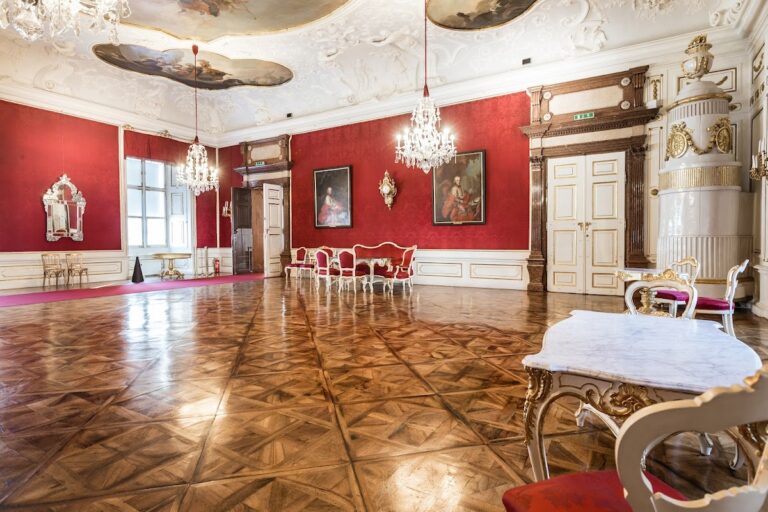
The ballroom ceiling carries Andreas Rensi’s The Four Seasons, painted around 1740. Rensi also produced works in the chapel, whose ceiling painting, The Marriage of Atalanta, was created at approximately the same time by Franz Anton Ebner. The palace chapel is also the place where Firmian’s heart was buried in 1744.
Reinhardt’s Additions
Max Reinhardt created a library modelled on the library of St Gall and added the Venetian Room and a garden theatre. He repaired the staircase, the Great Hall, and the Marble Hall. The library chandelier and the painted decoration in the Chinese Room retain evidence of the wartime blast, including damage caused by shattered glass and fragments.
Gardens and Water Landscape
Formal and Landscape Gardens
A Baroque garden lies in front of the palace, preserving a basic layout that reaches back to the building campaign of 1736 to 1740. The small Baroque park south and west of the palace was redesigned as an English landscape garden under King Ludwig I of Bavaria. Max Reinhardt later enlarged and remodelled it as a Neo-Baroque garden, restoring formal Baroque principles in a later design.
The wider landscape garden extends south of and around the Leopoldskroner Weiher. It also includes the nearby section of the Leopoldskroner Straße. The restored Johannes Nepomuk monument, designed by Josef Anton Pfaffinger in 1744, stands among the estate’s surviving features. A stumbling stone for Max Reinhardt and another for Richard Metzl are located at or near the palace entrance.
Leopoldskroner Weiher
The Leopoldskroner Weiher is supplied by the Almkanal, a historic artificial watercourse in and around Salzburg. During the nineteenth century and the first half of the twentieth century, its north shore contained a bathing establishment first intended for military training and later opened to Salzburg’s general population. Its entrance portal gave access in winter to a 13,000-square-metre skating rink, and the pond was also used for boat excursions.
Second World War air raids destroyed the wooden bathing establishment. For a period, the entire pond was used as a bathing lake. After 1960, the present Leopoldskron outdoor swimming pool was built on the site and later enlarged several times. The pool lies north of the palace. The older ponds of Salzburg’s St Peter’s Archabbey are nearby and were probably created through peat extraction. The pond remains publicly accessible and is also used for fishing.
Associated Features
Meierhof and Film Gazebo
The Meierhof is the agricultural service estate associated with the palace and stands north of it. It forms part of the estate’s surviving built complex and was acquired by the Salzburg Global Seminar in 1973. A gazebo associated with The Sound of Music was used for exterior filming, although scenes inside it were filmed on a Hollywood soundstage. After filming, the gazebo was moved to the opposite side of the lake and later relocated to Schloss Hellbrunn outside Salzburg.
Nearby sites