Hellbrunn Palace: A Mannerist Summer Residence and Water-Garden Complex in Salzburg


Site at a Glance
- Rating
- 4.6
- Popularity
- Very High
- Country
- Austria
- Primary era
- Early Modern
- External website
- Open
- Eras represented
- Early Modern
- Civilizations
- Holy Roman Empire
- Site type
- Domestic
- Remains
- Palace
On this page16 sections
History
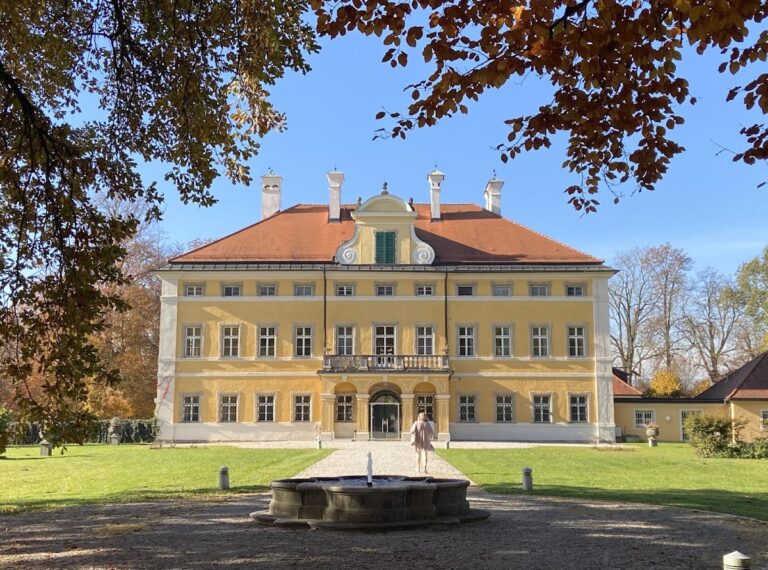
Hellbrunn Palace is a Mannerist late-Renaissance summer and pleasure residence in Salzburg, Austria, built between 1613 and 1615 for Prince-Archbishop Markus Sittikus von Hohenems. A prince-archbishop combined the highest Roman Catholic ecclesiastical authority in Salzburg with territorial rule. Hellbrunn followed the Italian model of a villa suburbana, a country residence outside the city intended for leisure, representation, and entertainment.
Foundation under Markus Sittikus
Markus Sittikus commissioned the residence soon after his election as prince-archbishop in 1612. Having spent part of his youth in Italy, he drew on the late Renaissance architecture associated with Venice and Rome. The architect Santino Solari designed the palace, as well as the reconstruction of Salzburg Cathedral. The new complex incorporated a late Gothic aristocratic residence and was established within the prince-archbishop’s hunting grounds south of Salzburg.
Hellbrunn served as a suburban residence and a setting for entertaining guests. Its fountains, automata, sculptural grottos, and concealed water devices were created chiefly to amuse visitors. These water jokes used unexpected sprays and streams as theatrical surprises, while flowing water or water pressure operated figures and other mechanisms.
Early entertainments and the hilltop lodge
The Monatsschlössl, first known as the Waldems-Schlösschen, was built in 1615 as a hunting lodge on Hellbrunner Berg. A local tradition tells that a Bavarian prince suggested constructing a small castle on the hill, after which Markus Sittikus had one completed within a month.
The Stone Theatre opened in 1617. A performance of Pastorale Orfeo took place there that year and is regarded as probably the first opera performance north of the Alps. The theatre formed part of Hellbrunn’s wider programme of courtly recreation, which combined landscape, architecture, music, spectacle, and water entertainment.
Garden transformation and later additions
Around 1730, Franz Anton Danreiter, inspector of the imperial gardens, directed a reconstruction of the gardens. The redesign introduced decorative elements in the Rococo manner while retaining earlier garden structures. The artificial Erdbeerberg, or strawberry hill, was removed, and a fir avenue made the principal garden axis more visually prominent.
Between 1749 and 1752, Archbishop Andreas Jakob von Dietrichstein added the Mechanical Theatre to the earlier water features. By the middle of the nineteenth century, Hellbrunn belonged to the Austrian emperor. Since 1924, the Monatsschlössl has housed the Salzburg Folk Culture Museum, with displays of regional cultural and domestic objects, traditional crafts and industries, and regional costume.
Religious landscape and modern protection
The southern garden was created as a religious landscape shaped by the Capuchin tradition associated with Saint Francis and by the example of the archbishop’s uncle, Saint Carlo Borromeo. The Capuchins are a reform branch of the Franciscan order, while Borromeo was a sixteenth-century cardinal associated with Catholic reform during the Counter-Reformation. The garden’s wilderness setting represented God’s natural creation and was intended to keep secular magnificence from disturbing devotion.
The religious garden was arranged as a Calvary, or Way of the Cross, representing the stages of Christ’s Passion through chapels, sculptures, and devotional stations. It included hermit sculptures and an inhabited hermitage. Only a few foundations of its sacred monuments survive, while the naturally landscaped area around the Anifer Alterbach remains part of the historic park. Substantial portions of the former sacred garden are now used by Salzburg Zoo.
Hellbrunn Palace, its historic garden monuments, and elements of its surrounding landscape have legal protection as heritage and nature sites. The gardens rank among Austria’s important garden-architectural monuments. The wider complex lies within the Salzburg-South landscape-protection area, while the oak row and Hellbrunner Allee also have protected landscape status. The City of Salzburg owns the palace and park. The grounds remain part of the green belt of the metropolitan area, and the former hunting-garden meadows east of Hellbrunner Berg belonged to the archiepiscopal hunting enclosure until 1800.
Remains
Palace and ornamental garden
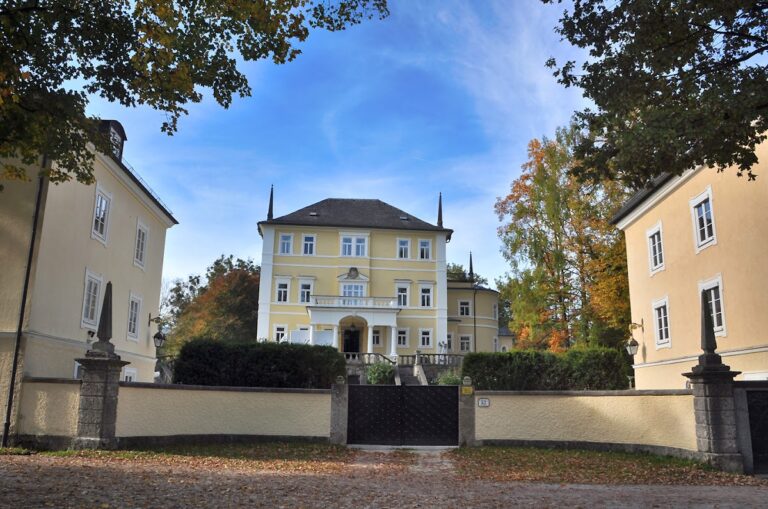
Hellbrunn is organized around a closed court of honour, with ancillary buildings arranged symmetrically around it. The eastern approach, formed by the East Portal and the Fürstenweg, creates a long axis extending into the surrounding landscape. The palace interior is largely preserved, although some furnishings and interior details have changed. Seventeenth- and eighteenth-century objects remain among the furniture, including pieces brought from other locations.
The Festival Hall has walls and a vaulted ceiling covered with allegorical paintings probably made by Donato Arsenio Mascagni. Other notable rooms include the octagonal hall, decorated with social and musical scenes, together with the Fish Room, Bird Room, and Corner Room.
The palace park covers 60 hectares. Its designed landscape contains ponds, sculptural groups, pavilions, fountains, grottos, and water-driven automata. The Mannerist ornamental garden, known as the Water Parterre, is arranged around a geometric main pond with a central island. Two further ponds are placed symmetrically on either side. Statues, clipped boxwood ornament, and architecturally trimmed tree avenues enrich the original Renaissance design, which was later reshaped as a geometrically ordered Baroque garden.
Water features and mechanical entertainment
Late Renaissance water ensemble
The surviving water features form an extensive late Renaissance ensemble of fountains, moving figures, water-driven devices, sculptural grottos, ponds, and concealed water jokes. The Roman Theatre includes the Prince’s Table and a pond, while the Orpheus Grotto and the wine cellar form part of the same entertainment complex. The Star Pond contains the Altems Fountain and a figure of Perseus. The Neptune Grotto, also called the Rain Grotto, includes a fountain described as having 1,000 jets.
Grottos, fountains, and animated details
Further features include the Mirror, Shell, Birdsong, and Ruin Grottos, as well as the Venus Grotto, fool and wild-boar statues, the Capricorn Grotto, the Fountain of the Goddess Diana, the Midas and Crown Grottos, and the Neptune Fountain. The Orpheus and Eurydice Grotto contains red-marble figures. Lead trees carry lead singing birds, adding moving and sounding elements to the water displays.
Mechanical Theatre
The Mechanical Theatre is a stone-built miniature stage containing 256 wooden figures. They depict daily life in a medieval town, including tradespeople, guild workshops, builders, soldiers, performers, and a town hall surrounded by several three-storey buildings. Water power operates both the figures and the water organ, linking the mechanical display to Hellbrunn’s earlier tradition of hydraulic entertainment.
Hill, theatres, and sacred garden
Monatsschlössl
The Monatsschlössl stands on the slope of Hellbrunner Berg, overlooking the centre of the ornamental garden. Built in 1615 as a hunting lodge, it now contains the Salzburg Folk Culture Museum. Its displays include regional domestic and cultural objects, traditional crafts and industries, and regional costume.
Stone Theatre
The Stone Theatre is carved directly into conglomerate rock in a natural cleft of Hellbrunner Berg. It is an open-air theatre built into the mountain and is described as the oldest such stage in Europe. Its stone setting preserves the connection between Hellbrunn’s natural terrain and its early programme of courtly performances.
Sacred garden
The southern sacred garden was laid out above the Anifer Alterbach as a wilderness garden in the form of a Calvary or Way of the Cross. Chapels, hermit sculptures, and an inhabited hermitage formed its devotional features. The surviving foundations and naturally landscaped ground around the stream preserve part of this religious landscape, while large areas of the former garden have been incorporated into Salzburg Zoo and retain historic vegetation.
Landscape axes and wider setting
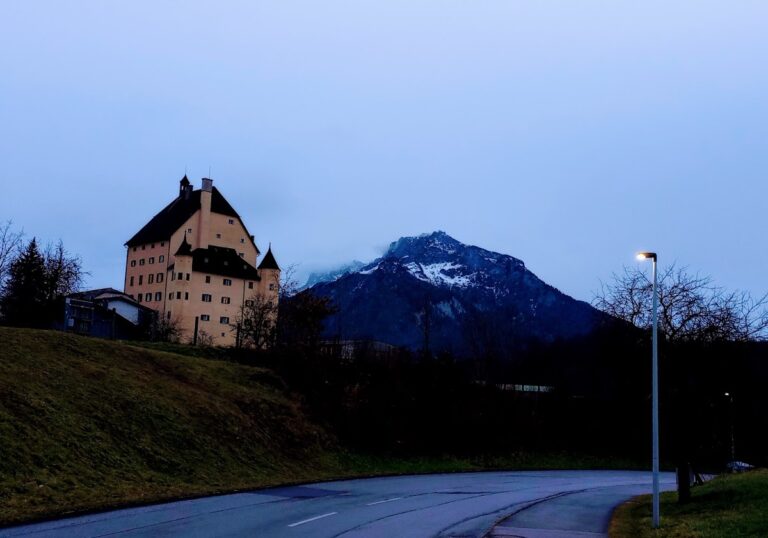
The Water Parterre and the fir avenue form an axis directed across the Salzach toward Schloss Goldenstein. The Great Garden Axis begins near the water features and a statue of Diana, then continues eastward through the Water Parterre, hunting garden, alluvial woodland, and across the Salzach to the elevated Schloss Goldenstein.
The Fürstenweg is an old lime-tree avenue leading toward the alluvial woodland and the Salzach. Together with the palace and the Star Pond, it forms an axis extending into the surrounding landscape. Hellbrunner Allee, established in 1614 and 1615 toward Schloss Freisaal, extends the formal garden beyond the palace. It is described as one of Central Europe’s oldest surviving avenues and possibly the oldest surviving avenue in the world.
Another historic avenue once connected Schloss Anif with Schloss Goldenstein, although only a short section remains visible. Hellbrunn, Schloss Goldenstein, and Schloss Anif form a roughly triangular spatial relationship, while the Keltenweg creates a long westward axis toward Schloss Glanegg. The wider historic landscape includes Hellbrunner Berg, the Anifer Alterbach, the Salzach, the alluvial woodland, the protected oak row, surviving avenue sections, and the former hunting-garden meadows. Together, the palace, gardens, waterworks, landscape axes, and associated monuments form an extensive designed landscape rather than an isolated building.