Castle of Montreuil-Bellay: A Medieval Fortress in France
Site at a Glance
- Rating
- 4.4
- Popularity
- Medium
- Country
- France
- Primary era
- Medieval
- External website
- Open
- Eras represented
- Medieval, Modern
- Civilizations
- French
- Site type
- Military
- Remains
- Castle
On this page20 sections
History
Castle of Montreuil-Bellay is a medieval fortress in Montreuil-Bellay, France, established by Foulque Nerra, count of Anjou, in the eleventh century. Built on a hill beside the Thouet River, it occupied a site already used by a Gallo-Roman settlement and a religious house near the river bridge. Its position at the meeting point of important routes made it a military and political centre in the region.
Foundation and Angevin control
One route linked Angers and Poitiers through Loudun and Doué, while another connected Le Mans, Saumur, Thouars, and the Aquitaine coast. Foulque Nerra probably established the fortress to secure the Loudunois and observe the viscounts of Thouars. In 1025, he granted the castle as a fief to his vassal Berlay, son of Giraud.
The Berlay family later became associated with the name Bellay, which gave both the town and the castle their present form of name. The medieval lordship extended across more than 4 square kilometres and was connected with 32 nearby villages in Anjou. Control of the castle was disputed during the twelfth century. Foulque V of Anjou besieged it in 1124, confiscated it, and later returned it to Berlai II. Berlai recovered possession after Foulque left for the Holy Land in 1129.
Sieges and royal authority
In 1130, Giraud II Berlai joined a coalition against Geoffroy Plantagenet, an Angevin prince of the Plantagenet dynasty, which controlled territories in western France and later ruled England. Giraud attempted to escape the authority of the counts of Anjou. Geoffroy responded by building a castle at Coudray-Macouard in 1147 to watch Montreuil-Bellay, then besieged the fortress. After a year-long siege, it fell in 1151. Giraud was imprisoned, and when he was released seven months later, he was required not to rebuild the tower or other fortifications.
In 1205, Philippe II Auguste, usually known as Philip Augustus, attached Anjou to the French Crown as royal control expanded into the region. He visited Montreuil-Bellay in 1208 to subdue its barony. Louis VIII returned in 1224 during a campaign against Poitevin barons supported by the English king. Giraud IV Berlay was restored to possession because of his family’s support for the French king.
The lordship entered the House of Melun through the marriage of Agnès Berlay to Guillaume II de Melun, count of Tancarville and seneschal of Poitou, probably around 1211. It later passed through the Houses of Harcourt-Montgommery and Orléans-Longueville. During the Hundred Years’ War, the prolonged conflict between the English and French crowns from the fourteenth to the fifteenth century, the lords of Montreuil-Bellay supported the French king.
War and late medieval rebuilding
English raids beginning around 1350, followed by the Black Prince’s campaign in 1356, exposed the weakness of the poorly maintained fortress. Because the town had no protective walls, its inhabitants took refuge inside the castle. Guillaume IV de Melun strengthened the lower bailey, an enclosed castle courtyard, between 1382 and 1415. The castle chapel vaults collapsed in 1382, while a contemporary list counted 150 lodgings within the complex. Repairs to the keep roof were carried out in 1365 and 1366.
Charles VII stayed at Montreuil-Bellay in 1437, and Charles VIII stayed there in 1488 and 1490. Louis XI also visited while attending the collegiate church at Puy-Notre-Dame. Between 1445 and 1480, Guillaume IV d’Harcourt and Yolande de Laval undertook extensive construction. Their work produced much of the residential and defensive complex that survives in altered form, including the Old Lodging, the New Lodging, the fortified entrance gatehouse, and the artillery boulevard.
From aristocratic residence to prison
Under the Orléans-Longueville family, Louis XIII stayed at the castle in 1618. Anne-Geneviève de Condé, wife of Henri II d’Orléans-Longueville, was exiled there in 1653. Charles de La Porte, marshal of La Meilleraye, and his wife, Marie de Cossé-Brissac, acquired the barony and castle between 1662 and 1664. Their purchase ended the succession of hereditary lords of Montreuil-Bellay. The property later passed to the La Trémoille family, who acquired it in 1756.
During the French Revolution, the castle was seized in 1792 from Jean-Bretagne-Charles-Godefroy de La Trémoille, the last baron of Montreuil-Bellay, because he had remained loyal to Louis XVI. The fortress was converted into a prison for women suspected of being royalists. It was sold as national property on 24 July 1796 to the merchant Augustin Glacon.
Ownership and conservation
The La Trémoille family recovered the property in 1815 but sold it in 1822 to Jean Niveleau, a merchant from Saumur, because restoration costs were burdensome. Niveleau divided the large property into rental units. Marie-Augustine Niveleau and her family commissioned a major restoration in 1860 under the direction of the architect Charles Joly-Leterme. Some interiors were remodelled in the nineteenth-century Troubadour style, which revived romanticized medieval forms. The main tower had already been demolished before 1840.
The property passed to Georges de Grandmaison in 1890 and then to his son Robert de Grandmaison. It subsequently came to the Thuy family, and the present owner is Marie-Guilhem de Valbray, born de Thuy. The castle was classified as a French historic monument in 1979. The former stables and granaries were registered in 2019 and classified in 2022. Château de Montreuil-Bellay is also the name of a premium wine produced on the property.
Remains
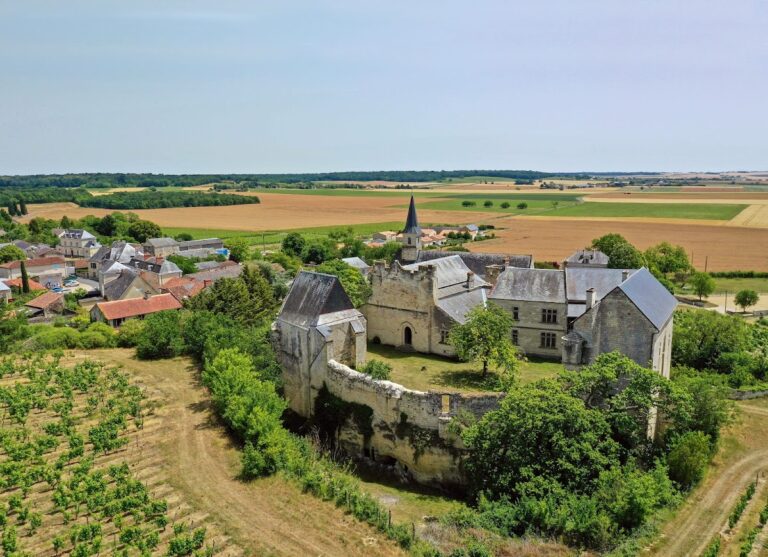
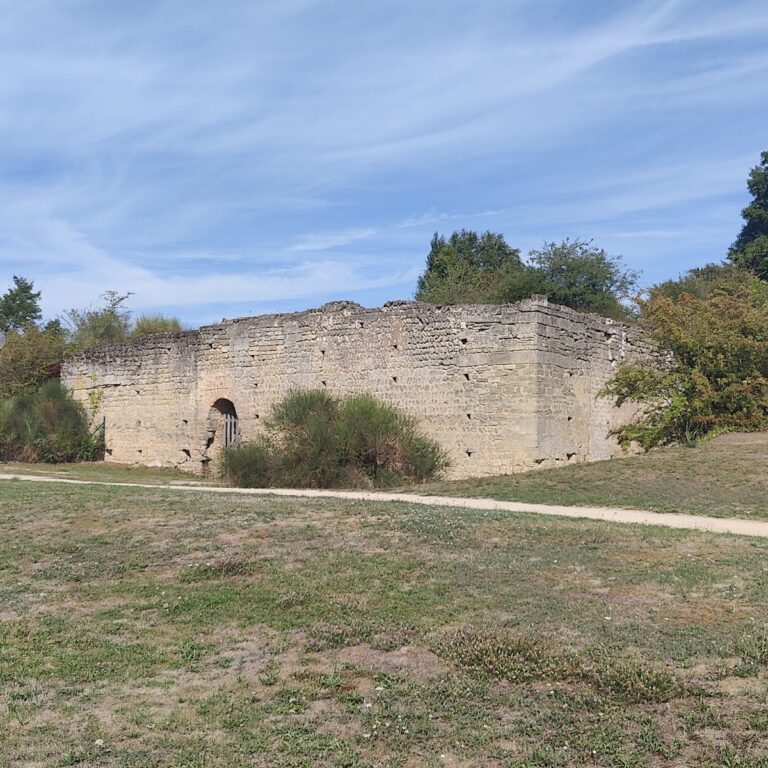
The surviving castle is a large, repeatedly altered fortress at the centre of the former walled town, positioned on high ground above the Thouet and the historic river crossing. Its medieval fabric combines massive defensive walls, towers, ditches, residential buildings, service structures, and religious buildings. The complex developed from an elevated fortified settlement, or castrum, and was repeatedly reshaped as military methods and aristocratic needs changed.
Early fortifications and lower bailey
Twelfth-century fortress
Twelfth-century descriptions present the fortress as having a very high stone tower, two defensive enclosures, an outer forewall, and a deep ditch. Siege accounts describe mobile towers, six stone-throwing engines, mining, incendiary devices, and other methods used against it. The ditch had to be filled before siege towers could be brought close to the walls.
Reconstruction directed under Philippe II Auguste included a cylindrical keep near the entrance, eleven small defensive towers, a gate, extensive ditches, a barbican ditch, and battlemented walls. A barbican was an advanced defensive work protecting an entrance. The plans also included a wall dividing the upper and lower baileys, a large projecting gate defence, a platform for a stone-throwing engine, a small secondary gate with a passage and a murder hole, and a wall along the water side. A murder hole was an opening through which defenders could attack people beneath a gate.
The specified works included 220 toises of ditch, each 40 feet wide and at least 20 feet deep, together with 80 toises of ditch on the water side and 105 toises of barbican ditch. The water-side wall was planned at 120 toises long, 6 feet thick, and 14 feet high. The principal castle wall was to be 200 toises long, 6 feet thick, and 18 feet high, with battlements. A toise was a historical French unit of length measuring approximately 1.95 metres. A later description characterizes the fortress as having high, massive walls and 13 towers reached through a fortified gateway.
Boille and bridge defences
Before 1362, ditches were dug around the Boille, the lower bailey. Rock dwellings were created within the ditches, while temporary buildings crowded the lower courtyard and the upper bailey was divided into numerous rented dwellings. Between 1382 and 1415, Guillaume IV de Melun built a wall and the New Tower of the Boille to protect the lower bailey and watch the bridge. The Mill Gate was constructed on the opposite side, and the earlier southern entrance gate was modified.
Residential and entrance buildings
Old Lodging and entrance châtelet
The Old Lodging comprises two wings set at right angles against the eastern curtain wall near the entrance. A curtain wall is the defensive wall enclosing a fortified complex. The eastern wing dates from 1445 to 1446, while the western wing was built in 1451 and 1452.
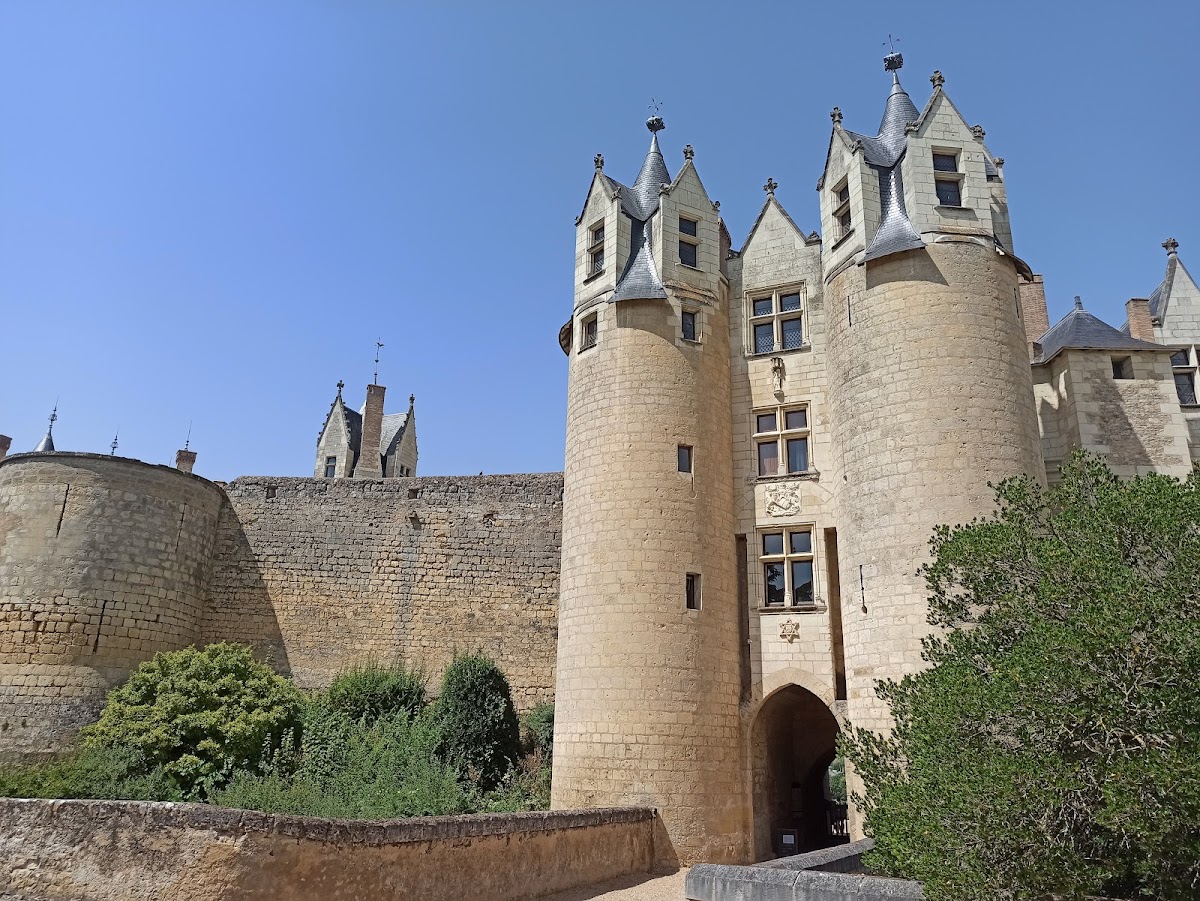
In front of the earlier gate and a thirteenth-century tower stands the three-storey entrance châtelet, or fortified gatehouse. Built in 1457 and 1458, it has two towers and contained prestigious apartments reached by a spiral staircase. Its interior arrangement was altered by Henri Enguehard in the 1970s.
New Lodging
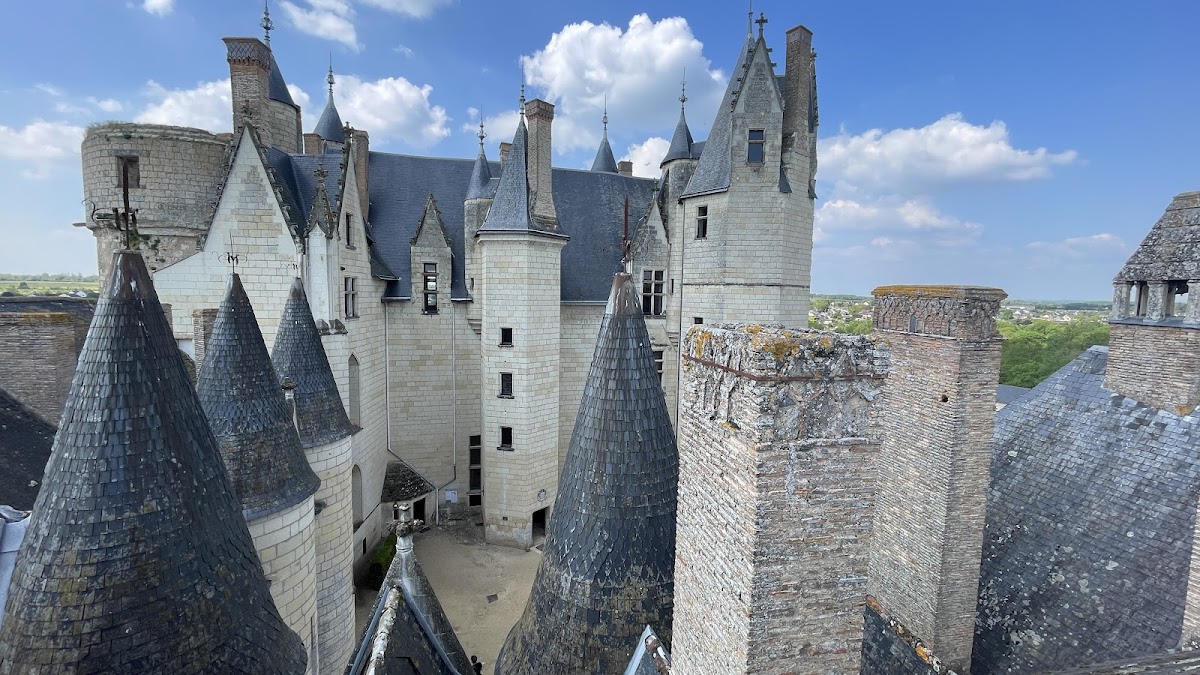
The New Lodging faces the Thouet as a rectangular residential building. It was roofed in 1475 and is flanked by three towers and a ceremonial spiral staircase. Two river-facing towers were newly built, while the third incorporates a thirteenth-century tower from the enceinte, the fortified enclosure. A small wing set at right angles contains two superimposed oratories, or private prayer rooms, and the building stands above cellars.
The ground floor contained a great hall and a large chamber connected with the lord’s chamber in the north-west tower and with an oratory. The great hall was later divided into apartments, the first-floor arrangement was altered in the nineteenth century, and the upper floor was divided into chambers. A second planned wing was never built. The ground-floor oratory received painted decoration and was restored by Henri Magne in 1909.
Artillery boulevard
In front of the entrance châtelet, the artillery boulevard formed a circular barbican designed to receive artillery. It measured 21.50 metres in diameter and was probably built between 1460 and 1470. Its position added an advanced defensive work before the principal entrance.
Service buildings and internal facilities
Kitchens and stables
The vaulted kitchen has ribbed vaults, ceilings strengthened by intersecting masonry ribs. It was converted into a stable before 1760. The kitchens had remained independent until the fifteenth century to reduce the danger of fire, after which a covered gallery connected them with the residential buildings. The Monseigneur stables form another part of the complex.
Canons’ Lodging and steam bath
The building known as the Canons’ Lodging, or offices, is a two-level structure set at a right angle against the curtain wall between the kitchens and the New Lodging. Four spiral staircases occupy turrets with pepper-pot-shaped roofs. Offices filled the ground-floor rooms, while the two lower rooms beside the kitchens stored food for their use.
A steam bath was built at the end of the building near the New Lodging. Its heating room was on the ground floor, and the hot, humid chamber occupied an intermediate level above a hypocaust, an underfloor heating system in which hot air circulates beneath the floor.
Religious and recreational features
Notre-Dame collegiate church
The collegiate church of Notre-Dame replaced the former castle chapel. Guillaume IV d’Harcourt sought papal indulgences from Sixtus IV in 1472 to help finance its construction. Only the eastern part was complete when Guillaume died, so Jeanne d’Harcourt continued the work. The church was completed during the 1490s and transferred to the municipality in the nineteenth century.
Gallery and furnished interiors
A recreational gallery once stood against the eastern side of the thirteenth-century curtain wall beside the Thouet. It appears in a 1699 engraving and was reached by a spiral staircase. The furnished rooms also contain old paintings, including a double portrait of musicians attributed to the painter Alexis Grimou.
The original keep was later reduced by the removal of its upper storey and was destroyed before 1840. The surviving complex therefore brings together medieval fortifications, late medieval residences, service buildings, religious spaces, and later alterations shaped by changing ownership and use.