Château de Berrie: A Medieval Castle in France


Site at a Glance
- Rating
- 4.7
- Popularity
- Very Low
- Country
- France
- Primary era
- Medieval
- External website
- Open
- Eras represented
- Medieval
- Civilizations
- Carolingian
- Site type
- Military
- Remains
- Castle
On this page10 sections
History
Château de Berrie is a medieval castle in France, in the village of Berrie. Its construction began in the twelfth century, within a Romanesque architectural tradition of heavy masonry and vaulted building. The site developed from an earlier rock-cut stronghold and remained associated with important territorial lordships until the modern period.
From Carolingian stronghold to medieval castle
At the end of the Carolingian Empire, the political order associated with Charlemagne and his successors, Berrie’s stronghold consisted of a rock cut into the local tuffeau limestone. A deep light well illuminated extensive underground caves, where daily activities and defense against invasions were organized.
By the end of the eleventh century, Berrie belonged to the barony of Loudun and consequently to Anjou. A barony was a territorial lordship held by a baron. The castle itself began to take shape in the twelfth century, transforming the earlier rock-cut stronghold into a more developed fortified residence.
Successive lordships
After Berrie’s last lord died in 1274, the castle passed to the lords of Amboise, who also held the viscounty of Thouars. A viscounty was a territory governed by a viscount. The lords of Amboise retained the châtellenie, a lordship and administrative jurisdiction centered on a castle, until the middle of the fifteenth century.
The châtellenie then passed to the La Trémoille family. In 1695, after its association with the La Trémoille, the castle was ceded to the Dreux-Brézé family. It suffered no damage during the French Revolution. In the second half of the nineteenth century, a descendant of the Dreux-Brézé family commissioned major alterations.
The castle and the parcel of land on which it stands were classified together as a historic monument on 3 October 1997.
Remains
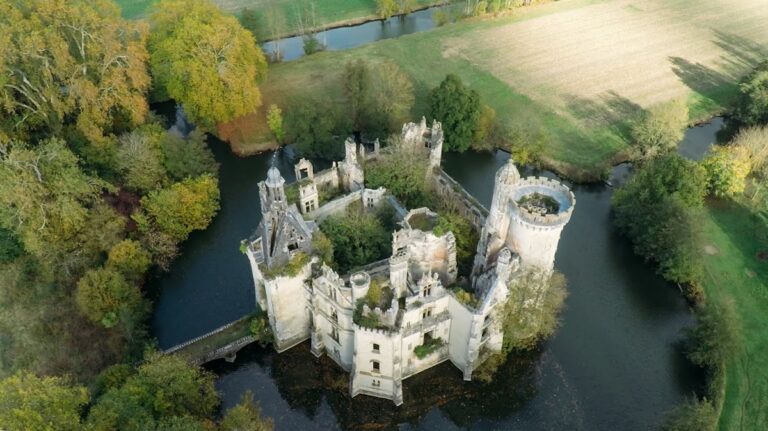
Château de Berrie occupies an oval platform surrounded by a moat. Dry ditches lead to extensive underground spaces, while the outer bank of the ditch contains caves and dwellings excavated directly into the rock. These features preserve the relationship between the fortified castle and the earlier rock-cut environment.
Fortifications and underground spaces
Oval platform and moat
The castle stands on an oval platform enclosed by a moat. Its outer bank, or counterscarp, contains underground spaces and troglodytic dwellings, meaning rooms cut directly into the tuffeau limestone. Dry ditches provide access to the caves beneath and around the fortified site.
Hypostyle cave
Among the underground spaces is a hypostyle cave, a room supported by pillars, arranged as a rotunda, or circular space. Its form demonstrates the extent and variety of the excavated areas connected with the castle.
Interior rooms and religious space
Romanesque rooms
The castle’s Romanesque rooms contain pointed vaults and transverse arches. Medieval rooms preserve pillars, arcades, and silos, reflecting the range of structural and storage features within the surviving complex.
Castle chapel
The castle chapel was founded around 1200 to 1250. It retains remains of fifteenth-century wall paintings, which preserve evidence of the chapel’s later medieval decoration.