Castle of Tournoël: A Medieval Fortress in France
Site at a Glance
- Rating
- 4.4
- Popularity
- Medium
- Country
- France
- Primary era
- Medieval
- External website
- Open
- Eras represented
- Medieval, Early Modern
- Civilizations
- French
- Site type
- Military
- Remains
- Castle
On this page15 sections
History
The Castle of Tournoël is a medieval fortress in France, standing at Volvic above the Limagne plain. Its origins are uncertain, but its first documented lord appears in records from the late eleventh century. The castle later became a strategic stronghold in the struggle for control of Auvergne, passing between the counts of Auvergne, the French Crown, and several noble families before remaining a seigneurial residence into the nineteenth century.
Origins and the counts of Auvergne
No documentary evidence survives from before the eleventh century. The first known lord was Bertrannus, or Bertrand, of Tournoile, who appears between 1077 and 1095. He had seized the church of Cébazat and later returned it to the cathedral chapter of Clermont. The name Tournoël is derived from the Gaulish place-name Turno ialon, interpreted as “the height above the plain.” Medieval documents used many forms of the name, including Tournoile, Tournoelle, Torniel, Tornoele, Tornelle, Tornolium, Turnollia, and Turnoialium.
The counts of Auvergne acquired the castle at an unknown date. Guy II of Auvergne held it by at least 1190, and in 1199 he imprisoned his brother Robert, bishop of Clermont, there during a political conflict. The dispute concerned the brothers’ opposing positions over support for Richard the Lionheart and the French king Philip Augustus.
The royal conquest of Auvergne
Around 1210 or 1211, Guy II attacked the royal Mozac Abbey and its priory at Marsat, carrying the relics of Saint Austremonius to one of his fortresses. Philip Augustus used the attack as a pretext to intervene against the count. At the end of 1212, a French royal army commanded by Guy II of Dampierre, lord of Bourbon, besieged Tournoël.
Gualeran of Corbelles organized the Auvergnat defense, with Guy II’s son Guillaume and his nephew Albert also inside the fortress. The defenders brought in additional troops and supplies and launched sorties against the royal forces. An Auvergnat attempt to capture French horses failed, however, and Guillaume and Albert were taken prisoner. The commander then surrendered the fortress.
Tournoël and the county of Auvergne definitively fell in December 1213. The siege brought most of Auvergne into the French royal domain for the first time. Guy II retained only the area around Vic-le-Comte, while Philip Augustus ordered the restoration of property belonging to Mozac Abbey. The territories confiscated by the Crown became known as the “lands of Auvergne.”
Guy of Dampierre took possession of Tournoël for the king in 1213 and sent Philip Augustus an inventory of the castle in a letter dated 20 December. After Guy’s death in 1216, his son Archambaud VIII of Bourbon retained the castle by royal decision. Louis VIII later planned to grant his Auvergne possessions as an appanage, a grant of royal lands or revenues to a younger member of the dynasty, to his son Alphonse of Poitiers. Alphonse took possession in 1241 and stayed at Tournoël in 1251. After his death in 1271, Auvergne returned to the French Crown.
The Maulmont and La Roche families
In 1306, Philip the Fair exchanged Tournoël, Châteauneuf, and part of the lordship of Cébazat with the heirs of Géraud de Maulmont. In return, the Crown received strategic strongholds between Limousin and Périgord, including Bourdeilles, Châlus Chabrol, and Châlus Maulmont. The exchange was intended to strengthen the frontier against the English territory of Aquitaine. Pierre de Maumont became lord of Tournoël on 12 February 1313.
Pierre died in 1345, leaving an only daughter, Marthe. Through her marriage to Géraud, lord of La Roche in Limousin, the castle passed to their family. Their son Hugues de La Roche later inherited Tournoël. Hugues became rector of the Comtat Venaissin, a papal territory in southeastern France, and marshal of the papal court through his marriage in 1343 to Dauphine Rogier, niece of Pope Clement VI and sister of the future Pope Gregory XI.
Appointed captain general of Lower Auvergne in 1359, Hugues fought the English during the Hundred Years’ War, the prolonged conflict between the English and French monarchies. He died in 1398 as Great Chancellor of France. During his ownership, he reinforced Tournoël’s defenses, especially the circular keep built between the early thirteenth and early fourteenth centuries.
Inheritance disputes and royal politics
Hugues’s son Nicolas de La Roche inherited the castle in 1398. Nicolas’s son Jean received Tournoël subject to usufruct, the legal right to use property and benefit from it while ownership belongs to another person. Jean married Louise de La Fayette in 1419 and was killed at the Battle of Verneuil in August 1424, aged 22. The battle was a major engagement of the Hundred Years’ War.
After Nicolas died in 1428, Jean’s brothers disputed Louise’s rights. The seneschal placed Tournoël under sequestration until the matter was resolved. In 1429, the castle was returned to Louise and her children, and her eldest son Antoine de La Roche received it when he reached adulthood.
Antoine lived at Tournoël with his wife Jeanne de Vieuville, whom he married in 1448. He supported neither Charles the Bold nor the League of the Public Weal, a revolt by powerful nobles against Louis XI. The king rewarded Antoine with the offices of court councillor and chamberlain. Antoine’s refusal to pay homage to his suzerain, John II, Duke of Bourbon, nevertheless led to his imprisonment and the seizure of Tournoël in 1478.
The duke’s guards occupied the castle while a detailed inventory was prepared. The Parliament of Paris ordered its return to Antoine in 1480, but the duke seized it again in 1487, claiming that his men had been mistreated. The seizure was lifted the following year. Antoine died in 1493.
From the d’Albon family to the Revolution
Antoine’s son Jean inherited Tournoël and died in 1501, leaving a daughter, Charlotte de La Roche de Tournoelle. Her marriage to Jean d’Albon in 1510 transferred the castle to the d’Albon family. Their son Jacques inherited it and became a military leader and court favorite. He was appointed Marshal of France in 1547 and became known as the Marshal of Saint-André. He was killed at the Battle of Dreux on 19 December 1562.
Jacques’s daughter Catherine d’Albon de Saint-André died in 1564, after which Tournoël passed to her aunt Marguerite d’Albon de Saint-André. In 1575, an act granted the barony of Tournoël to Charles d’Apchon, Marguerite’s son. Charles and his wife, Lucrèce de Gadagne, lived at the castle during the Wars of Religion, the civil and religious conflicts that divided France in the sixteenth century, chiefly between Catholics and Huguenots.
Riom and Mozac Abbey initially supported the Catholic League, while Charles joined the royal army in 1582. In 1645, Tournoël passed by marriage to the Montvallat family. Jean-Charles de Montvallat, although lord of the castle, was arrested there as a bandit. He was imprisoned at Clermont and fined 8,000 livres by the Great Days of Auvergne, extraordinary judicial sessions held to administer royal justice.
Through a marriage in 1734, part of Tournoël passed to the Naucaze family. Godefroy de Naucaze, baptized in 1739, later held half of Tournoël as well as the Château de Naucaze. Guillaume-Michel Chabrol, a lawyer to the royal court at Riom, councillor of state, and author of a major commentary on the custom of Auvergne, became the last titular seigneur of Tournoël. The decree of 17 July 1793 abolished seigneurial dues and feudal rights.
Residence and modern protection
The castle remained a permanent seigneurial residence until the nineteenth century. No settlement developed around it because of the proximity of Volvic. Tournoël has been privately owned and listed as a French historic monument since 1889.
Claude Aguttes purchased the castle from descendants of the Chabrol family in August 2000 and began a comprehensive restoration. The work included roofing, courtyard paving, windows, and masonry, helping preserve the surviving fortress and residence.
Remains
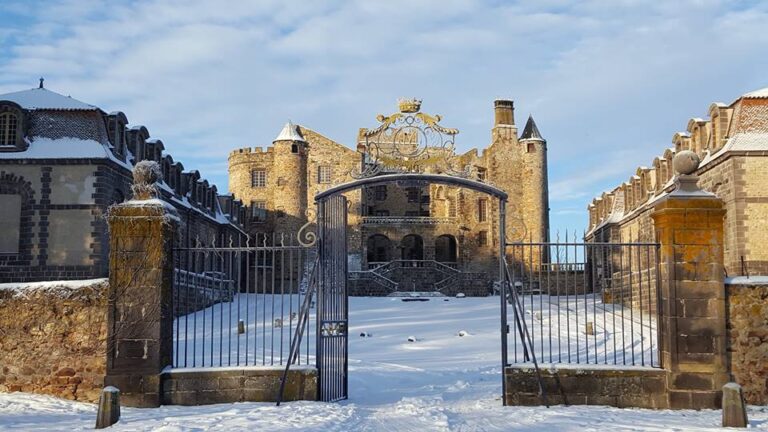
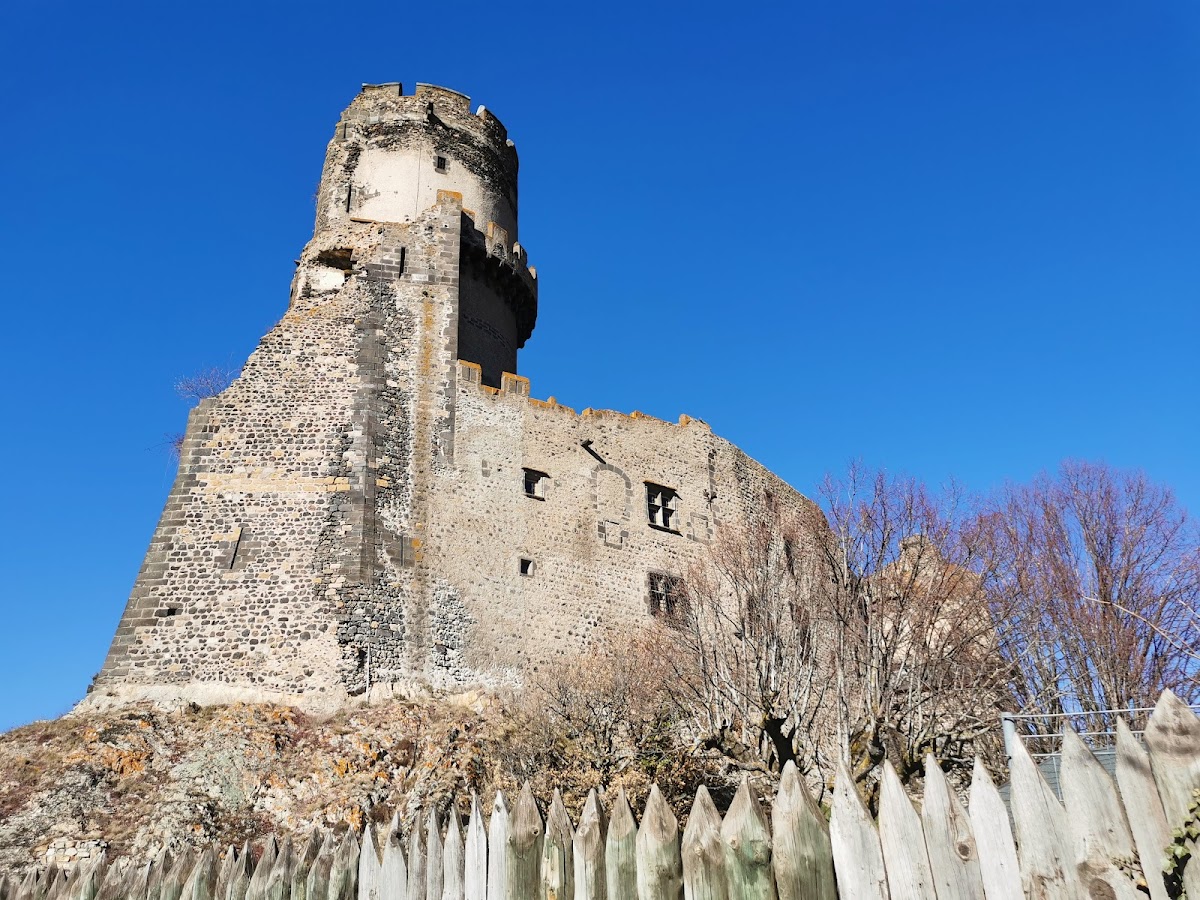
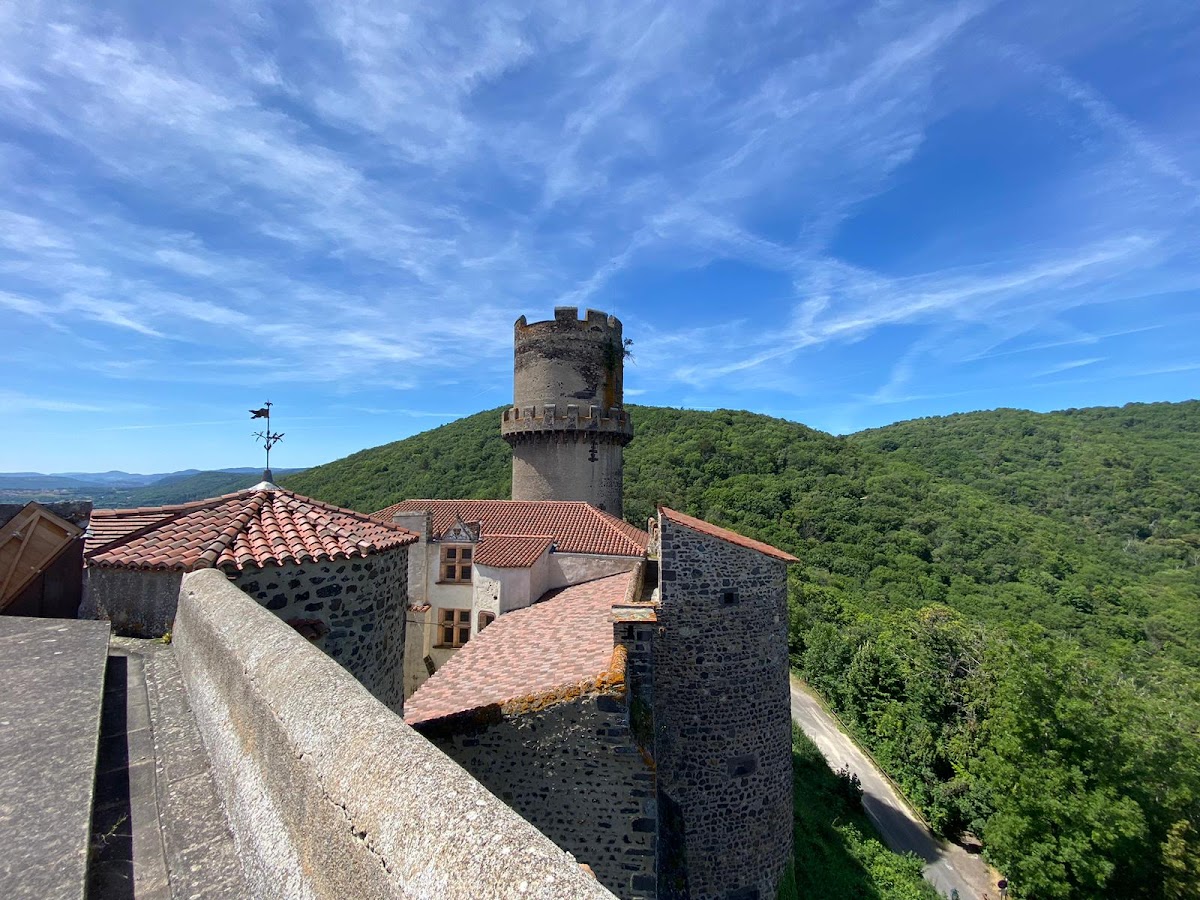
The Castle of Tournoël occupies a rocky spur and volcanic projection of the Puy de la Bannière at an altitude of 594 metres. It rises approximately 350 metres above Riom and overlooks the Limagne plain, Riom, and Mozac Abbey. The steep slopes, deep valleys, several towers, and enclosing walls shaped the castle’s defensive position and gave it a reputation for being difficult to capture.
Baileys and entrance defenses
Lower bailey
Access to the site begins through a large lower bailey, an enclosed outer court. Its boundary consists mainly of a wall and probably dates from the fifteenth century. This lower enclosure forms the approach to the more heavily defended upper part of the castle.
Guard Tower
The sixteenth-century Guard Tower protects the passage toward the upper bailey. Its masonry has unusual rounded projections, called bossage, whose forms resemble cannonballs or a loaf of bread. This appearance gave the tower a nickname meaning “miche tower.”
Enclosures and towers
Residential tower
One of the castle’s two enclosed spaces contains a rectangular residential tower dating from the twelfth century. It was modernized during the fifteenth and sixteenth centuries, when the fortress was adapted to the requirements of a noble residence.
Circular keep
The second enclosure contains a circular keep constructed between the first third of the thirteenth century and the beginning of the fourteenth century. A pentagonal shell wall protects it, with a projecting spur on the side facing the attack. Hugues de La Roche added a covered wall-walk, a defensive passage along a fortification, around two-thirds of the keep’s height.
The wall-walk has a crenellated parapet supported by machicolations, projecting galleries with openings through which defenders could attack enemies below. A protective passage also ran around the base of the keep. These defenses were placed lower than the summit because they protected a defensive zone at that level, including a projecting defensive mass and a terrace facing the attack. The circular keep was ruined during the siege of 1595.
Residential interiors and military equipment
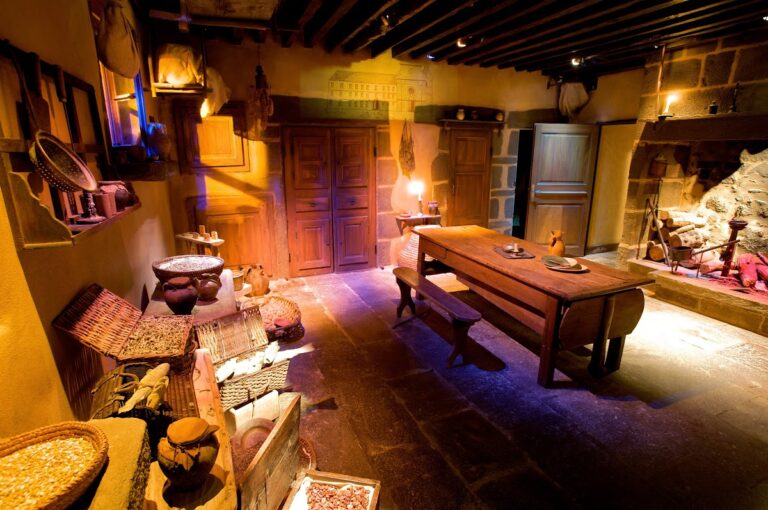
The residence interiors were embellished during the fifteenth century, particularly under Antoine de La Roche and Jeanne de Vieuville. New windows and Renaissance-style decoration helped transform the fortress into a more comfortable noble residence. Surviving old plaster preserves graffiti, including depictions of a wolf hunt and obscene designs. A battered relief on a door lintel shows Saint George defeating the dragon.
The inventory prepared during the 1478 seizure gives evidence of the castle’s military equipment at that time. It listed fourteen culverins, long-barreled early firearms, five small cannons that fired stone balls, and two ribaudequins, artillery pieces equipped with multiple small barrels or guns.