Domus de Sala-d’Heures: A Fortified Medieval Residence in Spain
Site at a Glance
- Rating
- 4.4
- Popularity
- Very Low
- Country
- Spain
- Primary era
- Medieval
- External website
- Open
- Eras represented
- Medieval, Modern
- Civilizations
- Crown of Aragon
- Site type
- Domestic
- Remains
- Elite Residence
On this page7 sections
History
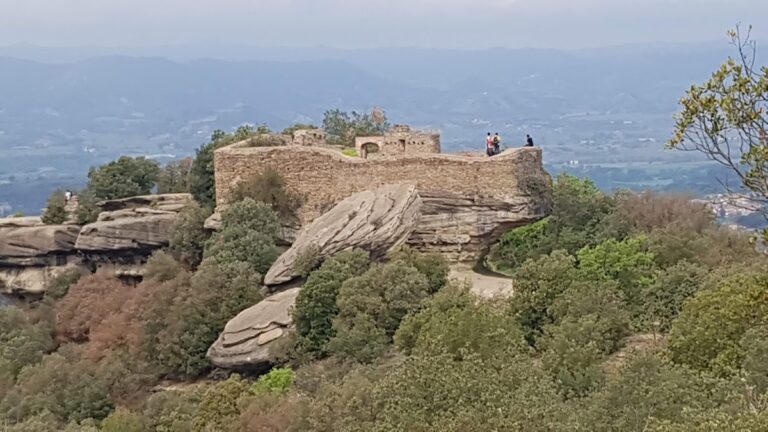
Domus de Sala-d’Heures, also known as Castell d’Heures, is a former fortified medieval residence in Spain, in Santa Eugènia de Berga. It developed within the former territory of Taradell Castle and was associated with the noble families of Eures and Santa Eugènia. The site’s first recorded reference dates to 1146, while its defensive role is clearly established by an agreement from 1148.
The Eures fortress
In 1146, Guillem d’Eures donated to the Monastery of l’Estany an alod, meaning freehold property held outright, in the parish of Sant Martí Sescorts. Two years later, Guillem and his brother Pere d’Eures reached an agreement with the Bishop of Vic and his canons, the ecclesiastical authority represented in the settlement. In return for grants from the bishop, the brothers undertook to defend the rights of the Church of Vic. They also permitted the bishop and the canons to enter, leave, and wage war in Castell d’Eures.
By the end of the twelfth century, the Eures family had adopted the surname Rocafort. In 1225, Elisenda de Rocafort transferred the Eures fortress to her husband, Berenguer de Santa Eugènia, through their marriage agreement. The lords of Eures thereafter used the surname Santa Eugènia. The Chapel of Sant Joan is mentioned in Elisenda’s testament of 1227 and in the testament of Pere Marc de Santa Eugènia from 1285, although the Consueta Vella, an old parish customary record, assigns its construction to 1773.
Changes of ownership
At the beginning of the fifteenth century, Roger de Vilademany sold the estate to the Dos-rius family of Torelló after acquiring it himself by purchase. Through marriage, the property later passed to the Sala family of Vic, and subsequently to the Tallander, Pascual, and Font-coberta families.
The chapel served more than the Heures, Rocafort, and Santa Eugènia families. Bequests to Sant Joan appear in most of the testaments of Santa Eugènia parishioners. The former complex also contained a rectangular tower and an old manor house. French forces damaged the manor in 1809, while the tower survived until it collapsed in 1937.
Twentieth-century transformation
Josep Gudiol i Cunill, a Catalan architect and art historian, carried out a detailed study and restoration of the fortress in 1910. A new manor house was built beside the ruins, on the site of the former domus. The owners restored the Chapel of Sant Joan in 1920 by plastering its interior and painting simulated ashlar blocks. Ashlar consists of regularly cut stone blocks.
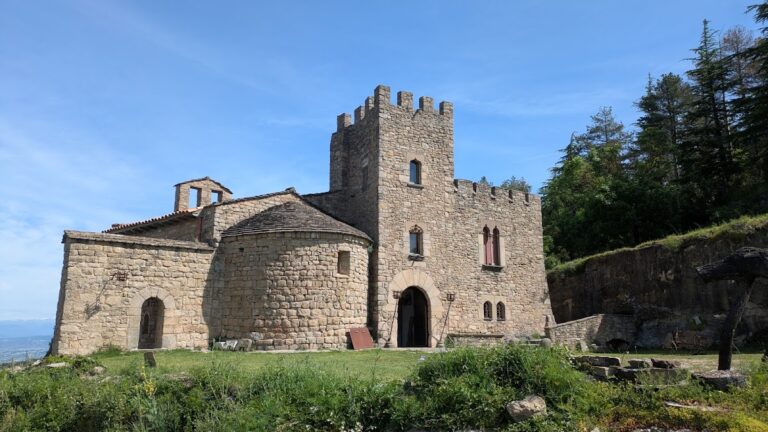
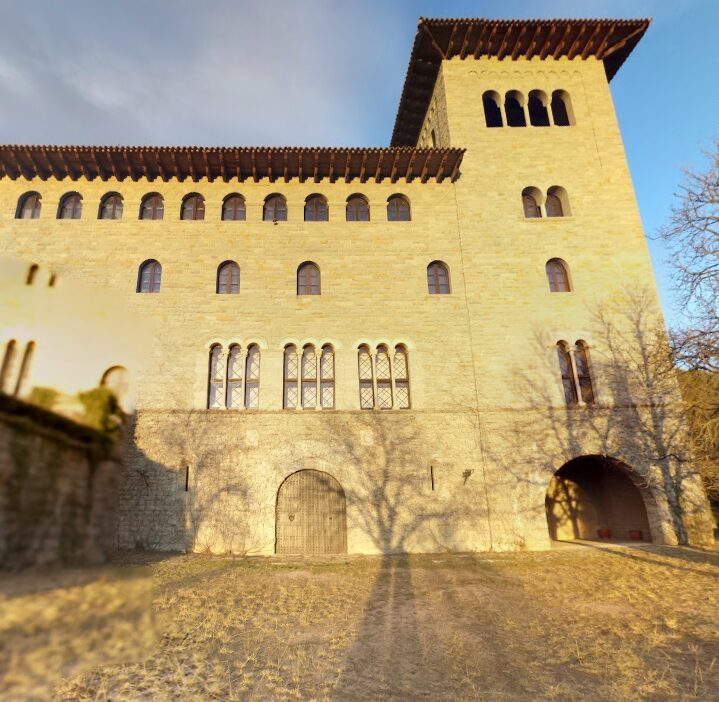
Sant Joan remained a place of worship until 1934, when its cult was transferred to the new Chapel of Mare de Déu del Carme. The body of Saint Amància, a Roman martyr brought from the catacombs of Rome, had been kept in Sant Joan for two centuries before being moved as well. Pope Clement X had given the relic to the Pasqual family. The new castle, a modern stone mansion in the Neo-Romanesque style, and the Chapel of Mare de Déu del Carme were built between 1930 and 1934. The old chapel was desecrated in 1936 and now serves as a storeroom. Domus de Sala-d’Heures was declared a Cultural Asset of National Interest as a historical monument in 1988.
Remains
The surviving complex combines the Romanesque remains of the former fortified residence with later buildings constructed beside and above the earlier structures. The principal medieval elements are the Chapel of Sant Joan, two carved lintels from the tower’s front facade, and a carved tympanum. The lintels carry a Latin inscription, while the tympanum bears an anagram of alpha and omega with a cross.
Romanesque remains
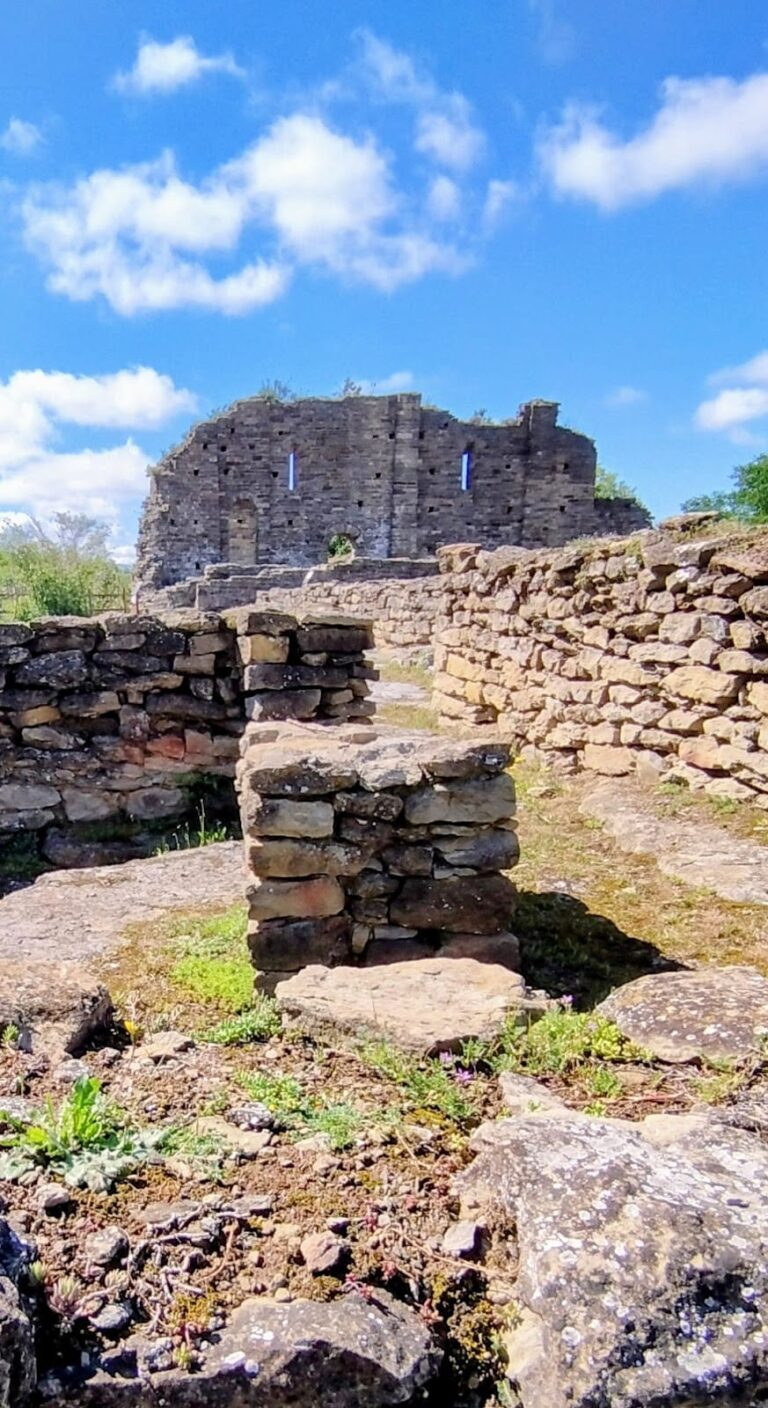
The Chapel of Sant Joan is a simple Romanesque building with a rectangular plan. Romanesque architecture is characterized by sturdy masonry, thick walls, simple forms, and round-headed openings. Because of the slope of the site, the chapel is oriented from south to north. Its walls combine large ashlar blocks with smaller masonry. On the south wall, a rectangular doorway has a semicircular lintel, a round-headed window is set above it, and a bell gable carrying the bells crowns the facade. The chapel also shelters worked stones from the former tower and the old ruins.
The carved lintels and tympanum from the tower are kept inside the new castle, hung on a south-facing wall near the Chapel of Mare de Déu del Carme. A tympanum is the usually triangular or semicircular field above a doorway or window. These carved elements preserve part of the tower’s decorated frontispiece after the tower collapsed in 1937.
Later buildings
The new castle is a modern stone mansion in the Neo-Romanesque style, built beside the ruins of the former manor house. The Chapel of Mare de Déu del Carme was constructed above the manor-house tower to accommodate the remains of Saint Amància after their transfer from Sant Joan.