Remains of the Castle in Stopnica: A Royal Residence in Poland
Site at a Glance
- Rating
- 4.4
- Popularity
- Low
- Country
- Poland
- Primary era
- Early Modern
- External website
- Open
- Eras represented
- Medieval, Early Modern
- Civilizations
- Kingdom of Poland, Polish–Lithuanian Commonwealth
- Site type
- Domestic
- Remains
- Palace
On this page14 sections
History
The Remains of the Castle in Stopnica in Poland originated as a royal castle erected around 1350 by King Casimir III the Great during the medieval period. Under Casimir III and King Władysław II Jagiełło, it served as a royal station on the road between Kraków and Sandomierz and as an administrative center for the surrounding royal estates.
Royal station and medieval estate
The castle formed part of the traveling royal administration. A curia regia, meaning a royal court or residence used during the monarch’s journeys and administrative work, was first explicitly described at Stopnica in 1470–1480 by Jan Długosz, a fifteenth-century Polish chronicler and church official. Royal visits indicate that the court existed earlier. Queen Jadwiga visited Stopnica twice, while Władysław II Jagiełło stayed there in 1405, 1410, 1411, 1412, and 1414.
In 1404, Jagiełło granted the castle, town, and surrounding villages to Świdrygiełło, a Lithuanian prince. After Świdrygiełło burned two castles granted to him in Lithuania and rebelled against Jagiełło and Grand Duke Vytautas, he lost control of Stopnica. The estate then remained royal property and continued to function as a royal station. Wacław Ostroróg held the Stopnica tenure in 1482.
The medieval castle’s original arrangement is uncertain. Długosz described Casimir III’s foundation as a small stone manor, and the complex was rebuilt during the sixteenth century.
The Zborowski and Tarnowski periods
From 1531, the Stopnica starosty was held by Marcin Zborowski. A starosty was a royal administrative district or tenure whose holder administered the district and its revenues without necessarily owning the underlying royal property. Zborowski established a Calvinist congregation at the castle, creating a community of worshippers belonging to the Reformed Protestant tradition.
After Marcin Zborowski died in 1565, the estate passed to his son Piotr. In 1571, Piotr transferred his rights to his son Mikołaj, and the property later passed by testament to his other son, Jan. Contemporary references mention a Zborowski building, suggesting that a new structure may have been added during this period.
In 1586, with the approval of King Stephen Báthory, Sandomierz castellan Stanisław Tarnowski purchased the Stopnica starosty. The transaction followed the political alignment of Andrzej Zborowski, the expected heir, with the pro-Habsburg opposition. In 1587, Andrzej attacked Stopnica and abducted Tarnowski, his wife, and children, but the action failed.
Seventeenth-century rebuilding and ownership
Construction undertaken around 1618 either created a new building or substantially rebuilt an older one. The work is tentatively associated with the structure preserved today. At the beginning of the seventeenth century, the residential complex included a Gothic stone house, a second building with a chapel and cloistered galleries, and a wooden building with masonry cellars.
In 1644, Krzysztof Ossoliński transferred the castle to his son, Krzysztof Baldwin Ossoliński. After Krzysztof Baldwin died at the Battle of Zborów, Stopnica passed to Stanisław Lanckoroński, who transferred it after one year to Jacek Lanckoroński. Jacek later passed it to his son Zbigniew.
The Swedish invasion, also known as the Swedish Deluge, brought the destructive Swedish occupation of much of the Polish–Lithuanian Commonwealth during the mid-seventeenth century. The castle was looted during the invasion. After 1664, Jan Klemens Branicki repaired it in the Italian style. Following Branicki’s death in 1673, his widow Aleksandra Czarniecka held the starosty for life until 1679, and their only son, Stefan Mikołaj Branicki, held it until 1683.
After the Battle of Vienna, King John III Sobieski granted Stopnica to Franciszek of Brzezie Lanckoroński in recognition of his service. The starosty passed to Józef Lanckoroński in 1717 and to his younger brother Wawrzyniec Lanckoroński in 1726.
Palace transformation and modern history
In 1752, King Augustus III awarded the Stopnica starosty to Eliasz Wodzicki of Granów, a general of the Crown army. In 1783, Wodzicki rebuilt the castle as a Baroque palace and added two masonry outbuildings. One of these may have incorporated remains of the medieval manor. King Stanisław August Poniatowski visited Wodzicki in the renovated palace on 11 June 1787. An inspection in 1789 described the complex as a main manor with two outbuildings.
The Third Partition of Poland in 1795 ended the Polish–Lithuanian Commonwealth and divided its remaining territory among Austria, Prussia, and Russia. Stopnica and the former Busko district, including the castle, came under Austrian rule. After 1809, Stopnica became part of the Duchy of Warsaw. In 1810, the palace and estate were leased to Justice of the Peace Jan Nepomucen Rupniewski.
After Rupniewski’s death, the complex was described as a three-storey palace with two masonry outbuildings and a stable. A fence with masonry pillars enclosed the property, and a substantial embankment to the southeast was probably constructed during the nineteenth century. After a town fire in 1854, municipal authorities moved their offices into the former palace. Another fire in 1859 destroyed the roof and upper storey.
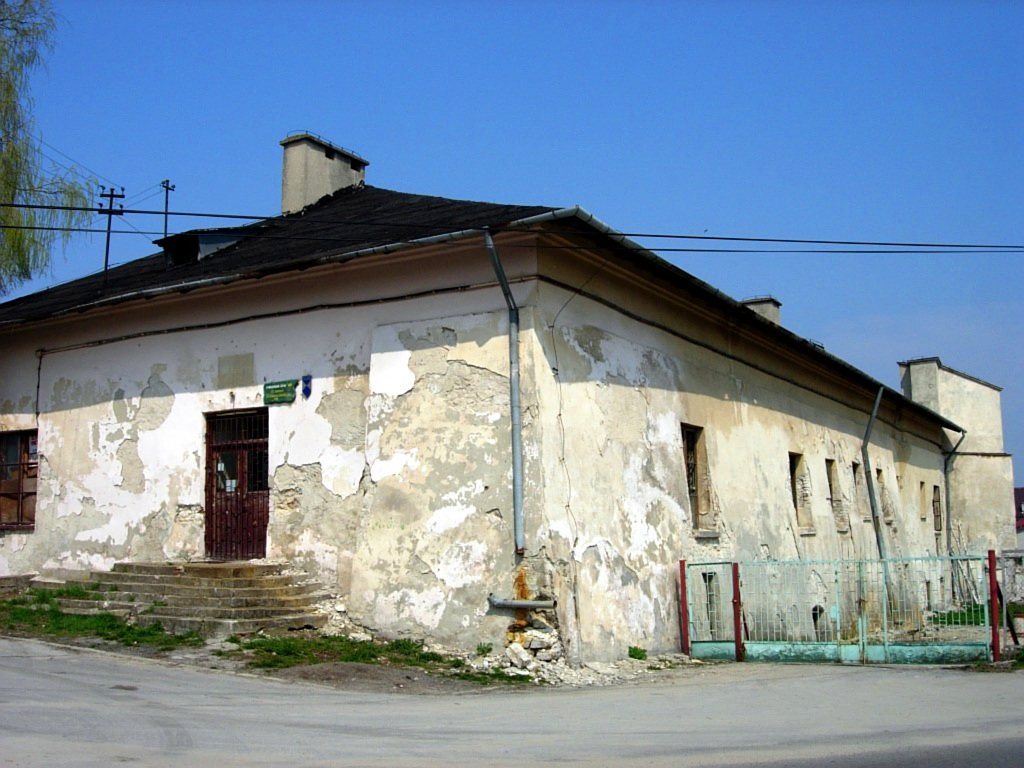
Before the Second World War, the building housed the county starosty and a gymnasium. Wartime operations in 1944 caused it to burn completely. The remains entered Poland’s register of immovable monuments on 16 October 1956 as “Relics of the castle in the warehouse building,” under registration number A.76. Around 1958, the burned, roofless upper storey was demolished, leaving a single-storey structure.
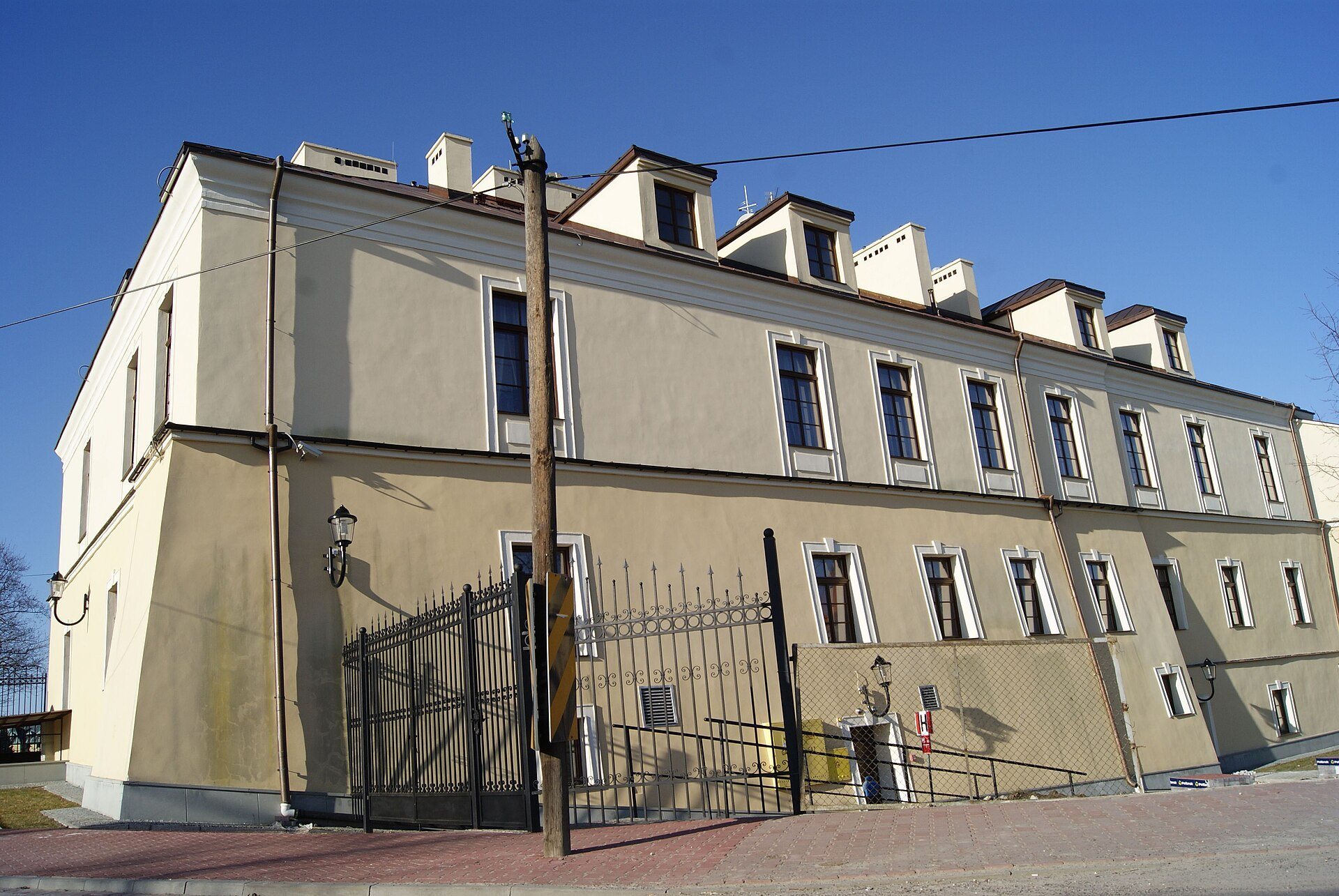
In 2004, the Municipality of Stopnica purchased the building from the regional horticultural and beekeeping cooperative in Busko-Zdrój, which had operated a fruit and vegetable purchasing station there until shortly before the sale. Reconstruction followed in 2011, using photographs and archival materials, mainly from the 1930s. The building entered service as the Municipal Cultural Centre in January 2011. Its present form is a contemporary neo-style architectural recreation, while the castle remains retain protection as an immovable monument in Poland.
Remains
The site occupies the western part of Stopnica. Its physical history is represented by a reconstructed building rather than a reliably preserved version of the medieval castle. The complex changed from a small stone royal manor into a group of Gothic, wooden, and later Baroque structures before fire, demolition, and twentieth-century reconstruction altered its surviving fabric.
Medieval and early modern residential complex
Gothic stone house
The early seventeenth-century complex included a Gothic stone house, representing the masonry residential element of the older castle group. Its construction belonged to the medieval architectural tradition characterized by pointed arches, ribbed vaults, and vertical emphasis, although the surviving evidence does not establish the original medieval castle’s complete form.
Chapel and cloistered galleries
A second building contained a chapel and cloistered galleries. These galleries formed part of the residential complex alongside the Gothic stone house and the separate wooden building. The chapel and galleries were among the principal components of the early seventeenth-century arrangement.
Wooden building with masonry cellars
The third principal building was made of wood and stood over masonry cellars. It completed the early seventeenth-century residential group, whose buildings represented different construction materials and functions within the castle complex.
Baroque palace and nineteenth-century grounds
Principal manor and masonry outbuildings
In 1783, Eliasz Wodzicki rebuilt the complex as a Baroque palace, an elaborate seventeenth- and eighteenth-century style associated with dynamic forms and ornament. The principal manor or palace was accompanied by two masonry outbuildings. One outbuilding may have incorporated part of the medieval manor, linking the later palace complex with the site’s earlier fabric.
Stable, enclosure, and southeastern embankment
The nineteenth-century palace complex included a stable and was enclosed by a fence supported by masonry pillars. A substantial embankment lay to the southeast and was probably formed during the nineteenth century. These features belonged to the wider grounds surrounding the principal building and its outbuildings.
Fire-damaged and reconstructed structure
The fire of 1859 destroyed the roof and upper storey of the palace. The building later burned completely during wartime operations in 1944. Around 1958, the roofless upper floor was removed, producing a single-storey structure. Reconstruction in 2011 relied mainly on photographs and archival documentation from the 1930s, creating the contemporary neo-style building that now occupies the site.