Kühndorf Castle: A Johanniter Fortress in Germany


Site at a Glance
- Rating
- 4.5
- Popularity
- Low
- Country
- Germany
- Primary era
- Medieval
- External website
- Open
- Eras represented
- Medieval
- Civilizations
- Holy Roman Empire, Knights Hospitaller
- Site type
- Military
- Remains
- Castle
On this page11 sections
History
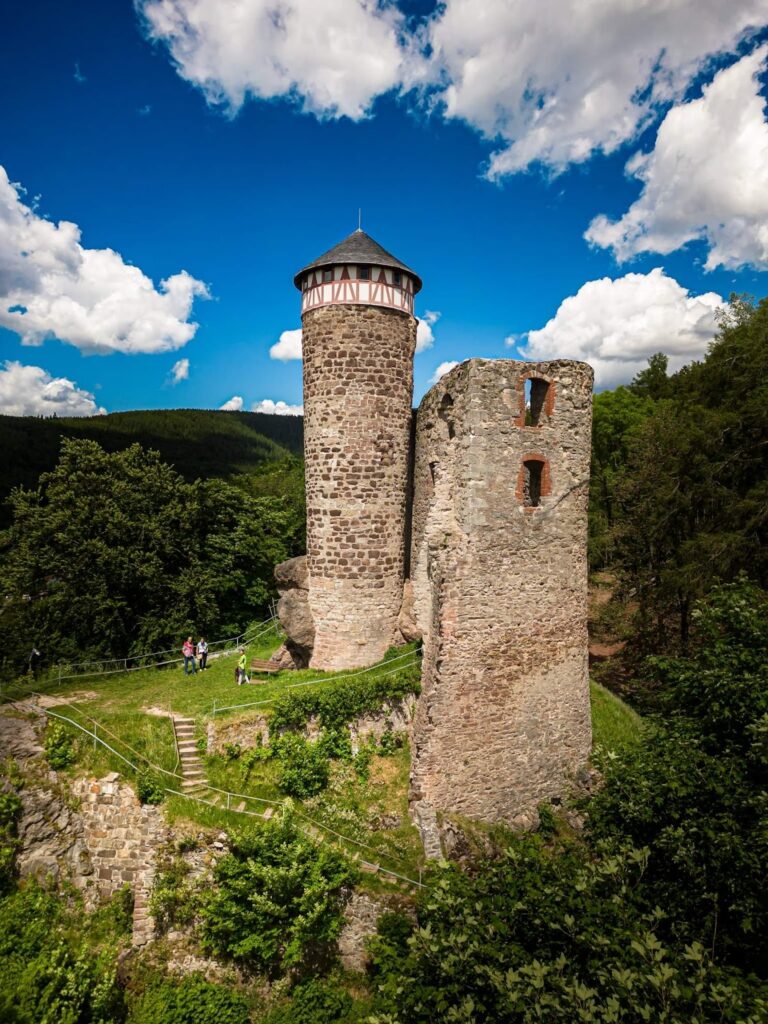
Kühndorf Castle is a medieval hilltop castle in Kühndorf, Germany, built by the Order of Saint John in 1315 on the remains of an earlier castle. The complex retains a late-Gothic character and is notable as the only surviving castle in Germany built by the order, whose presence in Central Europe had no military function at the time.
Early settlement and the first castle
The castle stands on older settlement ground at the foot of the Dolmar. A fortified settlement existed on the mountain during the Celtic period. After the Celts left, Germanic groups settled in the wider region, including Thuringians toward the Thuringian Forest and Franks in the Werra Valley.
Kühndorf appears as Chunitorpfe in a donation charter to Fulda Abbey dating from 795. In 1137, a document issued at the imperial palace in nearby Rohr was sealed by Gottfried of Kühndorf, probably a local nobleman who held a knightly seat there. A castle at Kühndorf is first recorded in 1274, when it belonged to the Counts of Henneberg.
The Johanniter castle
In 1315, Count Berthold VII of Henneberg, known as Berthold the Wise, sold the Dolmar, surrounding villages, and the existing castle to his brother Berthold VI and the Order of Saint John, with permission to construct a new fortress. Berthold VI had entered the order in 1291 and held senior offices within it. The earlier castle was demolished that year to make way for the new Johanniterburg.
The order, also known as the Knights Hospitaller, was a Catholic religious order that combined monastic life with caring for the sick and, in other regions and periods, military activity. Its castle at Kühndorf was unusual in the German-speaking lands. Only four castles of the order are known there, and Kühndorf is the one that survived in Germany.
After the deaths of Berthold VI and his nephew Berthold VIII, a grand prior of the order’s German administrative division who had also lived at the castle, the order lost interest in the property. The castle was offered for sale, and ownership was divided among several parties.
Henneberg rule and administrative use
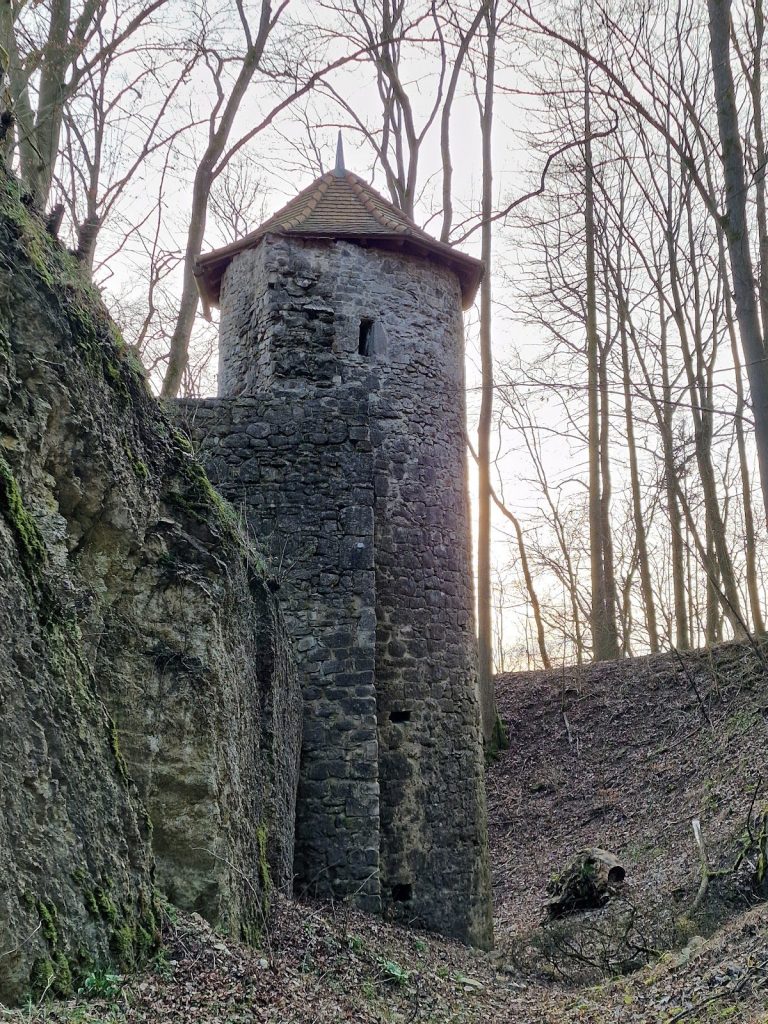
In 1444, Georg I of Henneberg-Römhild acquired all the ownership shares and modernized the castle for firearms. He surrounded it with an outer defensive enclosure containing five towers. The Counts of Henneberg were a comital dynasty whose territories included the region around Kühndorf.
The Henneberg-Römhild line became extinct with Hermann VIII in 1549, and the castle passed to the Henneberg-Schleusingen branch. Under Wilhelm IV of Henneberg-Schleusingen, an administrative court for the surrounding villages was established at Kühndorf. His son Georg Ernst briefly moved his residence there in 1569.
When the Henneberg-Schleusingen line became extinct with Georg Ernst in 1583, the Henneberg lands were inherited by the Dukes of Saxony. Kühndorf then continued mainly as the administrative and judicial seat of the Kühndorf district. The gatehouse received minor alterations, while the wider complex largely retained its late-medieval character.
Modern ownership and preservation
Following the Congress of Vienna, the Kühndorf district was ceded to Prussia in 1815 and became part of the Province of Saxony. In 1902, Prussia sold the lower castle to Michael Keßler, a farmer from Kühndorf, who divided it among his six daughters. The upper castle was transferred to Rittmeister Simon.
The upper castle changed hands again in 1920, when Dr. Treupel, a physician from Jena, established a weapons hall, an inn, and a hostel there. In 1945, it was expropriated and placed in public ownership under the legal administration of the municipality. Refugees and expellees were housed in the castle during the postwar years, and a school-meal service was established.
Johann-Friedrich and Gudula von Eichborn purchased the upper castle from the municipality and the lower castle from private owners in 1991. Extensive renovation and maintenance followed, exposing parts of the historical fabric. Konstantin and Sophie von Eichborn managed the castle from 2006 to 2013. Since 2017, Elisabeth, Baroness Truchseß von Wetzhausen, has lived there with her family. Kühndorf Castle remains privately owned and is designated as a heritage monument in Thuringia.
Remains
Kühndorf Castle is a preserved hilltop complex north of the center of Kühndorf, at the foot of the Dolmar, which rises to the northeast. It is divided into upper and lower sections. The 1315 Johanniter fortress was arranged around two broad residential towers, and a coat-of-arms stone from the building period indicates a division between secular and monastic areas.
Early castle remains
Predecessor keep
Part of the earlier castle survives within the present complex. A keep stump built during the first half of the thirteenth century is formed from bossed ashlar, dressed masonry whose stone centers project in a rough, cushion-like shape. Reused architectural fragments from the earlier castle, known as spolia, were incorporated into the later walls.
Defensive enclosure
Firearms-era towers
The defensive works added in 1444 created an outer enclosure around the castle. This structure contained five towers designed for defense with firearms. Together with the upper and lower sections, the enclosure expresses the castle’s adaptation to changing military technology while preserving the basic medieval arrangement.
Interior spaces
The surviving complex includes a castle kitchen, an upper-floor room, a courtroom, and a chapel. Renovation begun in 1991 revealed further parts of the historic building fabric and helped preserve the form of the castle as it developed from a Johanniter fortress into an administrative and residential complex.