Przezmark Castle: A Teutonic Order Fortress in Poland
Site at a Glance
- Rating
- 4.7
- Popularity
- Low
- Country
- Poland
- Primary era
- Medieval
- External website
- Open
- Eras represented
- Medieval, Early Modern
- Civilizations
- Crusader, Teutonic Order
- Site type
- Military
- Remains
- Castle
On this page12 sections
History
Przezmark Castle is a fourteenth-century fortress built by the Teutonic Order in Przezmark, Poland. It occupies a peninsula between Great Motlawa Lake and Little Motlawa Lake, on the site of an earlier Prussian stronghold. The Teutonic Order, a medieval religious-military institution that established fortified settlements across Prussia, developed the site from a wooden castle into a substantial brick complex.
Teutonic foundations and administration
A wooden Teutonic castle stood at Przezmark by the second half of the thirteenth century, and an order house with a single wing was recorded around 1274. Luter of Brunswick, commander of Christburg and the Order’s grand draper, initiated the brick rebuilding. Construction continued from 1316 to 1331.
The fortress first accommodated lower-ranking officials of the Order. A provision officer was connected with grain storage in the early fourteenth century, while a procurator, an administrative official, occupied the castle from 1320. From 1359, a vogt, who held territorial or judicial responsibilities, was based there. The enlarged castle also functioned by 1320 as an outer bailey of Marienburg, the principal Teutonic stronghold and administrative centre, now known as Malbork.
Wars and territorial change
Following the Battle of Tannenberg in 1410, a major defeat of the Teutonic Order by Polish-Lithuanian forces, Władysław Jagiełło’s troops took Przezmark without a fight. A notary carrying the castle inventory to the king was then murdered on the initiative of the commander Mrocwko. The First Peace of Thorn in 1411 returned the fortress to the Teutonic Order.
Polish forces captured Przezmark again in 1414 and inflicted severe damage. The Order later recovered the castle and enlarged and strengthened it substantially after nearby Christburg had been completely destroyed. In 1437 Przezmark became the seat of a Teutonic commander, or komtur, who governed a commandery, the Order’s administrative district. The local land court was also transferred there.
During the Thirteen Years’ War, a fifteenth-century conflict between the Teutonic Order and the Polish-Lithuanian side, citizens of Elbing seized the castle. Teutonic forces retook it, and Polish troops subsequently besieged the fortress. The besiegers captured the outer-bailey area but not the entire complex.
Episcopal ownership and residential transformation
From 1508 to 1527, Przezmark belonged to the bishops of Pomesania, a medieval ecclesiastical territory in parts of Prussia. From 1521, the families von Egmon and von Werdte also held the property, while the financially troubled Duchy of Prussia repeatedly pawned it.
During the 1580s, the castle was renovated and expanded as it changed from a predominantly defensive fortress into a residential seat. New buildings were erected along the northern and eastern curtain walls of the medium castle. The eastern wing of the high castle was repaired, and further wings were added around its courtyard.
In 1626, the owners supported Sweden and made the castle available on several occasions for food supplies. During the Second Swedish-Polish War, from 1656 to 1660, the declining complex again served a defensive purpose and became a permanent Swedish military quarter.
Neglect, conservation, and later use
A land office operated in the castle during the eighteenth and nineteenth centuries, but the buildings were seriously neglected. The decline accelerated in 1793, when parts of the walls began to be dismantled for building materials used in a farmstead and an Evangelical church.
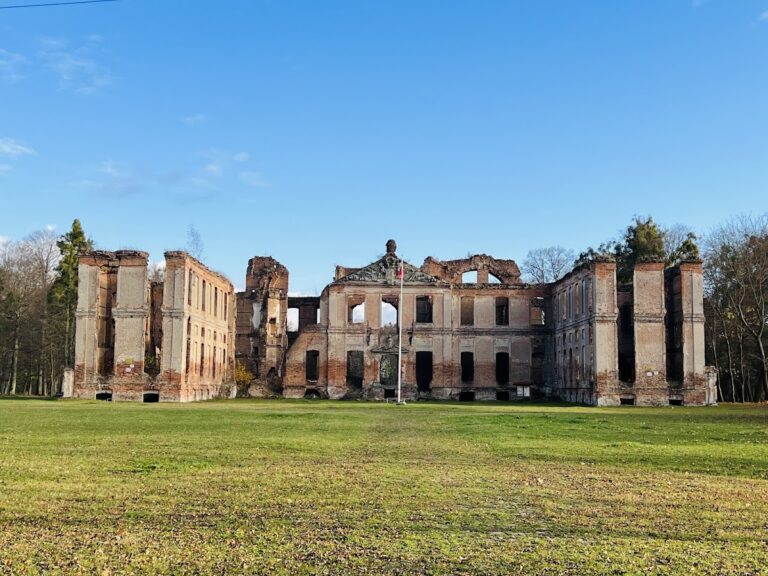
Clearance and conservation began in 1935 but were not completed. In 1958, the surviving tower and outer-bailey buildings were adapted as a holiday centre, and wooden cabins were built on the site. The ruined castle is privately owned, and renovation with partial reconstruction has begun. Polish monument-register entries dated 12 July 1961 and 17 August 1968 provide its heritage protection.
Remains
Approach and outer baileys
The complex occupied a defensible peninsula and was arranged as a high castle and a medium castle, with descriptions also distinguishing a main castle and two outer baileys. The approach from the village crossed a broad moat by a drawbridge resting on two brick piers. From there, the route reached a foregate and gate tower, with a defensive wall extending onward to two turrets.
Prisoners’ Tower
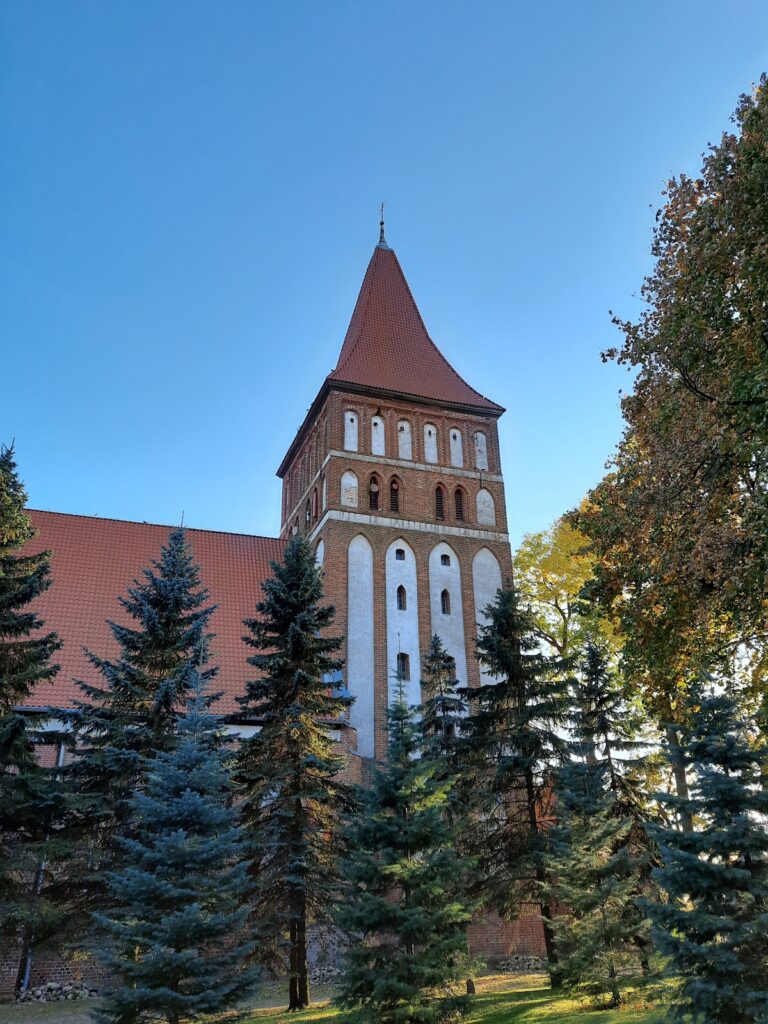
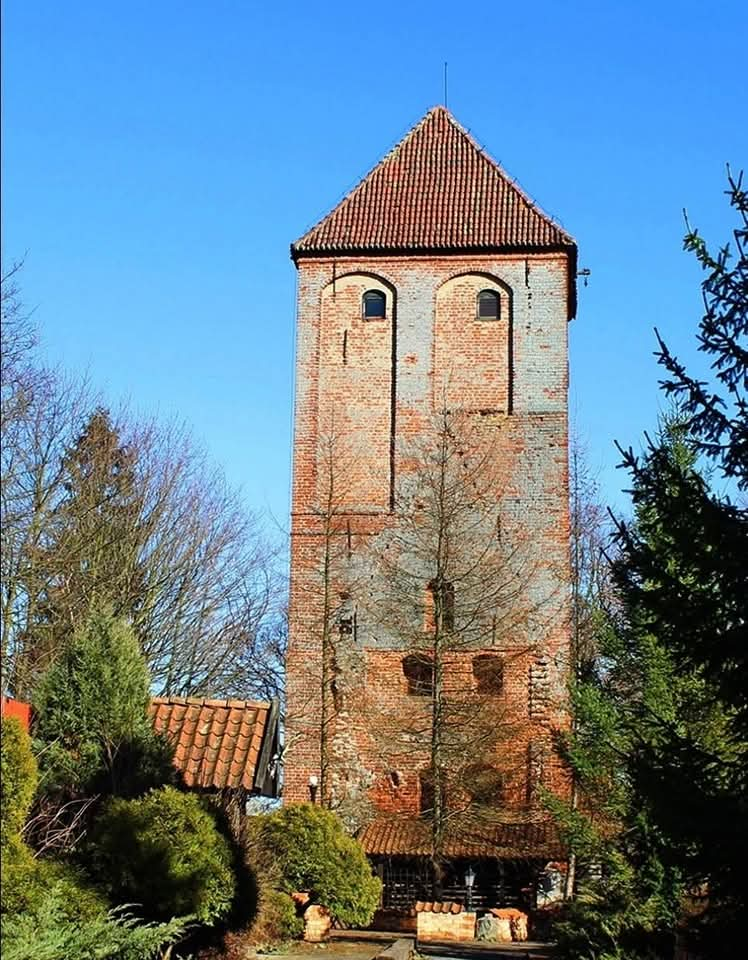
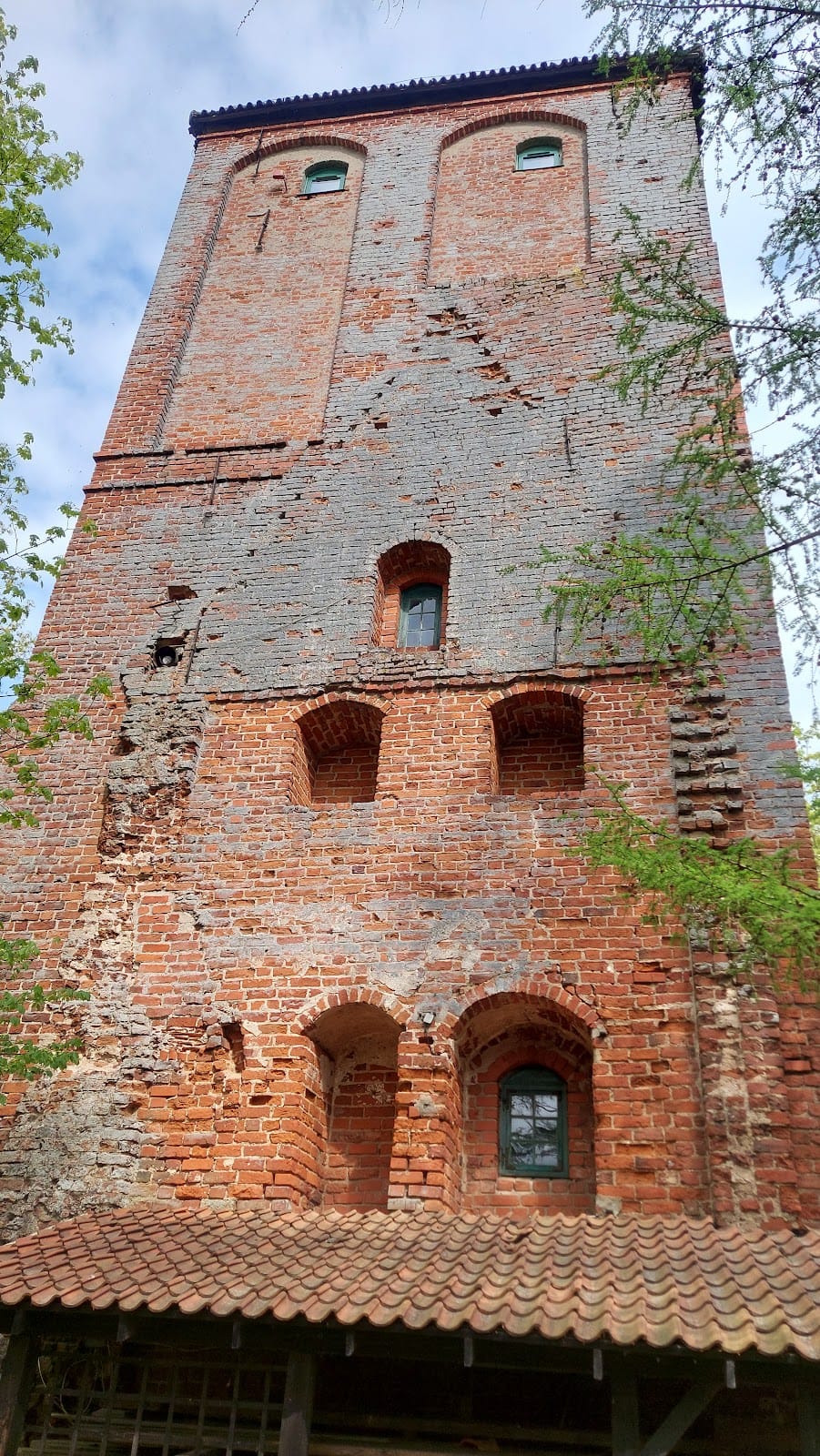
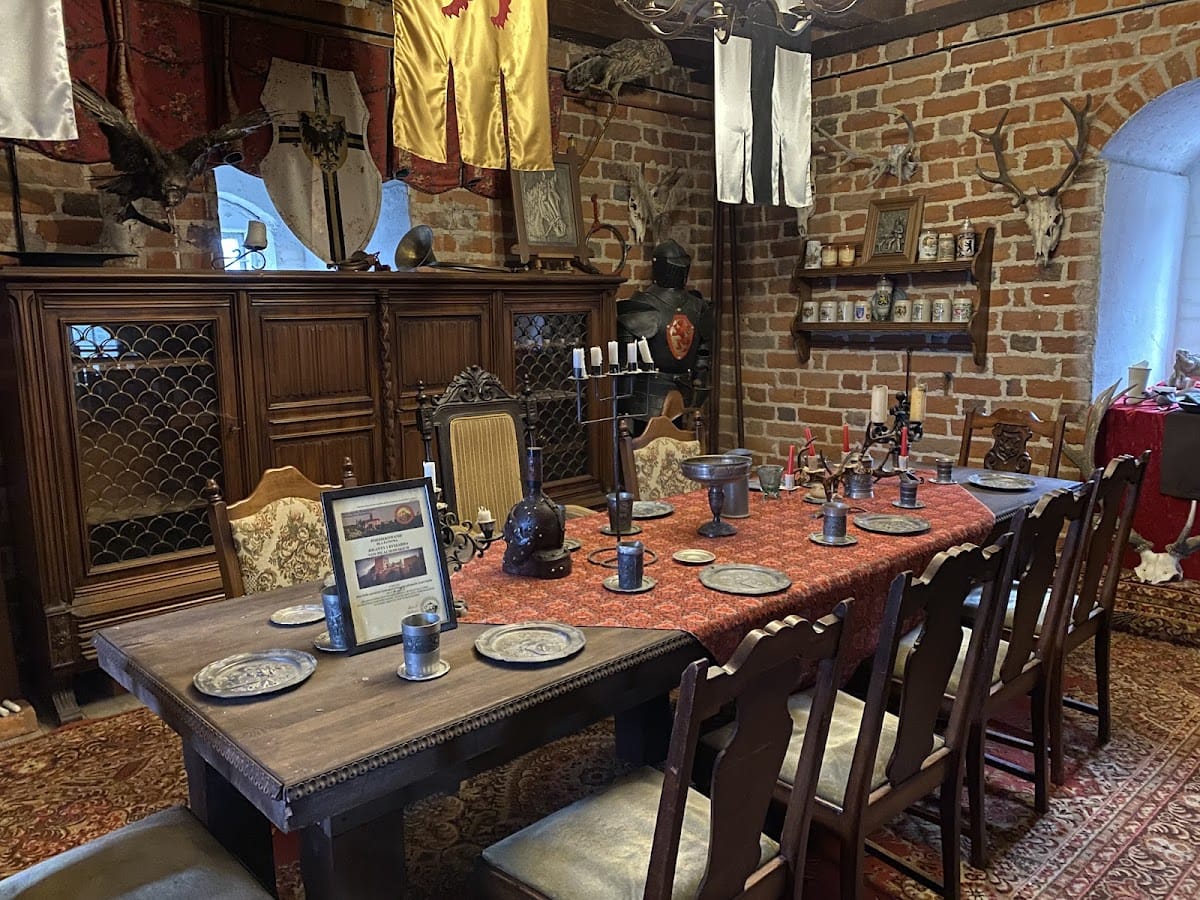
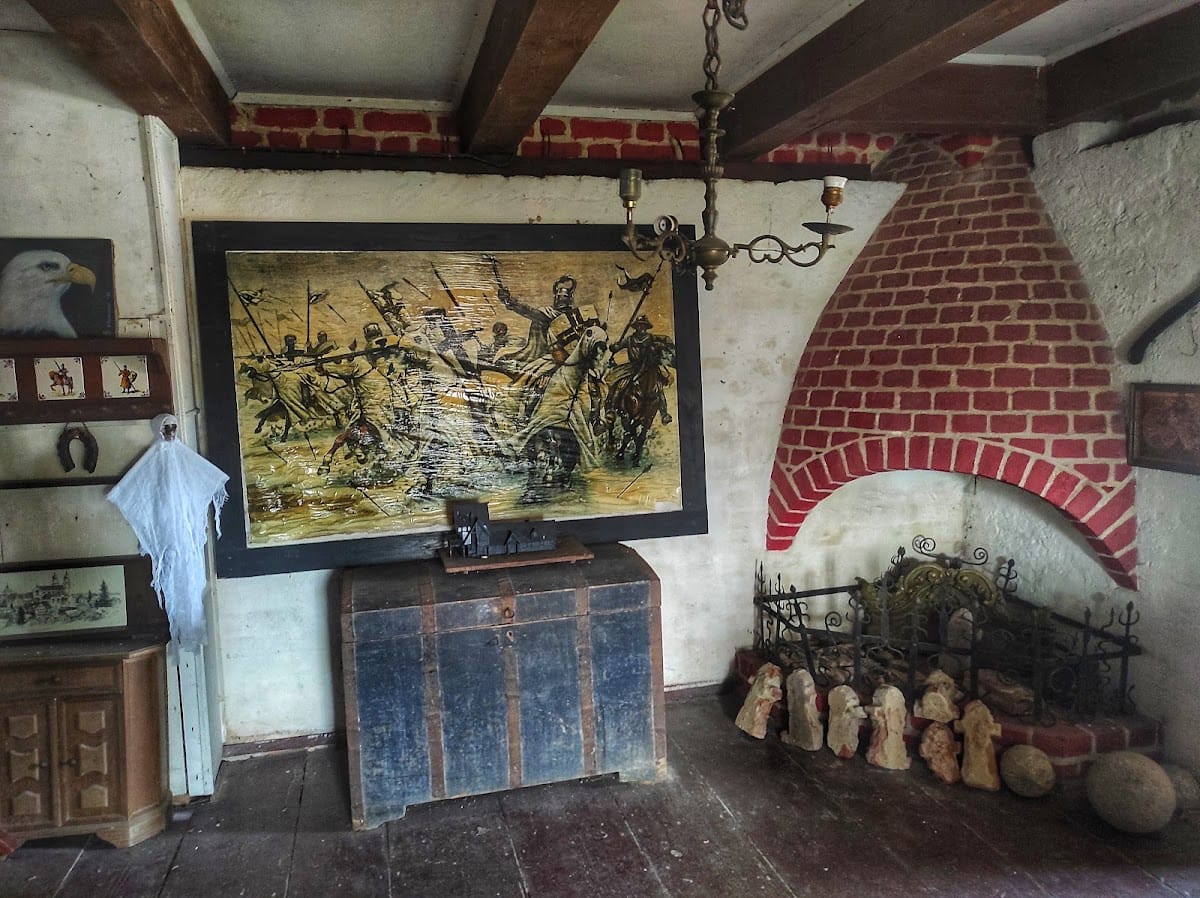
The eastern corner turret is the best-preserved part of the complex. Rising about 35 metres, it is known as the Prisoners’ Tower. The surviving corner tower of the first outer bailey contained dungeons, residential cells, and guard rooms, and it also served as a bell tower. Its present use includes exhibitions and events.
First outer bailey
The first outer bailey had a large northern gate complex and a round tower at its northwestern corner. The round tower survives in foundation remains. A bridge, whose piers can still be recognized, connected this area with a second outer bailey, also described as the first bastion, positioned on a hill where a church now stands.
High castle
A second drawbridge crossed a dry moat between the medium castle and the high castle. The high castle was enclosed by a four-sided defensive wall measuring approximately 50 by 75 metres. Small surviving sections of its outer walls preserve the outline of the former enclosure.
Main house
The medieval main house stood along the eastern side of the high castle and rose at least two storeys. It formed part of a four-winged complex measuring about 73 metres in length and 47 metres in width. The eastern wing was the oldest section and had three storeys. A gallery belonged to the main house, while a half-timbered garderobe bay, a projecting medieval latrine, extended from its exterior.
Southern tower and residential wings
An octagonal tower about 8 metres in diameter was built against the southern castle wall. During the sixteenth and seventeenth centuries, residential wings were added along the northern, southern, and western sides of the high castle, enclosing its inner courtyard.
The outline of a hall in the eastern wing remains legible, supported by granite pillars. The entrance gate can also still be traced among the surviving remains, giving physical form to the relationship between the high castle’s principal building and its fortified enclosure.