Burg Honberg: A Late-Medieval Territorial Fortress in Tuttlingen
Site at a Glance
- Rating
- 4.6
- Popularity
- Medium
- Country
- Germany
- Primary era
- Medieval
- External website
- Open
- Eras represented
- Medieval, Modern
- Civilizations
- Holy Roman Empire
- Site type
- Military
- Remains
- Fort
On this page9 sections
History
Burg Honberg is a late-medieval hilltop fortress in Tuttlingen, Germany, built by Württemberg between 1460 and 1470. Constructed under Count Eberhard V of Württemberg, known as “the Bearded,” it formed part of the region’s defensive system and became one of Württemberg’s most important territorial fortresses in the late Middle Ages.
Württemberg stronghold
When Eberhard became the first Duke of Württemberg on 21 July 1495, Honberg was the principal military structure in the southern part of the new duchy. Its position above the Danube valley gave the fortress a role within the military organization of the territory, while the settlement lay beyond a cemetery that separated it from the stronghold.
Destruction during the Thirty Years’ War
Honberg became involved in the Thirty Years’ War, the European conflict fought from 1618 to 1648 amid religious, dynastic, and territorial struggles. For several weeks, the fortress served as the headquarters of Franco-Weimarian troops, forces aligned with France and the duchy of Saxe-Weimar, during the Battle of Tuttlingen on 24 November 1643.
The Franco-Weimarian forces were defeated by Imperial and Spanish troops, particularly Bavarian dragoons. Their victory enabled the Imperial army, serving the Holy Roman Emperor, to approach the French camp from the southeast without detection. One interpretation holds that Honberg was already largely ruined during this battle. The continued existence of a demolition order from 1645, together with the probable presence of soldiers at the site, has also been taken to indicate that at least part of the fortress remained active afterward.
In 1645, the garrison, composed mainly of Imperial troops, destroyed the fortress down to its foundation walls. Konrad Widerholt, a Württemberg commander at Hohentwiel, ordered the demolition, stating that it was intended to protect Tuttlingen from an approaching superior enemy.
Ruins and later preservation
After the destruction, the remains deteriorated as their stone was reused for regional construction, including the Swabian Hüttenwerke metalworks at Ludwigstal, later associated with the SHW Group. Following the great fire of Tuttlingen in 1803, further stones were taken for the town’s reconstruction.
During the nineteenth century, a supporting association collected donations that financed the rebuilding of the fortress’s two towers and the rehabilitation of several other structures. The towers were not reconstructed in their original form, so the surviving monument presents mainly the ruins rather than a complete reconstruction of the former fortress. Burg Honberg is protected as an architectural monument in Baden-Württemberg. The Honberg-Sommer music festival takes place within the fortress walls for more than two weeks each summer, and the grounds are occasionally used for other local events.
Remains
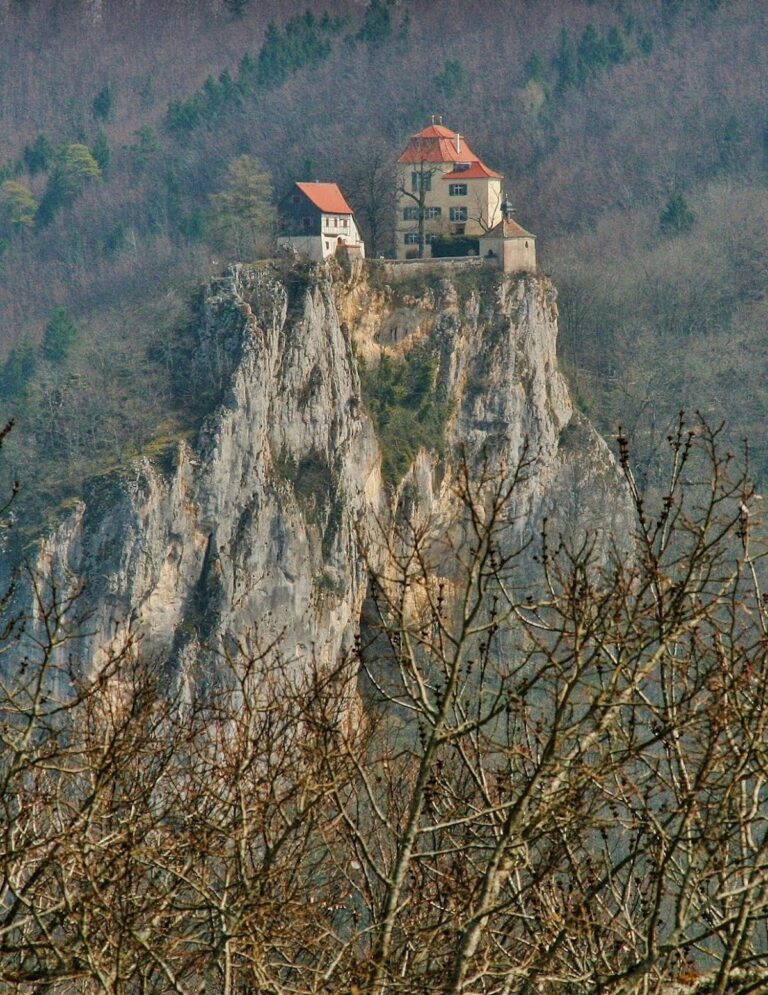
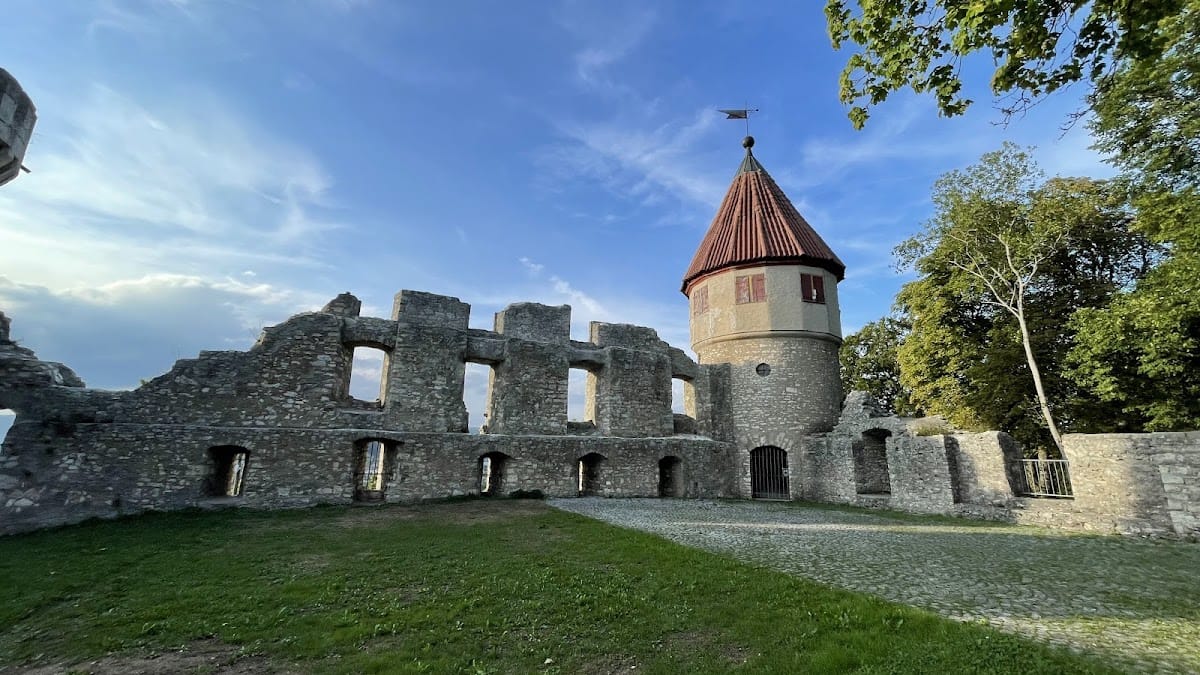
Burg Honberg occupies the summit of Honberg in central Tuttlingen. The hill rises to 739 metres above sea level, above the adjacent Danube valley at 642 metres. This summit position formed the physical basis of the fortification, a defensive installation built on elevated ground to improve surveillance and resistance against attack. Portions of the former fortress walls still stand, forming a well-preserved ruin on the hilltop.
Fortress structures
Defensive walls
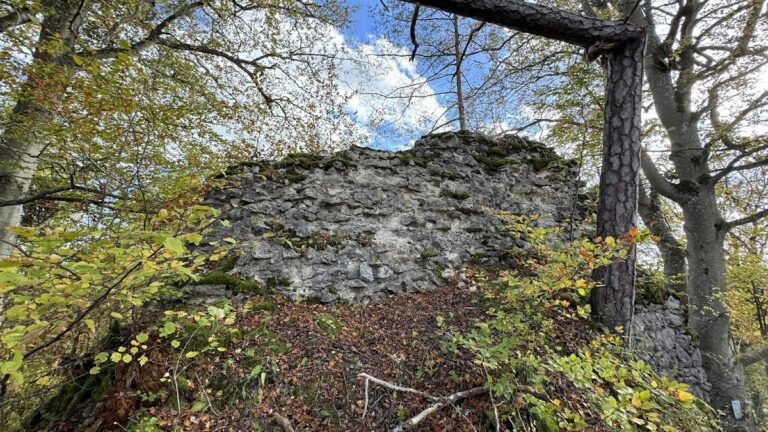
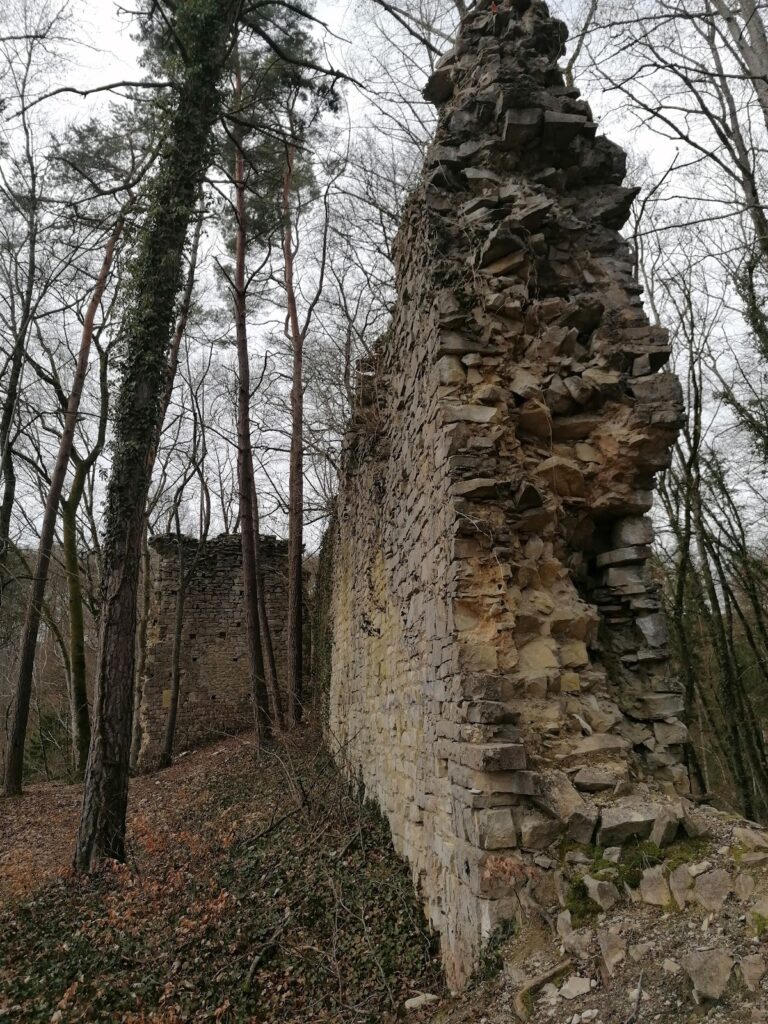
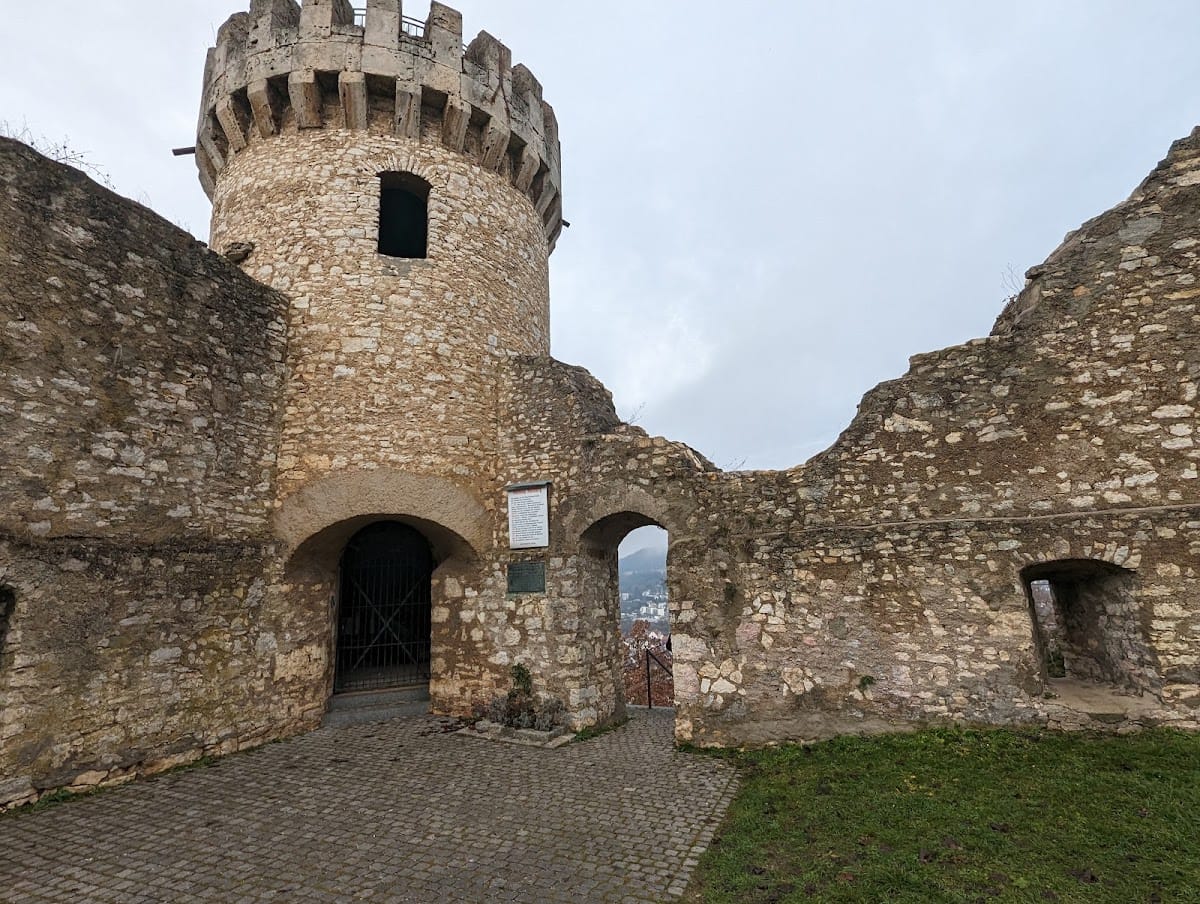
The surviving wall sections preserve part of the summit fortification’s former enclosure. Their present condition reflects the destruction of 1645, later deterioration, and the removal of masonry for construction elsewhere. Several other structures were rehabilitated during the nineteenth-century preservation work, but the visible complex remains primarily a ruin rather than a reconstruction of the entire fortress.
Rebuilt towers
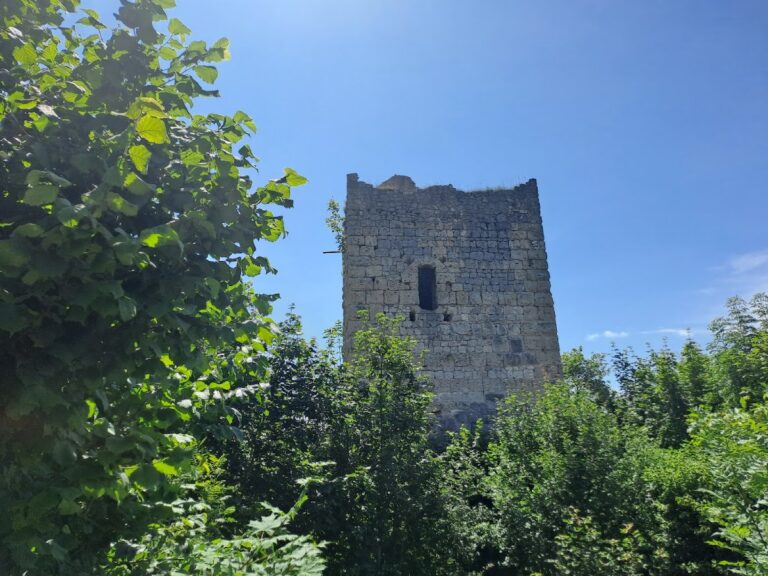
Two principal towers were rebuilt in the nineteenth century. Their reconstructed forms do not reproduce the original structures. The written order for the 1645 demolition is affixed to one of the towers, preserving a direct physical connection between the surviving monument and the event that brought the fortress down to its foundations.
Later installations
A regional radio installation stood east of the ruins until June 2013. Its transmitter antenna is now located in one of the towers, adding a modern communications installation to the preserved historic fabric of the fortress.
Nearby sites