Burg Konzenberg: A Medieval Spur Castle in Germany

Site at a Glance
- Rating
- 4
- Popularity
- Very Low
- Country
- Germany
- Primary era
- Medieval
- Eras represented
- Medieval
- Civilizations
- Holy Roman Empire
- Site type
- Military
- Remains
- Castle
On this page8 sections
History
Burg Konzenberg is a ruined medieval spur castle in Germany, located within Wurmlingen near Tuttlingen. Built during the High Middle Ages, the central medieval period from approximately the eleventh through thirteenth centuries, it was probably established by the free nobles of Wartenberg as a noble residence. The castle later became the administrative center of the Lordship of Konzenberg and was eventually used as a prison.
Noble Origins
The castle was already in the possession of the free noble Fürsts of Hirschegg when it was mentioned in 1239. Their father, Konrad Fürst I, had married Udilhild of Wartenberg, linking the family to the nobles who probably built the castle. This early connection places Burg Konzenberg within the network of aristocratic residences that shaped the region during the High Middle Ages.
Formation of the Lordship
In 1300, Konrad Fürst III of Konzenberg sold the castle and its associated rights to Heinrich II, Bishop of Constance. The following year, the bishop acquired the bailiwick of Wurmlingen, including Weilheim, together with part of the bailiwick of Frittlingen. A bailiwick was a territorial jurisdiction with judicial and administrative authority. These possessions were brought together as the Lordship of Konzenberg.
In 1460, the Prince-Bishopric of Constance, an ecclesiastical principality ruled by the bishop, pledged the Wurmlingen bailiwick and the Konzenberg fortress to the Constance cathedral provostry. The provostry, the institution headed by the provost of a cathedral chapter, joined them to the neighboring property of the cathedral provost and governed the enlarged territory from Wurmlingen. In 1614, it acquired the pledged part of the lordship outright.
Secularization and Demolition
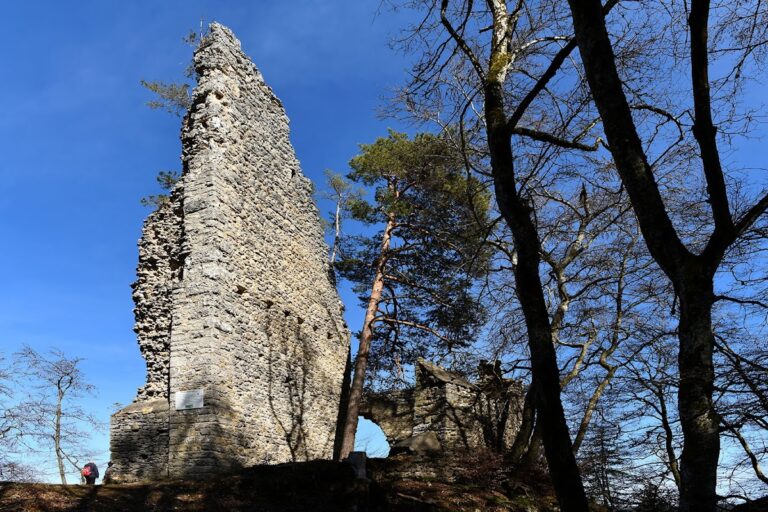
The lordship was secularized in 1802 and 1803, ending its ecclesiastical administration. A gamekeeper continued to live in the castle until 1816. The complex was sold for demolition in 1820, and the last walls were removed in 1838, apart from the massive keep that remains today.
Remains
Burg Konzenberg occupies a west-northwest-pointing spur at about 783.2 metres above sea level. The Eltatal lies to the north and the Bächetal, formed by the Krähenbach, to the southwest. The surviving complex includes a tall keep, parts of the fortified enclosure, and a system of ditches and outer defenses arranged along the spur.
The Keep
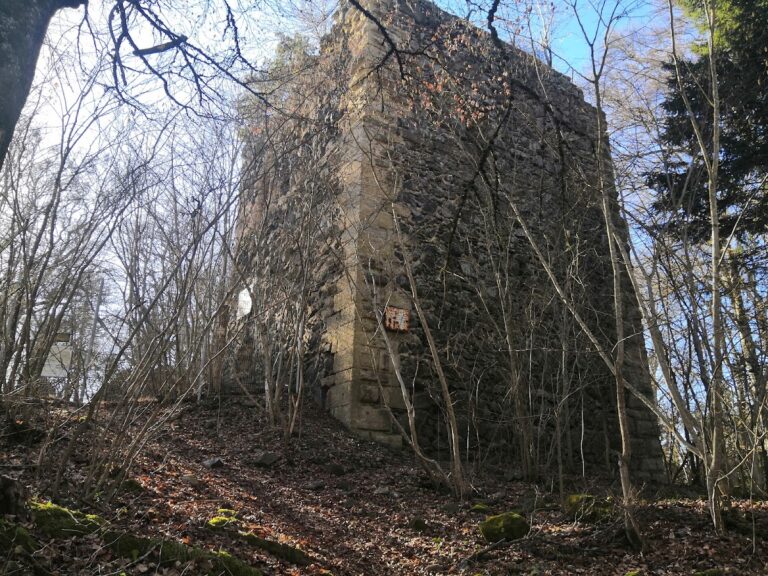
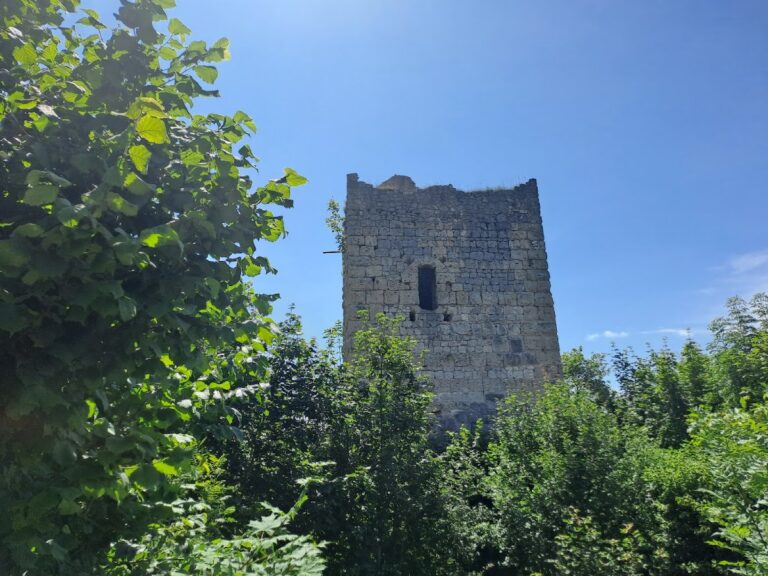
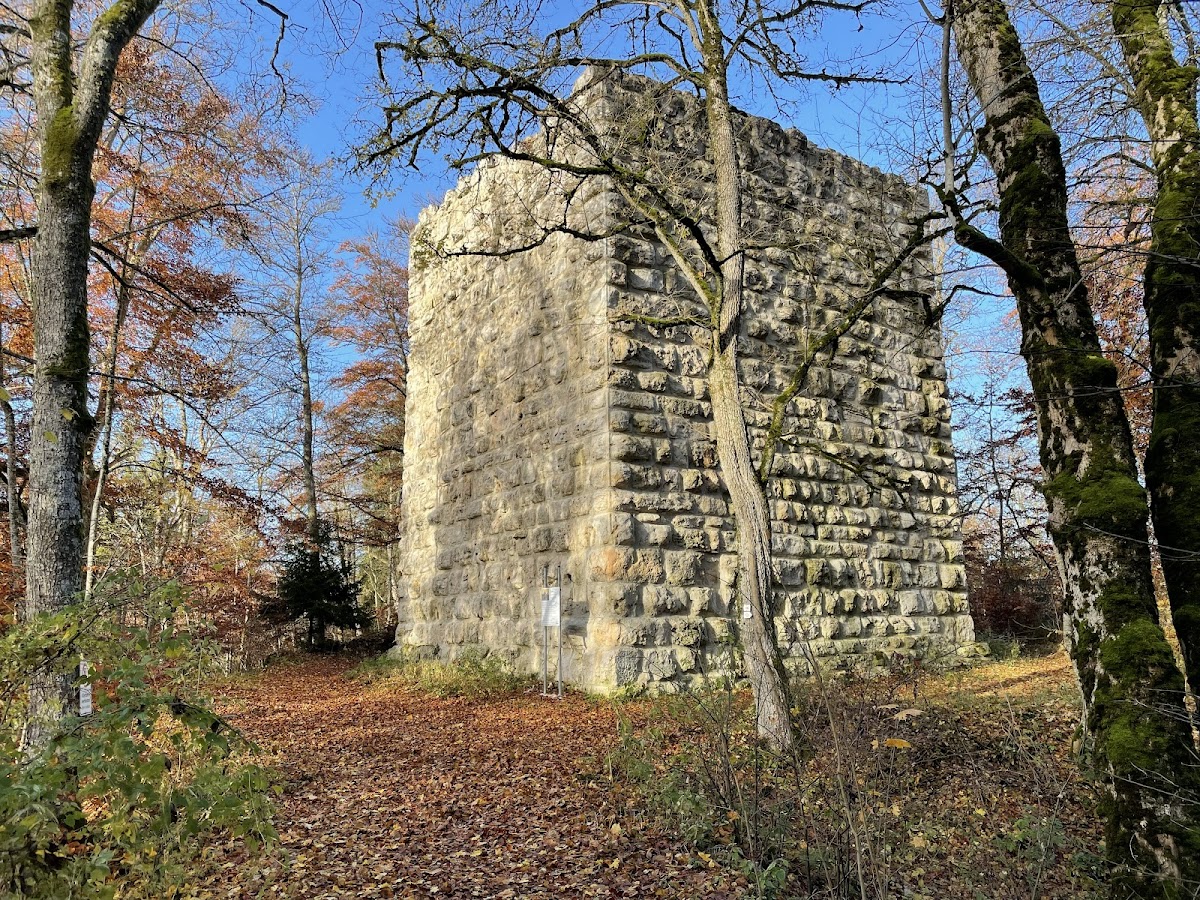
The principal surviving structure is a square keep measuring approximately 12.5 metres on each side and standing about 13 metres high. Its walls are roughly 4 metres thick, and the entrance is positioned about 10 metres above ground level. The tower was built from tuff brought from the distant Hegau rather than from the locally occurring White Jurassic limestone. Large bossage ashlar blocks, whose exposed faces project in a rough, strongly textured finish, form its masonry. One corner stone carries an unidentified coat of arms.
Fortified Enclosure
The enceinte, or fortified enclosure surrounding the castle interior, forms a narrow trapezoid. The sides running along the spur are slightly more than 50 metres long. Walls protecting the tip of the spur and its side measure approximately 16 and 23 metres respectively. Earth covers most of the interior, so only a few stone remains can be seen within the enclosure, while sections of the masonry survive on the outer faces.
Ditches and Outer Defenses
Ditches surround the castle, with those crossing the rear connection of the spur, known as neck ditches, markedly deeper than the ditches along its sides. An additional outwork, a separate defensive position beyond the main enclosure, strengthened the approach. A rampart and ditch protected the spur about 150 metres from the neck ditch, while further ramparts and ditches extended from the outwork toward the neck ditch along both sides. These outer defenses were considerably lower than the main fortifications, and forest tracks now pass through their western and northern walls.
Nearby sites