Langenstein Castle: A Medieval Stronghold and Renaissance Residence in Germany


Site at a Glance
- Rating
- 4.7
- Popularity
- Low
- Country
- Germany
- Primary era
- Early Modern
- External website
- Open
- Eras represented
- Medieval, Early Modern
- Civilizations
- Holy Roman Empire
- Site type
- Domestic
- Remains
- Castle
On this page9 sections
History
Langenstein Castle is a medieval castle in Orsingen-Nenzingen, Germany, whose surviving lower tower section dates to around 1100 and whose main complex was transformed into a Renaissance noble residence between 1570 and 1605. It stands on land once belonging to Reichenau Abbey, a Benedictine monastery on Reichenau Island in Lake Constance, and remains a privately owned estate of the Douglas family.
Reichenau Abbey and the medieval castle
Reichenau Abbey built the castle’s bergfried, the principal defensive and refuge tower of a medieval German castle, around 1100. The lower part of this tower survives, together with older foundations that form the core of the medieval remains.
During the twelfth and thirteenth centuries, Langenstein was the seat of ministeriales, dependent officials who carried out administrative and military duties for ecclesiastical lords. These officials served Reichenau Abbey and adopted the name von Langenstein. After the family died out in the early fourteenth century, the castle passed among several noble owners, including the knight Bilgeri von Heudorf.
Transformation into a noble residence
Hans Werner von Raitenau acquired Langenstein and its associated estates from Hans Wilhelm von Knöringen in 1568. From 1570 to 1605, the medieval stronghold was extensively rebuilt. The work adapted the earlier castle into a more comfortable aristocratic residence in the Renaissance style, with the main building arranged around a square tower.
Guidobald, Count of Welsperg, inherited Langenstein in 1677, and the estate remained with the Welsperg family until 1826. Karl, Count of Welsperg, then sold the castle because of his indebtedness to Grand Duke Ludwig of Baden, who acquired it as private property.
The Baden and Douglas families
After Ludwig died in 1830, Langenstein passed with his other privately acquired estates to his son, Count Ludwig Wilhelm August of Langenstein and Gondelsheim, who lived from 1820 to 1872. Born out of wedlock to Katharina Werner, an actress at the Karlsruhe court theatre, and regarded as having non-equal dynastic status, he was excluded from succession to the grand-ducal throne.
Count Ludwig Wilhelm August died childless, leaving Langenstein and the other estates to his sister Luise of Langenstein and Gondelsheim, who lived from 1825 to 1900. Her marriage in 1848 to the Swedish nobleman Carl Israel Vilhelm, Count Douglas, transferred the castle to the Douglas family. The family has continued to own the property.
The Douglas family has used Langenstein as a residence since 1906, with the private living rooms situated in a newer wing. After the First World War and the abolition of the monarchy, the abdicated Grand Duke Friedrich II of Baden, his wife Hilda, his mother Luise, and his sister Viktoria, then Queen of Sweden, stayed at the castle as guests of Count Douglas until 1920. Augusta Victoria of Hohenzollern-Sigmaringen, the wife of Manuel II of Portugal, died at Langenstein on 29 August 1966.
Fastnacht and the modern estate
Wilhelm, Count Douglas, opened the Langenstein Fastnacht Museum in the castle in 1969. Fastnacht is the pre-Lenten carnival tradition of German-speaking regions, while Swabian-Alemannic Fastnacht is known for regional figures, carved masks, costumes, and processions. The museum remained in the castle until 2018, and its association established a new museum immediately near the castle that opened in June 2025. Since the 1970s, the museum’s Alefanz Order has been awarded annually during the Fastnacht season.
From the late 1980s, Axel, Count Douglas, developed the Schloss Langenstein Country Club, including golf and equestrian facilities. In 2014, he sold the castle and its lands to his cousin Christoph, Count Douglas, who died in 2016. Christoph’s son Leopold, Count Douglas, now lives at Langenstein with his family and manages the property in southern Baden with his brother Ludwig, Count Douglas. The privately owned estate remains associated with golf, tennis, equestrian activities, and a shotgun-hunting course, including an 18-hole golf course.
Remains
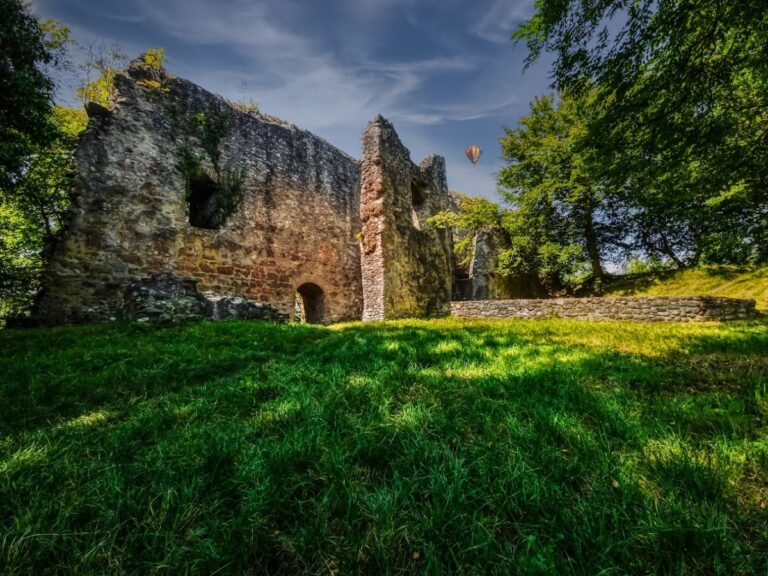
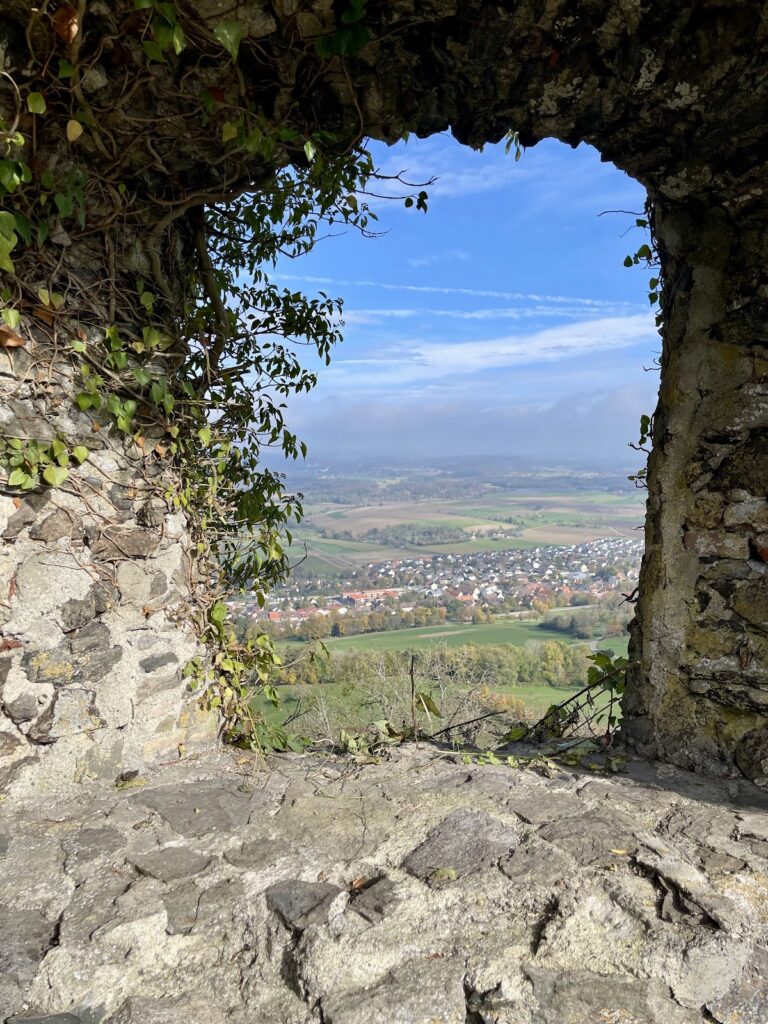
Langenstein Castle occupies a long, narrow outcrop of Jurassic limestone in the Hegau, between Singen and Stockach, within the municipality of Orsingen-Nenzingen. The surviving complex combines medieval defensive fabric with Renaissance residential buildings and later additions, preserving the physical development of the site from an abbey stronghold into a noble estate.
Medieval tower and foundations
The lower section of the bergfried built by Reichenau Abbey around 1100 survives within the castle complex. The tower was intended for defense and refuge rather than as the lord’s ordinary residence. Older tower foundations also remain, providing the principal physical evidence of the medieval castle and its earliest construction phase.
Renaissance residential complex
The main building was constructed largely between 1570 and 1605 around a square tower. Its arrangement represents the conversion of the earlier fortress into a Renaissance noble residence. The complex was later enlarged by the New Castle, which was linked to the older residential building by an intermediate wing. Together, these buildings form the principal residential parts of the present castle.
Chapel, service buildings, and collections
Other elements of the complex include a castle chapel, the Ludwigshof, and the Reichenau tithe cellar. A tithe cellar was a storage space for agricultural dues collected by an ecclesiastical institution such as Reichenau Abbey. The former Fastnacht Museum displayed more than 300 local carnival figures in brightly colored costumes with carved wooden masks, connecting the castle’s later cultural use with the regional traditions of Swabian-Alemannic Fastnacht.