Castle of La Celle-Guenand: A Medieval Fortress and Seigniorial Residence in France
Site at a Glance
- Rating
- 4.8
- Popularity
- Very Low
- Country
- France
- Primary era
- Medieval
- External website
- Open
- Eras represented
- Medieval, Early Modern, Modern
- Civilizations
- French
- Site type
- Domestic
- Remains
- Castle
On this page12 sections
History
Castle of La Celle-Guenand is a medieval castle in France, in the commune of La Celle-Guenand, whose present structure was built in the fifteenth century on the foundations of an earlier fortress. The site is thought to have originated as a monastery in the tenth century before becoming a fortress and the seat of the local lordship. Under the ancien régime, the system of monarchy and estates that existed before the French Revolution of 1789, it served as the seat of the Barony of La Celle-Guenand, a territorial lordship whose estate covered the present commune.
The Guenand Lords
The current château is dated approximately to 1422. Antoine de Guenand, lord of Saint-Cyran, Jambot, Vitray, Tanchou, Brossein, and La Celle-Guenand, is the first known lord associated with the château. His marriage to Oralie de Fontenay took place on 1 April 1422. In 1441, under Charles VII, king of France, Antoine became Captain-Governor of Loches.
Antoine’s son Pierre de Guenand inherited the estate in 1487. He served as Governor of the Royal Castle at Amboise and as Grand Chamberlain of France during the reign of Charles VIII. Antoine II de Guenand, a knight, continued the family’s noble succession. Georges de Guenand died without children in 1556, after which his aunt Antoinette d’Azay, born a Guenand, succeeded him.
Transformation of the Estate
In 1537, during the reign of Francis I, Guillaume de Coutance, lord of La Celle-Guenand, married René d’Azay. By 1570, the fiefs of La Celle-Guenand and La Celle-Draon had been brought together under René de Coutance. The Coutance family held the estate until 1780.
The château was reconstructed as a fortress in the fifteenth century, restored as a private residence in the seventeenth century, and altered and extended repeatedly during the eighteenth century and up to the Revolution. Religious conflict in 1779 resulted in the removal of the pastor of La Celle-Guenand. The two parishes were then merged under the name La Celle-Guenand.
From the Revolution to Modern Preservation
Jean Cantineau de Commacres held the château until 1785. Pierre Gaullier then held it until 1794, during the French Revolution. The Gaullier des Bordes family retained the estate through the July Revolution of 1830 and the First and Second French Empires, the imperial regimes established by Napoleon I and Napoleon III. In 1935, ownership passed to Jacques Devaulx de Chambord.
The estate has remained privately owned in modern times. It was protected as a monument historique, a French designation for a protected historic monument, on 11 June 1943 and is listed in the inventory. Its underground passages also continued to have a practical refuge function, serving local inhabitants during the Second World War.
Remains
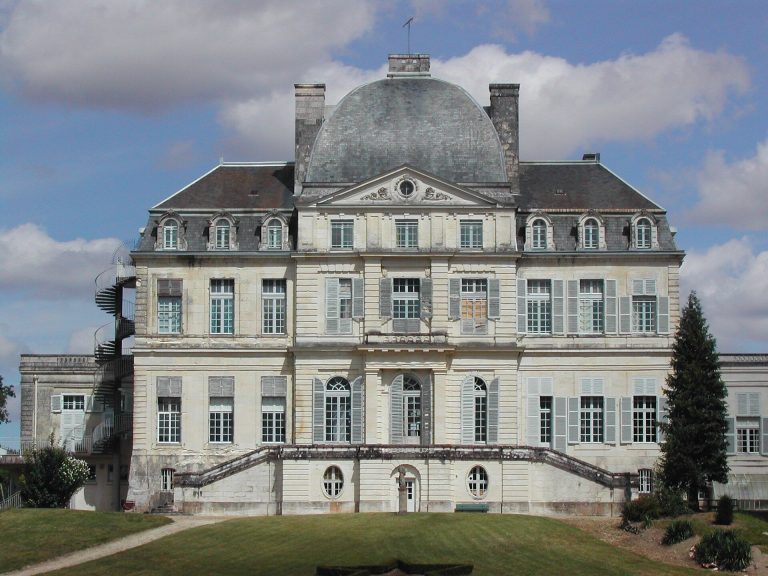
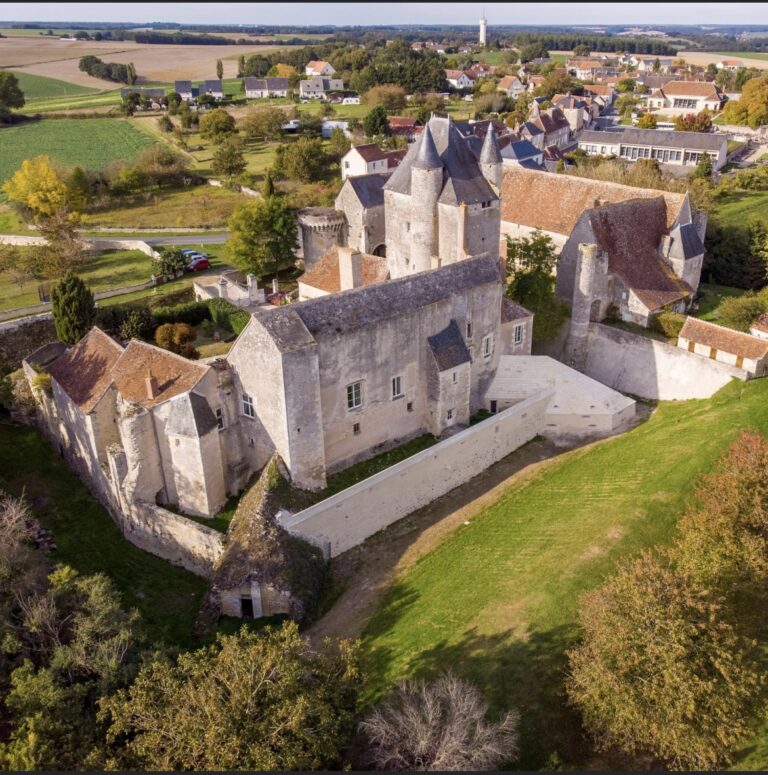
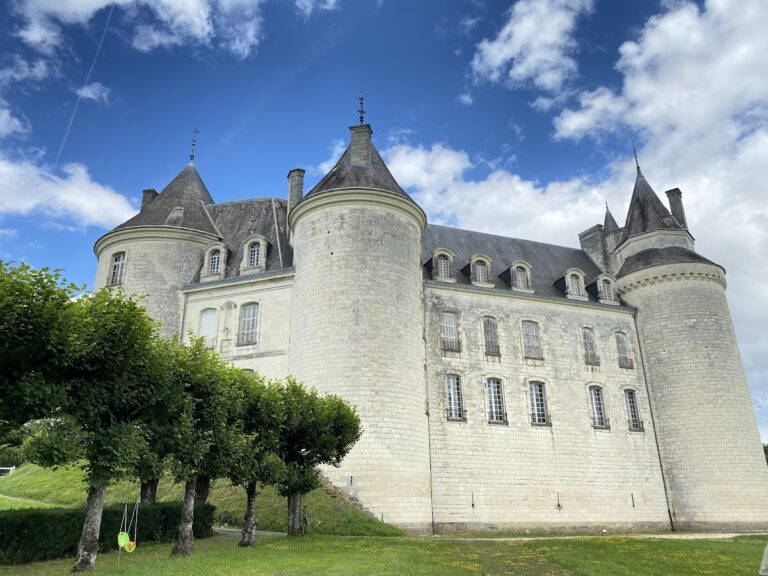
Castle of La Celle-Guenand is a medieval complex built principally from tuffeau, the soft, pale limestone widely used in the Loire Valley. Its layout developed around a U-shaped château framed by four round towers, with defensive works that included a square tower, watch turrets, a drawbridge, and surrounding moats. Later additions connected the fortified residence with an entrance structure and expanded the estate with service buildings and garden features.
The Fortified Residence
Main Château
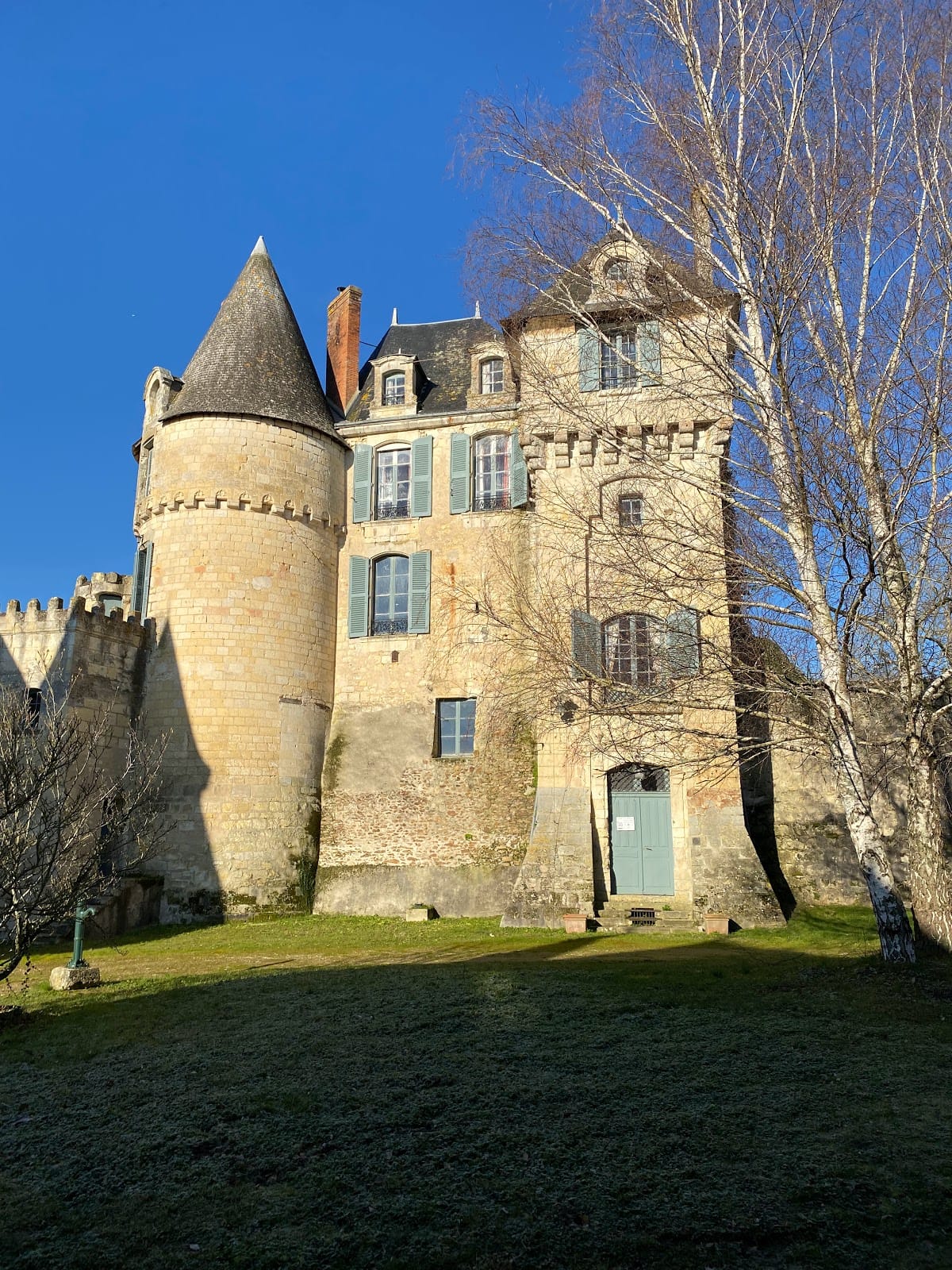
Antoine de Guenand’s fifteenth-century château followed a U-shaped plan enclosed by four round towers. The residence was protected by a square tower fitted with watch turrets, elevated structures used for observation or defence. A drawbridge and moats formed part of the original defensive arrangement. Elements of this military architecture remain visible on several façades and around the grounds.
Fortified Tower
A staircase built into the fortified tower later replaced the drawbridge. This change altered the approach to the château as the complex developed from a military stronghold toward a more residential form.
Entrance and Estate Buildings
Entrance Châtelet
At the end of the fifteenth century, a châtelet, or fortified gatehouse, was added at the entrance. A gallery connected it to the main residence. The entrance structure was later converted into a stable, recording the change in function that accompanied the château’s residential restoration.
Outbuildings and Dovecote
Outbuildings and a dovecote were constructed at the end of the fifteenth century. A dovecote housed pigeons, and its presence belonged to the estate’s seigniorial organization. Further outbuildings were added during the nineteenth and early twentieth centuries, when a new gateway and metal-framed greenhouses were also installed in the park.
Underground Passages
Underground passages survive as part of the estate’s defensive and refuge system. They served as places of shelter during periods of unrest and were still used by local inhabitants during the Second World War.