Znamenskoye-Sadki: A Historic Country Estate in Moscow
Site at a Glance
- Popularity
- High
- Country
- Russia
- Primary era
- Early Modern
- Eras represented
- Early Modern, Modern
- Civilizations
- Russian
- Site type
- Domestic
- Remains
- Manor House
On this page18 sections
History
Znamenskoye-Sadki is a former country estate in Bitsa Park in southern Moscow, Russia. Its first manor house and church were built in 1687; later buildings combined Elizabethan Baroque, the Russian Baroque associated with Empress Elizabeth’s reign, Classical forms inspired by ancient Greek and Roman architecture, and pseudo-Renaissance revival elements. The estate belonged to the Russian princely Trubetskoy family for generations and received Empress Catherine II in 1787.
Village and early estate
The first written reference to Sadki dates to 1617. The settlement was also known as Verkhov(o), on the right bank of the Obitsa River, now called the Bitsa. Sadki probably referred to fish-holding enclosures, reflecting the local residents’ use of the river’s abundant fish. In 1627, the village and surrounding wasteland belonged to voivode Ivan Ladyzhensky, a Russian military and administrative official, and his sons Abrosim and Evstraty. The family property passed to Abrosim’s son Fyodor in 1631, and Fyodor sold it in 1676 to Nikita Semyonovich Urusov, a second cousin of Tsar Alexei Mikhailovich.
Urusov commissioned a manor house and a church in 1687. The church’s dedication to the Sign of the Mother of God, an Eastern Orthodox title for Mary, gave the village the additional name Znamenskoye. Sadki continued in use, and the combined name Znamenskoye-Sadki became established. After Urusov’s death five years later, the estate passed to his eldest son Fyodor. It belonged to Fyodor’s wife, Elena, in 1722, and in 1731 passed to his nephews Vasily and Mikhail. Vasily became sole owner after Mikhail’s early death and sold estate trees for the creation of Annenhof Grove in Lefortovo.
The Trubetskoy estate
Vasily sold Znamenskoye-Sadki in 1750 to Princess Ekaterina Trubetskaya for 7,000 rubles. Her cousin Dmitry Trubetskoy inherited it in 1766 and enlarged the property by acquiring Kiovo and Kachalovo. After marrying Varvara Odoevskaya, he added Gavrikovo, Shibarovo, and Yazva, which came with her dowry. Trubetskoy developed a new estate ensemble on the expanded grounds.
In 1787, Trubetskoy received Catherine II, empress of Russia, and her grandsons Alexander and Constantine after the empress returned from a journey to Taurida, the historical name for Crimea. Alexander later ruled as Emperor Alexander I. The Trubetskoys also welcomed the poet and dramatist Mikhail Kheraskov, fabulist Ivan Dmitriev, and translator and philosopher Dmitry Venevitinov.
War, family life, and literary visitors
Dmitry Trubetskoy left the estate to his only son, Ivan. During Napoleon’s invasion of Russia in 1812, French forces burned some estate buildings and looted its property. Ivan sought financial help for restoration, but Moscow’s marshal of the nobility, Alexander Arsenyev, refused, arguing that Trubetskoy was wealthy and owned estates in other provinces.
In 1819, composer and pianist Joseph Genishta met historian and publicist Mikhail Pogodin at Znamenskoye-Sadki. Invited to tutor the Trubetskoy children, Pogodin spent nine years there. His story Rusaya kosa drew on people around the estate: his pupil Alexandra Trubetskaya inspired Countess O, his future wife Elizabeth Wagner inspired Maria, and Pogodin portrayed himself as Minsky. Pogodin’s diaries also mention visits by poet and critic Pyotr Vyazemsky, Princess Maria Volkonskaya, and poet Fyodor Tyutchev. In July 1822, Maria Tolstaya, Dmitry Trubetskoy’s granddaughter, came with her husband Nikolai. They were the parents of Leo Tolstoy.
Ivan laid out a new approach to the estate in 1825. After his death in 1827, his wife Ekaterina inherited the property. She died about four years later, and their younger son Nikolai became its owner. He improved the grounds and manor house and established a horse yard and dairy farm. In the early 1840s, he and his wife left Russia. His conversion to Catholicism in 1843 made a return impossible. Their daughter Ekaterina Orlova later helped sell the family’s Russian properties, including Znamenskoye-Sadki.
Shablykin and the Katkov family
In 1865, the estate passed to Ivan Pavlovich Shablykin, Moscow’s vice-governor. He made no major changes and sold it in 1876 for 30,000 rubles to publisher and publicist Mikhail Katkov. Katkov altered the manor-house interior and added spruce trees to the park, which was mainly planted with lime trees. He died in the house in 1887.
Katkov’s widow, Sofia Shalikova, inherited the estate and transferred it two years later to her eldest son, Andrei Mikhailovich Katkov. Andrei focused on its agricultural operations. He established a woollen-cloth enterprise, built a sheepfold, and introduced fine-wool sheep. He also built a stone laundry beside Big Znamensky Pond, dammed the pond, and installed a dynamo to supply electricity to the house and greenhouses.
Andrei died in December 1915, a year after his sons Mikhail and Andrei were killed in an early battle of the First World War. His widow, Maria Vladimirovna, née Princess Shcherbatova, became the estate’s last private owner. After the October Revolution, the 1917 upheaval that ended imperial rule in Russia, the estate was nationalized. In 1918, the manor house passed to the Moscow Central Workers’ Cooperative.
Nationalization and institutional use
Former estate employees took over the horse yard and dairy farm and formed the Znamenskaya Labour Commune, a community organized around collective work. It received two cows and two horses; the Sukhanovo volost council, the local governing body of a rural district, allocated the remaining livestock elsewhere. The commune lasted less than a year. During the 1920s, a state farm, a state-owned agricultural enterprise, used the horse and livestock yards, while an orphanage occupied other estate buildings.
A technical school for medicinal plants opened on the grounds in 1922. It later shifted to seed production and became the Bitsevsky Agricultural Technical School for Plant Breeding and Seed Production of Grain Crops. The Church of the Sign was closed and demolished in 1929. The estate library held 15,000 volumes. The People’s Commissariat for Education divided and removed the collection: foreign-language books went to the Russian State Library, while 5,399 volumes were sent to the Moscow State Book Fund for redistribution. Classical literature and fiction remained at the estate for a time, but the books’ later fate is unknown.
A Research Institute of Veterinary Virology and Microbiology moved onto the estate in 1959 and left for Vladimir Region in 1964. From 1972, the site housed the Central Laboratory for Nature Conservation of the USSR Ministry of Agriculture, later renamed the All-Union Research Institute for Nature Conservation and Reserve Management. The institute became the All-Russian Research Institute for Environmental Protection in 1993. In the late 1970s, the state farm transferred the horse and livestock yards to the institute. Restoration efforts followed in the 1990s, when the livestock yard was substantially rebuilt for a sports and health complex; an unfinished boarding house for the Ministry of Agriculture also became a long-running construction project.
In 1985, institute staff felled a distinctive pine in the park that had represented successive generations of the Trubetskoy family. Znamenskoye-Sadki has federal-level cultural heritage status in Russia.
Remains
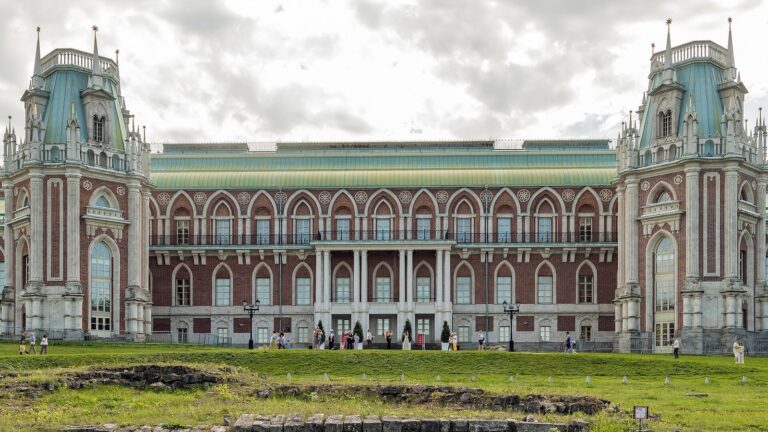
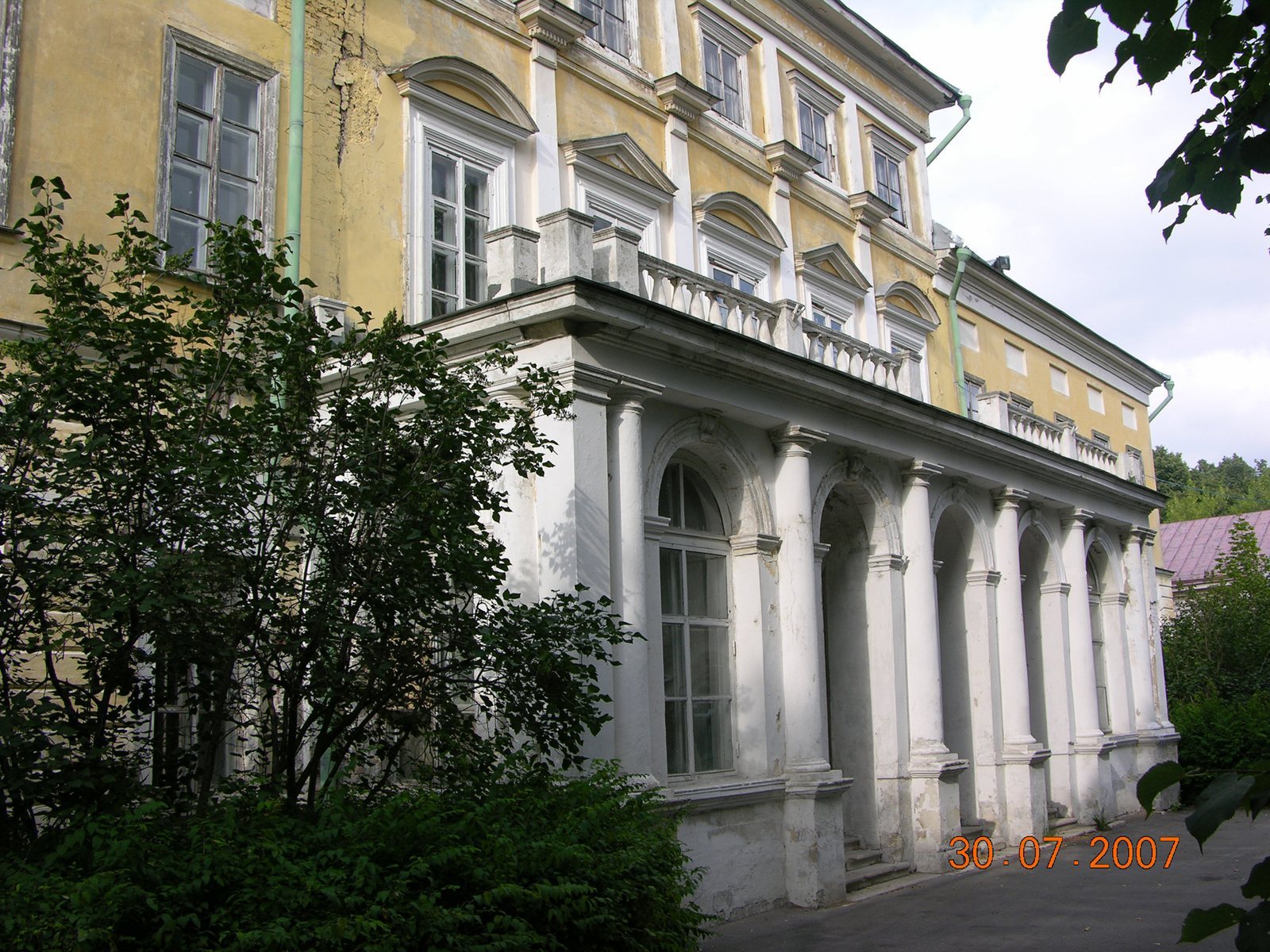
The estate’s surviving ensemble is set within Bitsa Park and includes the principal house and a wing, landscaped grounds, a pond, and former service buildings. Its architectural character is eclectic, combining Elizabethan Baroque and Classical elements with later pseudo-Renaissance alterations. The principal house stood in the northern part of the grounds, with its main façade facing the ponds.
Main house and interiors
Exterior and arrangement
The two-storey principal house had a mezzanine, a partial intermediate floor, and a basement. A projecting pediment rested above an arched portico, a roofed entrance structure supported by architectural elements. A carriage forecourt lay in front, while smaller houses with gardens formed a semicircle beside it. A large Classical-style greenhouse complex stood to the left of the church. Two two-storey wings and a further greenhouse were added under Nikolai Trubetskoy. The main house and one wing are the best-preserved parts of the ensemble.
During the 1967 restoration, remaining wooden sections of the house’s second floor were replaced with stone, and the interior arrangement was partly changed. The work removed the room where Mikhail Katkov had died. The façades were returned to a Classical appearance, although the central section kept its later nineteenth-century form. A fence and gate between the house and a wing were also removed.
Halls and surviving furnishings
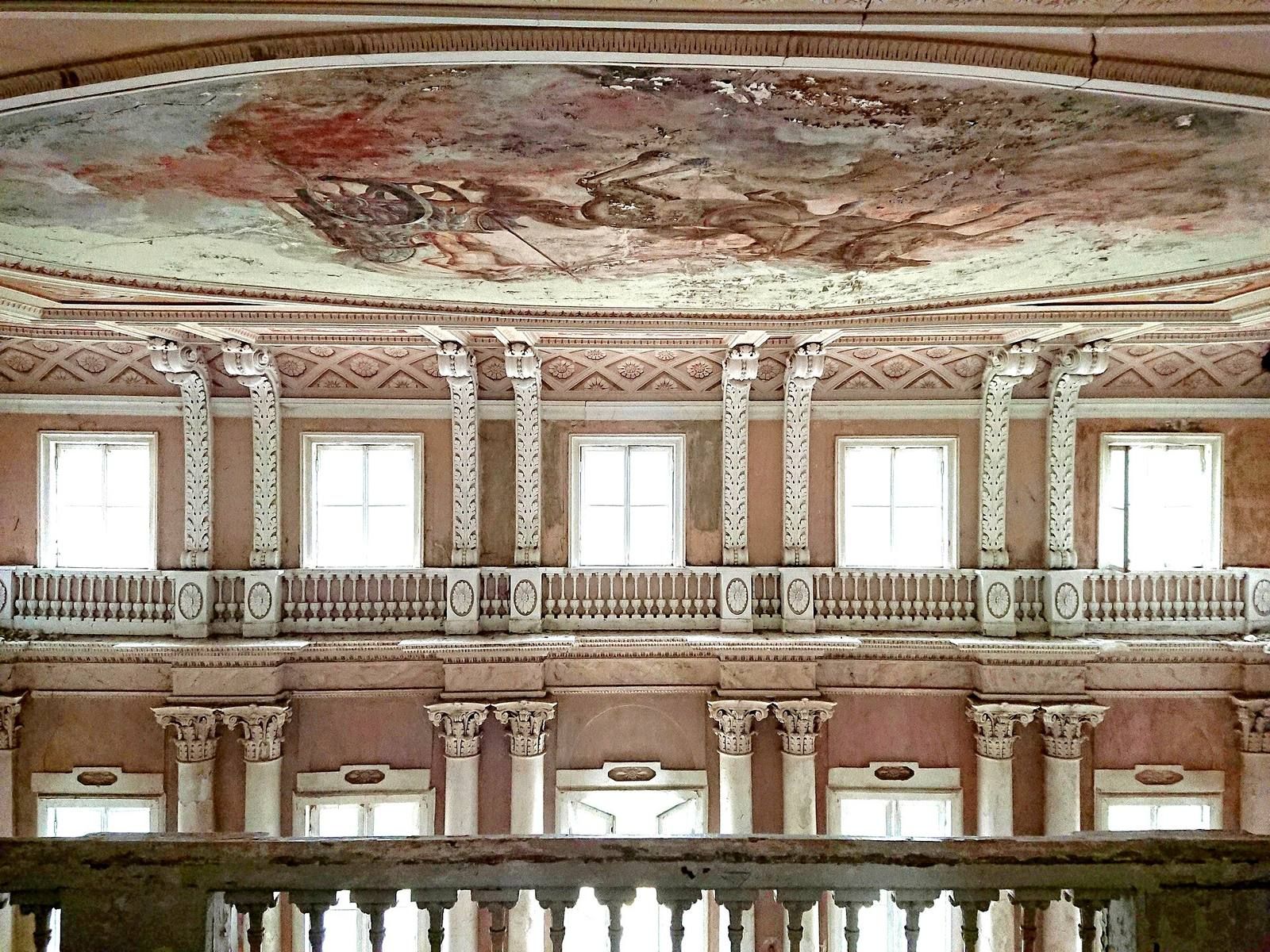
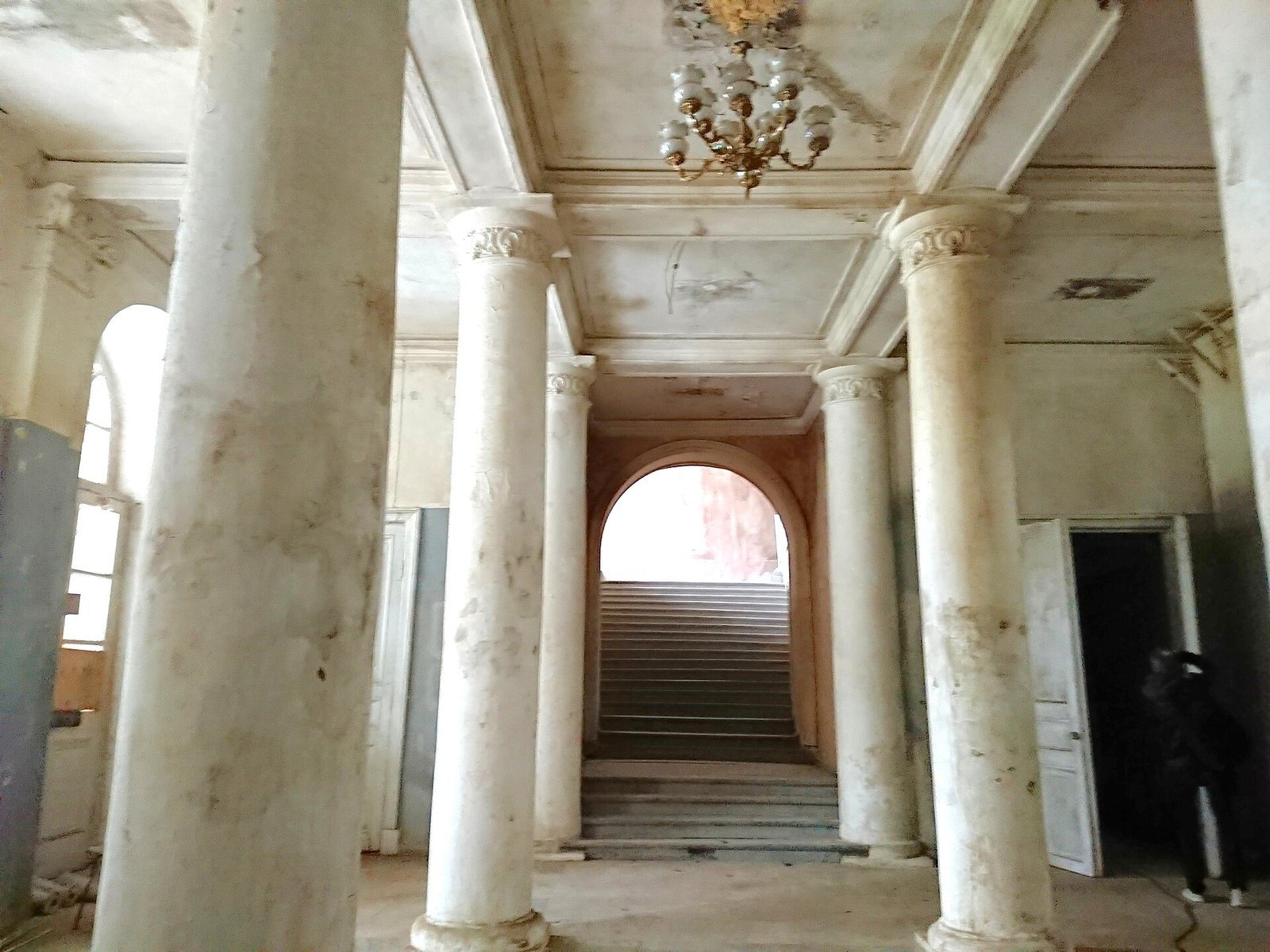
The double-height, two-tier Pink Hall, also called the Mars Hall, is in relatively good condition. Its painted ceiling shows Mars, the Roman god of war, riding in a chariot drawn by two horses. Restorers recalled that a third horse had been concealed behind a cloud after roof leaks damaged the painting. One of two other halls was adapted for the conservation institute’s service use, while the lilac hall survives. The entrance hall, principal staircase, and two ceremonial halls on the main upper floor are in poor condition.
Surviving furnishings include a floor clock from the reign of Catherine II and vases made by the Imperial Porcelain Factory bearing the monograms of Nicholas I. The vases were brought to the estate from other properties during the Soviet period.
Church of the Sign
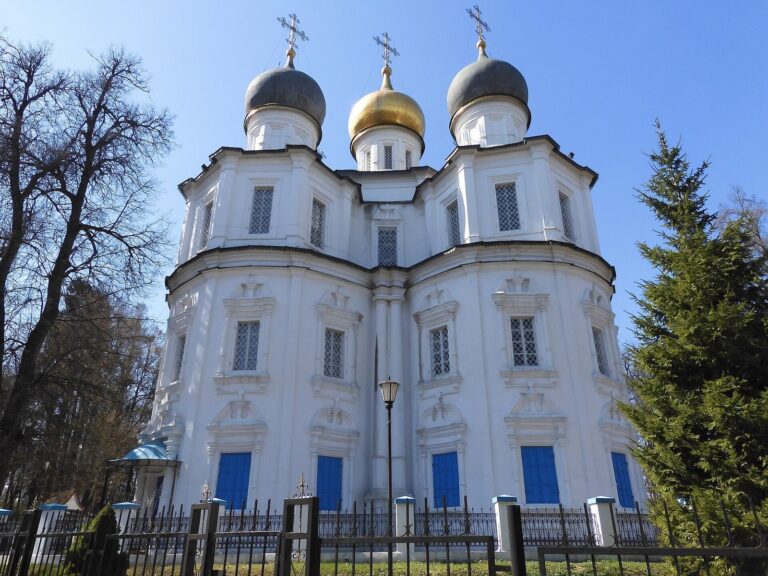
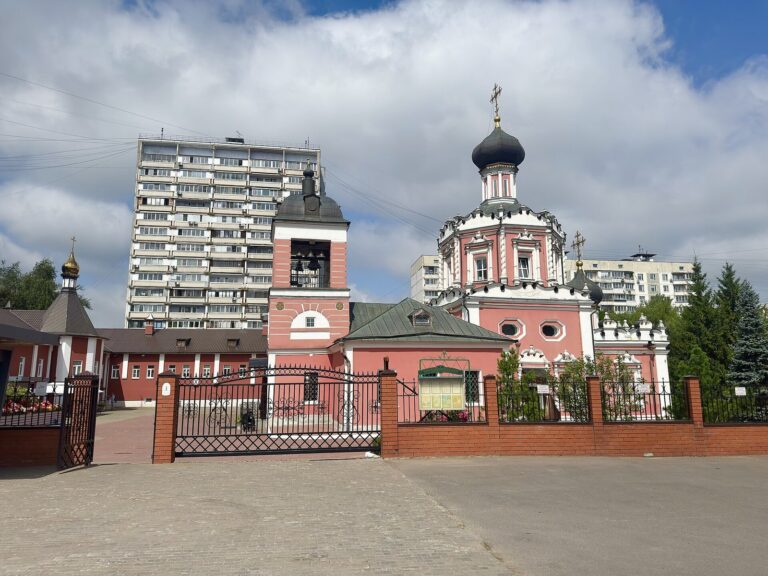
The first Church of the Sign of the Mother of God was built of wood in 1687. In 1754–1756, that single-domed church was replaced by a small stone building. Its square lower storey supported an octagonal upper storey, and two bell towers joined above the refectory, the church’s communal dining hall.
Park, ponds, and approach
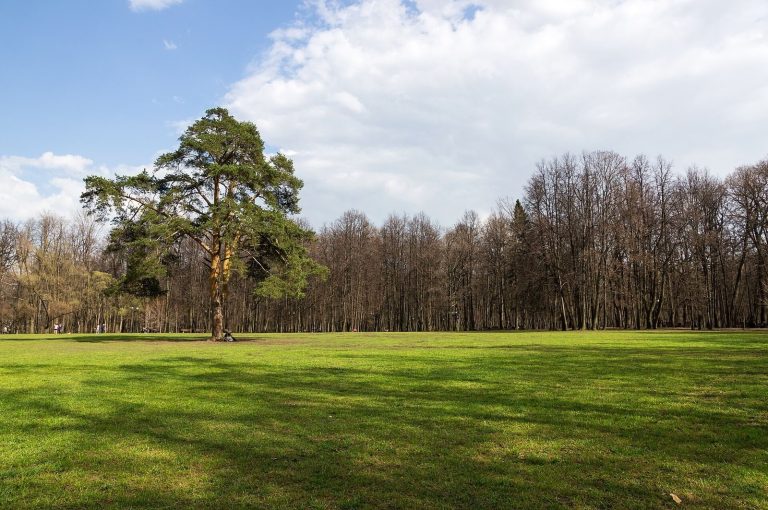
The estate grounds included a landscape park and a system of ponds and water features. Lime trees predominated, with spruce added during Mikhail Katkov’s ownership. Three oaks were planted before the main façade to mark Catherine II’s 1787 visit, and two survived into the modern period. Drainage altered the wider pond system, while Big Znamensky Pond remains beside the stone laundry. The approach laid out from the Great Serpukhov Road in 1825 ended at a rectangular viewing platform above a steep bank, overlooking the estate park.
Service buildings and agricultural grounds
Stone laundry
The stone laundry built under Andrei Katkov survives beside Big Znamensky Pond. It formed part of the estate’s service buildings and was constructed during his ownership.
Former horse and livestock yards
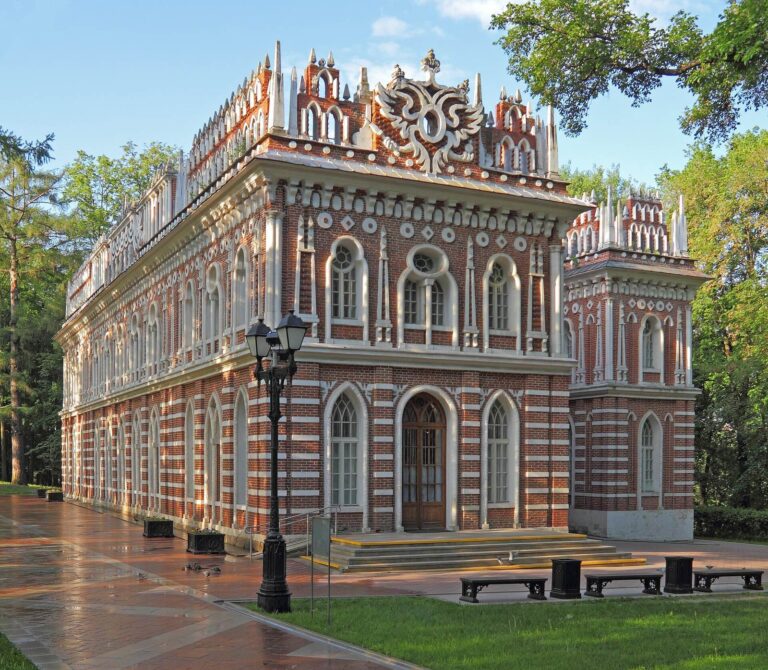
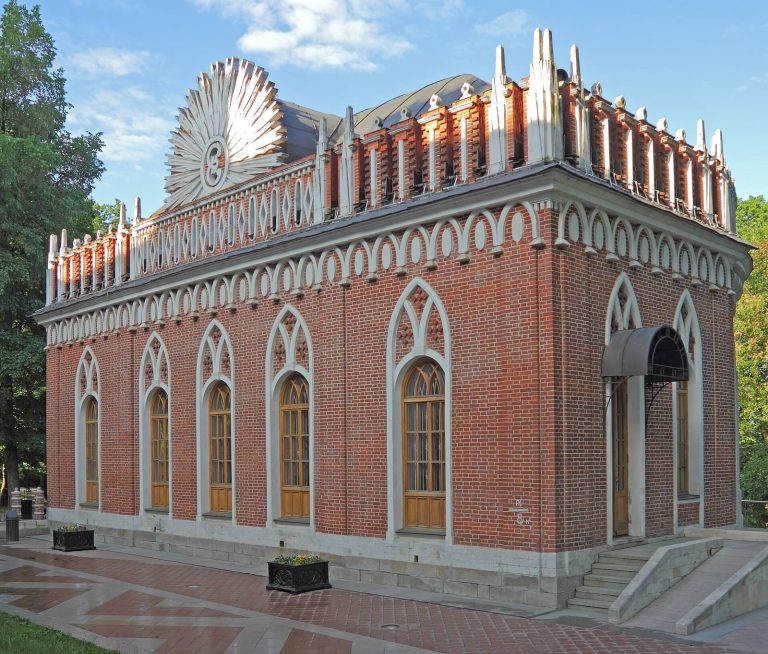
The former horse and livestock yards deteriorated after their roofs were removed. In the 1990s, the livestock yard was rebuilt as a sports and health complex. The reconstruction retained the façade of its eastern projecting section, added a flexible bituminous-shingle roof and mansard additions, upper floors built into the roof, and used ordinary rather than conservation-grade brick. These changes substantially altered its historic fabric. An equestrian sports complex was built north of the former horse yard.
Natural areas and memorials
Protected landscape features
Three areas within the grounds are designated as natural monuments, a legally protected natural feature or site under Russian conservation terminology: Znamensky Mixed Forest, Znamensky Small Spruce Grove, and Znamenskaya Spruce-and-Pine Forest. The last is a high forest of spruce and pine.
Memorials
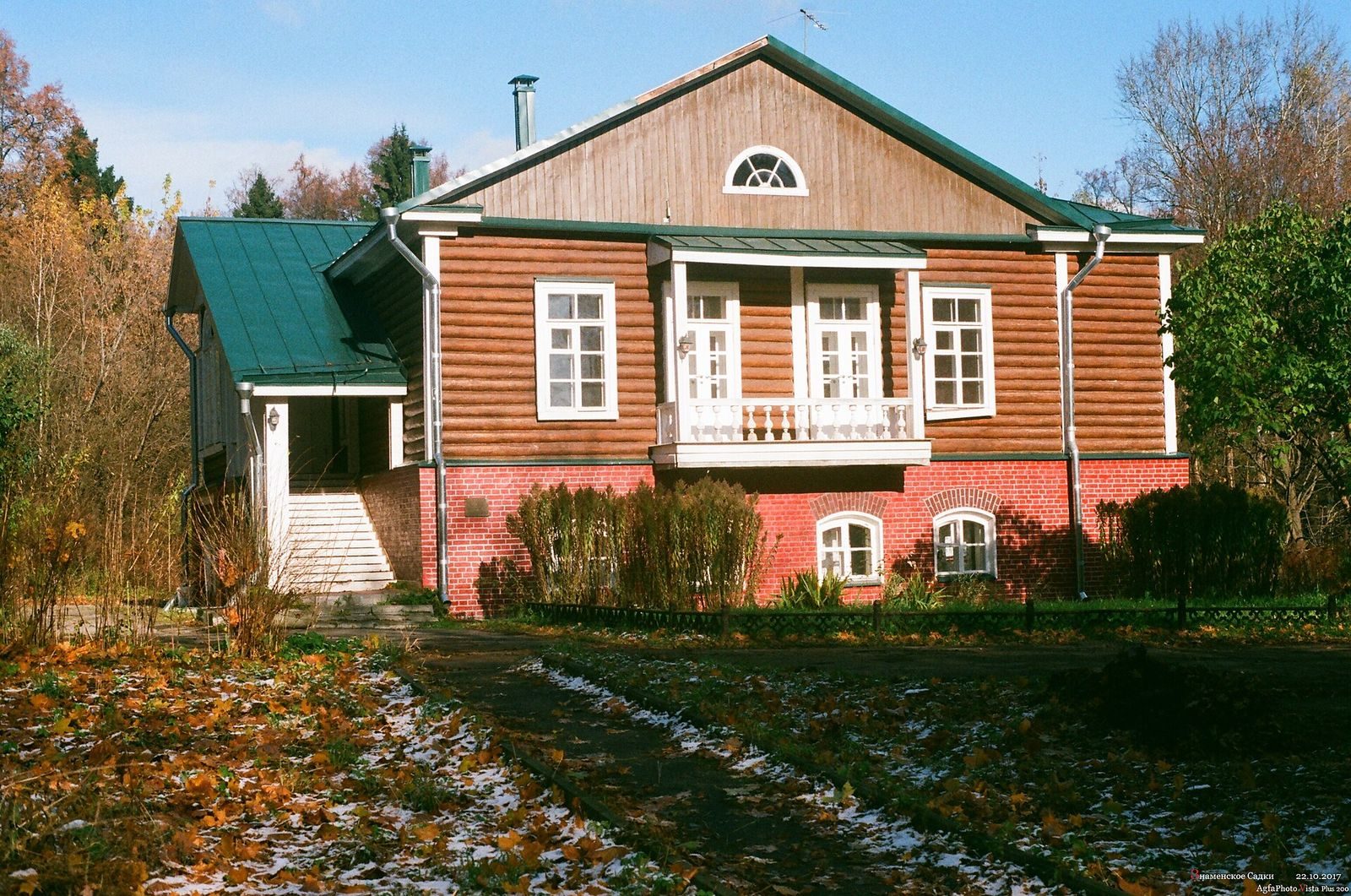
A memorial in the northern part of the park commemorates students and teachers of the Bitsevsky agricultural technical school who died in the Second World War. A plaque on the manor house honors L. K. Shaposhnikov, a nature-conservation specialist who worked there.