Holy Trinity Church in Konkovo: A Russian Orthodox Church
Site at a Glance
- Popularity
- Medium
- Country
- Russia
- Primary era
- Modern
- Eras represented
- Modern
- Civilizations
- Russian
- Site type
- Religious
- Remains
- Church
On this page8 sections
History
Foundation and estate chapel
Holy Trinity Church in Konkovo, Russia, is a Russian Orthodox church built between 1690 and 1694 in the Naryshkin Baroque style, a late-seventeenth-century Russian tradition combining established forms with elaborate Baroque-influenced decoration. Gavrila Ivanovich Golovkin, a royal bedchamber official, is identified as its principal builder; Siemion Tołoczanow, a senior Muscovite court official, is also named as a founder or builder. A record from 1694 links the new church to estates belonging to Golovkin and another court official and refers to a decree issued in 1692.
The church began as a house church, a chapel serving an estate household, and belonged to the Pekhryan church district in Moscow county. In 1747 it was described as a stone church of the Life-Giving Trinity, then owned by Count Alexander Gavrilovich Golovkin. Its original main altar was dedicated to Sergius of Radonezh, a Russian monastic leader and saint. Side chapels honored the Deposition of the Robe of the Virgin at Blachernae, commemorating the placement of a relic associated with Mary in Constantinople, and Philip of Moscow, an Orthodox metropolitan and saint. The church later took the Holy Trinity dedication. Its present main altar is dedicated to the Trinity, with side chapels for Sergius and the Deposition of the Robe.
Parish and nineteenth-century changes
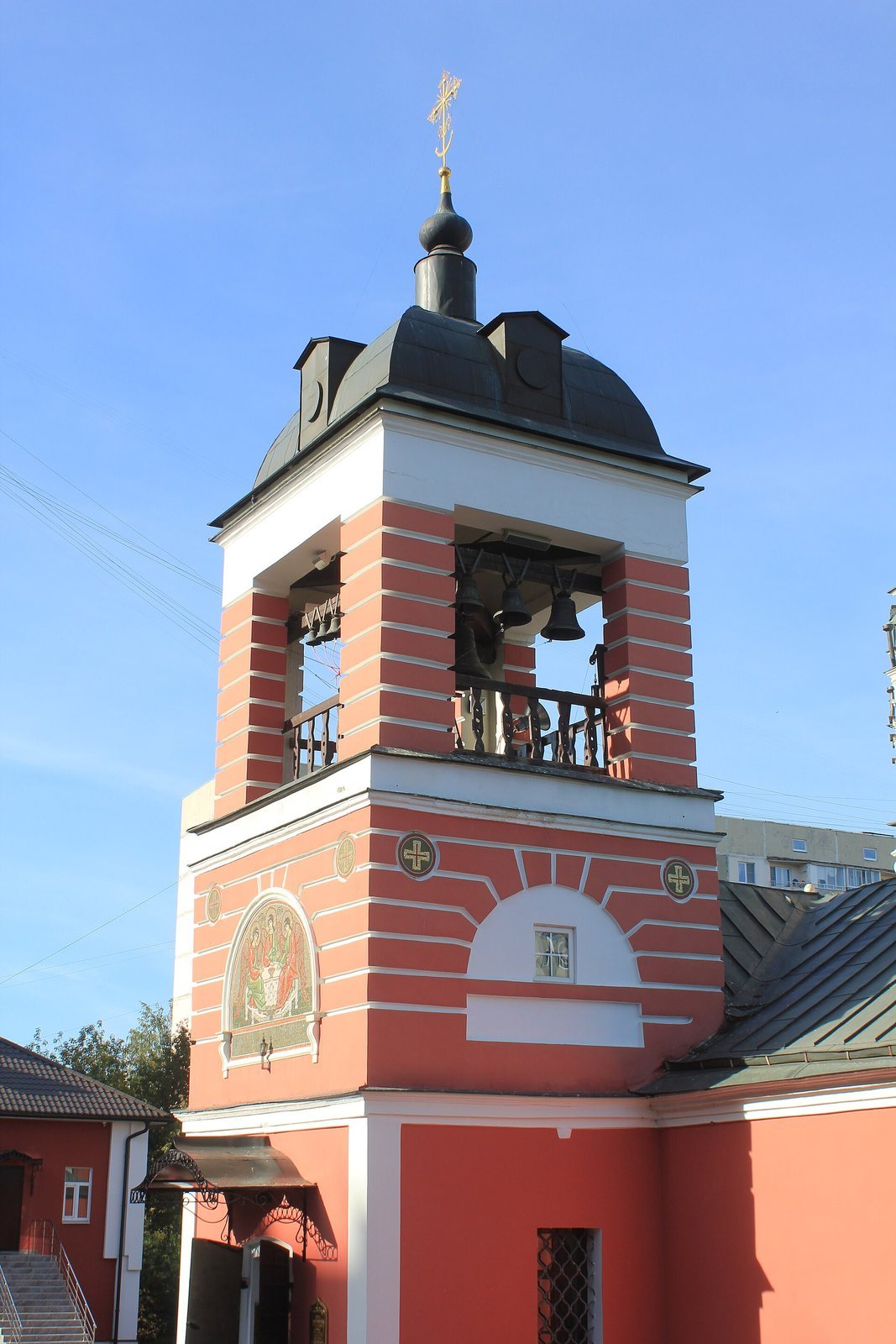
The church served the household as a private chapel until 1771. A parish was established the following year for Derevlevo and Belyaevo-Dolneye, and Konkovo joined its parish area in 1803. A refectory, a room for communal meals attached to a church, was added in 1808. The bell tower was built or altered in the early nineteenth century, though the sequence of work is unclear.
French troops destroyed the church in 1812, and the Moscow diocesan authorities decided against rebuilding it. Nevertheless, a side chapel dedicated to the Deposition of the Robe was added in 1818 with a private donation from Aleksiej Ładyżeński. Around three decades later, merchant Iwan Bakłanow funded another side chapel, dedicated to Philip of Moscow.
Closure, restoration, and renewed worship
During the 1922 confiscation of Russian Orthodox Church property, officials seized 28 items of church furnishing. The church closed in 1939 and was converted into a state-farm warehouse. It was recognized as a monument in 1960. A television technical center used the building from 1967 to 1972, followed by repairs in 1972–1973. The center ceased using it in 1982, and the building remained unused until worship resumed in April 1990. The Russian Orthodox Church regained the church in 1991.
The church is now an active parish in the Moscow Diocese and Andreevsky Deanery, and the building is a federal-level cultural heritage monument in Russia. On 12 April 2021, Patriarch Kirill established a representation of the Kishinev-Moldavian Metropolis at the church and appointed Metropolitan Vladimir (Cantarean), a senior-ranking bishop, as its rector.
Remains
Building plan and form
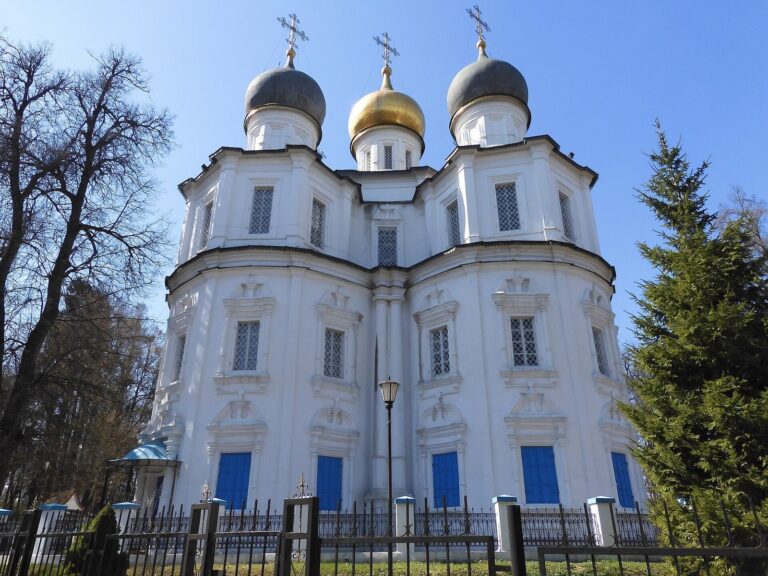
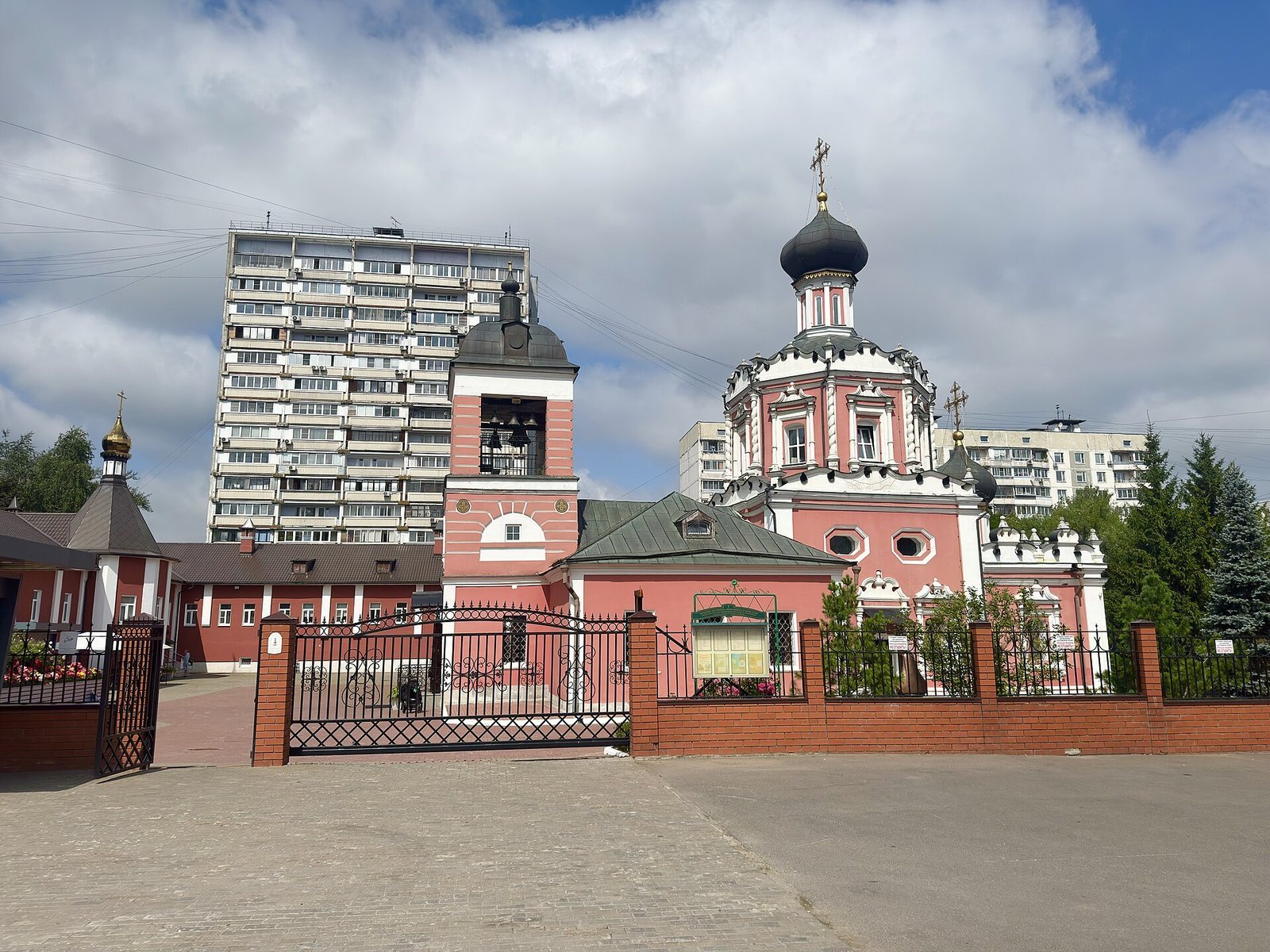
The brick church is a single-nave building, with one main worship space, arranged in an “octagon on a square” design: an eight-sided upper part rises over a square base. Its exterior has elaborate decoration, and the building is topped by an onion-shaped dome. The altar room occupies the northeast end, while the entrance is on the west. The original vestibule followed the altar room’s plan. The sanctuary faces northeast toward the Trinity-Sergius Lavra, a major Russian Orthodox monastery. The building has a main altar and two side chapels.
Later additions
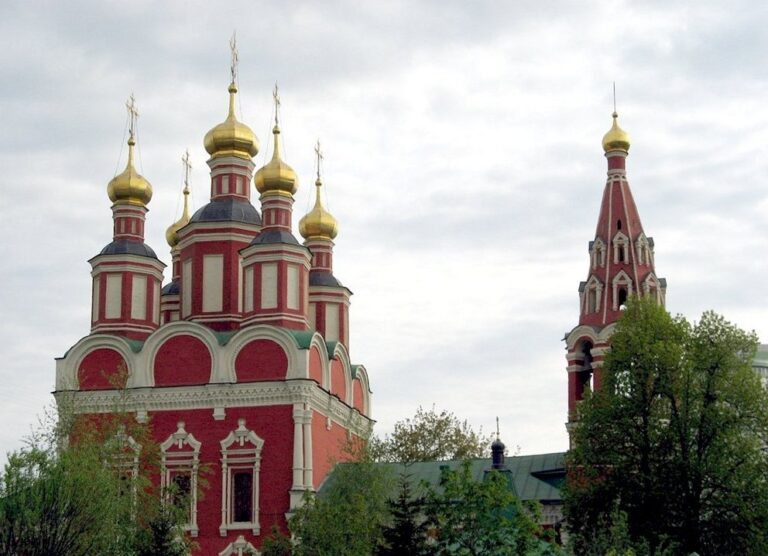
The refectory and bell tower are later additions to the church. Material from the 1812 ruins was used to build a bell tower, a guardhouse, and a gated fence beside the church. A sculpture of a guardian angel is located near the building.
Damage and repair
In 1939, crosses and bells were taken down, the central dome and its supporting drum were destroyed, and the fence was dismantled. The bell tower’s upper two tiers were taken apart, and part of the tower collapsed. After worship resumed, the dome and bell tower were restored.