Church of the Theotokos of Kazan in Uzkoe: An Orthodox Estate Church in Moscow
Site at a Glance
- Popularity
- Medium
- Country
- Russia
- Primary era
- Early Modern
- Eras represented
- Early Modern, Modern
- Civilizations
- Russian
- Site type
- Religious
- Remains
- Church
On this page9 sections
History
The estate and the church’s foundation
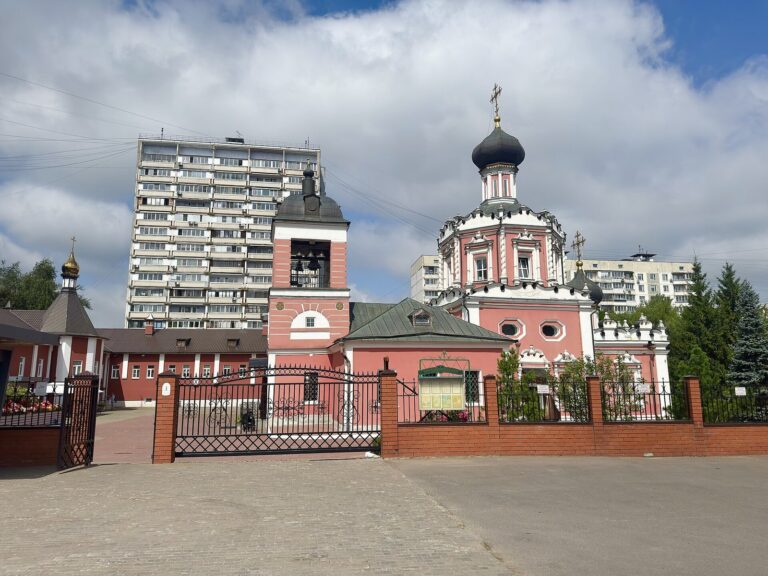
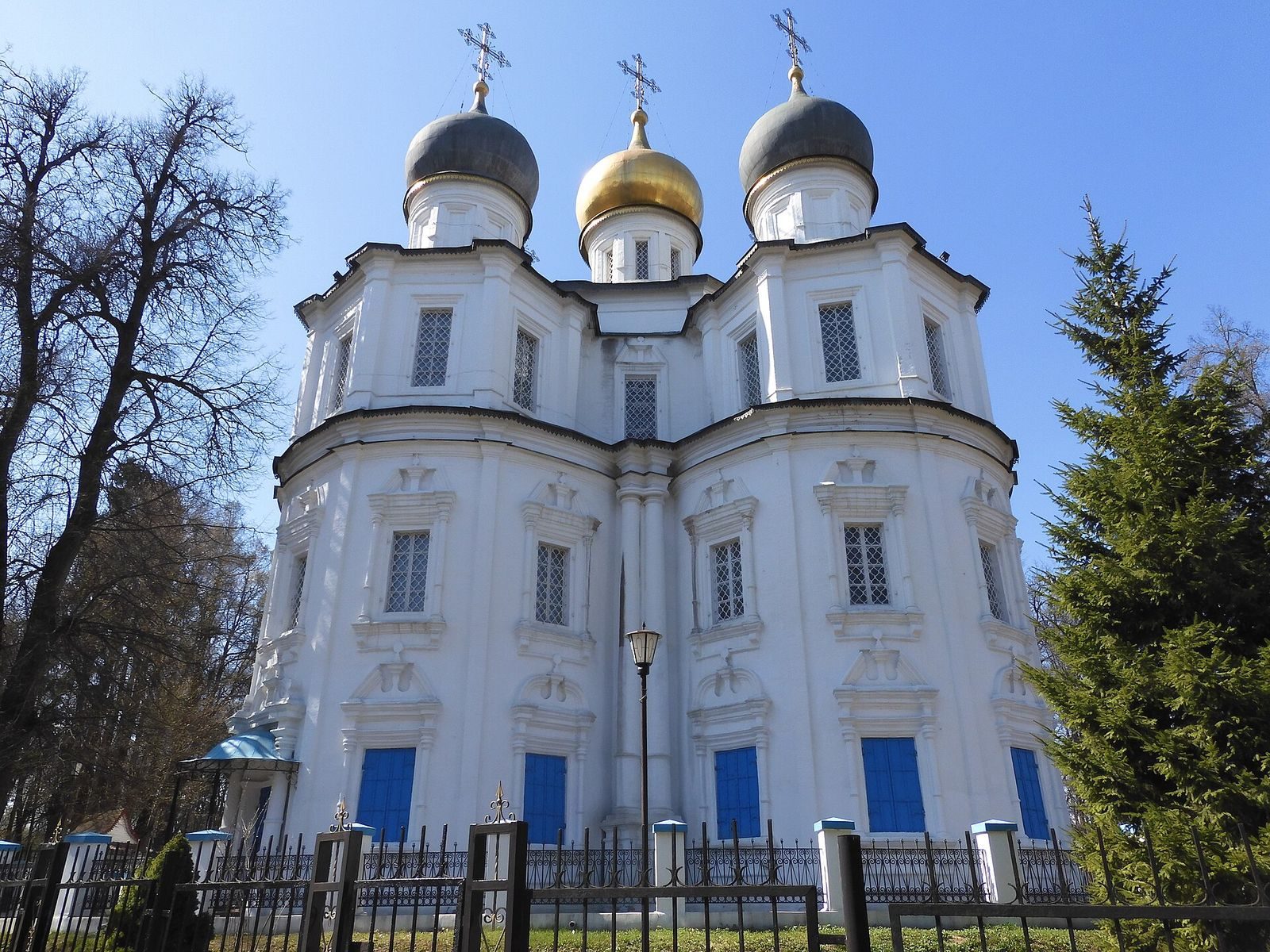
The Church of the Theotokos of Kazan in Uzkoe is an Orthodox church on the Uzkoe estate in Moscow’s Yasenevo district, Russia. The Theotokos is Mary, the mother of Jesus, in Eastern Christian usage. Commissioned by the Russian boyar Tikhon Streshnev, a member of the high-ranking aristocracy, the church was built from 1693 to 1698 in the Moscow Baroque style, a late seventeenth-century Russian architectural style. It served as a private church for the estate.
In the early seventeenth century, Uzkoe was a neglected estate held by Princes Athanasius Gagarin and Peter Ochin-Pleshcheev. Maxim Streshnev, a nobleman and cousin of Tsarina Evdokia Streshneva, bought it in the late 1620s and had established an estate there by 1641, when a wooden church on the site was first recorded. Tikhon Streshnev acquired the estate from one of Maxim’s descendants in 1692 and commissioned the present church.
Estate ownership and nineteenth-century events
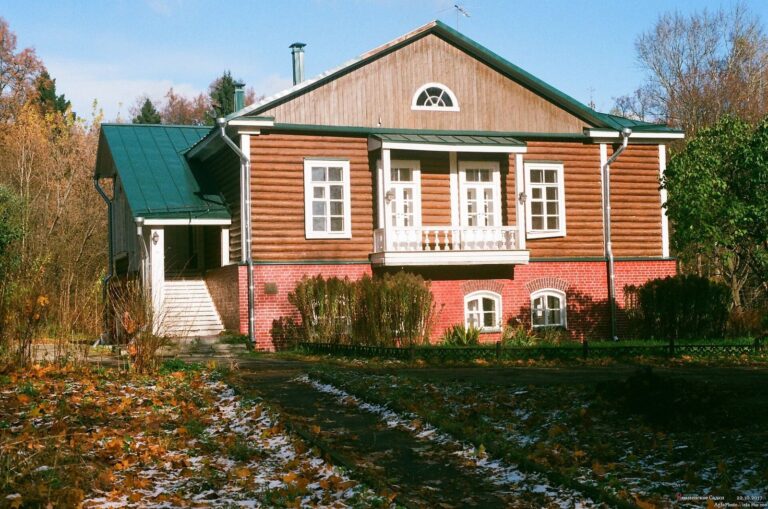
Over time, the estate passed among the Golitsyn, Streshnev, Obolensky, Neyelov, Tolstoy, and Trubetskoy families. Peter Trubetskoy had inherited it by 1883, and the Trubetskoys were its last owners.
The church suffered serious damage during the French invasion of Russia in 1812, when Napoleon’s forces entered the country. A local tradition says that Napoleon watched the retreating French army from the church’s bell tower.
Sergey Trubetskoy, a Moscow professor and friend of the religious philosopher Vladimir Solovyov, stayed at the estate in 1895 and 1900. Solovyov also visited the estate and church, and died at Uzkoe on 31 July 1900, aged 47. His body lay in the church before his burial at Novodevichy Cemetery.
Soviet use and return to worship
After the 1917 Revolution, the Trubetskoys left Russia. The estate was assigned in 1922 to the Central Commission for Improving Students’ Living Conditions, then transferred in 1937 to the Academy of Sciences of the Soviet Union, the country’s principal scientific institution. The Academy used the estate as a sanatorium for its members.
The church closed in 1930 and became a book repository. Its holdings included archives, church-service books, and books by writers subjected to political repression. Some books and archival documents had been taken from German libraries and archives at the end of the Second World War.
The Russian Orthodox Church resumed use of the building in 1990. The books were removed in 1992, after which the church was consecrated again. Restoration aimed to recover its earlier appearance, although the work also altered historic parts of the building. In 2015, a Moscow court fined the parish 100,000 rubles for unauthorized construction on the estate and breaches of the protection rules for a federally significant cultural heritage site. The church passed into Russian Orthodox Church ownership in 2022.
The church is active and belongs to the Moscow Diocese, a church administrative district, and the Paraskevo-Pyatnitsky Deanery, a smaller grouping of parishes. Its main dedication is to the Kazan Icon of the Mother of God, an Orthodox image of Mary, and its feast is observed on 22 October/4 November.
Remains
Exterior and layout
Plan and domes
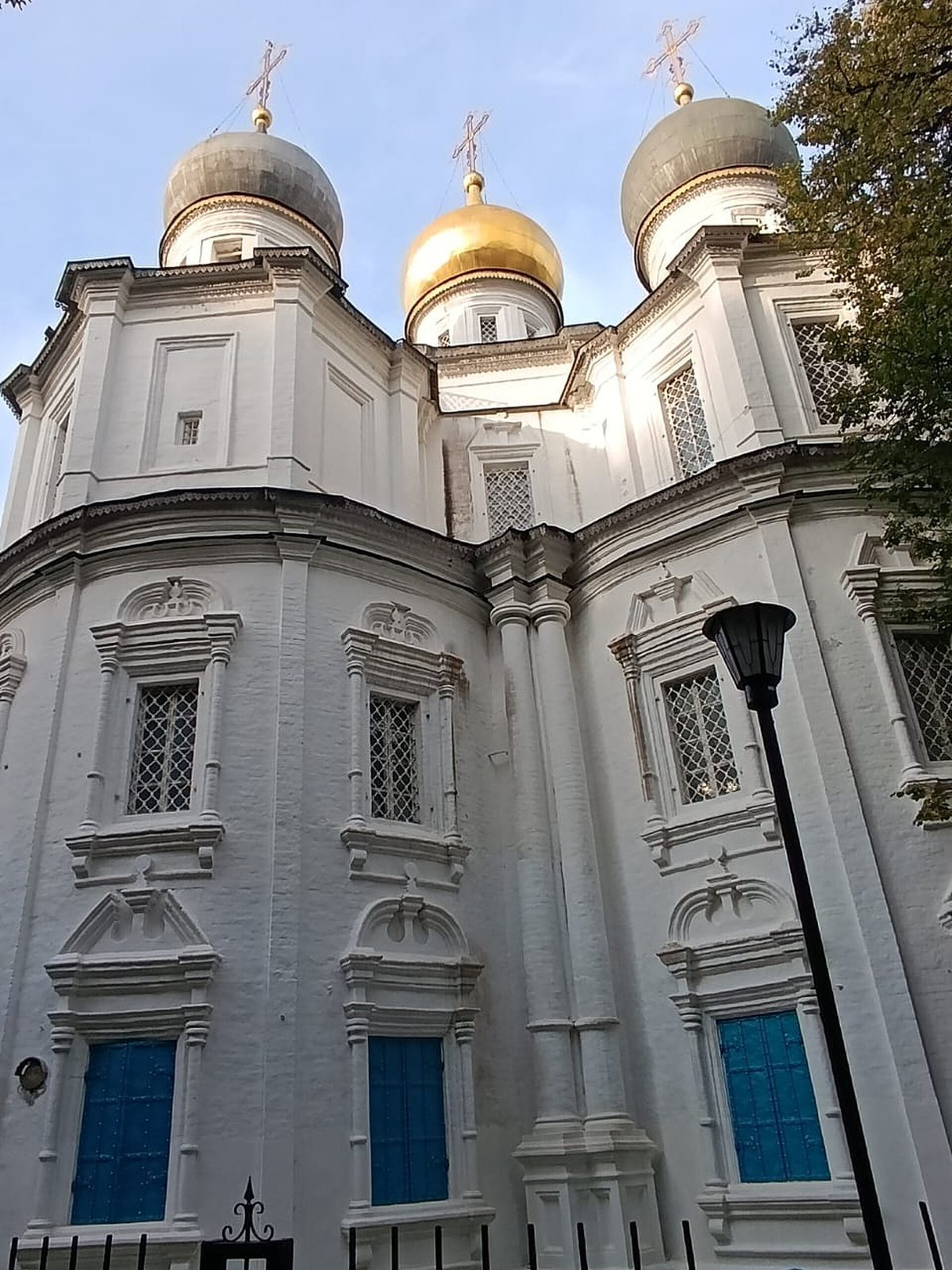
The church is built of brick, with whitewashed exterior walls, and has a cross-shaped plan with four lobed sections and five domes. Four domes face the cardinal directions above semicircular wall sections; the central dome is gilded. The five tower-like domes were originally equal in height, and the one above the entrance incorporated the bell tower. The western cylindrical base beneath a dome serves as a belfry, while its dome helps carry the sound of the bells. Bells hang in one of the western domes. Restoration in the 1970s gave the domes onion-shaped profiles, replacing elongated forms that dated from the late eighteenth century.
Porch
A white-stone porch once surrounded the church. Dating to the second half of the eighteenth century, it was removed during restoration and replaced in 1998 by a wider porch. Some of the old stones were reused in flower beds and small gardens behind the building.
Interior and altars
The main altar is dedicated to the Kazan Icon of the Mother of God. Two side altars honor the beheading of John the Baptist, a major biblical prophet, and Saint Nicholas, a Christian bishop venerated as a saint. The high interior beneath the central dome and within the side chapels contributes to the church’s distinctive acoustics, and its interior decoration is noted for its delicacy.