Vitovnica Monastery: A Serbian Orthodox Medieval Foundation in Serbia


Site at a Glance
- Rating
- 4.9
- Popularity
- Low
- Country
- Serbia
- Primary era
- Medieval
- Eras represented
- Medieval, Modern
- Civilizations
- Unclassified
- Site type
- Religious
- Remains
- Monastery
On this page13 sections
History
Vitovnica Monastery is a Serbian Orthodox monastery in Serbia, founded under the Serbian king Stefan Milutin Nemanjić around 1291 in the late medieval period. Its church is dedicated to the Dormition of the Mother of God, and the monastery belongs to the Braničevo Eparchy, the diocesan jurisdiction of the Serbian Orthodox Church. It stands on the right bank of the Vitovnica River, about 10 kilometers east of Petrovac na Mlavi, in the Kučaj area.
Foundation after the Braničevo campaign
The foundation of Vitovnica is traditionally linked to Stefan Milutin’s victory over the Bulgarian rebels Drman and Kudelin. The two men held Ždrelo in the Gornjak Gorge. Hungarian forces attacked them unsuccessfully in 1285, and Milutin’s brother, King Stefan Dragutin, later failed to defeat them without assistance. Dragutin then called on Milutin, and their combined forces captured Ždrelo and brought the Braničevo region under Serbian rule.
Vitovnica was established as Milutin’s religious endowment in thanksgiving for the victory and the recovery of the region. Its foundation is generally dated to 1291, although an establishment between 1289 and 1291 is also proposed. Another tradition associates the monastery with Armenian builders invited during the activity of Saint Sava after his visit to Armenia. This tradition is connected with an Armenian-Serbian inscription preserved at Vitovnica, although the surviving stone came from the church at Oreškovica, known as the Armenian Church.
Ottoman rule and seventeenth-century monastic life
The first written reference to Vitovnica dates from 1537, during Ottoman rule. Ottoman censuses list two monks in 1527, three in 1537, and six in 1578. The monastery’s relatively high tax assessment in 1537 indicates that it was then in sound economic condition.
In the seventeenth century, inscriptions and notes in monastic books record continuing religious and craft activity. A book written before 1620 preserves a donation note by the hieromonk Nikifor, a monk who was also an ordained priest. A Psalter bound at Vitovnica in 1661, during the abbacy of Visarion, shows that the monastery produced bindings and reinforced liturgical books with metal.
Desertion, return, and nineteenth-century renewal
The Austro-Turkish War and the Serbian migration of 1690 brought a major break in the monastery’s history. Vitovnica was probably deserted, and most of its brotherhood crossed the Danube to Bešenovo Monastery on Fruška Gora. A smaller group joined monks from Ravanica at Szentendre. Vitovnica’s property was inventoried separately at Bešenovo, where much of it remained until the Second World War.
Several monks later returned, and two were recorded at Vitovnica during a visit by an envoy of the Karlovci Metropolitan in 1733. After Austria’s defeat in 1739, the monastery was deserted again, and its monks once more withdrew to Bešenovo. References to Vitovnica then disappear until the First Serbian Uprising, when Ottoman forces reportedly burned and destroyed the monastery in retaliation for the participation of the Homolje population in the revolt.
Reconstruction began after the Second Serbian Uprising. In 1837, Pavle Matejić rebuilt the wooden outer entrance hall, while Stevan Dobrnjac repaired part of the residential quarters and made two cells and a kitchen usable. A broader revival followed under Stefan Mihajlović, Simeon Nikolić, and especially the abbot Hadži-Stefan Bojović. The church was frescoed again in 1851, three residential buildings and a bell tower were erected, and the complex was considered comprehensively restored around 1856.
The renewed monastery also became an economic and educational center. At its own expense, it established an elementary school in the village of Vitovnica in 1861. During the nineteenth century, it operated or leased a tavern and shop and managed forests, pasture, meadows, water resources, fields, vineyards, an orchard, and an apiary. Its vineyard contained 30,000 grafted vines in 1897, while its nursery held 40,000 vines. A public winter course in grafting, viticulture, and fruit growing was held there in 1898.
In 1870, Vitovnica belonged administratively to the Požarevac and Mlava districts and ecclesiastically to the Belgrade Eparchy. Four monks lived there, and the monastery’s patronal feast was the Dormition of the Mother of God. Its holdings included 1,586 hectares of forest and 77 hectares of arable land in 1889, followed by 1,652 hectares of forest and 52 hectares of fields in 1895.
Metodije Milovanović and the early twentieth century
Archimandrite Metodije Milovanović served as abbot from 1896 to 1902 and continued developing the monastery and its economy. In 1897 he founded the Serbian Beekeepers’ Society and helped establish the journal Pčelar. From 1902 he edited the church journal Besednik and wrote three books about Mount Athos and Hilandar.
During the Bulgarian occupation of the region from 1915 to 1918, Bulgarian soldiers arrested and killed the abbot Isaija Bogdanović. They looted liturgical objects and livestock and removed the relics of an unidentified Sinaitic monk buried beside the church. Sinaitic monks were Orthodox monks associated with Mount Sinai who settled in medieval Serbia and contributed to its monastic life. The relics were taken to Bulgaria, leaving the grave empty.
Destruction during the Second World War and postwar revival
German occupation authorities burned Vitovnica in 1943 in retaliation for an attack on a nearby German patrol. All residential and economic buildings were destroyed, while the church survived with a partly burned bell tower. The hierodeacon Avakum Momčilović, a monk ordained as a deacon, was arrested, sent to the Banjica concentration camp in Belgrade, and killed.
In 1945, local communist authorities killed the remaining brotherhood and confiscated the monastery’s property. Among those killed were the abbot, hieromonk Mardarije Zdravković, and hieromonk Sava Marković, who was 33 years old. After the war, Vitovnica had neither a brotherhood nor its residential and service buildings. In 1946, the church authorities appointed hieromonk Hrizostom Pajić as abbot of the burned and deserted monastery. Working without adequate shelter, he began the postwar revival and maintained monastic life during the difficult conditions of socialist Yugoslavia.
Saint Tadej of Vitovnica returned from Kosovo to the Braničevo Eparchy in 1955. He became abbot of nearby Gornjak Monastery while also taking responsibility for Vitovnica’s spiritual life, and he became Vitovnica’s abbot in 1962. Born in Vitovnica on 6 October 1914, he became a monk at Gornjak in 1935 and was ordained a hieromonk in 1937. After serving at Peć Patriarchate from 1939 and becoming its abbot in 1947, he returned to Braničevo in 1955. He died in 2003, and his grave at Vitovnica became a place of pilgrimage and popular veneration. Hrizostom Pajić, Teodor Arsić, Tadej Štrbulović, and Lazar Ranković led the partial restoration of the monastery after the destruction of the first half of the twentieth century.
Vitovnica is legally protected as an immovable cultural property and a cultural monument of great importance. Protection is administered by the Regional Institute for the Protection of Cultural Monuments in Smederevo.
Remains
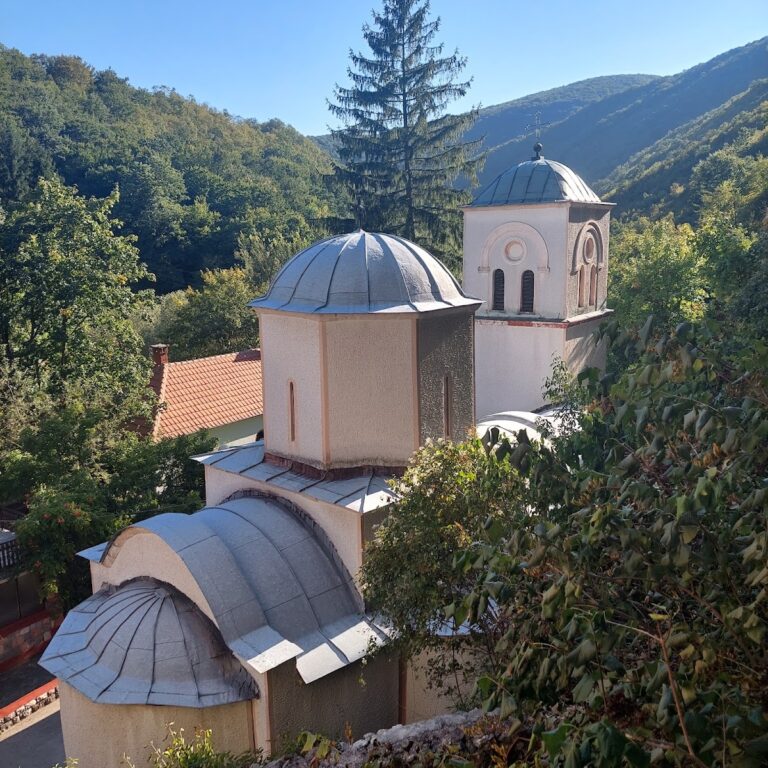
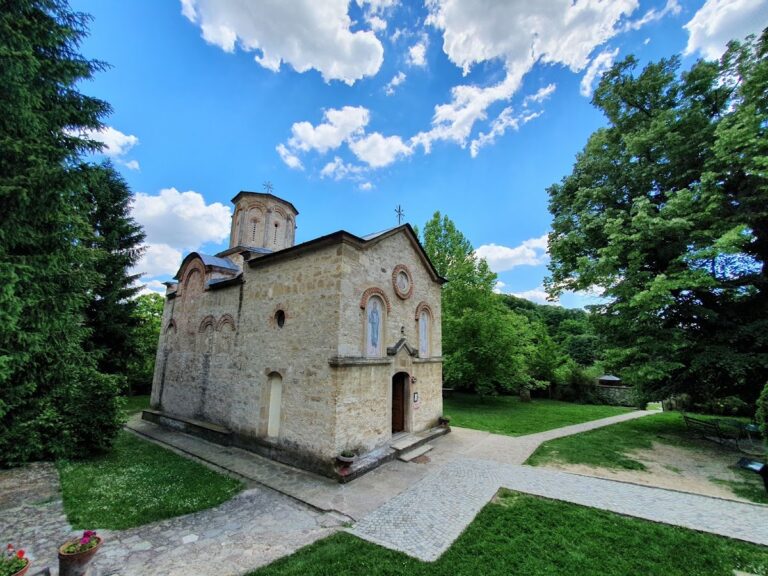
Vitovnica’s surviving core is a small church in the Morava architectural style, a late medieval Serbian tradition known for compact plans, articulated masonry, apsidal projections, blind arcades, and domes. The church has a compact three-apsed plan, with polygonal projections on the exterior and semicircular forms within. Pilasters, shallow vertical supports attached to the walls, carry the dome. The building forms a cross with pronounced altar and choir apses, and its interior is divided into an entrance hall, nave, and altar area. The outer entrance hall and bell tower belong to later additions and nineteenth-century rebuilding.
The monastery church
The church is built mainly from stone bonded with slaked-lime mortar, with only a small amount of brick. The brick is not arranged in regular horizontal courses. Beneath the moulded roof cornice, a band of blind arcades runs along the northern, eastern, and southern facades. A stone slab above the northern doorway carries an inscription in Armenian and Old Church Slavonic dated 1218. Because the slab was transferred from Oreškovica’s Armenian Church, its date belongs to the reused object, not to the construction of the Vitovnica church.
The altar apse preserves frescoes from 1856. The wooden iconostasis, the screen separating the altar from the nave, is associated with work or phases dated to 1831, 1854, and 1894. The floor was paved with stone in 1856. The outer entrance hall and bell tower were added or completed during the nineteenth-century rebuilding. The church survived the 1943 fire, although the bell tower was partly burned, while the surrounding residential and economic buildings were later rebuilt or partially restored during the postwar revival.
Burials and the monastic courtyard
Monks’ graves lie beside the church and are marked by tombstones carrying basic information about the deceased. A larger monastic cemetery occupies the courtyard and includes the grave of the nun Marina-Miloradović. The former tomb of an anonymous Sinaitic monk stood in the northern part of the central section of the church. It is empty because the monk’s relics were taken to Bulgaria during the occupation in 1915.
Books and liturgical objects
The Vitovnica Gospel
The Vitovnica Gospel is a manuscript Gospel written at the monastery in the first half of the sixteenth century. In 1557, the goldsmith Vuk Kondo bound it in gilded silver and left an inscription about his work on the upper part of the binding. The text is written in black ink, while important passages are marked in molten gold. Gold, blue, red, and green decorate its ornaments and initials, and gold dots separate the sentences. The front cover depicts the Twelve Feasts; the back shows the Dormition of the Mother of God, with a hymn inscribed around the edge.
Monks carried the Gospel to Bešenovo during the migration of 1690, and it consequently became known there as the Bešenovo Gospel. It is now preserved in the Museum of the Serbian Orthodox Church in Belgrade under inventory number 355.
The Vitovnica Cup
The Vitovnica Cup is an anaphorikon, a liturgical vessel used to distribute antidoron, the blessed bread given to worshippers after the Eucharistic service. Luka Kujundžija, a silversmith from Čiprovtsi near Kyustendil, made it in 1652. The cup is 4 centimeters high and 18 centimeters in diameter, and its figures and halos are gilded. It was transferred with other Vitovnica valuables to Bešenovo and is now preserved in the Museum of the Serbian Orthodox Church in Belgrade.
Library and surviving objects
Vitovnica once maintained a substantial library and produced copies and bindings of liturgical books. Some books were destroyed when the National Library burned during the Second World War, while other Vitovnica books and possessions are preserved in Belgrade, Kyiv, Sremski Karlovci, and Pakra Monastery. A book dated before 1620, with a donation note from hieromonk Nikifor, is held in the Kyiv library. A silver cup dated 1662 remains at Bešenovo, and the silver seal of the abbot Visarion, dated 1703, is preserved at Krušedol. Liturgical books associated with Vitovnica include Srbljak and Časlav, whose notes contain information about the monastery’s history.
Nearby sites