Ladislaus Fortress: A Medieval Danube Frontier Fortress in Romania


Site at a Glance
- Rating
- 4.2
- Popularity
- Very Low
- Country
- Romania
- Primary era
- Medieval
- Eras represented
- Medieval
- Civilizations
- Hungarian
- Site type
- Military
- Remains
- Castle
On this page7 sections
History
Ladislaus Fortress is a fourteenth-century Hungarian frontier fortress in Romania, built on the site of an earlier Dacian fortification that had later been seized by the Romans. Its first documented mention dates to 1427. Construction was completed under Sigismund of Luxembourg, a medieval ruler who was also king of Hungary, Croatia, and Bohemia and Holy Roman Emperor. He dedicated the fortress to Saint Ladislaus, the Hungarian king Ladislaus I, and assigned it to the Teutonic Order, a Christian military order that administered and defended fortified territories. The order held the fortress until 1435.
Sigismund and the Ottoman frontier
Sigismund strengthened Ladislaus Fortress in response to the Ottoman threat along the Danube. In 1427, he made an agreement with Serbian Despot George Branković concerning Golubac Fortress. Golubac’s ruler instead submitted to Sultan Murad II rather than accepting Hungarian rule, prompting Sigismund to seek stronger defenses against an Ottoman advance into the Banat, the historic frontier region between the Habsburg and Ottoman spheres.
Hunyadi and Corvinist resistance
From 1435, Romanian knights from the Banat of Caransebeș defended the fortress as vassals of János Hunyadi, a Hungarian military leader and regent known for resisting Ottoman expansion. After Hunyadi defeated Sultan Mehmed II at the Battle of Belgrade in 1456 and later died of plague at Zemun, the fortress was occupied by his most loyal warriors. They also served his son, Matthias Corvinus, who became king of Hungary in 1458.
During the civil war that followed Hunyadi’s death, Ladislaus Fortress became a strongpoint of Corvinist resistance and an important link in the Danube’s defensive line against the Ottoman Empire. Its military role ended after Hungary’s defeat by the Ottomans at Mohács in 1526. The fortress was captured and destroyed that year, and its territory was incorporated into the Temesvar Eyalet, an Ottoman provincial administrative unit. The locality later became known as Alibeg.
Later strategic importance and restoration
The area regained strategic importance after Austria liberated the Banat and the Treaty of Passarowitz in 1718 restored the Danube as the frontier between the Habsburg and Ottoman realms. Firearms had advanced by this period, making reconstruction of the old fortress unnecessary, so only a guard post was established there. The ruins then remained neglected until restoration began in 2021.
Remains
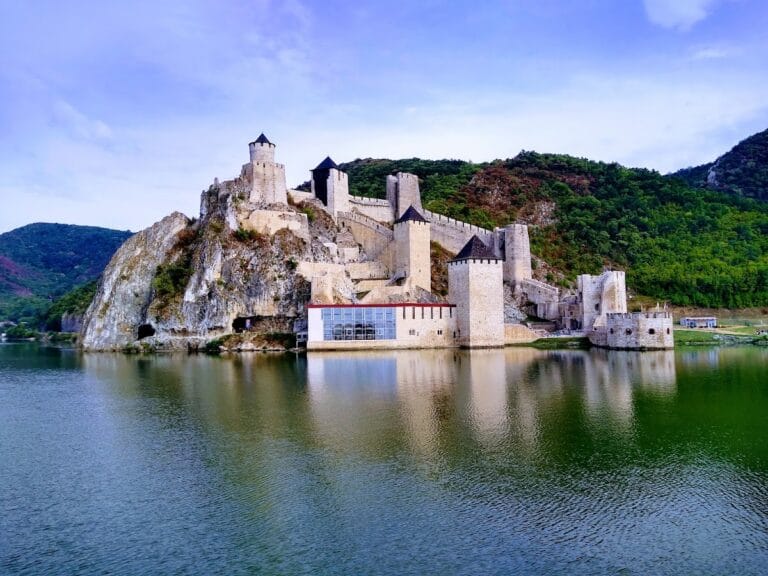
The ruins stand in the Coronini commune of Caraș-Severin County, on the Danube, with Golubac Fortress on the opposite bank. The fortification was arranged in two sections that followed the natural terrain. Its outer section had an elliptical plan, while the inner enclosure formed a triangle. The surviving remains are known as Ladislaus Fortress, Saint Ladislaus Fortress, or the Coronini keep.
Outer defenses
The northern side of the outer section was considered the most vulnerable part of the fortification. A ditch approximately nine metres wide protected it, and water from the Danube could be directed into the ditch to flood it. Access across this defensive obstacle was controlled by a drawbridge, a bridge that could be raised to restrict entry.
Inner enclosure
The triangular inner enclosure contained the principal fortified tower, or keep, at its eastern end. A round keep occupied this position, while the southern section held the entrance gate and the governor’s palace. Together, these elements formed the central defensive and administrative area within the wider outer fortification.