Gornjak Monastery: A Medieval Serbian Orthodox Monastery in Serbia


Site at a Glance
- Rating
- 4.8
- Popularity
- Medium
- Country
- Serbia
- Primary era
- Medieval
- External website
- Open
- Eras represented
- Medieval, Early Modern, Modern
- Civilizations
- Ottoman
- Site type
- Religious
- Remains
- Monastery
On this page13 sections
History
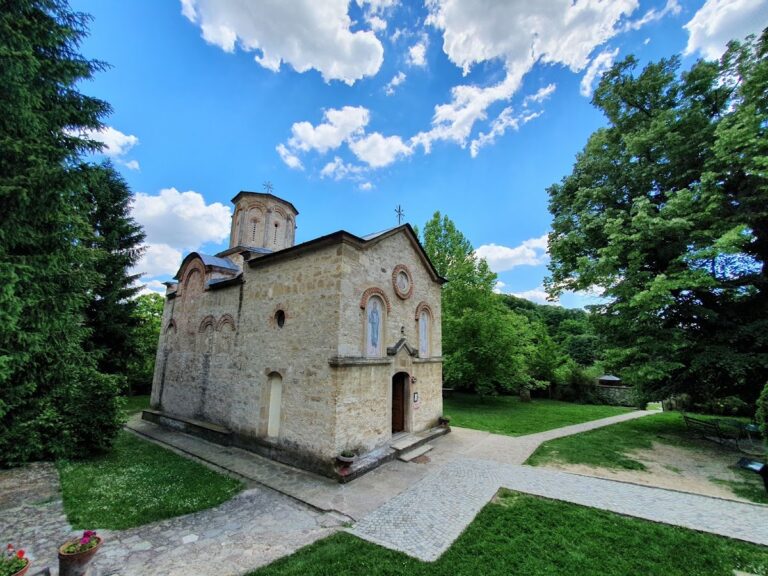
Gornjak Monastery is a Serbian Orthodox monastery in Serbia, founded by the medieval Serbian state around 1379 or 1380 in the late medieval period. Its Church of the Entrance of the Most Holy Mother of God into the Temple follows the Moravian architectural school, a Serbian tradition known for compact trefoil plans and domes. Formerly called Ždrelo, the monastery became an endowment of Prince Lazar Hrebeljanović and remains under the Eparchy of Braničevo, the diocesan jurisdiction of the Serbian Orthodox Church.
Foundation under Prince Lazar
Prince Lazar issued the monastery’s founding charter, and Serbian Patriarch Spiridon later confirmed its foundation. The original charters and surviving eighteenth-century copies were eventually lost, although the dates 1 August for Lazar’s charter and 17 May for Spiridon’s charter were preserved. Lazar dedicated the monastery to the Virgin Mary and granted it estates in Braničevo, Stig, Homolje, and the Danube region. Its foundation may also have marked his recent extension of authority over Kučevo and Braničevo.
Gregory of Sinai the Younger arrived in Lazar’s territories in 1379 with fellow monks. The group had travelled from the Christian East through Mount Athos and Paroria, and Gregory was a disciple of Romil of Ravanica. With Lazar’s financial support, the brotherhood helped establish the monastery. The institution appears to have enjoyed an unusual degree of internal independence: its monks could elect their own abbot, while the local bishop’s authority was apparently limited to spiritual matters and commemoration.
Medieval monastery and Ottoman rule
Gornjak maintained a continuous monastic presence and held a respected position during the medieval Serbian state. Around 1503, its abbot tonsured Despot Đurađ Branković’s grandson and gave him the monastic name Maksim. The monastery’s earlier name, Ždrelo, came from a fortified town of the same name. Gornjak Gorge contained older fortifications and defensive gates controlling the difficult route into Homolje. A later tradition connected the name Gornjak with a local wind.
In 1437, Despot Đurađ surrendered the towns of Višeslav and Ždrelo to the Ottomans, and many monks were displaced. During later migrations, monks carried books and valuables with them. Some former Gornjak books consequently entered other monasteries, including a 1628 collection of sermons by Gregory of Nazianzus preserved at Remeta.
Ottoman registers listed the monastery with the village of Bistrica. A census from the first half of the sixteenth century recorded six monks and an annual payment of 437 akçes, small silver Ottoman coins, to the sultan’s treasury. Later records listed eight monks and annual dues of 2,681 akçes, while a census during the reign of Murad III recorded two monks and payments of 1,000 akçes. That census contains the earliest appearance of the name Gornjak.
Destruction and rebuilding in the eighteenth and nineteenth centuries
After the Austrian occupation established by the Treaty of Passarowitz in 1718, Gornjak was found in ruins. During the eighteenth century, only one monk lived there, and the monastery possessed a vineyard of 15 acres. Abbot Maksim, mentioned in 1743, added the outer entrance hall, or narthex, and built a concealed refuge at Ključ for monks and valuables during Ottoman attacks.
Ottoman forces destroyed and burned the monastery in 1765. The monk Kyriakos then restored it. Ottoman troops burned it again in 1788 during the Kočina Krajina war, an uprising and conflict connected with Austrian attempts to expand into Ottoman lands. The destruction was reportedly linked to Abbot Isaiah’s assistance to Austrian intelligence. The monastery was rebuilt, a watermill was acquired in 1792 with the metropolitan’s intervention, and Mustafa Pasha authorized repairs to the dome in 1796.
Repairs continued during the Serbian uprisings and the restoration of Serbian rule. Karađorđe issued a certificate in 1812 confirming the monastery’s right to use its mountain and land, while Prince Miloš contributed substantially to its restoration and maintenance. Milutin Petrović, the brother of Hajduk Veljko, donated a hanging lamp. Floods repeatedly hindered recovery, and a severe flood in 1825 destroyed the residential quarters.
During the nineteenth century, Gornjak, together with Studenica and Saint Roman, served as a sanatorium for mentally ill patients. It also held prisoners, including convicted clergy. The Russian Church gave Gornjak a small monastery in Moscow, whose administrator was the Gornjak abbot Sava, who later died there. Other notable members of the community included Sava, a professor at the Belgrade Lyceum, Dositej Novaković, later Bishop of Timok, and Bishop Sava Andrić of Braničevo.
Wartime losses and modern monastic life
During the First World War, Bulgarian forces removed or destroyed monastic valuables, including Lazar’s charter, a gold chalice, a banner attributed to Emperor Stefan Dušan, and the bells. A tradition holds that a merchant rescued Lazar’s charter and a cross from being burned in Petrovac. The Second World War brought further destruction. The superior, Hieromonk Mardarije Zdravković, was interned in Germany and died in a camp, while the brotherhood dispersed. German forces occupied the monastery buildings from 1943 until the end of the war, and wartime plunder and burning destroyed valuable treasury and library materials, including copies of the founding charters.
After the war, the Yugoslav Army took over the monastery and retained it until 1953, when it was returned to the Eparchy of Braničevo and monks moved back in. The Holy Synod of the Serbian Orthodox Church later converted Gornjak into a women’s monastery. A Macedonian sisterhood led by Abbess Nadežda Lukijanjuk entered the community because it did not wish to remain within the so-called Macedonian Church.
In December 2021, part of the brotherhood from Tuman Monastery, led by Protosyncellus Petar Bogdanović, moved to Gornjak. Petar was elected and consecrated vicar bishop of Toplica in 2022. The current abbot is Hieromonk Gavrilo Stević. Gornjak is a protected cultural monument of Serbia. The Serbian poet and painter Đura Jakšić visited the monastery and wrote The Journey to Gornjak and The Night at Gornjak.
Remains
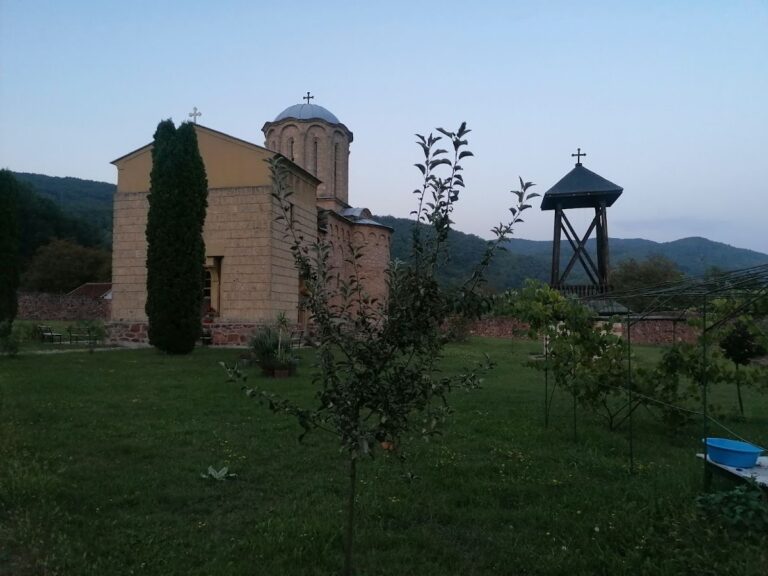
Gornjak stands on a small plateau above the left bank of the Mlava in Gornjak Gorge, beneath the steep cliffs of Mount Ježevac. The church is attached to the rock and occupies the central position in the small monastic courtyard. The surviving complex includes the main church, the Chapel of Gregory of Sinai, the Winter Chapel, the Chapel of Saint Elijah, old and new residential quarters, a one-storey building for the spiritual director and guests, and a refectory for worshippers attending major feasts.
Church and courtyard buildings
Main church
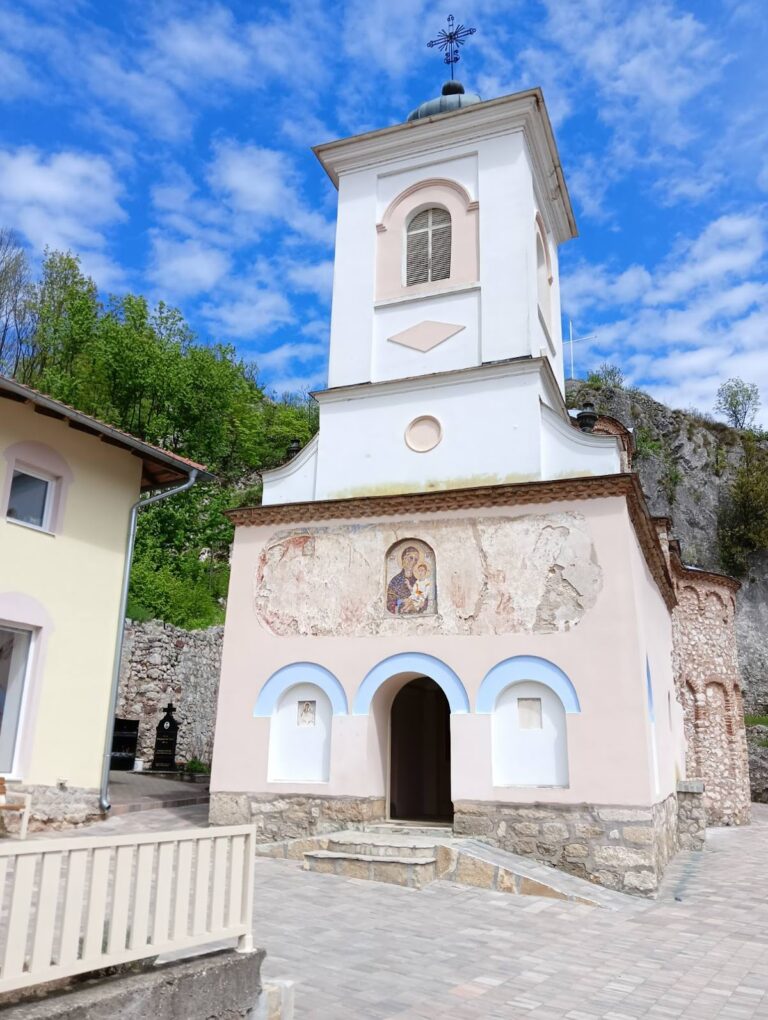
The main church follows the Moravian school and has a trefoil, or triconch, plan. Its single nave measures approximately 14 by 4.5 metres, with a semicircular eastern altar apse and smaller apses for the choir on the north and south sides. Four pilasters support the square base of the dome, which carries an octagonal drum. The roof is covered with lead. A narthex was added to the west and south sides, followed by a bell tower and porch. The outer narthex belongs to the eighteenth century, while the bell tower and porch are later additions.
Fires, warfare, and exposure after Ottoman forces removed the lead roof damaged the original fresco decoration. Surviving paintings date mainly from the eighteenth and nineteenth centuries and include a portrait of Prince Lazar and images of holy warriors in the choir apses. In 1847, Živko Pavlović of Požarevac repainted or overpainted the wall paintings. The iconostasis, the screen of icons separating the sanctuary from the main worship space, was made in Ohrid in 1935 by Timotej Polebzej. Its icons were painted at Rakovica Monastery in 1937 by Slobodan Lazarević and Milosav Jović.
Residential quarters and chapels
The Winter Chapel occupies the narthex added to the south side of the main church. The Chapel of Saint Elijah is situated in the new residential quarters. The old residential building is a single-storey structure measuring approximately 24 by 6 metres. Built in 1963, it contains a kitchen, refectory, and modest monastic cells. The new residential quarters were built and consecrated in 1979 and provide approximately 200 square metres of usable floor area.
Gregory of Sinai’s cliffside hermitage
Cave chapel
The Chapel of Gregory of Sinai is a hermitage, a secluded residence for a monk pursuing a solitary or semi-solitary ascetic life, formed in a cave within the steep cliff above the monastery. Gregory enlarged the cave into a monastic cell and chapel dedicated to Saint Nicholas. He was buried there in a tomb prepared during his lifetime.
The chapel walls were originally covered with frescoes. Time, moisture, and later whitewashing damaged most of the decoration, while some paintings remain discernible. The surviving frescoes are attributed to an artist probably from Kratovo who also worked at the Church of Saints Peter and Paul at Orlica and at Prohor Pčinjski Monastery. Ottoman records mention the cave in 1467 as the Monastery of Saint Nicholas at Ždrelo, which paid 200 akçes annually.
Relics and later use
A niche in the northern wall of the main church contains a reliquary with the relics of Gregory of Sinai the Younger, also called Gregory of Gornjak and Gregory the Silent. During periods of Ottoman danger, the relics were moved through Oreškovica, Hopovo, and Vojlovica monasteries. During the Second World War, they were kept in the cathedral church at Požarevac before returning to Gornjak.
After Ottoman administrative control was established, the Braničevo subaşı, an Ottoman local military-administrative official, Ali-beg Mihaloğlu, converted the cave chapel into his personal residence. The monastery then became a seat of Ottoman authority, although monks continued to live there and the chapel continued to pay its tax. The chapel was later returned to the monks when the Ottoman frontier moved northward.
Rebuilding of the church
The monastery was repeatedly rebuilt after destruction. Work on the church began in 1953 on the foundations of the fourteenth-century building, and the rebuilding is associated with the priest-monk Vasilije. This later fabric forms part of the surviving complex alongside the medieval plan, the cliffside hermitage, the chapels, and the twentieth-century residential buildings.
Nearby sites