Castello Visconteo: Lodi’s Medieval Defensive Fortress


Site at a Glance
- Rating
- 4.2
- Popularity
- Very Low
- Country
- Italy
- Primary era
- Medieval
- Eras represented
- Medieval, Early Modern, Modern
- Civilizations
- Duchy of Milan, Habsburg, Holy Roman Empire, Italian
- Site type
- Military
- Remains
- Castle
On this page8 sections
History
Castello Visconteo is a medieval defensive fortification in Lodi, Italy, founded in the twelfth century by Emperor Frederick Barbarossa near the city gate on the road to Milan. It served imperial forces during the conflict with Milan and the Lombard League, an alliance of northern Italian communes opposed to imperial authority, including the attack on Milan in 1162.
Imperial and Visconti phases
The castle stood near the former Porta Regale, the most vulnerable of Lodi’s three original gates because it faced the Milan road. Access was provided through the Porta Imperiale. More than a century after its foundation, the fortification was adapted by Napo della Torre, a Milanese political leader involved in the city’s thirteenth-century power struggles.
Members of the Visconti family acquired the castle during their expansion in the first half of the fourteenth century. Bernabò Visconti ordered a major reconstruction between 1355 and 1370, greatly enlarging the fortress and giving it four towers and deep underground dungeons. The Visconti were the ruling family and later dukes of Milan.
Strengthening and artillery adaptation
In 1416, Filippo Maria Visconti strengthened the inner ravelin with a fortified stronghold outside the main walls. A ravelin is a detached defensive work placed beyond a fortress entrance to hinder direct attack. After the surrounding marshland was reclaimed, Francesco Sforza, the duke of Milan who succeeded the Visconti dynasty, added a round tower at the northern corner in 1456.
Between the sixteenth and eighteenth centuries, the defensive system was modified for artillery warfare. The walls were thickened, and bastions, projecting artillery structures built into or attached to defensive walls, were raised to keep enemy guns farther away from the fortress.
Demolition and later use
During the Austrian rule of Joseph II, the Habsburg ruler whose administration governed the area, a major demolition programme began. The moats were filled, the drawbridges removed, and an entire side of the castle demolished. The remaining structure was converted into a barracks, and by the early nineteenth century it had lost its original appearance and military function.
Castello Visconteo now serves as the headquarters of the Questura of Lodi, the provincial headquarters of the Italian State Police and an office of the Ministry of the Interior. Exploration of its underground passages began in the 2000s through the initiative of a private association, although investigation remains difficult because much of the system was buried or walled up during the 1950s.
The uncertain gallery tradition
The castle and its underground remains are linked to an unproven hypothesis that galleries once crossed Lodi through the outer and inner ravelins. The proposed routes may have led outside the city walls and toward the centre, in the direction of the churchyard of Piazza della Vittoria. They were thought to provide escape routes during attacks and to enable surprise attacks against forces occupying parts of the city. Their original extent cannot be established because the passages were repeatedly altered, while some sections may have been incorporated into cellars and private properties in the historic centre.
Remains
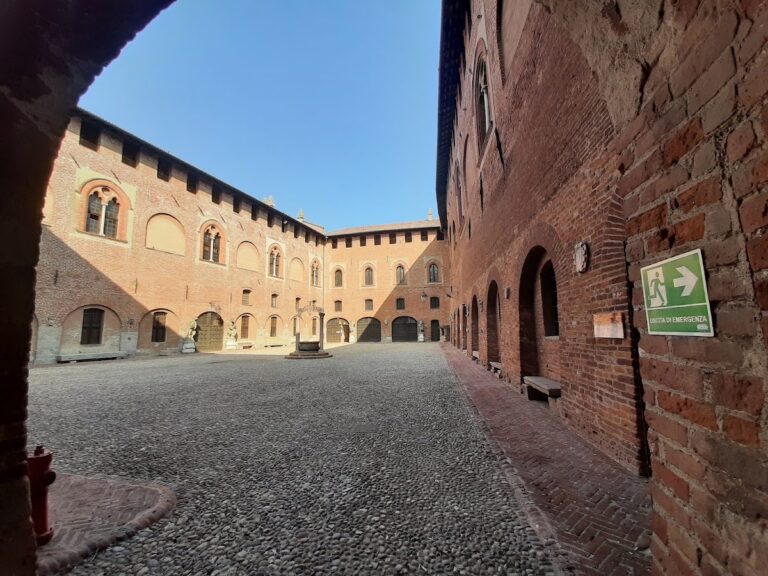
The surviving fortress retains three sides of the former castle. Its medieval defensive fabric was later altered by artillery improvements and by the conversion to a barracks. The remaining sides were fitted with porticoes topped by two levels of open-sided galleries, or loggias, while the original moats and drawbridges were removed during the eighteenth-century demolitions.
Northern towers
At the northern corner are two structures from different phases of the fortress. A square-plan tower belongs to the earlier castle, while the round tower added by Francesco Sforza in 1456 was designed by the engineer Serafino Gavazzi. Known as the Torrione, the round tower was raised in 1906 to contain the municipal water-supply reservoir. It later became one of Lodi’s landmarks.
Underground passages
Passages have been found approximately six metres below the castle, probably forming part of the outer ravelin. Some reach 2.70 metres in height, enough to allow a mounted person to pass, and some sections extend across two interconnected levels. The wider gallery system proposed for the outer and inner ravelins remains uncertain in both extent and continuity. Later cellars or private buildings may contain sections of the passages.
Nearby sites