Golubac: A Medieval Fortress on Serbia’s Danube Frontier


Site at a Glance
- Rating
- 4.7
- Popularity
- High
- Country
- Serbia
- Primary era
- Medieval
- External website
- Open
- Eras represented
- Classical, Medieval
- Civilizations
- Byzantine, Hungarian, Ottoman, Roman, Serbian
- Site type
- Military
- Remains
- Castle
On this page16 sections
History
Golubac is a medieval fortified town in Serbia, about 4 km downstream from the modern town of Golubac, at the entrance to the Iron Gate gorge. Developed in the late 13th and early 14th centuries, probably by a local Serbian or Orthodox noble, it occupied a frontier position where river and land traffic could be regulated and taxed. Its location made it an important military outpost in the contested borderland between the Kingdom of Hungary and the Ottoman Empire.
Roman and medieval foundations
The fortress stands on the remains of an earlier Roman settlement identified as Vico Cuppae. Later Roman and Byzantine occupation is reflected in archaeological remains, while the wider region passed through several political phases. It belonged to the First Bulgarian Empire from 803 to 1018, the Byzantine Empire from 1018 to 1193, and the Second Bulgarian Empire from 1193 to 1257. Afterward, Serbs, Hungarians, and Bulgarians contested the area before the Ottoman conquest.
The founder and precise beginning of the medieval fortress remain uncertain. Most of its construction is generally placed in the early 14th century, although archaeological, architectural, and historical evidence points to development during the second half of the 13th and the opening decades of the 14th century. One tradition credits the Serbian king Stefan Dragutin with building it in 1286. Another attributes its construction to the Hungarians after their conquest of part of the Braničevo region. Neither explanation is confirmed. A Serbian Orthodox chapel incorporated into one of the towers indicates that at least the earliest part may have been built by a local Serbian or Orthodox noble. The chapel is probably connected with the period of Despot Stefan Lazarević in the first half of the 15th century.
Hungarian and Serbian rule
Golubac first appears in Hungarian records in 1335, followed by references from 1337 and 1342. It was associated with the rule of King Louis I of Hungary and described as a stone watchman guarding the gorge. Between 1345 and 1355, Serbian Tsar Stefan Dušan visited the Braničevo region and Golubac, which was then under Hungarian control and commanded by Castellan Toma, Voivode of Transylvania.
After Stefan Dušan’s death, the Rastislalić family established power in Braničevo. In 1379, Prince Lazar of Serbia expelled the last Rastislalić feudal lord, Radič Branković, and granted nearby villages as monastic estates. Golubac was under Serbian control by the time of the Battle of Kosovo in 1389, a conflict that reshaped the political balance of the central Balkans.
Following the battle, Sultan Bayezid I captured Golubac in its first Ottoman occupation. The fortress changed hands twice in 1391. The Hungarian count Péter Perényi of Timișoara seized it and soon lost it again to the Ottomans, after which it returned to the Kingdom of Hungary.
The fief of Stefan Lazarević
In 1403, King Sigismund of Hungary granted Golubac and Belgrade as personal fiefs to Despot Stefan Lazarević. Stefan was a Serbian ruler who had entered the highest rank of the Hungarian Order of the Dragon. An agreement in 1426 provided that Golubac, Belgrade, and Mačva would return to Hungary after his death.
When Stefan died in 1427, the fortress commander, Voivode Jeremija, demanded 12,000 ducats from Sigismund as compensation. After Sigismund refused, Jeremija surrendered Golubac to the Ottomans, who made it a pasha’s residence. Đurađ Branković attempted to persuade Jeremija to return the fortress, but the effort failed and was followed by the Battle of Golubac in 1428.
The Battle of Golubac and Ottoman control
Sigismund attacked the fortress in 1428 with approximately 25,000 infantry, 6,000 Wallachian archers commanded by Prince Dan II, 200 Italian artillery pieces, Polish cavalry, and river vessels. Sultan Murad II arrived to relieve the Ottoman garrison. After Sigismund agreed to a treaty and part of the Hungarian army began withdrawing, the Ottoman commander Sinan Bey attacked the retreating forces. Many soldiers were killed or captured, including the Polish knight Zawisza Czarny.
Cecília Rozgonyi intervened and rescued Sigismund. The king later granted her and her brothers hereditary rights in Golubac. The fighting after Stefan Lazarević’s death also caused extensive damage in southern and eastern Serbia, including at Daljša Monastery near the fortress. A monk from Daljša later referred to Sigismund as “our Emperor,” contrasting him with the Turkish “pagan emperor.”
The Ottomans retained Golubac during their occupation of the Serbian Despotate. The Peace of Szeged in 1444 restored the Despotate and included the fortress within its redefined territory, but the Ottomans recaptured it after Đurađ Branković died in 1456. Matthias Corvinus of Hungary regained Golubac in 1458 and lost it to Sultan Mehmed II later that same year.
In 1481, the Hungarian commander Pál Kinizsi raided the Ottoman-held fortress with an army of approximately 32,000 men. About 1,000 Ottoman cavalrymen were killed or captured, 24 ships were sunk, and Mihaloğlu İskender Bey, the Ottoman pasha of Smederevo and commander of the army, was beheaded at the gate. The raid produced no lasting territorial gain. The Ottomans soon retook Golubac and strengthened its defenses.
Later occupations and modern preservation
The Habsburg monarchy held Golubac from 1688 to 1690 and again from 1718 to 1739. Serbian rebels controlled it during Kočina Krajina, the Serbian uprising against Ottoman rule in 1788–1791, and during the First Serbian Uprising from 1804 to 1813. The fortress then returned to Ottoman control until it was transferred to Serbian Prince Mihailo Obrenović III in the late 1860s.
During the Ottoman period, a civilian settlement developed in front of the fortress. In the 18th century, Golubac was described as a prosperous town, and partially investigated structures survive from that settlement. After the First World War, a major road was driven through the fortress using both carriage gates. The main entrance gate was demolished without prior documentation, and heavy vehicles continued to pass through the fortification. Around 1925, a contractor permitted to extract stone near the old town began removing stone from the fortress itself, although the local district administration opposed the work.
Construction of a hydroelectric dam in the Iron Gate gorge between 1964 and 1972 raised the Danube’s water level and flooded the lowest parts of Golubac. Archaeological and conservation work began in 1969 and continued until 1987, with delays caused by insufficient funds. By the early 21st century, neglect, vegetation, rotting wooden access structures, quarrying, and the raised water level had made much of the upper fortress inaccessible and made entry unsafe.
Vegetation removal and repairs began in spring 2005, clearing much of the moat and forward compound and repairing the fountain dedicated to Zawisza Czarny. A broader revitalization project began in 2012, followed by principal reconstruction works in summer 2014 as part of the European Union-supported Cultural Route: Fortresses on the Danube project. A 152 m tunnel, built through controlled blasting, opened in July 2017 and diverted vehicles away from the fortress. The road had passed through the site since the 1930s. Golubac was fully reconstructed and ceremonially reopened on 29 March 2019.
Golubac was declared a Cultural Monument of Exceptional Importance in 1979 and is protected by the Republic of Serbia. It has its own state administration, a distinction shared among Serbian cultural monuments only with Belgrade Fortress. On 21 August 2022, lightning struck the Hat Tower, damaging roof shingles and electrical equipment in much of the complex.
Remains
Golubac occupies high cliffs on the Danube where the river narrows into the Iron Gate gorge. The fortress has an irregular plan adapted to the rocky terrain and is arranged in three principal compounds: the upper compound with the citadel, the rear compound, and the forward compound. Ten towers, two large carriage gates, a palace, and walls generally 2–3 m thick form the surviving fortification. In the medieval period, a strong chain extended from the fortress to Babakaj, a rock on the opposite bank, allowing the garrison to control river traffic.
The three fortified compounds
Upper compound and citadel
The upper compound is the oldest part of Golubac. It contains the nearly rectangular citadel, Tower 1, which served as the keep or donjon, and Tower 4. A narrow route runs between the outer wall and the rock supporting Tower 1 before reaching the citadel. Its final section is less than 1 m wide, with cliffs dropping about 5–6 m toward the citadel on one side and several tens of metres toward the Danube on the other.
A path parallel to the wall links the area between Towers 1 and 3 with a gate into the citadel. A rain-fed reservoir is cut into the rock beneath Tower 1, while a projecting terrace stands between Tower 4 and Gate IV. Gate IV lies about 2 m above ground level beside Tower 3 and is reached by stairs before leading into the upper compound.
Rear compound
A wall connecting Towers 2 and 4 separates the rear compound from the upper compound, together with a steep rock formation about 3–4 m high. Building VII, beside Tower 5, probably served as a military barracks and ammunition store. From Tower 5, another wall runs roughly parallel to the river toward the rock supporting Tower 2. Changes in the Danube’s water level can allow boats to enter or pass close to Building VII.
Forward compound
The forward compound is divided into lower and upper sections by a wall linking Towers 4 and 7. Its lower section contains Entrance II, guarded by Towers 8 and 9, and another carriage gate leading toward the rear compound. A channel beside the route is approximately 0.5 m wide and 0.75 m deep before turning into a steep descent.
Gate III in the dividing wall connects the lower and upper sections. A path in the upper section leads to Gate IV. Tower 10 stands at the outer end of the lower forward compound and is connected to Tower 9 by a low wall. Added by the Ottomans as a low artillery tower, it controlled movement along the Danube and guarded the entrance to a harbour probably located between Towers 5 and 10. The forward wall, designated Wall I, also formed the outer side of a moat connected to the Danube and probably supplied with water from it. Partially investigated remains of the civilian settlement survive outside the fortification.
Towers, gates, and defensive construction
The main towers
The first nine towers rise approximately 20–25 m. Their internal floors and stairs were made of wood, while external stairs were built of stone, with steps less than 60 cm wide. Towers 1, 2, 4, 5, and 10 are enclosed on all four sides and built entirely of stone. Towers 3, 6, 7, 8, and 9 have open sides facing the interior of the fortress.
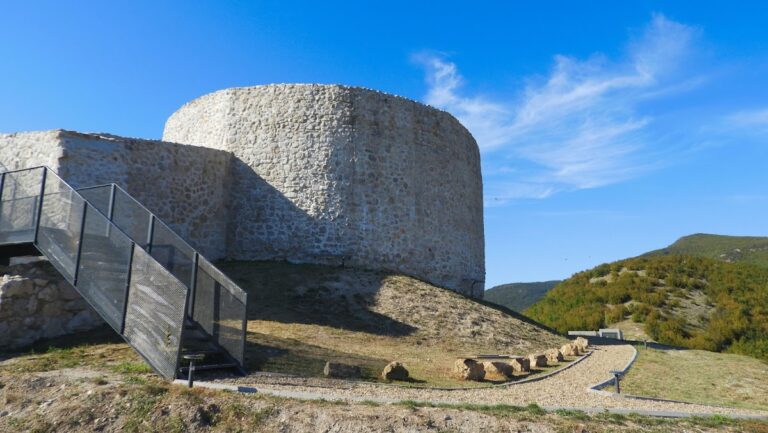
Tower 1, also known as the Hat Tower, has an eight-sided base, a circular upper section, and a square interior. It functioned as both citadel and donjon. A doorway opens onto a terrace protected by a parapet, from which access continues into the circular upper part. Stone stairs run around the square interior to the summit.
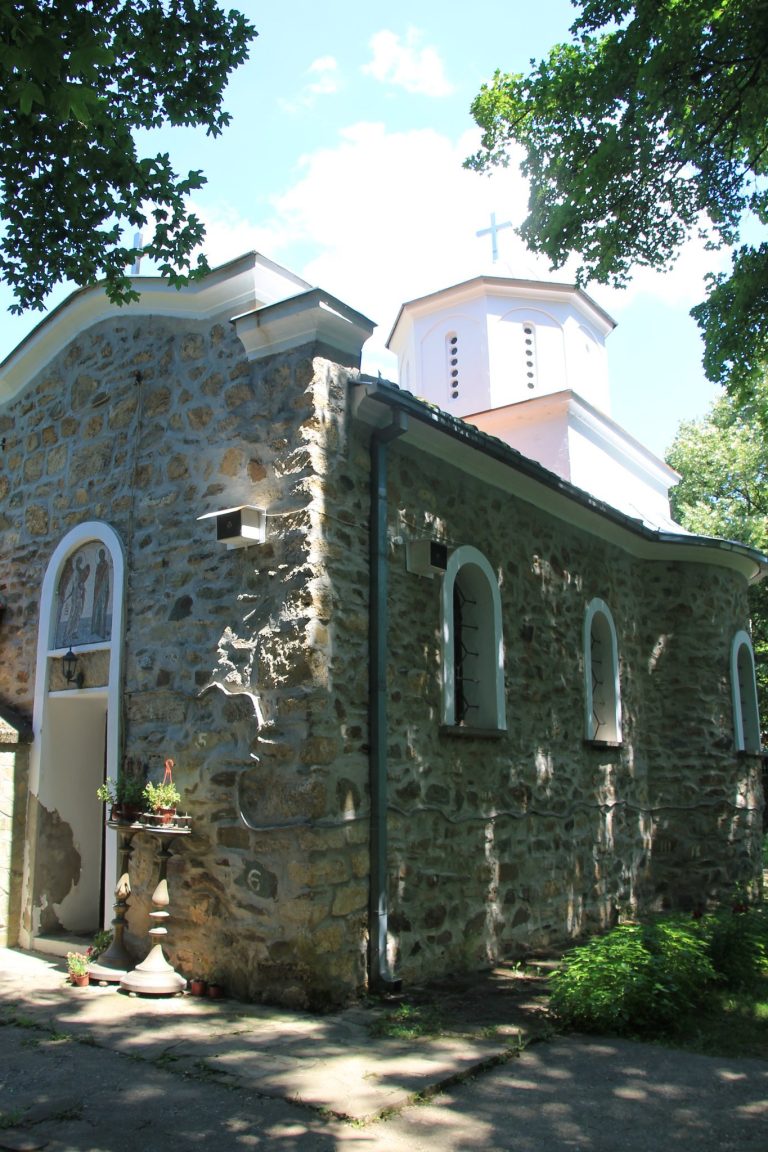
Tower 2, west of Tower 1, is entirely circular and built of stone. Tower 3 has a square base with its open side facing north toward the donjon, and its upper floor contains a terrace overlooking the Danube and the entrance to the Iron Gate gorge. Tower 4 has a square base and contains the Serbian Orthodox chapel on its ground floor. Tower 5 is completely square, with an entrance in the wall joining it to Tower 4, reached by stone stairs.
The western and forward towers
Tower 6 has a square base reinforced externally by an irregular six-sided structure. Tower 7 has a square base strengthened by a circular outer foundation. Tower 8 has an irregular, generally square base and is the shortest of the first nine towers. A cannon opening strengthened its defenses near the forward gate. Tower 9 has a square base reinforced by an eight-sided outer structure.
The earliest towers were rectangular or square, reflecting a period when close combat with hand weapons remained important. After firearms came into use, the Ottomans strengthened the western towers with cannon openings and polygonal or cylindrical reinforcements up to 2 m thick. They also added cannon openings and galleries after the Hungarian raid of 1481.
Hat Tower and White Tower
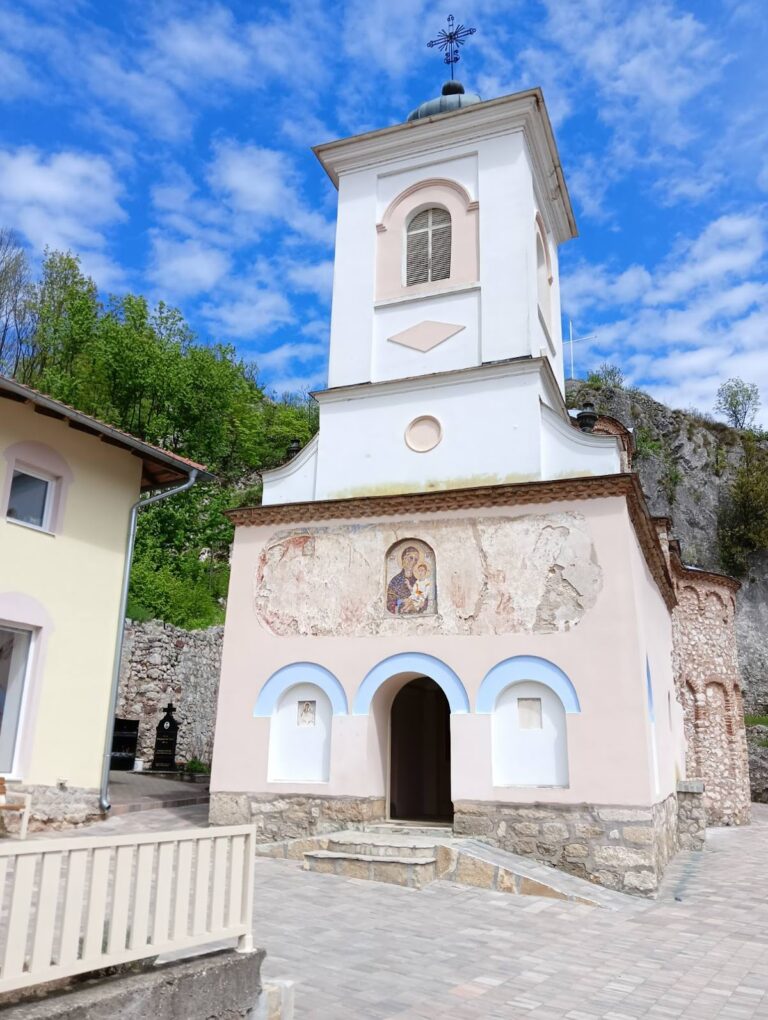
The Serbian Orthodox chapel in Tower 4 was built into the tower rather than added later. Its east-facing niches provided spaces for the altar, the diaconicon, used for liturgical preparation and storage, and the prothesis, where Eucharistic offerings were prepared. Medieval Serbian frescoes were discovered inside the fortress.
Tower 10, also called the White Tower, is the youngest and shortest tower. It has a single floor, an eight-sided base, and openings for cannons. Its form is nearly identical to three artillery towers added to Smederevo Fortress. Built originally on dry land, it now projects into the Danube because the formation of Lake Đerdap raised the water level in the late 1960s and early 1970s.
Archaeological remains and reconstruction
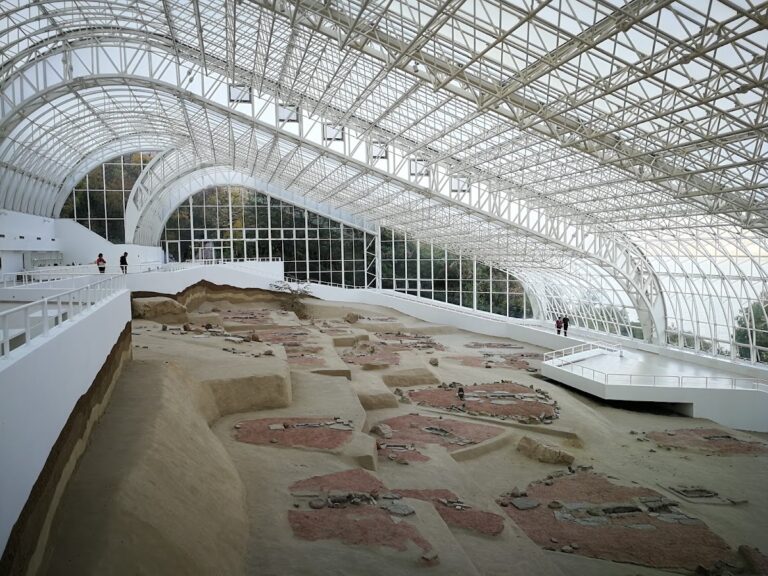
Reconstruction work in the 2010s uncovered Roman and Byzantine structures built with a characteristic combination of brick and stone. One building was later reused by the Ottomans as a hammam, or bathhouse. Remains of a waterworks system were also found, adding evidence of the site’s earlier occupation and infrastructure.
The lower sections of the fortress and associated walls are partly flooded. The walls, towers, and stone stairs were in relatively good condition before the modern reconstruction, while wooden floors and stairs had largely rotted away. The 2014–2019 reconstruction used traditional stone and manually executed stone-working techniques alongside archaeological investigation. The bypass tunnel removed heavy traffic from the protected fortification and helped restore the physical coherence of the site.