Veste Landskron: A Renaissance Water Castle in Neuendorf B, Germany
Visitor Information
Google Rating: 4.8
Popularity: Low
Country: Germany
Civilization: Early Modern
Site type: Military
Remains: Castle
History
Veste Landskron, located in the municipality of Neuendorf B in present-day Germany, is a Renaissance-era water castle erected by the Pomeranian noble family von Schwerin. Its construction between 1576 and 1579 was led by Ulrich II von Schwerin, who used his military income from service to the Duke of Mecklenburg to fund the project. The castle’s name, Landskron, meaning “Land’s Crown,” was reportedly controversial at the time, as the Duke of Pomerania expressed dissatisfaction and wanted the name changed to Lanzkron, though this new name never took hold.
Ownership of Landskron remained within the von Schwerin family for several generations. After Ulrich II, his son Georg Ernst von Schwerin inherited the castle, followed by Georg Ernst’s son, Ulrich Wigand von Schwerin. When Ulrich Wigand died without heirs in 1651, the estate passed to his sister Anna and her husband, a Swedish nobleman named von Anrieppe. Their daughter, Agnes von Anrieppe, subsequently married Jürgen von Pentz, linking the castle to the Pentz family.
From the mid-17th century onward, Veste Landskron began to deteriorate due to accumulating debts and lack of maintenance. A 1661 visitation report specifically noted the poor condition of the castle’s chapel. By 1683, the Pentz family had abandoned Landskron in favor of a residence in Neuendorf. The castle suffered further decline during the tumultuous years of the Thirty Years’ War and the Scanian War, during which nearby villages were destroyed by fire, accelerating the castle’s decay.
In 1699, Landskron and its surrounding lands were sold back to the von Schwerin family for a sum of 13,000 thalers. Despite reacquisition by the original family, there were no significant restoration efforts made. By the 19th century, the ruins had become a site for excursions. A tavern was constructed on the eastern side of the outer bailey in 1852, operated by a burgwart, who also served as the innkeeper. In the early 20th century, modifications to the southeastern tower transformed it into an observation tower by adding a balcony, a roof, and leaded-glass windows.
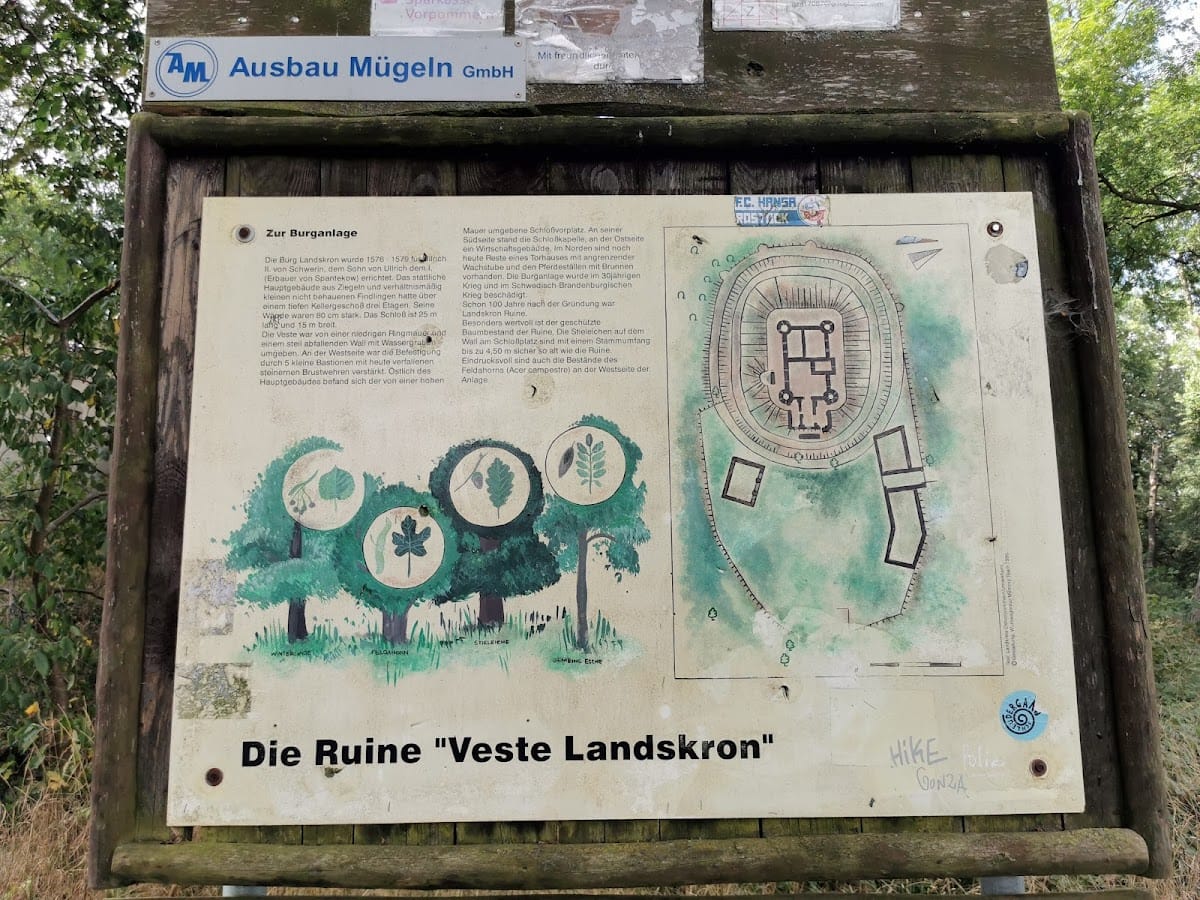
Near the castle lies the Schwedenschanze, a Slavic fortification dating back to the 7th century. This site gained association with the events of the Thirty Years’ War and is marked for visitors by an informational plaque at Landskron.
Remains
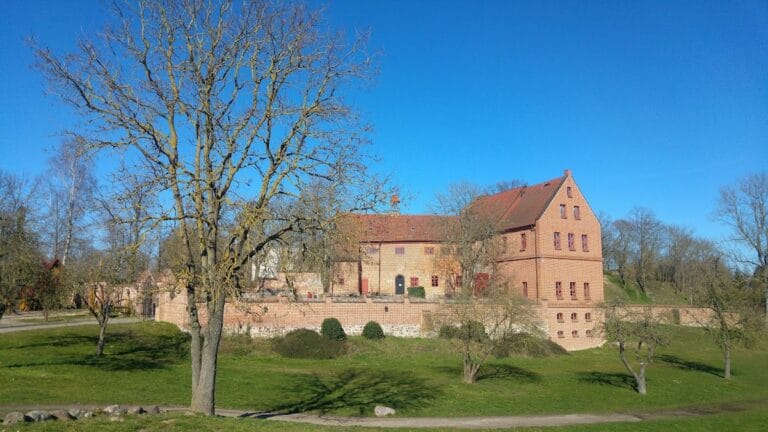
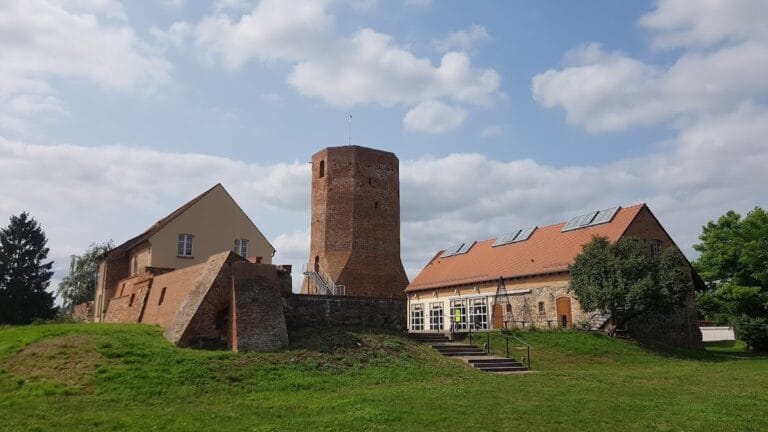
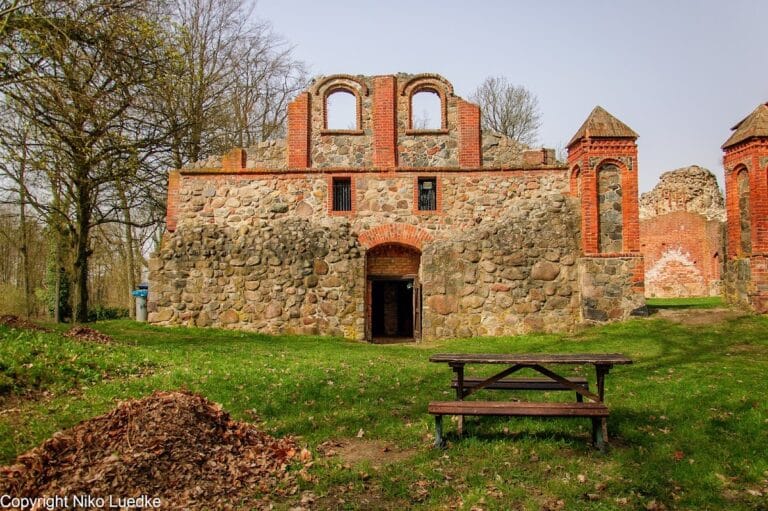
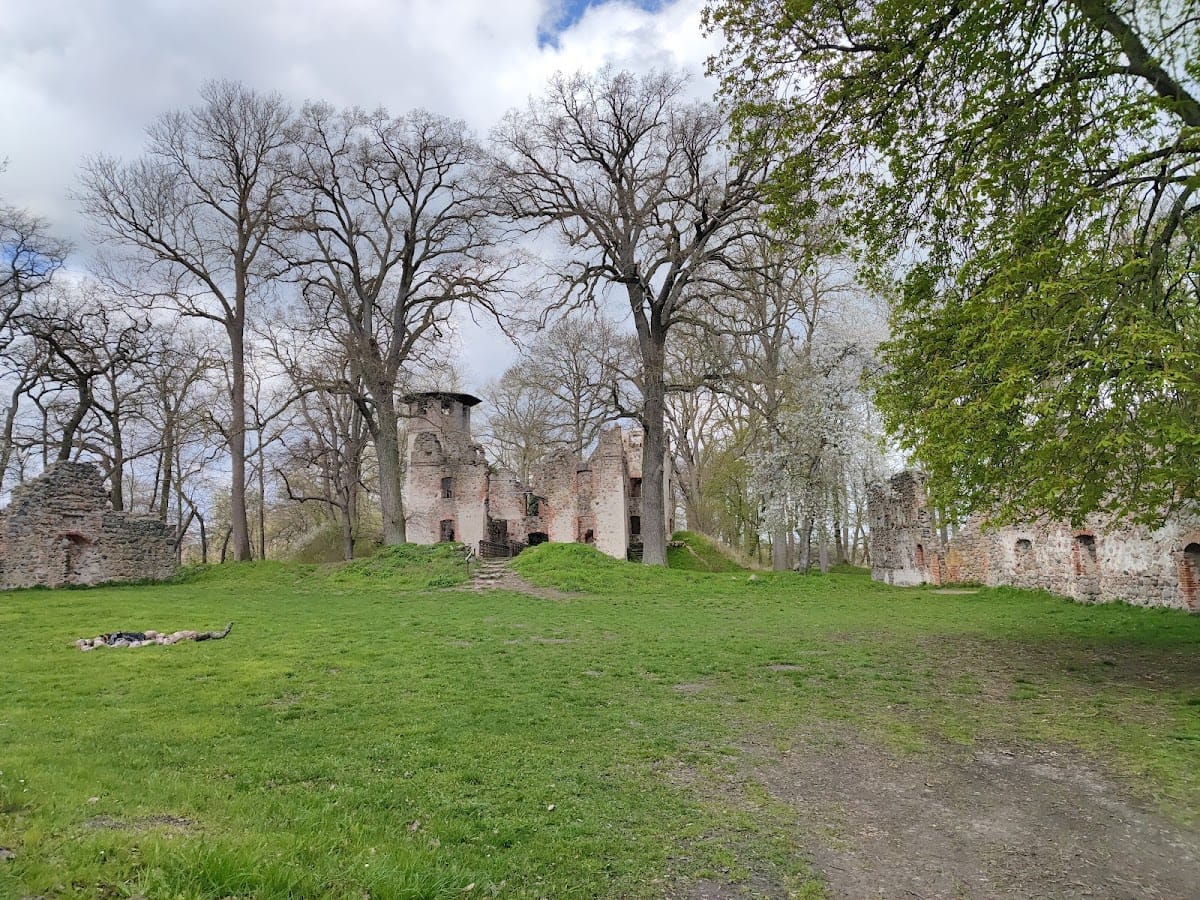
Veste Landskron consists of a water castle set in a swampy valley near the Großer Landgraben stream, originally surrounded by a moat fed by this waterway. Following river alterations in the 18th century, the stream now lies farther from the castle ruins. The complex is composed of two main sections: the western main castle, or Hauptburg, and the eastern outer bailey known as the Vorburg. The surviving walls and structures are primarily built from fieldstone, with window and door openings framed in brick.
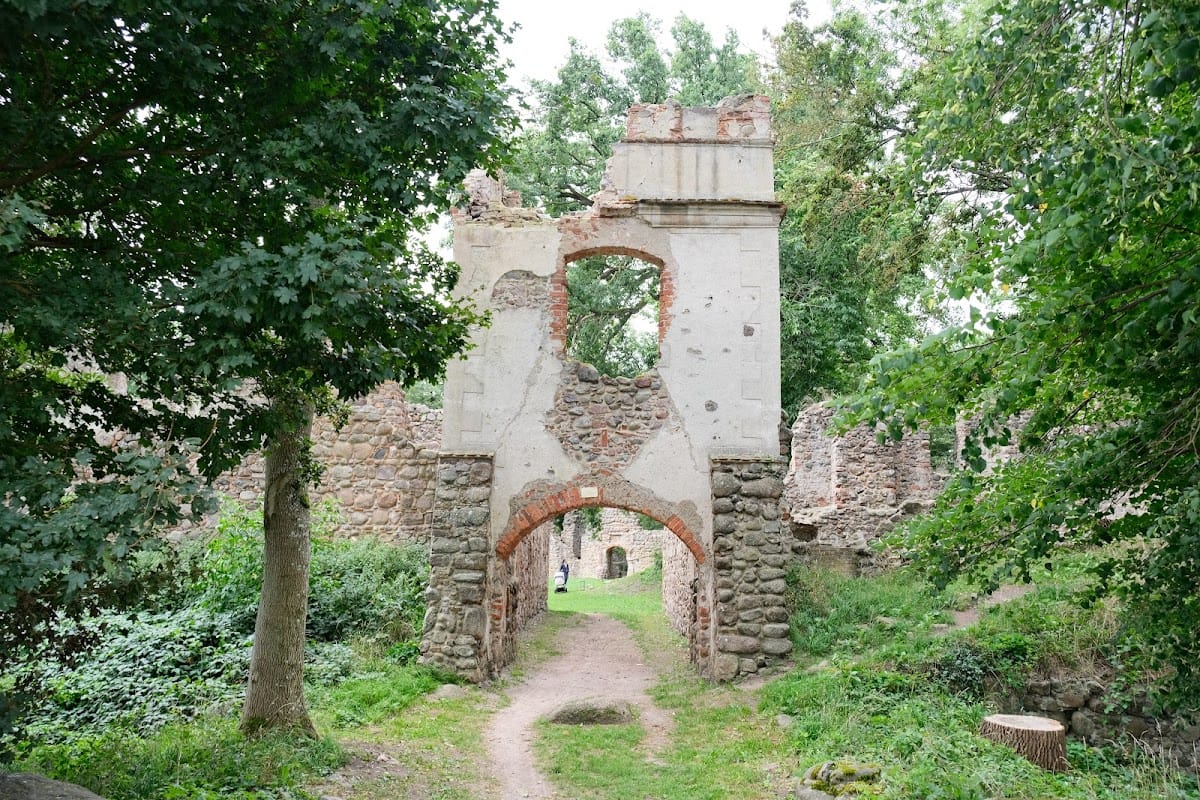
The outer bailey features walls reaching up to three meters high and is entered through a northern gatehouse. This gatehouse once displayed a large stone plaque dated 1586, portraying relief portraits of Ulrich II von Schwerin and his wife Katharina von Waldenfels, along with their family coats of arms and inscribed text. This plaque disappeared in the mid-19th century. Flanking the gatehouse are a probable guardhouse to its west and a former stable with upper-level storage to its east. The southern section of the bailey holds the ruins of the castle chapel. A 19th-century tavern had been built on the east side where the castle’s kitchen once stood, but this structure was removed in the 1960s.
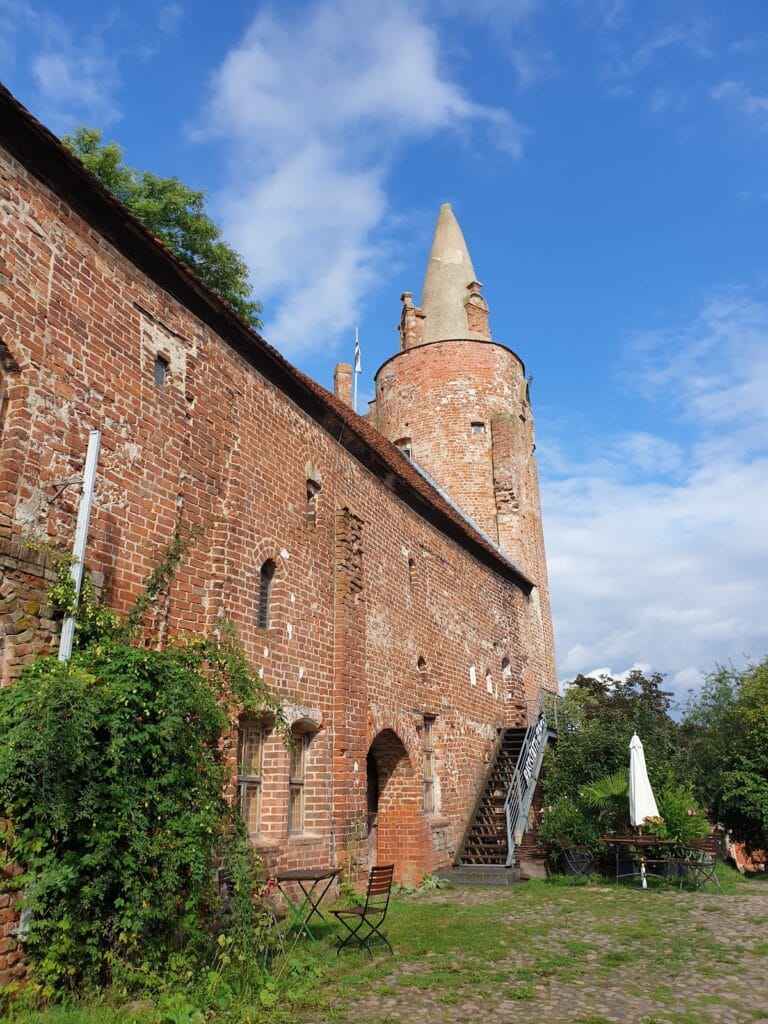
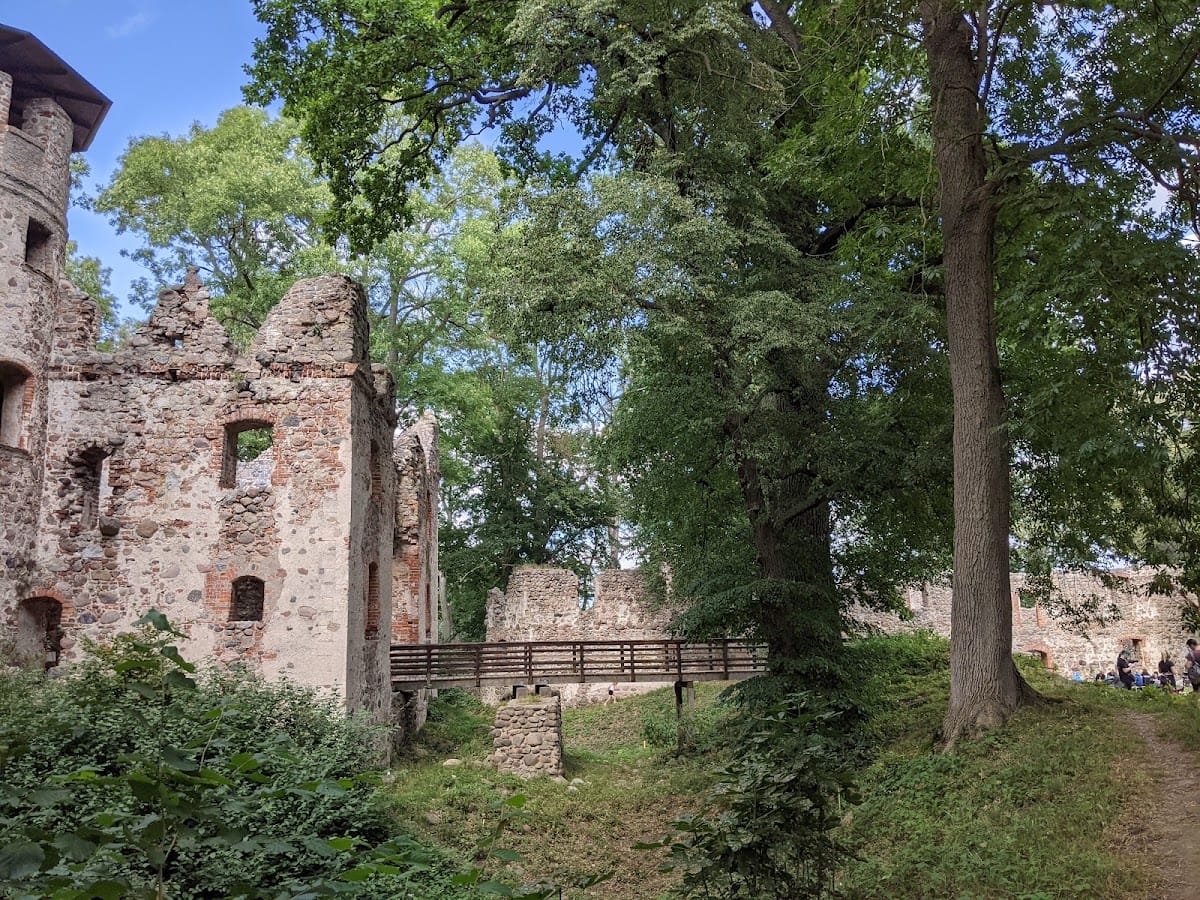
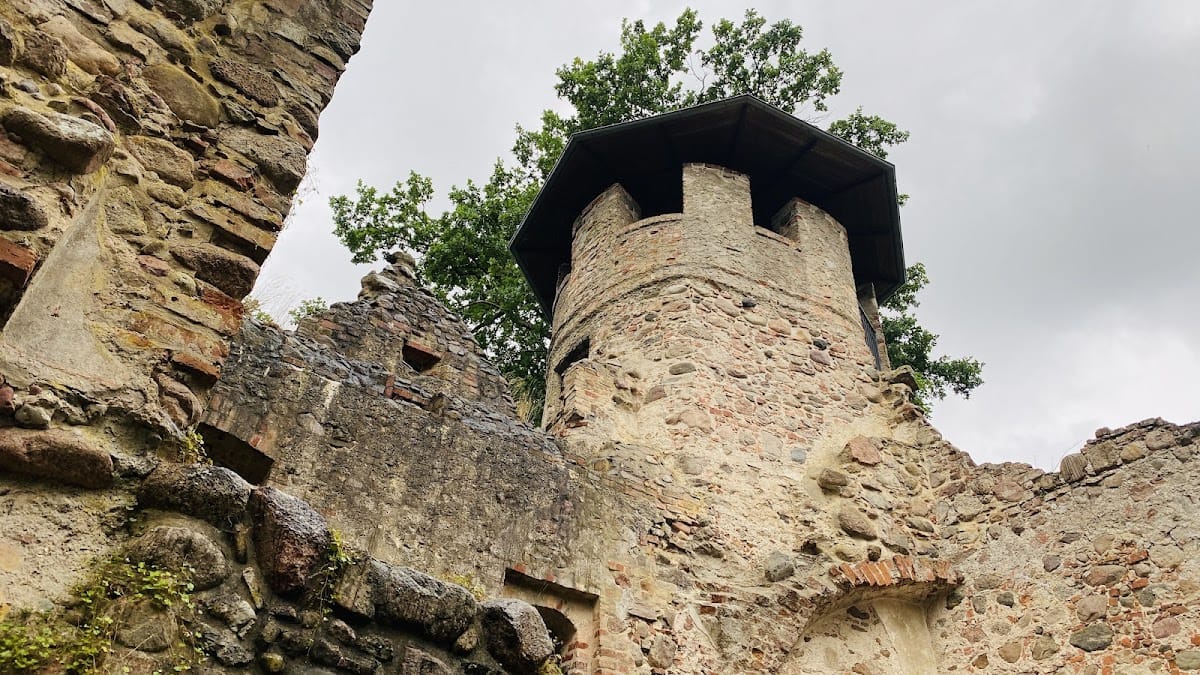
The main castle itself has a rectangular base approximately 15 by 25 meters in size, enclosed by a continuous fieldstone wall around two meters high that once functioned as a battlement. On the western side, five bastions remain visible, standing alongside an inner moat. At each of the four corners rise round towers four stories tall, measuring roughly 3.5 meters in diameter, with walls about 80 centimeters thick. The southeastern tower is the most intact and was adapted in the 20th century for use as an observation tower, featuring a roof, balcony, and leaded-glass windows.
Originally, the main building comprised three stories and a basement. Remnants of a stair tower survive on the north side. Access into the main castle was gained from the east via a drawbridge that linked the outer bailey to the Hauptburg. Inside, the foundations of cellar walls remain visible, hinting at the building’s original interior layout.
The northern gatehouse complex also contained a guardhouse on the west side and stables on the east. A well was located in this area. Legend tells of a second drawbridge made of copper that spanned the outer moat in front of the gatehouse, though such details retain a folkloric quality. The courtyard between the main building and the outer bailey included two additional structures: a chapel to the south and a kitchen to the east. The castle’s walls bear traces of corner stones known as quoins and remnants of plaster, revealing elements of the original finish.
Together, these features illustrate the castle’s design as a fortified residence adapted to its watery environment, complete with defensive bastions, living quarters, and service buildings typical of its time.
Nearby sites