Jagdschloss Prillwitz: A Historicist Hunting Lodge in Germany


Site at a Glance
- Rating
- 4.2
- Popularity
- Low
- Country
- Germany
- Primary era
- Modern
- External website
- Open
- Eras represented
- Early Modern, Modern
- Civilizations
- German, Holy Roman Empire
- Site type
- Domestic
- Remains
- Elite Residence
On this page7 sections
History
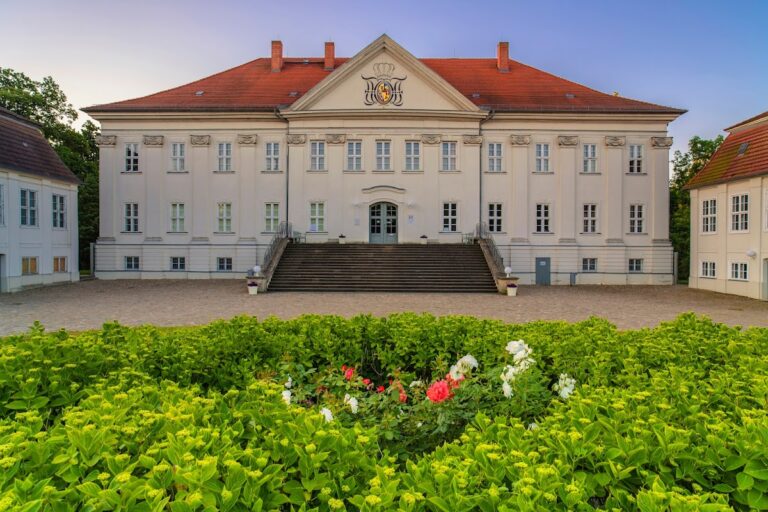
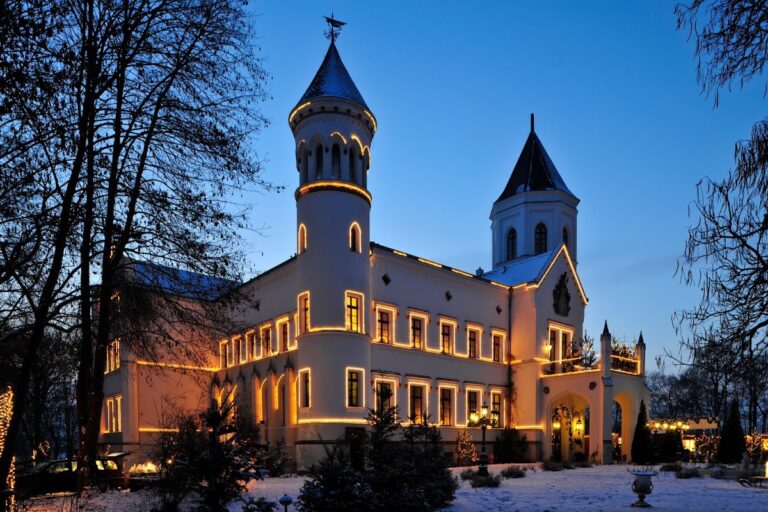
Jagdschloss Prillwitz is a former hunting lodge of the grand dukes of Mecklenburg-Strelitz in Germany, built in the late 1880s in the Neo-Renaissance style at Prillwitz, now part of Hohenzieritz. The estate developed through a long succession of noble owners before becoming part of the grand ducal property of Mecklenburg-Strelitz.
The Peccatel and Heydebreck estates
The history of Prillwitz is closely associated with the noble von Peccatel family, which held and developed Prillwitz, Peckatel, Weisdin, and other places before 1408. Vicke von Peccatel held the estate until that year, when Joachim von Heydebreck received one-third of it. Heinrich von Heydebreck later took over his brother Georg’s share in 1444. In 1505, Heinrich had to pledge the estate together with additional lands, and Bernd von Maltzan became the owner.
Hans von Blankenburg held Prillwitz from 1616 to 1648. Christoph and Joachim Cuno von der Osten then owned it in 1648 and 1649, followed by Lieutenant Colonel Christoph von Gamm from 1649 to 1680. His son, Carl Gustav von Gamm, held the estate from 1680 to 1717 and had the older manor house built between 1680 and 1706.
From private estate to grand ducal property
After 1717, the estate passed to the feudal relatives at Gohren. Sigismund von Bredow owned it from 1720, followed by his son Asmus Wilhelm von Bredow from 1743. Duke Charles II of Mecklenburg-Strelitz bought Prillwitz from the von Bredow family in 1795. From 1801, the estate belonged to the grand duchy’s Cabinet Office, an administrative institution responsible for managing the property of the ruling house and state.
Hereditary Grand Duke Adolf Friedrich V took over management in 1882. His father, Grand Duke Frederick William II, commissioned the hunting lodge for him, and the building was constructed in 1887-1889 to designs by Eugen Mueschen, a grand-ducal master builder working in Neustrelitz. Adolf Friedrich V held the estate until 1914, when it passed to his son Adolf Friedrich VI.
Adolf Friedrich VI, the last unmarried grand duke, held Prillwitz from 1914 until his suicide on 23 February 1918. The estate then passed to his mother, the Dowager Grand Duchess Elisabeth, born Princess Elisabeth of Anhalt. Mecklenburg-Strelitz remained a German grand duchy until the end of the German monarchies in 1918.
Postwar use and restoration
The lodge was looted in 1945 and subsequently accommodated refugees and new settlers. From 1955, the Neubrandenburg Energy Combine operated it as a holiday and convalescent facility for employees. It was later used as a consumer-cooperative restaurant and recreation home, uses that prevented prolonged vacancy and decay but also altered the building’s appearance. Three flagpoles were installed for the flags of the Soviet Union, the German Democratic Republic, and the Neubrandenburg Energy Combine, while Jugendstil decoration disappeared during the conversion.
From 1995, the former hunting lodge operated as a hotel with a restaurant. After a change of ownership in late 2006, heritage-sensitive renovation took place in the winter of 2007-2008, alongside work in the park. The reconstructed complex reopened on 4 April 2009. Further conservation and reconstruction from 2012 to 2014 restored much of its historic appearance, including the rebuilding of a tower demolished during the East German period. The property has been available for rental since 2014 and is designated as an architectural heritage monument in Mecklenburg-Vorpommern.
Jagdschloss Prillwitz has also entered modern regional culture. It provides the principal setting for Frank Pergande’s regional crime novel The Curse of the Duck and appears as the residence of a protagonist in the television series The Dead of Marnow.
Remains
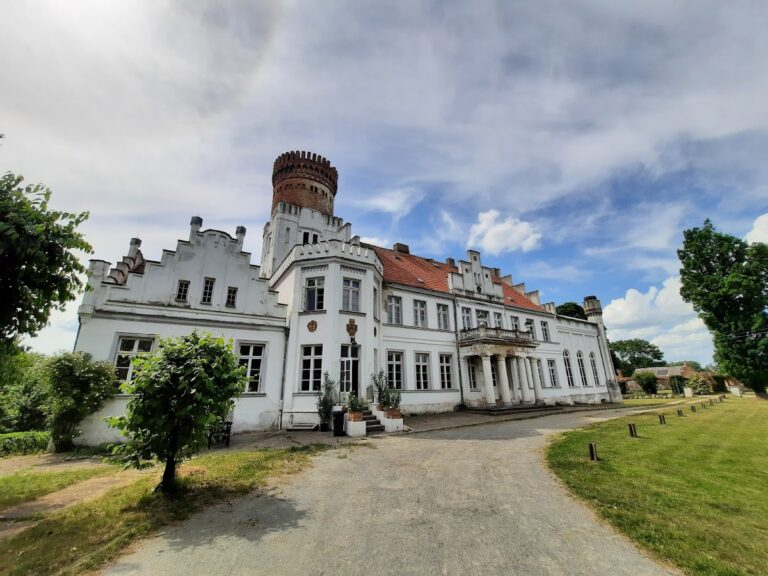
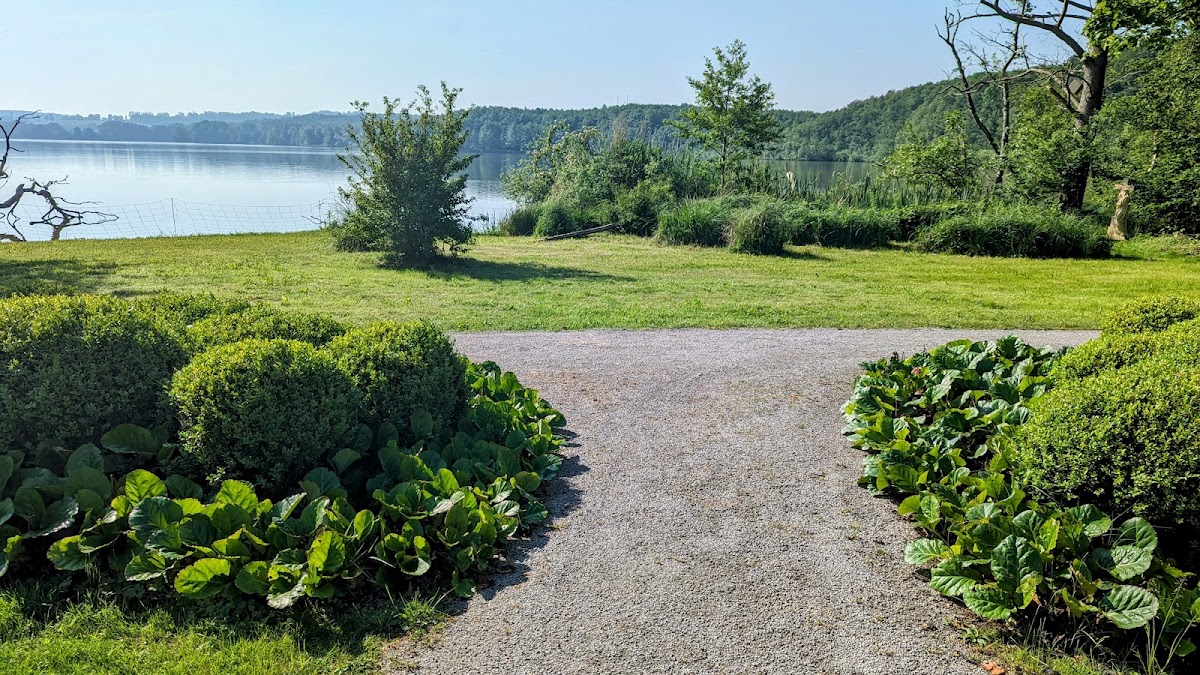
Jagdschloss Prillwitz is a small Historicist hunting lodge in the form of a country house at the far end of Hohenzieritz Castle Park, on the shore of Lake Lieps. Historicism was a nineteenth-century approach that revived and combined forms from earlier periods. Here, Eugen Mueschen used Neo-Renaissance forms, drawing on the design vocabulary of Renaissance architecture. The surviving lodge stands beside the older manor house dating from 1706.
The lodge and manor house
The hunting lodge retains much of its historic interior fabric despite the 1945 looting and later alterations. Wooden panelling survives in the entrance hall, staircase, and large hall. The large hall was later adapted as the restaurant dining room. A tower removed during the East German period was reconstructed between 2012 and 2014, contributing to the recovery of the building’s earlier appearance.
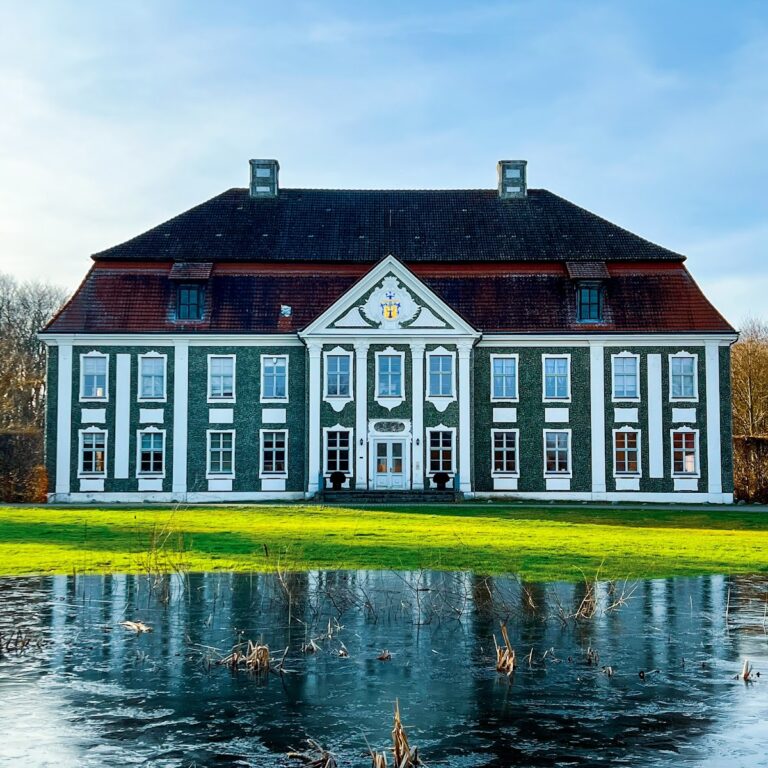
The older manor house, built for Carl Gustav von Gamm between 1680 and 1706, remains immediately beside the later lodge. Together, the two buildings preserve the physical relationship between the estate’s early modern manor and its nineteenth-century grand-ducal hunting residence.
Former auxiliary building and park
An adjoining one-storey auxiliary building contained a room or interior area known as a grotto. Parts of its walls were decorated with embedded oyster shells and vineyard-snail shells. The auxiliary building itself is lost, but the description of its shell decoration preserves evidence of a distinctive element of the former estate complex.
The park has been restored and redesigned according to historical models. A separate nineteenth-century park tower in the Neo-Tudor style was not rebuilt. Neo-Tudor architecture reinterprets forms associated with the Tudor period, distinguishing that un rebuilt park feature from the reconstructed tower attached to the lodge.
Nearby sites