Löcknitz Castle: A Medieval Lowland Fortress in Germany


Site at a Glance
- Rating
- 4.4
- Popularity
- Low
- Country
- Germany
- Primary era
- Medieval
- Eras represented
- Medieval
- Civilizations
- Duchy of Pomerania, Holy Roman Empire, Margraviate of Brandenburg
- Site type
- Military
- Remains
- Castle
On this page12 sections
History
Löcknitz Castle is a lowland castle in Germany, in the municipality of Löcknitz on the Randow River. Its origins are traced to the Slavic stronghold of Lokenitza, probably built to protect a ford, while a later masonry castle arose during the medieval period. The site became important because it controlled a river crossing on the boundary between the Duchy of Pomerania and the Margraviate of Brandenburg, neighboring territorial states whose shifting frontier repeatedly brought conflict to Löcknitz.
Slavic stronghold and ecclesiastical estate
The first stronghold probably consisted of wooden stakes and beams arranged within a ring rampart, palisades, and ditches. Its position at the Randow ford gave it a defensive and administrative purpose. A Slavic castle bailiff named Conrad de Lokeniz appears around 1124, although his direct connection with this site remains uncertain. In 1212, Thomas de Lokenitz, probably the castle’s episcopal bailiff, witnessed a donation charter issued by Duke Bogislaw II of Pomerania.
The fortified settlement was described as castrum Lokenitze cum opido, meaning a castle together with a town or fortified settlement. It probably belonged to the estates of the Bishopric of Cammin from the bishopric’s foundation in 1175 until 1385. The Bishopric of Cammin was a medieval ecclesiastical territory whose bishop controlled religious institutions and associated landed estates. Bismark, now part of Ramin municipality, along with Plöwen and Bergholz, was also linked with the castle.
Contested frontier stronghold
Löcknitz belonged to Pomerania until 1250, when the Treaty of Landin transferred it to Brandenburg. It returned to Pomerania from 1390 to 1468, before Brandenburg reconquered it in 1468. Brandenburg’s possession was confirmed by the Treaties of Prenzlau in 1472 and 1479. During this period, the castle fief was pledged to the von Wussow family from 1390 to 1416, and by 1433 at the latest it was held by the von Heydebreck family.
From 1479, Elector Albrecht III Achilles of Brandenburg granted Werner von der Schulenburg the hereditary captaincy of the castle and made him official administrator of Löcknitz. Both positions remained with the von der Schulenburg family until 1688. In 1557, Joachim von der Schulenburg built a Renaissance palace or manor house beside the medieval castle, added a chapel, and built a church. The palace was a separate building from the older fortress.
The Thirty Years’ War, the major European conflict of 1618 to 1648, brought Swedish occupation to Löcknitz from 1636 to 1650 and forced the von der Schulenburg family from its estate. After the war, Löcknitz lay largely in ruins, but its surviving castle, palace, fortifications, and castle mill gave the settlement renewed value as a Brandenburg frontier fortress. From 1650, the Welse and Randow formed the new boundary between Brandenburg and Swedish Pomerania.
Wars with Sweden and the end of military importance
In 1659, during the Second Swedish-Polish War, the frontier fortress served as an important base for Brandenburg-Prussia’s campaign against Swedish Pomerania. Fighting returned in 1675 during the Swedish-Brandenburg War. On 14 or 15 May, after a day-long Swedish bombardment, the fortified palace surrendered to Swedish forces commanded by Jobst Sigismund. Its 180-man garrison, led by Brandenburg Colonel Götze, received safe passage and offered little resistance. Götze was later sentenced to death by court-martial and executed in Berlin on 24 March 1676. Elector Friedrich Wilhelm, known as the Great Elector, recaptured the fortress from Sweden in 1675–1676.
The dispute between the von der Schulenburg family and the Brandenburg Elector over ownership continued after the war. In 1685, the elector made Löcknitz an electoral domain, a territory administered directly for a ruler or state, and rejected the family’s claims. The property formally returned to the Brandenburg electors in 1688.
After the Great Northern War, Löcknitz was no longer on the frontier and lost its military importance. The castle, palace, and fortifications still held 18 guns in 1715, but their crews were already lacking. Lieutenant Colonel Heinrich von Blankenburg was the last documented fortress commander in 1717. The complex remained in defensible condition until the peace settlement of 1720, after which it was abandoned and gradually deteriorated.
Destruction, residential use, and survival
The Seven Years’ War caused severe further destruction. In 1760, only 25 houses, the palace, parts of the fortifications, and the administrative office remained. During the Napoleonic Wars and the Wars of Liberation, large parts of the Löcknitz domain were subdivided and sold to private owners in 1807, together with the palace. Löcknitz continued as an independent Brandenburg administrative office in the Uckermark region until 1818.
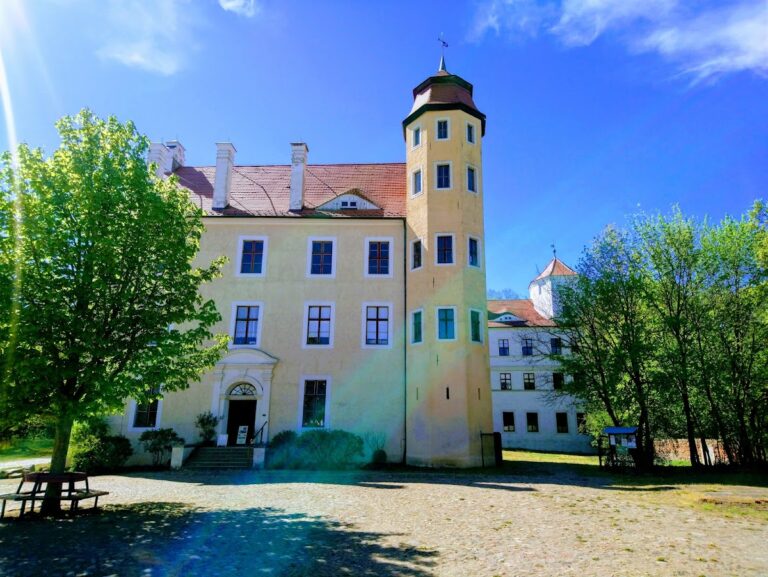
The palace underwent extensive renovation in 1851 and was converted into apartments. It remained in residential use into the mid-twentieth century, but was closed for building-code reasons in 1958. After later standing vacant and deteriorating, it was demolished in 1985. Parts of the castle complex are now privately owned. The octagonal keep and cellar vaults are used by the local Löcknitz tourism, local-history, and castle association, which is also concerned with restoring the castle.
Remains
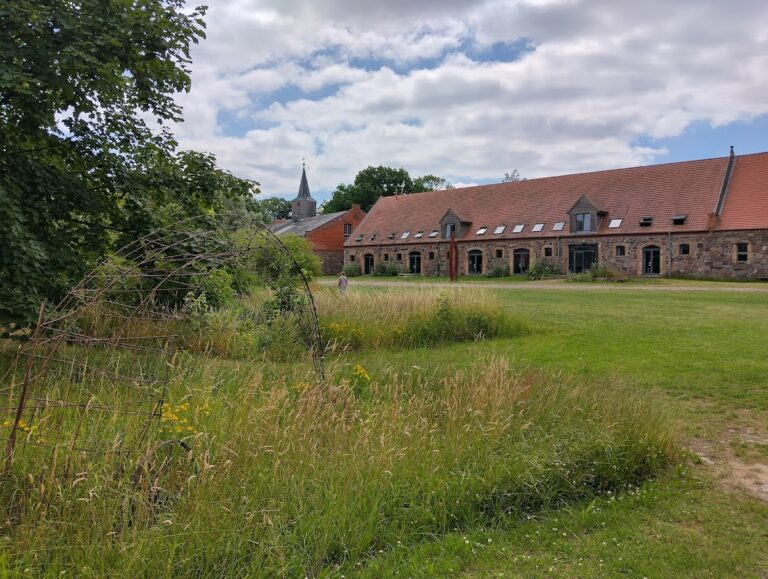
Löcknitz Castle survives as a partial lowland-castle complex beside the Randow and its former ford. The site developed from a timber stronghold with ramparts, palisades, and ditches into a medieval masonry fortress built mainly of brick. The surviving remains include the octagonal keep, cellar vaults, several ancillary buildings, and fragments of the walls. The later Renaissance palace occupied a separate position beside the medieval castle and belonged to the same fortified complex.
Fortress remains
Octagonal keep
The octagonal brick keep is the clearest surviving principal structure of the castle. As the keep, it formed the main fortified tower, a building that could serve defensive, residential, or administrative purposes. Its survival preserves part of the medieval masonry phase, while the wider defensive arrangement is represented by remnants of the castle walls and the associated fortifications.
Cellar vaults and ancillary buildings
Cellar vaults and several ancillary buildings also remain within the complex. Together with the wall fragments, they preserve elements of the castle’s supporting structures and its relationship to the former palace and fortifications. The keep and cellar vaults are used by the local castle and historical association. The ancillary remains and other surviving parts are privately owned and are not publicly accessible.
Renaissance palace and associated buildings
Palace and chapel
Joachim von der Schulenburg’s 1557 Renaissance palace stood beside, rather than within, the medieval castle. It included a chapel and formed part of the expanded complex associated with the church, ancillary buildings, and castle mill. The palace was later renovated for residential use, but its building was demolished in 1985.
Church and castle mill
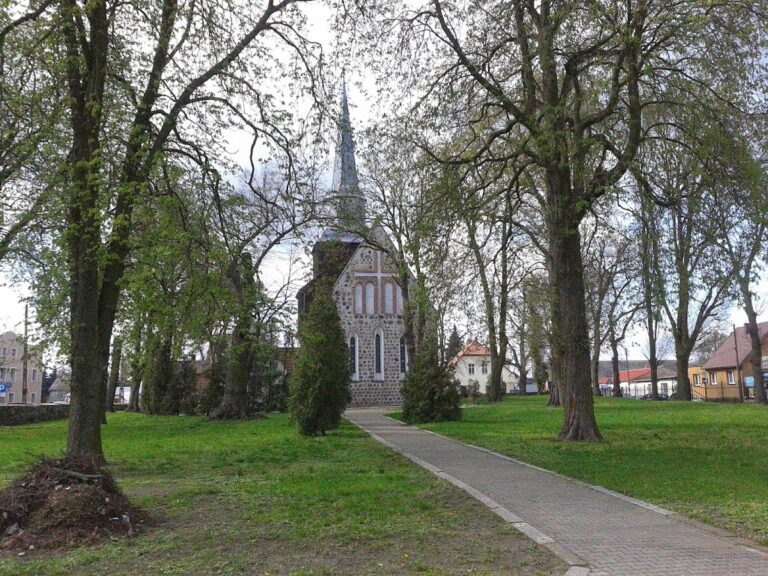
The church and castle mill belonged to the group of buildings associated with Löcknitz Castle. The mill formed part of the settlement’s surviving postwar complex when Löcknitz served as a Brandenburg frontier fortress after 1650. The surviving fabric of the wider site is now fragmentary, with the keep, cellar vaults, wall remnants, and ancillary buildings preserving portions of its earlier arrangement.