Turku Cathedral: Finland’s Medieval Cathedral and Lutheran Mother Church


Site at a Glance
- Rating
- 4.6
- Popularity
- Medium
- Country
- Finland
- Primary era
- Medieval
- External website
- Open
- Eras represented
- Medieval, Early Modern, Modern
- Civilizations
- Russian, Swedish
- Site type
- Religious
- Remains
- Cathedral
On this page20 sections
History
Turku Cathedral is Finland’s only medieval cathedral and basilica, standing in the centre of Turku beside the Aura River. Built as a medieval brick and stone church, it became the mother church of the Evangelical Lutheran Church of Finland, the central church of the Lutheran Archdiocese of Turku, and the seat of the Archbishop of Finland. It is also regarded as a national shrine and an important record of Finnish architectural history.
Origins and medieval construction
A wooden parish church dedicated to the Blessed Virgin Mary stood on Unikankare Mound by about 1230. The bishop’s see moved from Koroinen to central Turku in 1229, as the town developed into an important trading centre. The cathedral eventually replaced the wooden church and was dedicated to the Blessed Virgin Mary and Saint Henry.
Around 1249, the cathedral’s foundation phase was associated with the establishment of a Dominican monastery dedicated to Saint Olav. The cathedral chapter, the body of clergy assisting the bishop in worship and administration, was established in 1276. Training for priests began at the same time, and the cathedral school became an important early educational institution in Finland.
Bishop Johannes I initiated the early Gothic construction in brick. By the end of his tenure in Turku in 1290, the choir and part of the three-aisled church had been completed. His successor, Bishop Maunu I, introduced architectural models from the Baltic region and made substantial changes to the plan and interior, while Dominican liturgical practice continued to shape worship.
Bishop Magnus I consecrated the stone cathedral on 17 June 1300 as the cathedral church of the Blessed Virgin Mary and Saint Henry. At the consecration, the relics of Bishop Henry, regarded as Finland’s first bishop and later its patron saint, were brought to the church.
Construction resumed after forces from the Novgorod region burned Turku in 1318. Gothic stone churches in the Hanseatic cities, northern European trading centres linked by the Hanseatic League, then provided architectural models. Fourteenth-century building campaigns brought the cathedral to its present length, while further medieval alterations continued into the fifteenth century.
Late medieval development and attack
Bishop Hemming of Turku, who died in 1366, was a major benefactor and supervised important fourteenth-century restorations. After Pope Leo X recognised him as blessed, his remains were moved in 1514 from the choir to a reliquary niche in the north aisle. A reliquary is a container made to preserve and display the remains or relics of a saint or blessed person.
During the Danish attack on Turku in 1509, the cathedral was looted. Its movable artworks and episcopal treasury were taken, and only the episcopal insignia were later recovered, after prolonged negotiations and payment of a ransom.
Reformation and repeated fires
The Reformation, the sixteenth-century transformation through which territories under Swedish rule adopted Lutheran Christianity and altered or removed many Catholic practices, changed the cathedral’s institution and interior. Catholic furnishings and practices were removed or modified, side-chapel altars ceased to be used, and images of saints were stored in the sacristy. Worship became centred chiefly on the high altar and pulpit. In 1554, Mikael Agricola became the first Protestant bishop of Turku. Agricola was a leading figure in the development of written Finnish.
A major fire in 1546 destroyed the medieval furnishings. A wooden pulpit made in 1649 and 1650 by the sculptor Mikael Balt for Henrik Fleming was later destroyed in the fire of 1683. The tower was rebuilt repeatedly after fires, including the blaze of 1681.
The Great Fire and nineteenth-century rebuilding
The Great Fire of Turku in 1827 severely damaged the cathedral and much of the city. The tower, the interior of the nave, and most furnishings were destroyed or badly affected. Reconstruction was first directed by Carl Ludvig Engel and later by Jacob Johan Ahrenberg. The restoration and embellishment continued for decades and generally reached its final form in 1928.
The nineteenth-century work produced most of the present interior. Fredrik Westin completed the altarpiece in 1836, and Robert Wilhelm Ekman painted the chancel frescoes between 1850 and 1854. Later chapel windows included works by Wladimir Swertsckoff from 1871 and 1876. The last major renovation before the 2020s took place around 1979, when modern heating and fire-protection systems were added.
Burials and continuing national role
Turku Cathedral has long served as a burial place for bishops, nobles, military commanders, members of the Swedish royal family, and the scholar Henrik Gabriel Porthan. Approximately 4,500 bodies are estimated to lie beneath the church floor. Burials were prohibited in 1784 on public-health grounds, and 91 family vaults were sealed; eight were later reopened.
Queen Karin Månsdotter, consort of King Erik XIV of Sweden, died in 1612 and was buried beneath the Tott Chapel. Her remains were moved in the 1860s to the Kankas Chapel, where they were placed in a black marble sarcophagus. She is regarded as the only Swedish royal buried in Finland.
The cathedral’s bells have been broadcast nationally at noon since 19 June 1944. The practice began during the Continuation War, when Gerda Ryti called on the Finnish people in a radio address to pray for the country. The cathedral also remains central to Finland’s annual Christmas celebrations. Its tower and spire have become symbols of Turku alongside the city’s castle.
Remains
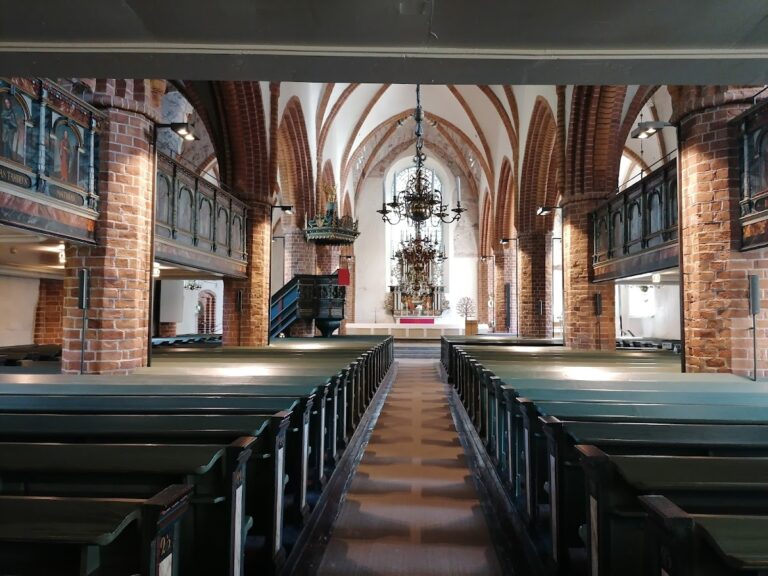
Turku Cathedral stands on Unikankare Mound in central Turku, beside the Aura River and near the Old Great Square. The building is approximately 89 metres long and 38 metres wide, with capacity for about 1,400 people. It combines Romanesque, Gothic, and Gothic Revival elements, while its medieval brick Gothic construction gives much of the building its distinctive character. The earliest sections used grey stone and clay brick, an unusual medieval building material in Finland because its manufacture and transport were difficult. A clay pit owned by the local Dominican order stood near the cathedral, suggesting nearby brick production.
Medieval fabric and layout
Early church and surviving medieval elements
The earliest surviving elements of the present cathedral include part of a column beneath the pulpit and a pillar on the left side of the sacristy. These remains belong to the early building history that followed the wooden parish church on Unikankare Mound.
Choir and high altar
The fourteenth-century choir survives in the present chancel, including its octagonal Gothic pillars. The high altar originally stood opposite the easternmost nave pillars. In the mid-seventeenth century it was moved to its present position in the apse, which had formerly been the Chapel of All Saints.
Nave, chapels, and vaults
Fifteenth-century additions created side chapels along both sides of the nave. By the end of the Middle Ages, 42 chapels had been dedicated to saints including Mary Magdalene, Catherine of Alexandria, Catherine of Siena, Birgitta of Sweden, and Barbara of Nicomedia. During the 1460s, the nave walls were raised under the direction of the master Pietari Kemiöläinen. Additional windows were inserted to reduce the darkness produced by the encircling chapels, and the Chapel of All Saints opposite the entrance acquired its final form. The roof vaults were raised later in the fifteenth century to their present height of approximately 24 metres. By the beginning of the early modern period, the cathedral had broadly acquired its present plan.
Tower and spire
The tower has been rebuilt several times after repeated fires. The tower and spire constructed after the 1827 fire are approximately 85.53 metres high, including the cross. The spire reaches about 101 metres above sea level and can be seen over a considerable distance.
Nineteenth-century interior
Altarpiece and crossing
The nineteenth-century rebuilding gave the cathedral an Empire-style roof structure and a Classicist tower designed by Carl Ludvig Engel. The altarpiece, painted by Fredrik Westin in 1836, depicts the Transfiguration of Jesus. Engel also designed the reredos behind the high altar and the pulpit in the crossing.
Chancel frescoes and chapel windows
Robert Wilhelm Ekman’s Romantic-style frescoes, painted between 1850 and 1854, cover the chancel walls and vaults. They depict episodes from the life of Jesus, Bishop Henry baptising the first Finnish Christians at the spring of Kupittaa, and Mikael Agricola presenting the first Finnish translation of the New Testament to King Gustav Vasa.
Wladimir Swertsckoff’s stained-glass works include a 1871 composition showing Karin Månsdotter renouncing the throne. His works from 1876 depict Christ on the cross and King Gustav II Adolf beside the body of Evert Horn. The latter composition decorates the Tavast family chapel, where Horn’s tomb monument stands.
Reliquaries, memorials, and organs
Bishop Hemming’s reliquary
A reliquary tomb for Bishop Hemming occupies a niche beside the pulpit in the north aisle. The reliquary is a wooden chest decorated in an early sixteenth-century style, with traces of gold, yellow, blue, and red still visible on its surface.
Tott Chapel and royal burial
The Tott Chapel on the south side contains the memorial of Åke Tott and his first wife, Sigrid Bielke. Life-size white marble figures stand against a background of black marble columns. Karin Månsdotter’s burial was formerly in this chapel, whose present decoration dates largely from the nineteenth century.
Military monuments
The cathedral contains memorials to Evert Horn, Samuel Cockburn, Torsten Stålhandske, Åke Tott, and Knut Jönsson Posse. Evert Horn’s tomb monument was made by the Tallinn stonemason Arendt Passer. Torsten Stålhandske’s richly decorated double coffin and shared marble monument were commissioned by his wife, Kristiina Horn. The monument to Åke Tott was commissioned by his second wife, Kristiina Brahe.
Organs and Agricola statue
Three organs are housed in the cathedral. The main organ was built in 1980 by Veikko Virtanen Oy of Espoo and has 81 ranks with mechanical action. A separate choir organ by Veikko Virtanen dates from 1973. On the south side of the cathedral stands a statue of Mikael Agricola made by Oskari Jauhiainen in 1952.