Tullibole Castle: A Historic Scottish Laird’s House Near Crook of Devon
Visitor Information
Google Rating: 4.7
Popularity: Low
Official Website: www.tullibolecastle.com
Country: United Kingdom
Civilization: Early Modern
Site type: Military
Remains: Castle
History
Tullibole Castle is situated near Crook of Devon in Scotland, a site originally developed by Scottish lairds. Records indicate that a structure existed on this site as early as 1304, during the reign of King Edward I of England, who considered building a castle nearby but ultimately decided against it due to the lack of a suitable location.
By the late 15th century, the land was under the ownership of the Heron family, documented in 1490. Ownership passed to the Halliday family towards the end of the 16th century when John Halliday acquired the property in 1589. Halliday undertook significant enlargement of the earlier tower house in 1608, creating a more substantial dwelling that reflected the status of its owners during that era.
In the mid-18th century, around 1740, Tullibole Castle came into the possession of the Moncreiff family through marriage. This family retained control of the estate from that time onward, overseeing further developments. The 18th century saw additional expansions to the castle, enhancing its stature and living spaces. Later, during the late 1950s, extensive renovations took place within the castle’s interiors and its surrounding gardens. It was during this period that the castle’s name changed from “Tulliebole” to the current “Tullibole.”
The castle’s history is marked by a somber connection to the witch trials of 1662 in nearby Crook of Devon, where 11 individuals were executed following accusations linked to members of the Moncreiff family. In remembrance, a memorial was erected at Tullibole Castle in 2012 by the then-owner, Rhoderick Moncreiff. Recognizing its historical and architectural importance, the castle was designated a Category A listed building in 1971, highlighting its national significance within Scotland’s heritage.
Remains
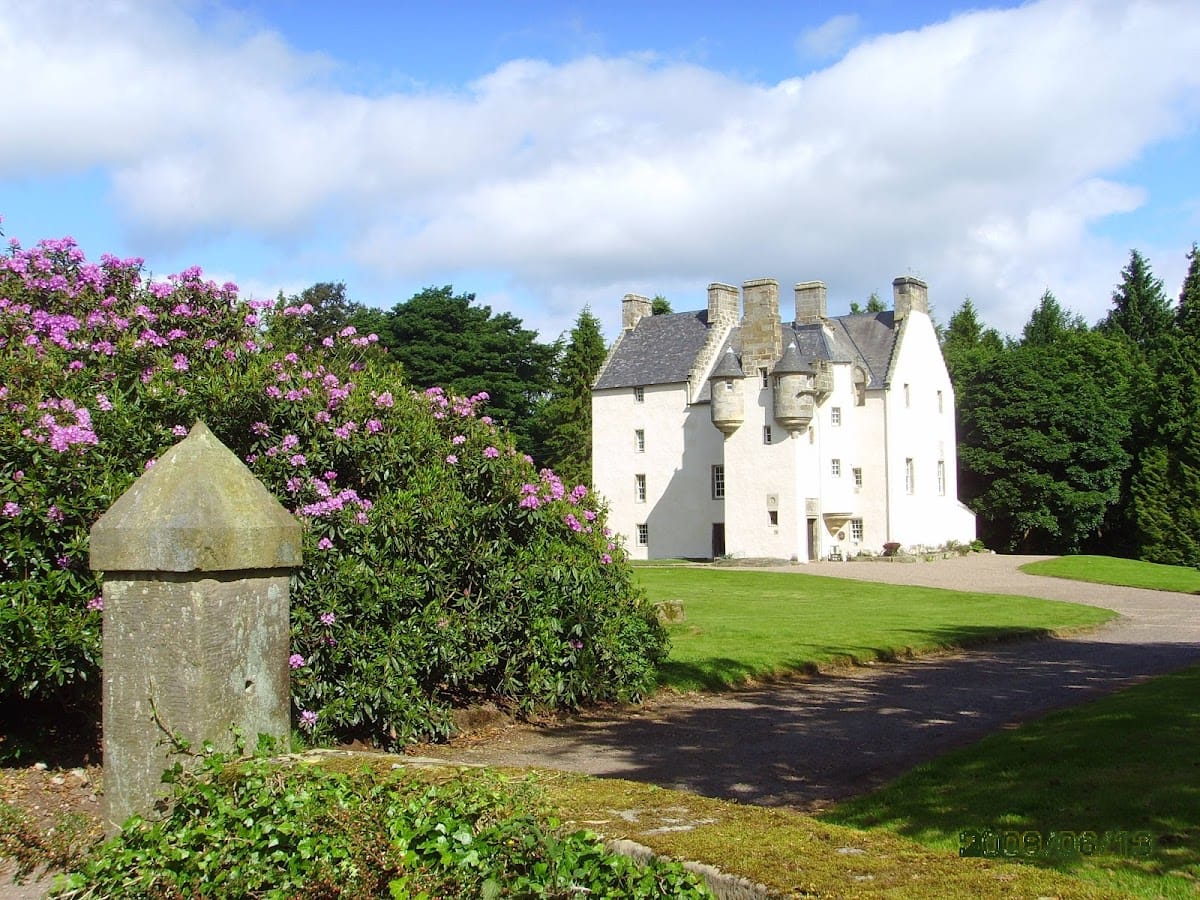
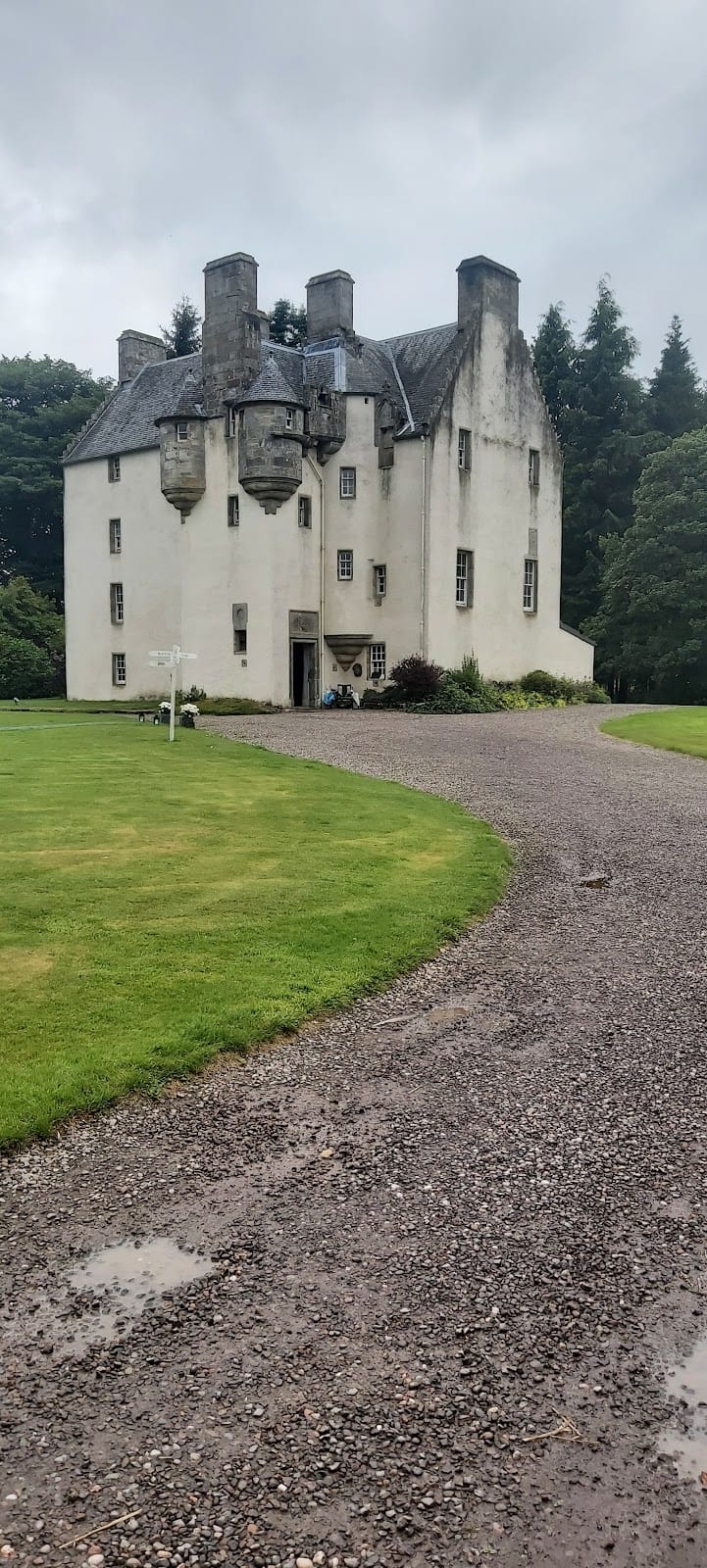
Tullibole Castle is a well-preserved example of a seventeenth-century laird’s house that evolved mainly from a four-story tower house structure. Its form reflects the typical Scottish laird house style, developed to be both defensible and comfortable. The exterior is coated with harl, a traditional roughcast lime render that protects the stone walls against Scotland’s weather.
One of the castle’s distinctive architectural elements is its rounded stair tower, which is located in the inner angle formed by the main wings. This tower contains a spiral staircase providing access between floors and enhances the castle’s defensive features. At the level of the roof’s eaves, small corner turrets, known as tourelles, project outward, adding both to the building’s visual character and its historical defensive capability. The roofs are covered with slate and topped with stepped gables, a feature commonly found in Scottish architecture of this period.
Above the main entrance is a carved stone panel dated 1508, bearing the monograms “M.I.H.” and “H.O.,” likely commemorating early owners or builders connected with the castle’s construction or expansions. Inside, the first floor houses a kitchen, consistent with the practical needs of a laird’s residence, while the second floor contains a hall featuring an open fireplace, the central space for social and domestic activities during the castle’s occupation.
The castle underwent major restoration work in 1956, which helped preserve both its structural integrity and decorative details. Today, it stands as a largely intact example of its type, with much of its original fabric and character maintained through careful conservation.
Nearby sites