Tōmyōji Nawate: A Battlefield Associated with Nitta Yoshisada
Site at a Glance
- Rating
- 4
- Popularity
- Very Low
- Country
- Japan
- Primary era
- Early Modern
- External website
- Open
- Eras represented
- Early Modern
- Civilizations
- Tokugawa
- Site type
- Military
On this page7 sections
History
Tōmyōji Nawate is a historical battlefield in Fukui City, Japan, traditionally identified as the place where Nitta Yoshisada was killed during the Battle of Fujishima in 1338. Yoshisada was a commander of the Southern Court, the imperial faction that opposed Ashikaga Takauji during Japan’s Nanboku-chō, or Northern and Southern Courts, period of competing imperial governments and prolonged warfare.
Yoshisada and the Battle of Fujishima
After helping overthrow the Kamakura shogunate, Yoshisada supported Emperor Go-Daigo, who had attempted to restore direct imperial rule. Yoshisada became an important commander of the Kenmu government, the short-lived regime created through that restoration, and later served the Southern Court after Ashikaga Takauji defected from the imperial cause.
Following the Southern Court’s defeat at the Battle of Minatogawa, Yoshisada withdrew toward the Hokuriku region under pressure from Ashikaga forces. In 1338, he advanced toward Fujishima Castle with just over 50 mounted retainers. His purpose was to supervise allied troops attacking the castle, which was held by Ashikaga forces. At Tōmyōji Nawate, he encountered the opposing army and was killed in the confused fighting that followed.
The helmet tradition and Nittazuka
In 1656, a farmer named Kaehei is traditionally said to have found a helmet while cultivating the land at the site. He reportedly used it as a container for sweet potatoes. Ihara Ban’emon, a military scholar serving the Fukui domain, examined the object and identified it as a helmet worn by Yoshisada, citing its inlay work and an inscription traditionally read as “August, first year of Gen’ō, Sagami Province.” The lettering was too indistinct for a reliable reading.
In 1660, Matsudaira Mitsumichi, lord of the Fukui domain, erected a stone monument at the reported discovery place. Its inscription states that Yoshisada died there on the second day of the intercalary seventh month of the first year of Ryakuō. The mound or locality associated with the find and monument subsequently became known as Nittazuka.
Shrine, designation, and historical debate
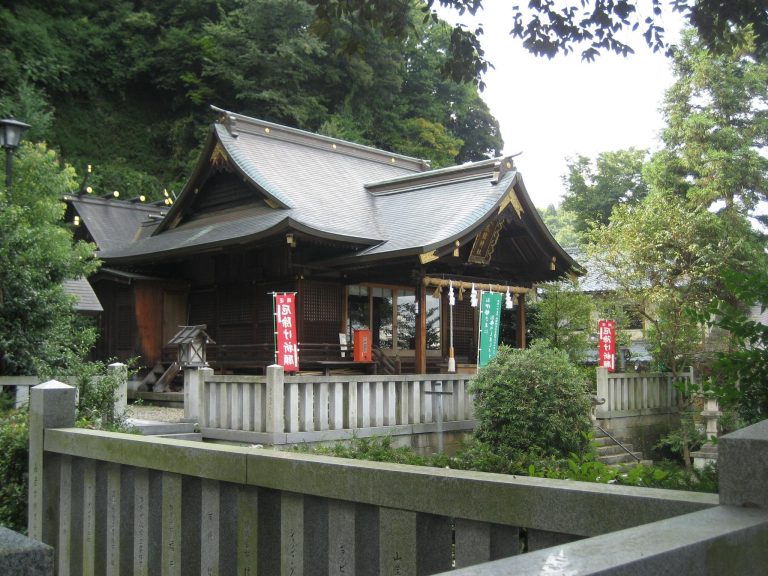
A shrine dedicated to Yoshisada was built near Nittazuka in 1870 and was named Fujishima Shrine in 1876. The Matsudaira family donated the helmet regarded as Yoshisada’s to the shrine. Tōmyōji Nawate was designated a national Historic Site on December 9, 1924, on the basis of the tradition identifying it as Yoshisada’s place of death.
The helmet was designated a national treasure under the former Law for the Preservation of Ancient Shrines and Temples in 1900. Under the current legal system, that status corresponds to Important Cultural Property. The identification of the helmet as Yoshisada’s has nevertheless been challenged by armor researchers, including Yamagami Hachirō, a scholar of Japanese armor.
Yamagami argued that the helmet’s shape and decorative techniques identify it as a Sengoku-period Odawara bowl, made in Sagami by armorers of the Myōchin lineage retained by the Later Hōjō family, the warrior house that ruled much of eastern Japan from Odawara. This helmet type did not appear before the late Muromachi period, well after Yoshisada’s lifetime.
Several helmets made by Nagasone Okihiro, a Fukui-based armor maker of the Nagasone school, during the Enpō era bear inscriptions meaning “made after Yoshisada’s helmet.” These objects offer limited support for the tradition that a helmet was found at the battlefield, while their form also places them in a later period. Yamagami proposed that the excavated helmet may instead have been used in the Tenshō-period Echizen Ikkō uprising, a sixteenth-century conflict involving the Ikkō religious movement and its armed supporters, and buried afterward. He argued that the helmet’s identification and the fixing of Tōmyōji Nawate as Yoshisada’s final battlefield should be considered separately.
Remains
Battlefield monument and Nittazuka
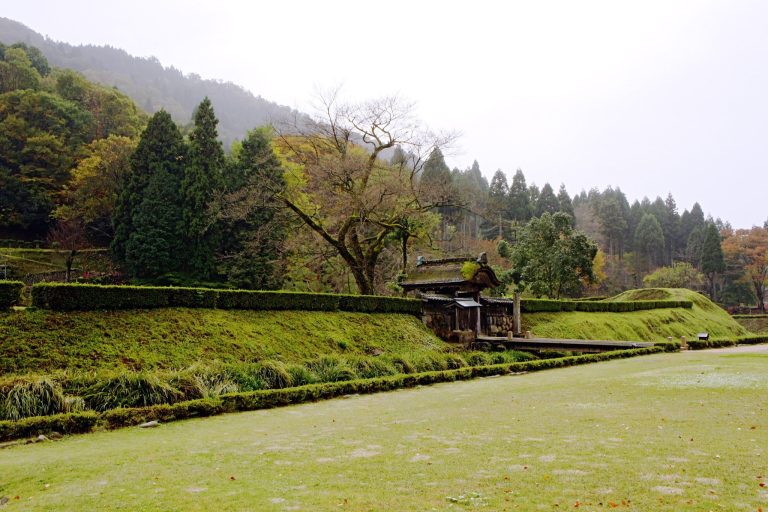
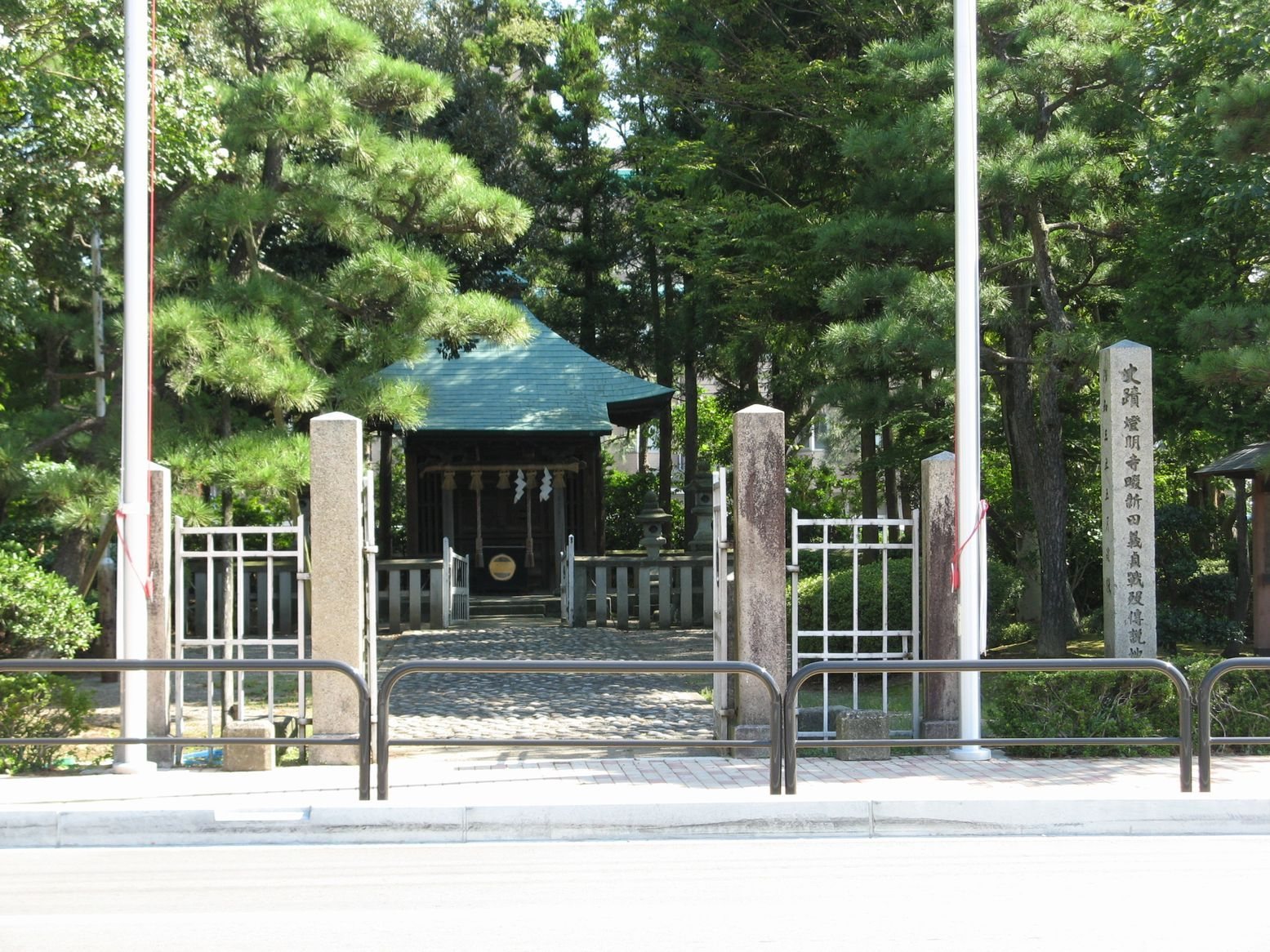
Tōmyōji Nawate occupies a battlefield area in present-day Nittazuka-chō, Fukui City. The locality known as Nittazuka is associated with the reported helmet discovery and with the stone monument erected there in 1660. The monument’s inscription identifies the place as the site where Nitta Yoshisada died on the second day of the intercalary seventh month of the first year of Ryakuō, preserving the tradition that gives the battlefield its historical identity.
Fujishima Shrine and the helmet
Fujishima Shrine stands near Nittazuka and is dedicated to Nitta Yoshisada. It holds the helmet bowl regarded as Yoshisada’s. The bowl has inlay decoration and an inscription traditionally read as referring to the first year of Gen’ō and Sagami Province, although the lettering is too indistinct to decipher with certainty. Its form and decorative methods identify it as a Sengoku-period Odawara bowl, a helmet bowl associated with production in the Odawara region, rather than a fourteenth-century type.
The helmet bowl is the main protective shell of a Japanese helmet. The shrine formerly also received its neck guard and another helmet fitting. An associated provenance document states that the bowl had previously accompanied the “Fish-Scale Armor” used by Matsudaira Shungaku, a nineteenth-century lord of Fukui Domain and a prominent political figure of late Edo and early Meiji Japan. The bowl was detached when it alone was enshrined as a sacred representation, and the other components were deposited at the shrine one month later.