Eihei-ji Temple: A Principal Head Temple of Sōtō Zen Buddhism


Site at a Glance
- Rating
- 4.5
- Popularity
- Medium
- Country
- Japan
- Primary era
- Modern
- External website
- Open
- Eras represented
- Early Modern, Modern
- Civilizations
- Japanese, Tokugawa
- Site type
- Religious
- Remains
- Monastery
On this page24 sections
History
Eihei-ji Temple is a major head temple of Sōtō Zen Buddhism in Japan, founded by the monk Dōgen in 1244 in what is now Eiheiji, Fukui Prefecture. Together with Sōji-ji, it is one of the two principal head temples of the Sōtō school, whose institutional practice centers on meditation, disciplined monastic life, and practice integrated into everyday activities. The temple bears the mountain name Kichijōzan and has Shakyamuni, Maitreya, and Amitabha as its principal Buddhist images.
Dōgen and the foundation
Dōgen was ordained at the age of 14 and studied at Enryaku-ji on Mount Hiei before traveling to Song China at 24. At Tiantong Temple, he became a disciple of Rujing and devoted himself to zazen, or seated meditation. After returning to Japan, Dōgen continued to teach shikantaza, the practice of “just sitting.” He first lived at Kennin-ji in Kyoto and later established Kōshō-ji at Fukakusa, where he preached and wrote.
Dōgen left Kōshō-ji after facing opposition from established Tendai Buddhist institutions. In 1243 he moved to Shibishō in Echizen Province, where the samurai Hatano Yoshishige, one of his lay followers, held territory. Hatano initially invited him to Yoshimine-ji, a Tendai temple connected with the Hakusan mountain cult. After spending the winter there, Dōgen established Sanshōhō Daibutsu-ji in 1244 on a site closer to the settled area. This foundation is regarded as the beginning of Eihei-ji. In 1246 the institution was renamed Kichijōzan Eihei-ji. The name “Eihei” comes from the reign-period name of Emperor Ming of the Later Han, during which Buddhism was traditionally said to have entered China, and means “eternal peace.”
Early abbots and institutional conflict
Under the second abbot, Kōun Ejō, and the third, Tettsū Gikai, the monastery was organized further and expanded. Gikai later left during the internal conflict known as the sandai sōron, or “third-generation dispute.” Its chronology and precise character remain uncertain, but it may have involved competing views about the preservation and promotion of Dōgen’s teachings and the direction of the monastery.
After the fourth abbot, Gien, took office, support from the Hatano family weakened and Eihei-ji declined almost to abandonment. The fifth abbot, Giun, rebuilt the institution and established the foundation that continued thereafter. The early succession was shaped by disputes among the lineages of Dōgen, Gikai, Gien, and the Chinese disciple Jakuen. From the early fourteenth century until the Tokugawa reorganization of the Sōtō school in the early seventeenth century, Jakuen’s Dharma successors dominated Eihei-ji.
Imperial patronage and destruction
From the Muromachi through the Azuchi-Momoyama periods, the Imperial family patronized Eihei-ji. In 1372, Emperor Go-En’yū granted the temple an imperial plaque and edict identifying it as the “First Sōtō Training Monastery of Japan.” Emperor Go-Nara issued another edict in 1539, calling it the “First Sōtō Monastery for Advancement in Japan.” In 1591, Emperor Go-Yōzei issued an edict recognizing Eihei-ji as the principal Sōtō temple and a monastery for advancement.
Fire repeatedly damaged or destroyed the temple complex. Major conflagrations occurred in 1340 and 1473, and followers of the Ikkō school attacked and burned the temple and surrounding buildings during the late sixteenth century. As a result, much of the complex seen today belongs to early-modern and later rebuilding phases.
Head-temple status and continuing practice
Eihei-ji and Sōji-ji developed a long rivalry over which institution should be regarded as the principal temple of the Sōtō school. In 1615, the Tokugawa shogunate issued regulations that formally established Eihei-ji as a head temple with equal rank to Sōji-ji.
Dōgen is traditionally said to have invited carpenters from Song China to build the monastery. These craftsmen settled near the temple gate in a community later known as the Eihei-ji carpenters. Their descendants continued to participate in the complex’s expansion, renovation, and repair.
Eihei-ji remains a Sōtō training monastery with a monastic training hall. Approximately 100 resident trainees were recorded in 2025, while the monastery has also been described as housing more than 200 monks and nuns. Training periods range from three months to two years, and the monastery maintains institutional ties with Sōtō temples in Japan and with some Zen centers in the United States.
The daily routine includes zazen, sutra reading and chanting, communal meals, cleaning, weeding, and snow removal. Trainees traditionally begin the day around 3:30 a.m., later in winter, and retire around 9 p.m. Meals are vegetarian and highly ritualized. Since the medieval period, Eihei-ji has also sought income by encouraging monks to purchase honorary religious titles. Advancement through four Dharma ranks leads to zuise, the ceremonial status of serving as abbot for one night at both Eihei-ji and Sōji-ji. After this ceremony, a monk is recognized as an oshō, or priest and teacher.
Modern preservation
In the modern period, Eihei-ji, Fukui Prefecture, and Eiheiji town promoted reconstruction of the settlement along the temple approach, treating it as a semi-sacred zone. The temple’s 19 designated historic buildings were also measured internally with laser technology, and the resulting data were used to create a digital twin of the structures.
Eihei-ji’s cultural-property holdings include Dōgen’s Universally Recommended Instructions for Zazen, a National Treasure dated 1233. The temple bell, Dōgen’s transmission document, Sanmon, Chūjakumon, and other buildings are Important Cultural Properties, while 19 buildings in the complex have that status as designated cultural properties of Japan.
Remains
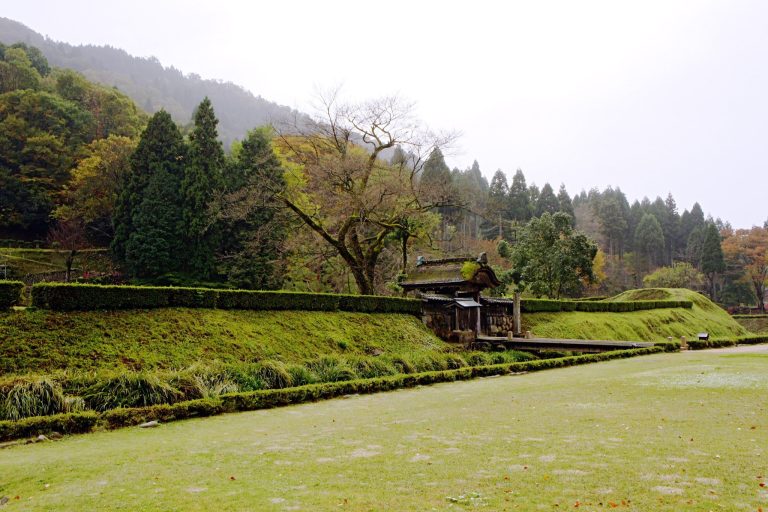
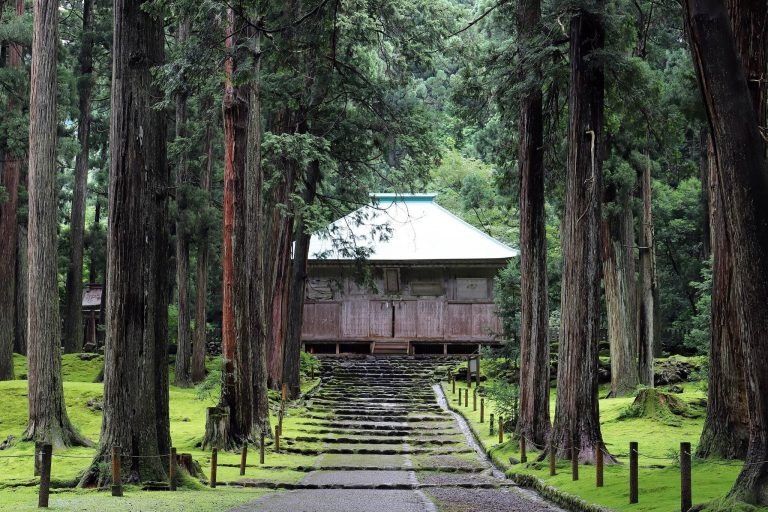
Eihei-ji occupies approximately 330,000 square metres on a wooded hillside. More than 70 large and small buildings are linked by corridors, with cedar trees, moss-covered boulders, and Japanese maples surrounding the structures. The surviving complex combines gates, ceremonial halls, meditation and service buildings, memorial spaces, and facilities for lay practice. Its buildings represent repeated rebuilding after medieval and sixteenth-century fires, as well as later construction and repair.
Ceremonial and teaching buildings
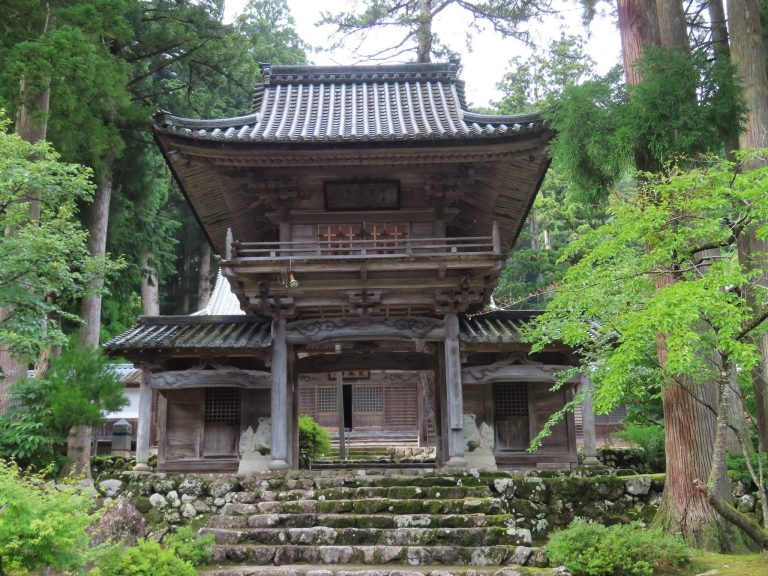
Sanmon
Sanmon, the main gate, was rebuilt in the eighteenth century and is the oldest surviving building specifically identified at Eihei-ji. Its upper floor contains a Rakan Hall, with sculptures representing the Buddha’s sermon to 500 disciples. Statues of the Four Heavenly Kings occupy the corners of the lower floor. These guardian figures traditionally protect the Buddhist law and mark the gate as a place of religious transition.
Butsuden
Butsuden, the Buddha Hall, was rebuilt in 1902 with a stone floor and a double roof. Its design copies the structure of Tiantong Temple in China, where Dōgen practiced. The main altar presents the Buddhas of the Three Times: Amitabha, the Buddha of the past, stands on the right; Shakyamuni, the Buddha of the present, occupies the center; and Maitreya, the Buddha of the future, stands on the left. Carved friezes around the altar depict Buddhist teachings.
Hattō
Hattō, the Dharma Hall, was rebuilt in 1843. A Dharma hall is a monastic space for teaching and ceremonies, and Hattō is used for morning, midday, and evening prayers, major ceremonies, and instruction. Its altar contains Kannon, the bodhisattva of compassion. Four white lions, known as the a-un lions, stand before the image.
Chokushimon and Chūjakumon
Chokushimon, the Imperial Messenger Gate, dates from 1839 and was reserved for imperial envoys. Chūjakumon, the Central Gate, leads toward Butsuden. Both gates belong to the complex’s historic architectural fabric, and Chūjakumon is among the buildings recognized as an Important Cultural Property.
Monastic practice spaces
Sōdō
Sōdō, the meditation hall, was rebuilt in 1902. Monks practice zazen on a raised platform called a tan, covered with tatami mats. Each trainee receives one mat, approximately 1 by 2 metres, for meditation, eating, and sleeping. Conversation and reading are prohibited inside the hall. An image of Monju, the bodhisattva of wisdom, occupies its center.
Daiku-in
Daiku-in, the Great Kitchen, was rebuilt in 1930. The three-storey building has a basement where vegetarian meals are prepared for monks and guests. Dōgen’s Tenzo Kyōkun sets out the duties and rules of the temple cook, connecting food preparation with the monastery’s wider discipline of everyday practice.
Yokushitsu
Yokushitsu, the bathhouse, is a designated place of monastic practice. Trainees shave one another’s heads and bathe every fifth day. Before bathing, they perform three bows and recite a sutra before an image of Baddabara, also called Kengo Daishi.
Tosu
Tosu, the toilet, is one of three important silent practice spaces in the Zen monastery, together with the meditation hall and bathhouse. Dōgen described rules for its use in the Shōbōgenzō. An image of Ususama Myōō, also called Katokongō, represents purifying power and is treated with respect by those entering.
Memorial and community buildings
Jōyōden
Completed in 1881, Jōyōden serves as Dōgen’s mausoleum and the Founders Hall. A mausoleum or Founders Hall preserves memorial objects and remains associated with a temple founder and lineage. The main altar contains images and ashes of Dōgen and his early successors. Additional altars hold memorial tablets and ashes of later Eihei-ji abbots and other clergy important to Sōtō Zen. Food is offered daily before images of the deceased as though they were living teachers.
Shōrōdō
Shōrōdō, the belfry, houses the great Brahma bell. The bronze bell dates from 1327 and is rung during morning zazen, at the beginning of the midday ceremony, at the beginning and end of evening zazen, at the close of the day, and during special ceremonies.
Shidōden
Shidōden, the Memorial Hall, contains thousands of tablets commemorating deceased lay followers and their families. A cherry-wood Buddhist rosary approximately 18 metres long hangs above its entrance. A follower from Nagoya donated it after the Second World War as a symbol of hope for world peace.
Sanshōkaku
Sanshōkaku is a modern reception and lecture building whose main hall has a ceiling dating from 1930. The ceiling contains 230 painted panels of birds and plants produced by 144 painters, including Kawai Gyokudō and Itō Shinsui. The room also contains a painting of Mount Fuji and an image of Hotei. It is used for lectures and zazen.
Kichijōkaku
Kichijōkaku is a large modern facility for lay visitors undertaking Zen practice. It contains a kitchen, baths, a reception area, conversation rooms, guest bedrooms, lecture rooms, meditation rooms, a zendō on the fourth floor, and a room for copying sutras.
Manuscripts and sacred imagery
Eihei-ji preserves manuscripts connected with Dōgen’s teaching, including works he brought back from Song China in 1227 and a record of a subsidy for an earlier Sanmon written by Emperor Go-En’yū in 1372. The complex’s imagery gives each principal religious space a defined devotional focus. Sanmon has the Four Heavenly Kings, Butsuden the Three Buddhas of past, present, and future, Hattō Kannon and the four white lions, Yokushitsu Baddabara, Sanshōkaku Hotei, and Tosu Ususama Myōō.