Ōno Castle: A Sengoku-Period Japanese Castle in Fukui


Site at a Glance
- Rating
- 4
- Popularity
- Medium
- Country
- Japan
- Primary era
- Early Modern
- External website
- Open
- Eras represented
- Early Modern
- Civilizations
- Oda regime
- Site type
- Military
- Remains
- Castle
On this page11 sections
History
Ōno Castle is a Japanese castle in Ōno, Japan, built during the Sengoku period around 1575 and completed by 1580. The Sengoku period was an era of political fragmentation and prolonged warfare before the Tokugawa shogunate. The castle stood on the main route linking Echizen Province with Mino Province and later became the seat of successive lords of Ōno Domain under Tokugawa rule.
Construction during the Sengoku period
Before the castle was built, the Ōno area was controlled by the Asakura clan and formed a major stronghold of the Ikkō-ikki, militant religious and popular leagues associated especially with the Jōdo Shinshū Buddhist movement. These leagues controlled fortified settlements in several regions and challenged samurai authorities. In 1575, Oda Nobunaga destroyed both the Asakura power and the Ikkō-ikki presence in the area. He then assigned Ōno to his general Kanamori Nagachika under the regional authority of Shibata Katsuie, a senior Oda commander.
Kanamori began building Ōno Castle around 1575, using contemporary Japanese castle designs. An earlier Asakura castle at Inuyama was initially used, but its position was poorly connected to the principal routes. Kanamori therefore established the new castle at the junction of the highways leading through Hokuriku and toward Mino. Construction was completed by 1580.
Kanamori was transferred to govern Hida Province in 1586. Control of Ōno subsequently passed to Aoki Kazunori and then to Oda Hidekatsu under Toyotomi Hideyoshi. These changes took place during the political unification of Japan led successively by Oda Nobunaga, Toyotomi Hideyoshi, and Tokugawa Ieyasu.
Ōno Domain under the Tokugawa shogunate
After the Battle of Sekigahara, the conflict that established Tokugawa dominance in 1600, Tokugawa Ieyasu assigned Echizen Province to his second son, Yūki Hideyasu, in 1601. The territory became Fukui Domain. When Fukui Domain was divided in 1624, Hideyasu’s third son, Matsudaira Naomasa, received a fief of 55,000 koku centered on Ōno. A koku was a historical measure of assessed agricultural production used to calculate a lord’s territorial income, and the new arrangement created Ōno Domain.
Naomasa moved to Matsumoto Domain in 1633 and was replaced in Ōno by his younger brother, Matsudaira Naomoto, in 1635. Naomoto was transferred to Yamagata Domain in 1644, after which another younger brother, Matsudaira Naoyoshi, took control. Naoyoshi’s son, Matsudaira Naoakira, moved to Himeji Domain in 1682.
That same year, Ōno Domain was assigned to a cadet branch of the Doi clan under Doi Toshifusa. The Doi, a hereditary vassal family, governed Ōno for eight generations until the Meiji Restoration, the nineteenth-century political transformation that ended the Tokugawa shogunate and established imperial government in Japan.
Fire, reform, and demolition
A fire destroyed the castle’s central enclosure and its buildings in 1775. Reconstruction was completed by 1795, although the main donjon was not rebuilt. The domain also experienced serious financial difficulties during its history. Doi Toshitada, who lived from 1811 to 1869, responded with substantial reforms and promoted rangaku, or Dutch learning, through which Western science and technology were studied from Dutch sources. During the Bakumatsu period, the final years of the shogunate, Ōno became known for its Westernized army and its han school, an educational institution established by a domain to train officials and retainers.
Following the Meiji Restoration, Ōno Castle was demolished in 1871. Two gates were transferred to nearby Buddhist temples, while the former castle grounds were later used for government buildings. The surviving remains and later reconstruction preserve evidence of the castle’s changing role from a Sengoku stronghold to the administrative center of Ōno Domain. In 2017, Ōno Castle was included among the Continued Top 100 Japanese Castles.
Remains
Hilltop and summit enclosure
Ōno Castle occupied the east-west ridgeline of Kameyama Hill, which extends for approximately 300 meters. The summit held the honmaru, the innermost enclosure, whose stone ramparts were made mostly from unmodified natural boulders. The position placed the principal defensive area above the lower enclosures and shaped the castle’s long, ridgeline layout.
Donjon complex
The summit enclosure contained a two-story donjon, a smaller donjon, the Tengu-shoin, and the Asagi watchtower at the eastern end of the ridge. A shoin was a formal study or reception space, while a watchtower provided observation, defense, or storage. The donjon complex was reconstructed in concrete in 1968 as a non-original replica. It now serves as a local history museum, while some original stone-rampart remains survive on Kameyama Hill.
Lower enclosures and water defenses
Second enclosure
The ni-no-maru, or second enclosure, lay at the foot of the hill. It contained a residence protected by water moats, whose supply was diverted from the Akane River. This lower area formed part of the castle’s defensive and residential organization below the summit enclosure.
Outer enclosures and approach
Beyond the second enclosure stood the san-no-maru, or third enclosure. Farther outward was the sotomaru, an outer enclosure that contained the castle’s main gate. The lower enclosures were connected with the summit by the Hyakken-zaka slope, linking the castle’s residential, defensive, and administrative areas.
Castle-town remains
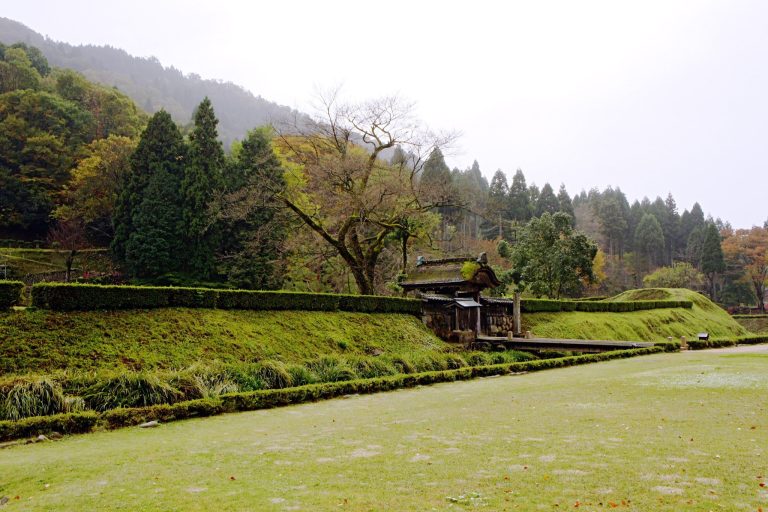
Parts of the former castle town survive around the site, including traditional samurai residences and merchant houses. Together with the remaining stone ramparts and the reconstructed donjon complex, these buildings convey the relationship between the hilltop castle and the settlement that developed around it.