Suvodol Monastery: A Serbian Orthodox Monastic Complex in Serbia


Site at a Glance
- Rating
- 4.8
- Popularity
- Low
- Country
- Serbia
- Primary era
- Modern
- Eras represented
- Modern
- Civilizations
- Serbian
- Site type
- Religious
- Remains
- Monastery
On this page13 sections
History
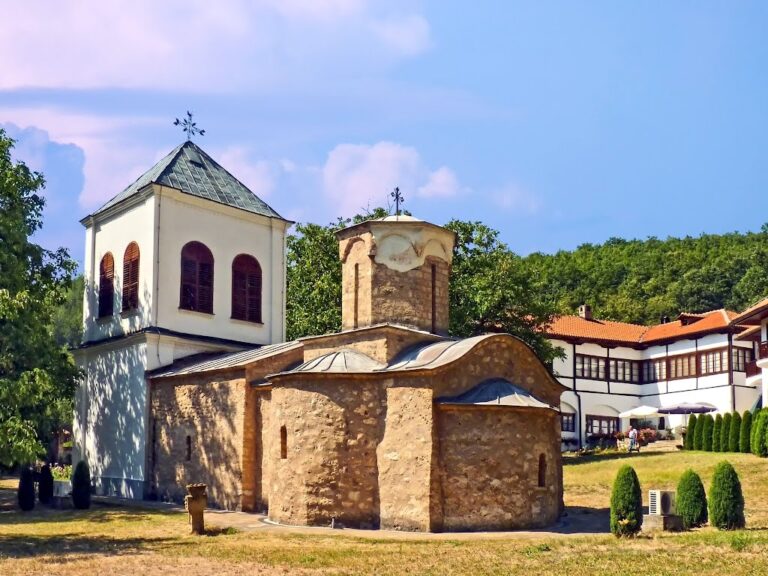
Suvodol Monastery is a Serbian Orthodox monastery in Selačka, Serbia, dedicated to the Nativity of the Most Holy Mother of God. Its present church belongs to the nineteenth-century rebuilding of the complex, while the monastery’s earlier foundation remains uncertain. It is part of the Timok Eparchy, a territorial jurisdiction of the Serbian Orthodox Church, and currently houses a community of nuns.
Uncertain beginnings and medieval tradition
The date and founder of Suvodol Monastery are not securely established. Sopiens Don Šop associated the construction of its church with the Byzantine conquest of Vidin and the surrounding region between 1004 and 1008. Local tradition instead links the monastery with Prince Lazar Hrebeljanović, a fourteenth-century Serbian ruler, and presents it as a foundation of the Nemanjić dynasty, Serbia’s principal medieval ruling house. The older monastic archive was burned during the Serbian–Turkish War of 1876–1878, and the newer archive was destroyed during the Serbian–Bulgarian War, leaving these traditions without the original records that might have clarified the monastery’s beginnings.
The monastery experienced attacks associated with the movements of the Uzes, Pechenegs, Cumans, and other groups in the late eleventh century. Human bones found across the courtyard during construction of the present church, together with bones sometimes exposed by high water near a cave above the monastery, have been tentatively connected with violence in the eleventh and twelfth centuries and with large-scale killings in the seventeenth and eighteenth centuries. A tombstone dated 1255 is identified as the sole surviving material remnant linked with the monastery’s earliest history.
Ottoman attack and nineteenth-century rebuilding
In 1810, Suvodol was the scene of a battle between Serbian forces commanded by Vojvoda Nino Vasiljević, also called Bocić, and the Ottomans. After plundering the monastery, Ottoman troops damaged the church’s frescoes by gouging out the eyes of the painted saints.
The old church was demolished in 1865. Construction of its replacement began in August 1866 during the rule of Prince Mihailo Obrenović and the tenure of Bishop Gerasim Stojković. Bishop Evgeni Simonović consecrated the new church and furnished it with an antimins, a consecrated cloth placed on an Orthodox altar, on 25 October 1869. During the ceremony, he declared that relics of Saint Panteleimon, a Christian martyr and healer venerated in Eastern Christianity, were being sealed into the Holy Throne.
The rebuilt church was severely damaged during the Serbian–Turkish War in 1876. Ottoman troops filled the building with straw, soaked it with gas, and set it alight, leaving the walls standing. Milosav Marković of Knjaževac, originally from Mali Izvor, restored the iconostasis and painted decoration in 1892. A note about this work survives in one of the monastery’s Menaia, liturgical books containing services and hymns arranged by the months of the church year.
Monastic administration and twentieth-century change
In 1845, the brotherhood consisted of the superior Vasilije Konstantinović, Hieromonk Kiril H. Stojanović, and Monk Konstantin H. Avramović. A hieromonk is a monk ordained as a priest. By 1870, the monastery belonged administratively to the Knjaževac District and the Timok Zaglavak subdistrict, and ecclesiastically to the Negotin Eparchy. Four monks lived there. In 1898, the community comprised Archimandrite Josif, its superior, and Hieromonk Vasilijan, and the monastery held second-order status.
The estate covered 1,072 hectares in 1895. Forest accounted for 1,014 hectares, while 43 hectares were arable land, with smaller areas of meadows, vineyards, and orchards. Its immovable property was valued at more than 72,000 dinars. At the end of the nineteenth century, Selačka belonged ecclesiastically to the monastery parish. In 1928, the hieromonk Nikanor headed Suvodol, which was described as one of Serbia’s most advanced monasteries, with extensive forest resources and a well-organized estate.
During the Bulgarian occupation of the Timok region from 1915 to 1918, the occupying authorities installed a Bulgarian priest at Suvodol. In 1917, Bulgarian forces killed 82 priests and monks in the region, including two from the monastery: Đorđe, known locally as Đorđica and originally from Kumanovo, and another monk whose name is unknown.
Suvodol suffered during the Second World War and under the postwar authorities. Agrarian reform confiscated its land, and in 1946 the monastery changed from a male to a female community. Nuns arrived from monasteries in Srem and from what was then Bosnia, including the sisters Devora and Anastasija Golić. Devora remained abbess, the female superior of a women’s monastery, until her death in 1975. Anastasija then assumed leadership, transferring it to the hieromonk Justin in 1990 because of her age. Nuns recorded as living at the monastery include Melanija Vidović and Evdokija Plavšić.
The latest renovation took place in 1990 under Abbess Anastasija Golić and Hieromonk Justin. The community supports the monastery through agriculture and livestock raising on its estate, which the nuns cultivate themselves, together with donations from the faithful. Suvodol Monastery is protected as a cultural monument of major importance in Serbia and is listed under the national identifier SK 664.
Remains
Valley setting and church complex
Suvodol Monastery occupies a terrace cut into the northern side of Manastirska Glava Mountain in the Selačka River valley. It lies below the heights of Janošica, 992 metres, Vetren, 500 metres, and Treska, 1,025 metres. Three caves are located near the complex, including one above the monastery where high water has sometimes exposed human bones. A drawing made by Felix Kanitz in 1860 shows the monastery with a waterfall. Kanitz, a nineteenth-century travel writer, artist, and ethnographer, described a narrow gorge along the Selačka River, with limestone cliffs, dense vegetation, a clear stream, and a waterfall more than 20 metres high descending in several cascades.
The monastery church
The former church followed a Byzantine-style cruciform plan and reportedly had a small chapel or related side space, called a paperta, on each side. The present church has a rectangular ground plan. Descriptions of the rebuilt building compare its arrangement with Žiča: a narrow narthex, or entrance hall, is flanked by two chapels, while the principal undomed space ends in three apses, the semicircular or polygonal ends of the sanctuary, arranged in a trefoil form. A small number of windows provided limited interior light.
The church also reportedly had an unusual bell arrangement at its front. Projecting walls and two arches carried on free-standing columns concealed bells fixed to the vault. Inscriptions stated that one bell had been cast in Pest and another in Vršac in 1858. The church’s painted decoration had been renewed in 1645 through the efforts of the hieromonk Pimen. Josif Pančić, a nineteenth-century Serbian naturalist and botanist, described the paintings after visiting the monastery in 1863 with students from the natural-sciences department of the Higher School.
Spring and pool
A strong spring in the monastery courtyard was enclosed in 1866 as a fountain with five spouts. Its water is described as cold and pleasant-tasting throughout the year. A pool or fishpond at the center of the complex uses the spring water.
Residential and devotional buildings
Earliest residential building
The monastery court contains three residential buildings, or konaks, built or rebuilt in different periods. The earliest was erected in 1880 from bricks left over from the church construction. A larger building later replaced it on the same site between 1986 and 1999 through the efforts of Justin and Anastasija.
Konak for worshippers
A second konak was built in 1920 under Nikanor Pujić, who was originally from Mali Izvor. It served to accommodate worshippers during major visits and religious feasts.
Later konak and Saint King Milutin Chapel
A third konak was constructed under Nikanor Pujić between 1926 and 1930. A new building replaced it on the same site in 1978 and 1979 through the work of Hieromonk Justin and the monastery sisterhood. Inside this later konak is a chapel dedicated to Saint King Milutin, the medieval Serbian king Stefan Uroš II Milutin and a major patron of Orthodox churches and monasteries. Bishop Milutin Stojadinović of Timok requested the chapel for the sisterhood’s use during winter. Patriarch German consecrated the konak and chapel on 29 July 1979.
Books and liturgical possessions
The monastery’s historical treasury included the late-fourteenth-century Marinko Gospels, written on parchment, and an Octoechos dated 1692. An Octoechos is an Orthodox liturgical book organized around the eight musical modes used in the weekly service cycle. Marinko Stanojević removed both manuscripts from Suvodol and donated them to the Serbian Royal Academy. In the mid-nineteenth century, under Abbot Kiril, the monastery possessed 34 liturgical books and 10 large icons.
Nearby sites