Belogradchik Fortress: A Roman and Ottoman Stronghold in Bulgaria


Site at a Glance
- Rating
- 4.8
- Popularity
- High
- Country
- Bulgaria
- Primary era
- Modern
- Eras represented
- Classical, Medieval, Modern
- Civilizations
- Bulgarian, Ottoman, Roman
- Site type
- Military
- Remains
- Fort
On this page13 sections
History
Belogradchik Fortress is a historic stronghold near Belogradchik in Bulgaria, first built by the Romans between the 1st and 3rd centuries when the region formed part of the Roman Empire. Its earliest role was mainly to watch and control the surrounding area, rather than to serve solely as a defensive battlefield position. The fortress later became an important military center because its walls could be integrated with the imposing natural rock formations of the northern Balkan Mountains.
Roman and medieval foundations
The Roman-period fortress established the earliest known phase of the site. Archaeological work has identified wall foundations, construction fragments, ceramics, weapons, coins, and parts of the water-management system connected with its Roman and later use.
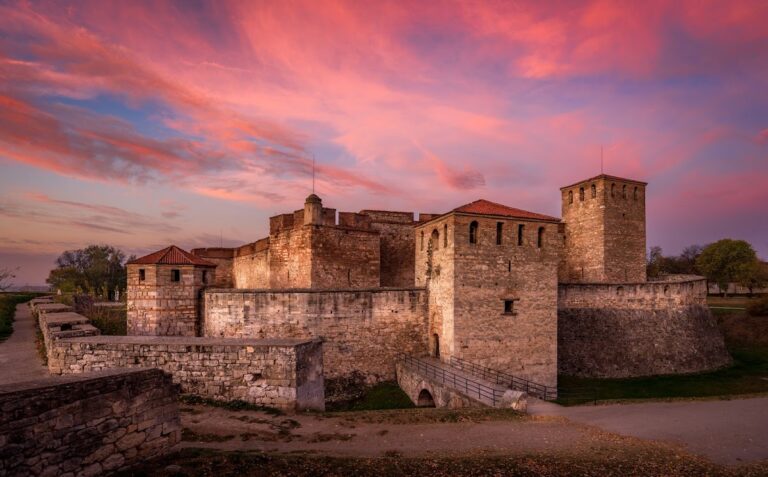
In the 14th century, Ivan Stratsimir, the Bulgarian ruler of the Tsardom of Vidin from 1356 to 1396, enlarged the earlier fortress. He placed fortified garrisons in front of the existing rock formations, turning the site into one of the region’s most important strongholds. Its regional standing was considered second only to Baba Vida Fortress in Vidin, the principal stronghold of the rulers of Vidin.
A Hungarian annalist’s account of Louis I of Anjou’s campaign states that, three months after Vidin was captured on 2 June 1365, other fortresses, including Belogradchik, also fell. Bulgarian rebels expelled the garrison in 1369, briefly restoring Bulgarian control.
Ottoman occupation and expansion
The Ottomans captured Belogradchik Fortress in 1396 during their conquest of Bulgaria and partly destroyed it. They later enlarged and strengthened the site as armed insurgents known as Hajduks, active in the Balkans under Ottoman rule, and local uprisings increased the need for military control.
Ottoman administrative records first mention the fortress in 1455. Further records from 1466, 1528, and 1586 describe its garrison. In 1528, sixteen guards served there, including an imam and a dizdar, the fortress commander. By 1586, the garrison included twenty-seven guards and nine associated personnel. Forty Muslims involved in agriculture also lived within the fortress in seven households.
Nineteenth-century military role
In 1809, the Hajduk leader Velko and other insurgents captured the older fortress. Major alterations and a comprehensive reorganization followed during the early 19th century, especially between 1805 and 1837. The rebuilding adopted contemporary Ottoman fortress architecture while also incorporating European elements through the participation of French and Italian engineers.
During the reign of Sultan Mahmud II, who ruled the Ottoman Empire from 1808 to 1839, Serbia gained independence and the Ottoman-Serbian border was redrawn about 15 kilometers west of the fortress. This change increased Belogradchik’s strategic importance. The fortress was used in the Ottoman suppression of the Bulgarian Belogradchik Uprising of 1850 and again during the Serbo-Bulgarian War of 1885. The latter conflict was its last military use.
The western part of the complex was reinforced in 1862 through construction of the Suleiman Fortification. During the Russo-Ottoman War of 1877–1878, Russian and Romanian troops besieged the fortress. After the armistice, it was handed over to the allied forces.
Archaeology and preservation
Later rebuilding preserved the fortress as a historic monument, and it was designated a cultural monument of national importance. The local historical museum authority administers the site, which is also included among Bulgaria’s 100 national tourist sites.
Remains
Natural setting and overall layout
Belogradchik Fortress stands near the town of Belogradchik on the northern slopes of the Balkan Mountains in northwestern Bulgaria. Natural rock formations reaching up to 70 meters high protect two sides of the complex. As a result, fortified walls were built mainly along the northwestern and southeastern sides, while the rock masses formed an essential part of the defensive arrangement.
The complex covers approximately 10,210 square meters. Its walls are more than 2 meters thick at the foundations and rise to about 12 meters. Three separate fortified courtyards are linked by gates. The layout includes entrances, fortification sections, fortified positions, and rock masses incorporated into or associated with the defenses. The 14th-century expansion placed fortified garrisons before the existing rock formations and added wooden bridges and stone steps.
Ottoman defensive works
Walls, platforms, and fighting positions
The major Ottoman reorganization added new stone-and-mortar walls and a defensive belt made with embedded wooden stakes. The fortress road was paved with cobblestones. Three gun platforms, fortified positions designed for artillery, were installed, each with three cannons. Narrow loopholes allowed observation and the use of weapons, while fighting walks provided defenders with platforms or passages from which they could reach those openings.
Storage and working spaces
The complex contained residential facilities, guardrooms with fireplaces and benches, and workshops. The second courtyard included a granary, a wheat mill, a salt mill, and a stable. Underground storage cellars held ammunition and food, supporting the fortress’s military occupation and its ability to withstand siege conditions.
Water supply and archaeological finds
Water-management system
Water came from a well in the southern part of the courtyard and from two cisterns supplied by rainwater and snow. Supports for rectangular wooden channels remain visible, along with the channels themselves. They directed rainwater and snowmelt into a reservoir measuring 85 square meters, forming part of the site’s defensive infrastructure.
Excavated evidence
Archaeological investigations have uncovered wall foundations, structural fragments, ceramics, iron spearheads and arrowheads, and coins issued under the Roman emperors Vespasian, Trajan, Septimius Severus, Gordian III, and Decius Trajan. Together with the surviving fortifications and water system, these finds reflect the fortress’s long development from its Roman origins through its medieval and Ottoman phases.