Rozhen Monastery: A Medieval Orthodox Monastery in Bulgaria


Site at a Glance
- Rating
- 4.8
- Popularity
- Medium
- Country
- Bulgaria
- Primary era
- Early Modern
- Eras represented
- Medieval, Early Modern
- Civilizations
- Ottoman
- Site type
- Religious
- Remains
- Fortified Monastery
On this page10 sections
History
Rozhen Monastery is a medieval Orthodox monastery in Bulgaria, located above the village of Rozhen northeast of Melnik. Formally dedicated to the Nativity of the Mother of God, it is among the country’s few surviving medieval monasteries. Its earliest history remains uncertain, although archaeological and documentary evidence points to activity at the site by the thirteenth century.
Medieval origins
Athonic chronicles place the monastery’s foundation in 890, while oral tradition links it to Despot Alexius Slav, a medieval Bulgarian ruler who governed an autonomous principality in the southern Balkans during the early thirteenth century. Kalist Angelikoud, a Byzantine monk and theologian associated with fourteenth-century Orthodox spirituality, has also been identified as its founder. These attributions remain uncertain.
Archaeological excavations in the courtyard uncovered a grave containing jewelry and coins from the reign of Byzantine Emperor Michael VIII Palaiologos, who ruled from 1259 to 1282. A marginal note in a Greek manuscript provides further indirect evidence for the monastery’s existence during the thirteenth century. The earliest secure written reference dates to 1551, when the hieromonk Cosma, an Orthodox monk ordained as a priest, copied a manuscript for the monastery of the All-Holy Mother of God Rosinotisa. The manuscript is now held by the Great Lavra on Mount Athos.
The monastery is also associated with a calligraphic school in the fourteenth century. A fourteenth-century illuminated manuscript connected with Rozhen is preserved in the Church of the Holy Sepulchre in Jerusalem.
Sixteenth-century growth and artistic development
Rozhen entered a period of expansion in the sixteenth century. The present southern wing and main church were built around the middle of the century, and frescoes were added to the church and refectory toward its end. The ossuary dedicated to Saint John the Baptist was built outside the monastery walls in 1597 and painted with frescoes in 1662. The southern facade of the main church was painted in 1611.
Fire, reconstruction, and changing jurisdiction
A major fire between 1662 and 1674 severely damaged most of the monastery buildings and probably destroyed its archive and library. Rozhen then entered a period of serious decline. Reconstruction began in 1715 with financial assistance from wealthy Bulgarians from across the country, and the church was completed in 1732. Building work continued during the early nineteenth century.
In 1761, citing financial difficulties, the monastery lost its independence and became a metochi, a dependent monastic estate or branch, of Iviron Monastery on Mount Athos. Iviron is a Georgian monastic foundation on Mount Athos. Monks from Iviron were appointed as abbots. During the nineteenth century, Rozhen became a regional spiritual center and owned extensive land in the surrounding area, but it declined again in the late nineteenth and early twentieth centuries.
Twentieth-century administration and restoration
In 1910, Georgi Triantafyllidis, a former petty officer in the Royal Navy who presented himself as the French citizen Georges Putois, became a lessee and administrator of the monastery’s estates. He raised French and Greek flags at the monastery and organized an armed group from young men of Melnik, ostensibly to protect the area from raids. His administration also involved the systematic cultivation and protection of monastery lands, together with pressure and threats against Slavic-speaking tenants who resisted.
After 1912, Bulgaria and Greece disputed ownership and jurisdiction over Rozhen. The Hague arbitration court settled the dispute in Bulgaria’s favor in 1921. The monastery subsequently came under the Bulgarian Exarchate, an ecclesiastical institution established for Bulgarian Orthodox communities within the Ottoman Empire, and it now belongs to the Nevrokop Eparchy of the Bulgarian Orthodox Church.
Architectural and structural conservation and restoration were completed in 1981 under the direction of Hristina Staneva. Restoration of the frescoes, icons, and woodcarving began in the late 1960s and continued until the early 1990s under teams led by Lozinka Koynova-Arnaudova and Aleksandar Penev. Rozhen was declared a cultural monument of national importance in 1973. It remains an active monastery used by monks.
Religious life and associated buildings
The principal annual feast is held on 8 September for the Nativity of the Mother of God. Pilgrims traditionally bring offerings, spend the night in the church, join a procession with the miraculous icon, and receive blessed monastery food. The Feast of the Holy Cross on 14 September was also celebrated historically.
The church of Saints Cyril and Methodius was built between 1912 and 1914 on the initiative of Yane Sandanski, a Bulgarian revolutionary and political activist. It was built by Bulgarian Exarchists, Orthodox Christians affiliated with the Bulgarian Exarchate, who were not admitted to the patriarchal monastery. Sandanski was killed in 1915 and buried beside the church.
Remains
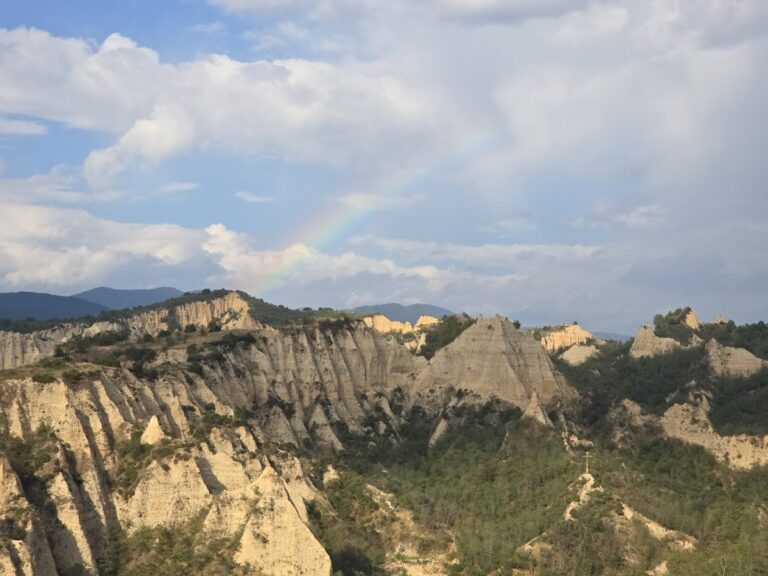
Rozhen Monastery stands at about 585 metres above sea level on the southwestern slopes of the Pirin Mountains, above the village that bears its name and northeast of Melnik. Its setting is associated with the sandstone pyramids of Melnik. The complex has an irregular hexagonal plan and the appearance of a medieval fortress. Two- and three-storey residential buildings, linked by surrounding galleries, enclose the courtyard where the monks’ cells are located. Parts of the courtyard are shaded by grapevines.
The monastery church
The katholikon, the principal church of an Orthodox monastery, dominates the courtyard. It measures approximately 10 by 22 metres and is a three-nave, three-domed basilica. Its interior and exterior preserve frescoes from several periods, including paintings described as dating to the fourteenth century and later campaigns from 1597, 1611, 1715, and 1732. The narthex, or entrance hall, contains dramatic scenes of the Last Judgment, while the halos of the saints are executed in relief. A donor portrait of the nun Melania is also preserved.
The church was restored in 1715. In 1727, the iconographers Theocharis and Nikolaos painted its interior, including a depiction of the Dormition of the Mother of God with a donor portrait on the eastern wall of the narthex. They also left a Greek signature. In 1732, Alexios of Ioannina painted the icons of the iconostasis, the decorated screen separating the sanctuary from the main body of the church, and added further church frescoes.
A small chapel separated from the southern side of the altar contains a carved wooden iconostasis attributed to the Debar School, a Balkan woodcarving tradition associated with the Debar region. Its decoration combines animal figures and plant ornaments with scenes from the Old Testament. The church also preserves valuable icons depicting Saints Cosmas and Damian, the Entry into Jerusalem, and the Assembly of the Archangels.
The chapel of Saints Cosmas and Damian houses a copy of the Iviron Monastery icon of the Mother of God Portaitissa, known in Bulgarian as the Gatekeeper. The icon was created in 1790 by Jacob of Iviron for the leatherworkers’ guild of Melnik. Made of consecrated iron, it is surrounded by ten small scenes showing healing miracles associated with the icon and is regarded as miraculous.
Ossuary and nearby church
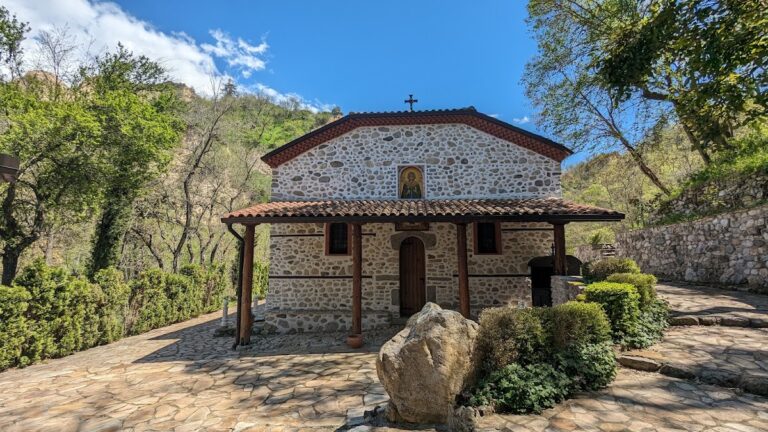
The ossuary dedicated to Saint John the Baptist, a building used for keeping human bones, stands outside the monastery walls beside the cemetery, about 50 metres to the north. Built in 1597, it was frescoed in 1662. The church of Saints Cyril and Methodius stands about 200 metres from the monastery, with the tomb of Yane Sandanski beside it.
Archaeological and manuscript evidence
The courtyard grave containing jewelry and coins associated with the reign of Michael VIII Palaiologos provides material evidence for the site’s medieval activity. A marble frieze above the main entrance of the church dates to the thirteenth or fourteenth century. Together with the fourteenth-century illuminated manuscript and the medieval calligraphic tradition associated with Rozhen, these remains connect the monastery with the intellectual and religious life of the medieval Balkans.
Nearby sites