Timacum Minus: A Roman Military Fort in Serbia


Site at a Glance
- Rating
- 4.4
- Popularity
- Very Low
- Country
- Serbia
- Primary era
- Classical
- External website
- Open
- Eras represented
- Classical
- Civilizations
- Roman
- Site type
- Military
- Remains
- Fort
On this page10 sections
History
Timacum Minus, in Serbia near the village of Ravna, was a Roman military site built in the first century AD and regarded as the oldest military fort in the Timok Valley. It occupied a strategic position on the Roman route from Lissus through Naissus to Ratiaria, forming part of the military and communications network that connected the region.
Roman military foundations
The site lay about 60 kilometres northeast of Naissus, a major Balkan trading centre where routes running north to south and west to east converged. Roman mining near Naissus encouraged the establishment of permanent forts, roads, and administrative facilities across the surrounding territory. Early units linked with this system included Legio V Macedonica, Legio IV Scythica, and cohors I Thracum Syriaca, a smaller auxiliary unit recruited outside the regular citizen legions.
During the reign of Marcus Aurelius, who ruled from AD 161 to 180, cohors I Thracum Syriaca was replaced by cohors II Aurelia Dardanorum. This auxiliary cohort was formed from the local population of Moesia Superior, a Roman province in the central Balkans. Dardanian brigands were active in the Timacum Minus region at this time, and the deployment of the new unit marked the construction of the site’s first permanent military base.
Settlement and later occupation
An urban settlement developed around the military base as mining activity expanded and major road construction continued. Timacum Minus and Timacum Maius, near Svrljig, worked as paired elements within the Roman network of the Timok Valley.
The fortress and nearby settlement date from the first century AD. Occupation continued until the sixth-century restoration of imperial authority under Justinian, the Byzantine emperor associated with efforts to recover parts of the former Roman world. The site was designated a Monument of Culture of Great Importance in 1979 and remains protected by the Republic of Serbia.
Remains
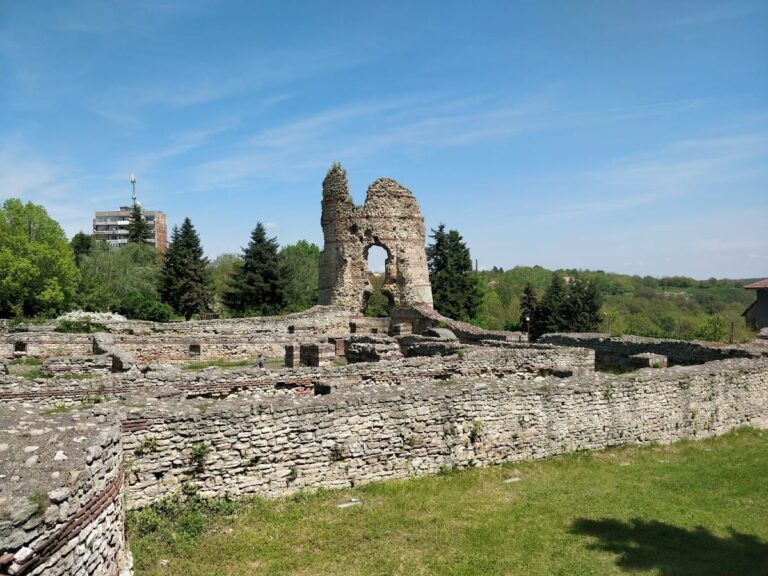
The archaeological site lies southeast of Ravna, north of Knjaževac, near the White Timok River. It occupies a hilly landscape surrounded by several mountain ranges and consists of a Roman fortress together with a nearby settlement.
Fortress and settlement
Roman fortress
The fortress represents the permanent military base established for cohors II Aurelia Dardanorum. It formed the central defensive feature of the site and stood within the wider Roman military and communications system of the Timok Valley.
Nearby settlement
A settlement grew around the fortress during the period of expanding mining and road construction. Its presence reflects the development of civilian and administrative activity alongside the permanent military deployment.
Burial grounds and archaeological collections
Slog Hill necropolises
Two Roman necropolises, or cemeteries associated with the ancient settlement, were found several kilometres from the fortress on the slope of Slog Hill. They contained numerous finds and burial gifts, including jewellery, ceramic and glass vessels, and coins.
Lapidarium and displayed finds
Finds from Timacum Minus are displayed mainly at the County Museum of Knjaževac and in the site’s archaeological-ethnographic park. The park includes a lapidarium, a collection of stone monuments and architectural fragments, providing a setting for material recovered from the Roman site.
Nearby sites