Stavronikita Monastery: An Orthodox Monastery on Mount Athos
Site at a Glance
- Popularity
- High
- Country
- Greece
- Primary era
- Early Modern
- Eras represented
- Early Modern, Modern
- Civilizations
- Greek, Ottoman
- Site type
- Religious
- Remains
- Fortified Monastery
On this page21 sections
History
Stavronikita Monastery is an Eastern Orthodox monastery on Mount Athos in Greece, dedicated to Saint Nicholas and affiliated with the Ecumenical Patriarchate of Constantinople. The Ecumenical Patriarchate is the first-ranking patriarchate in Eastern Orthodoxy, but does not govern all Orthodox churches as a central authority. Monastic activity at Stavronikita reaches at least the early eleventh century. The monastery ranks fifteenth among the Athonite monasteries and was the last to receive official monastery status, granted by a decree of Patriarch Jeremias I in 1536. The decree brought the number of recognized Athonite monasteries to twenty.
Early community and medieval decline
Monks used the site from the tenth century. Documents dated 1012 and 1016 name a monk associated with Stavronikita, placing its community by the first half of the eleventh century. By the end of the fifteenth century, the Russian pilgrim Isaiah described it as a Greek monastery.
Several traditions explain the monastery’s beginnings and name. One tells of two monks, Stavros and Nikitas, who lived in cells there before a monastery was established. Another credits its foundation to the Byzantine officer Niceforus Stavronikitas, who served under Emperor John I Tzimiskes, a tenth-century ruler. A third attributes it to the patrician Nikitas, a high-ranking aristocrat, and connects his name with stavros, the Greek word for “cross.” Some old documents call the monastery the Monastery of the Theotokos, the Orthodox title for the Virgin Mary, suggesting an earlier dedication. “Stravonikita” is a corruption of the original name.
By around the first half of the thirteenth century, the monastery had been deserted amid repeated pirate raids and the consequences of the Fourth Crusade, a western European expedition that captured Constantinople in 1204. Stavronikita came under the Protos, the leading authority of the Athonite monastic community, and later passed to Koutloumousiou and Philotheou. It functioned as a skete, a dependent monastic settlement. In 1287 it was associated with the Protos and subsequently assigned to Koutloumousiou as a dependent cell.
Rebuilding and formal recognition
In 1533, monks from Philotheou sold Stavronikita to Gregorios Giromeriatis, a hieromonk (a monk who is also a priest) and abbot of a monastery in Thesprotia. He settled at Stavronikita and began rebuilding and enlarging it. The 1536 decree of Jeremias I granted the community official monastery status. After Gregorios died in 1540, the patriarch continued the work personally.
The monastery remained modest in both its property and the size of its community. Disputes over land with neighboring sketes and monasteries, particularly Koutloumousiou, hampered its growth. Assistance came from the Athonite community and individual benefactors, including Servopoulos in 1612, the monk Markos in 1614, residents of Kea in 1628, Thomas Klados in 1630, and Prince Alexandru Ghica of Wallachia between 1727 and 1740.
Fires, war, and recovery
Fires in 1607 and 1741 devastated the monastery, reducing it to its foundations. Its principal church was renovated in 1628. Another period of development followed, while fires in 1864, 1874, and 1879 caused further extensive damage. The buildings were reconstructed, but the resulting debt and other financial pressures contributed to a decline. Abbot Theophilos, formerly a monk of Vatopedi, helped reverse the setback, and the monastery recovered by the early twentieth century.
During the Greek War of Independence, the early nineteenth-century conflict for Greek independence during Ottoman rule, Stavronikita took on exceptional debt to help finance the war. Ottoman forces entered Athos and dispersed the monks. The monastery and its holdings in Wallachia, Moldavia, and elsewhere were abandoned for about a decade. After the Ottomans left Athos, surviving monks returned.
Luke of Agia Anna was tonsured at Stavronikita as a rassophore, a monk who had received the monastic robe but not yet taken full vows. Later revered as a neomartyr, a Christian martyr of a later historical period, he died on March 23, 1802. The monastery celebrates Saint Nicholas on December 19, corresponding to December 6 on the Julian calendar.
Twentieth-century restoration
After the Second World War, Stavronikita declined again. In 1968, only three monks remained and almost the entire complex lay in ruins. A small community spiritually connected with Paisios undertook restoration, with Paisios also doing manual work there for several months. Vasileios Gontikakis became abbot that year and re-established communal life under a shared rule, known as cenobitic monasticism. Stavronikita was the first of nine Athonite monasteries converted from the idiorrhythmic system, which allowed monks more independent routines, to communal life during the twentieth century.
From 1981 to 1999, the state Center for the Preservation of Athonite Heritage, under the Ministry for Macedonia-Thrace, carried out extensive renovation and restoration. Work on the ruined wings added a floor to the previously uninhabited west wing between 1986 and 1989. When that work was completed, the community had 25 monks and five novices. About half later accompanied Vasileios to Iviron in 1990, where they established communal life.
The Russian monk Tikhon, Paisios’s spiritual mentor, died on September 23, 1968. Tikhon and Paisios had lived in a Stavronikita-affiliated hermitage dedicated to the Holy Cross in Kapsala. Paisios remained there from 1968 to 1979, then moved to a cell belonging to Koutloumousiou.
Remains
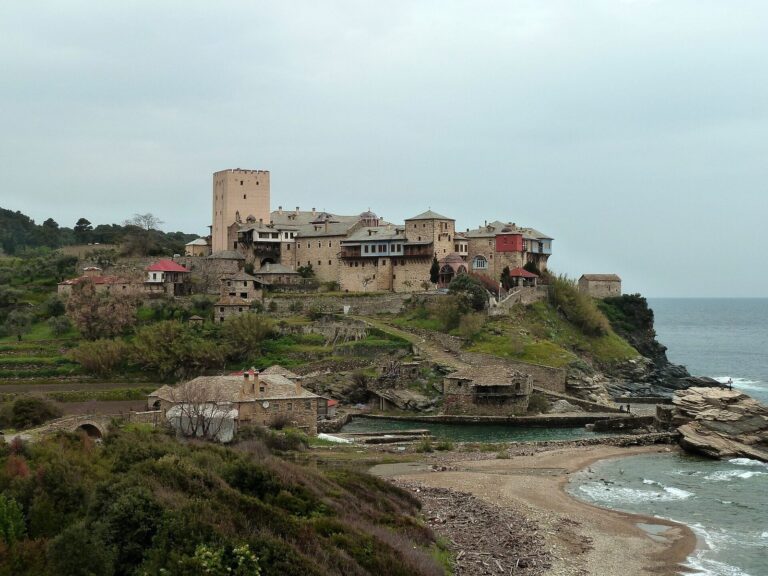
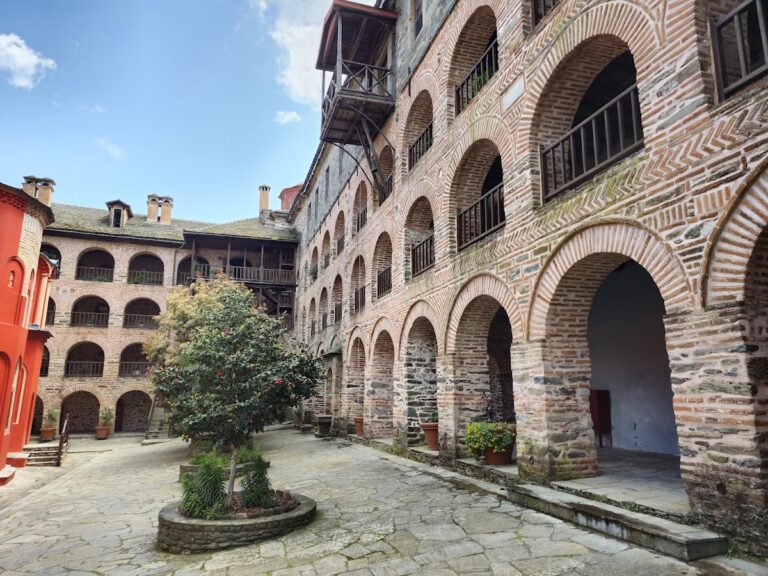
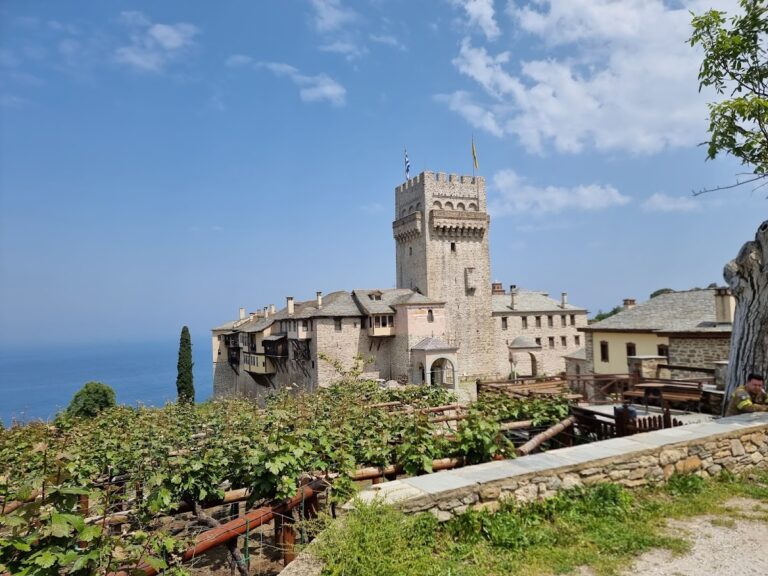
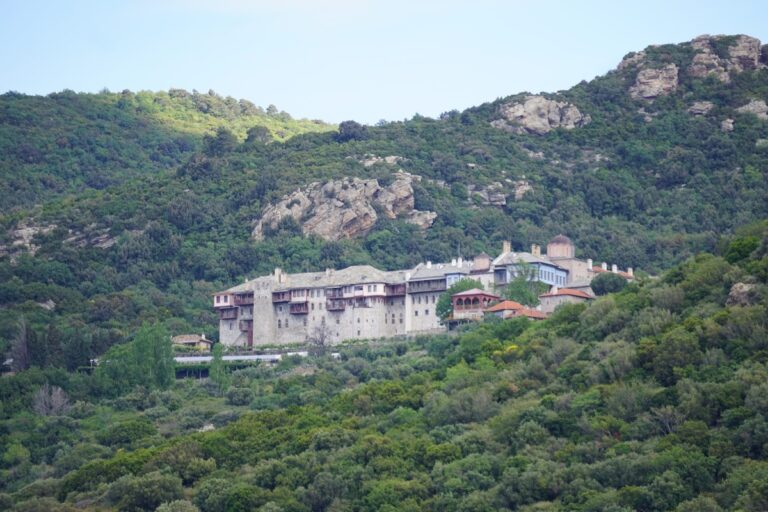
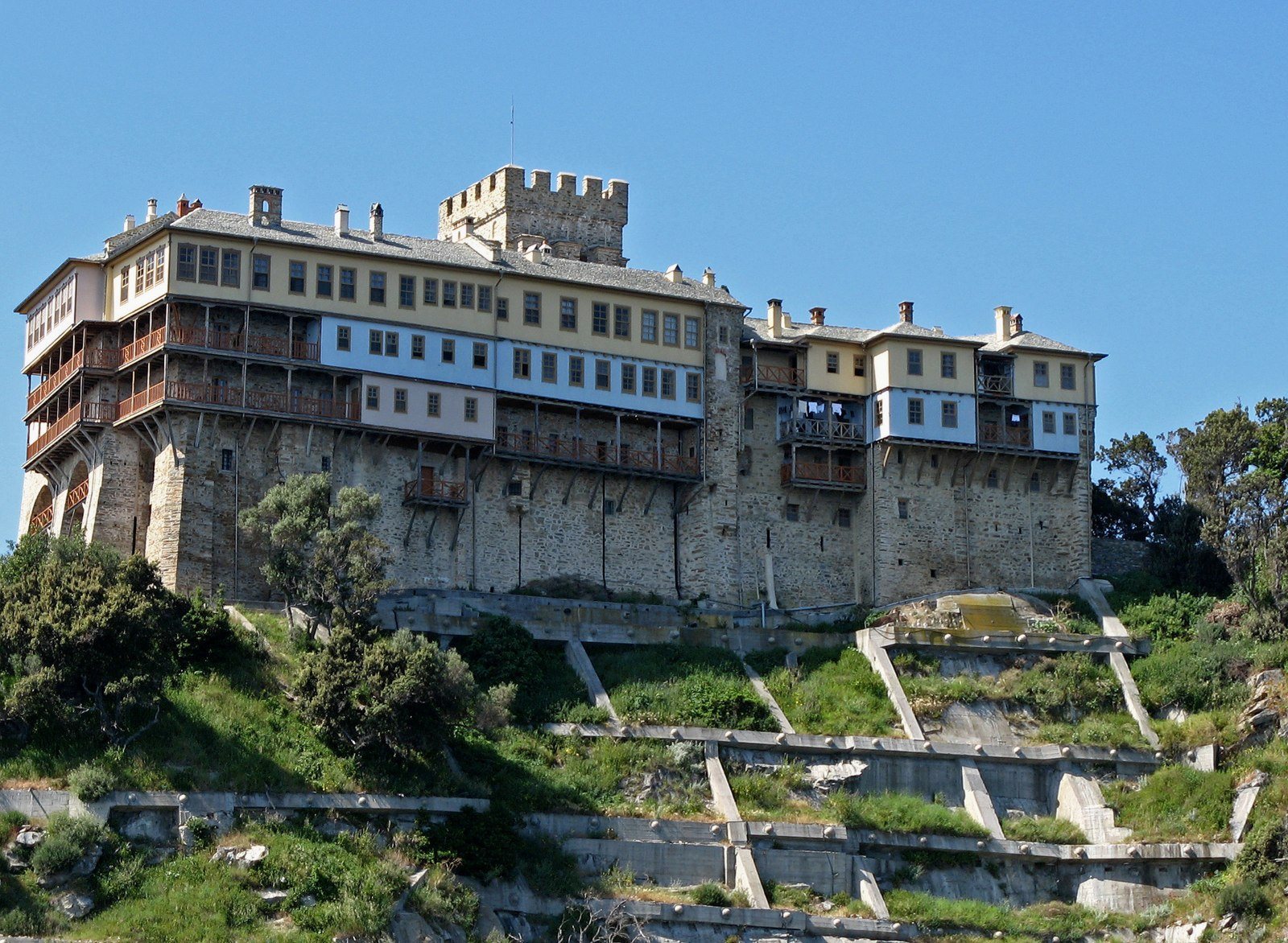
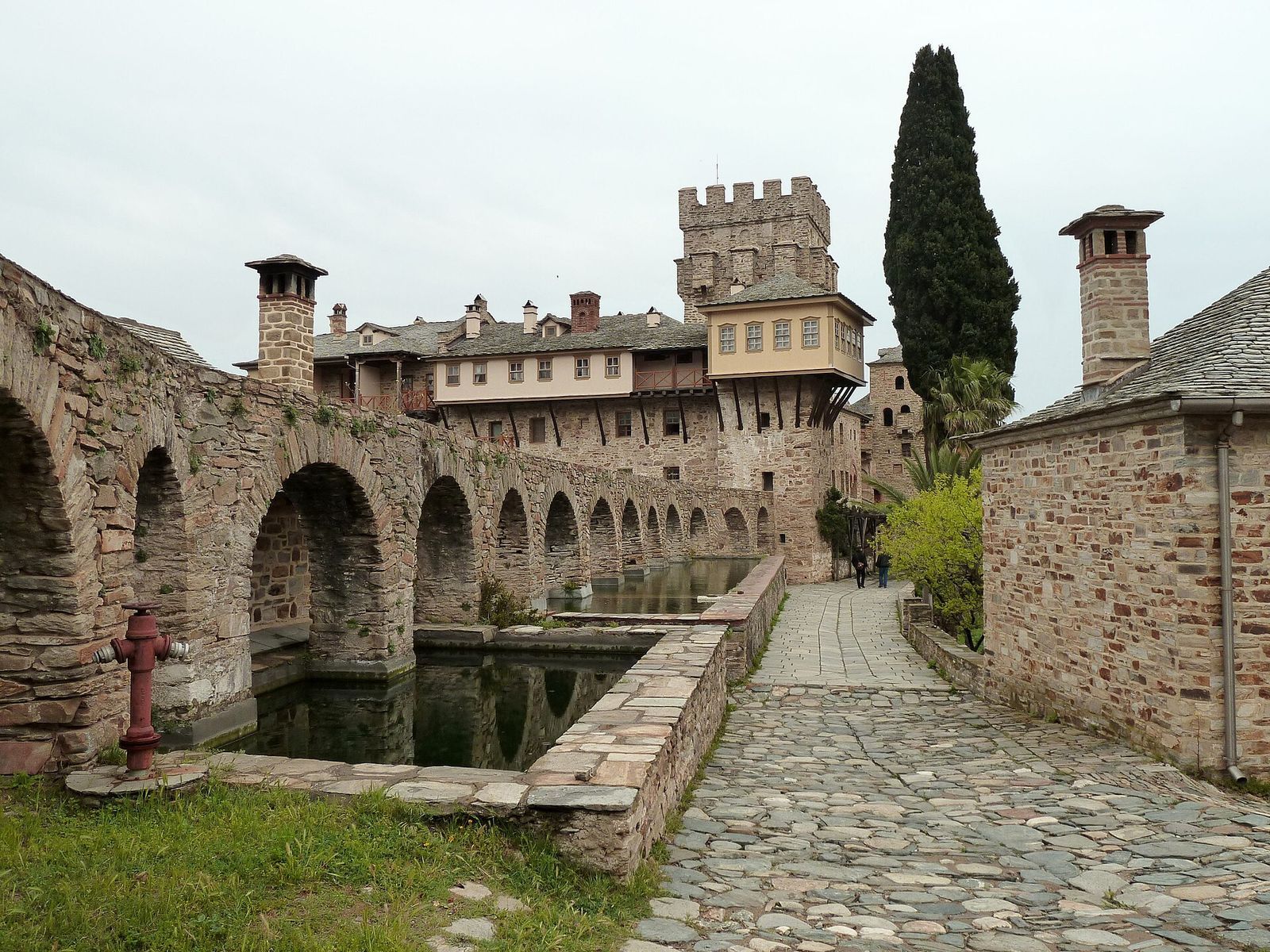
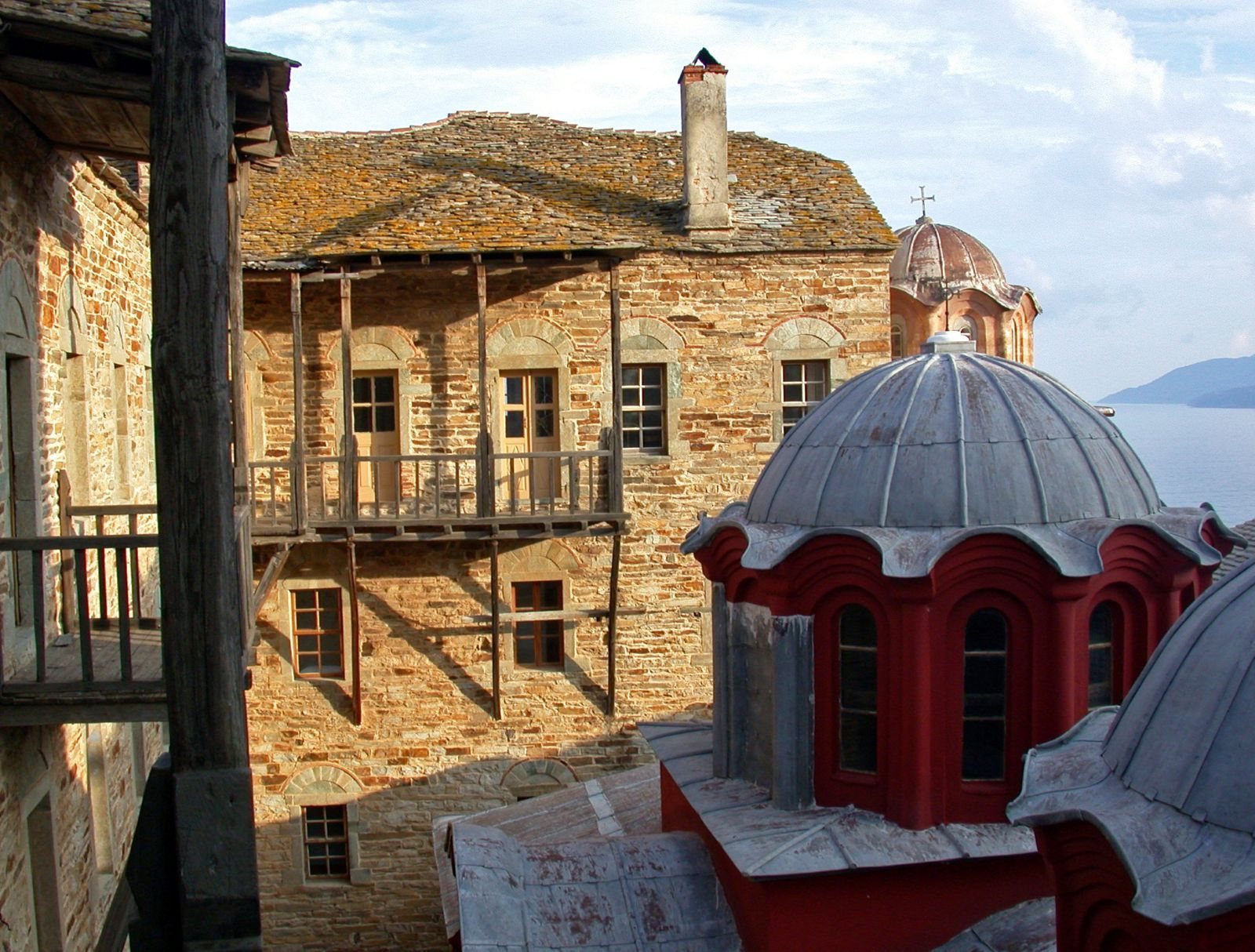
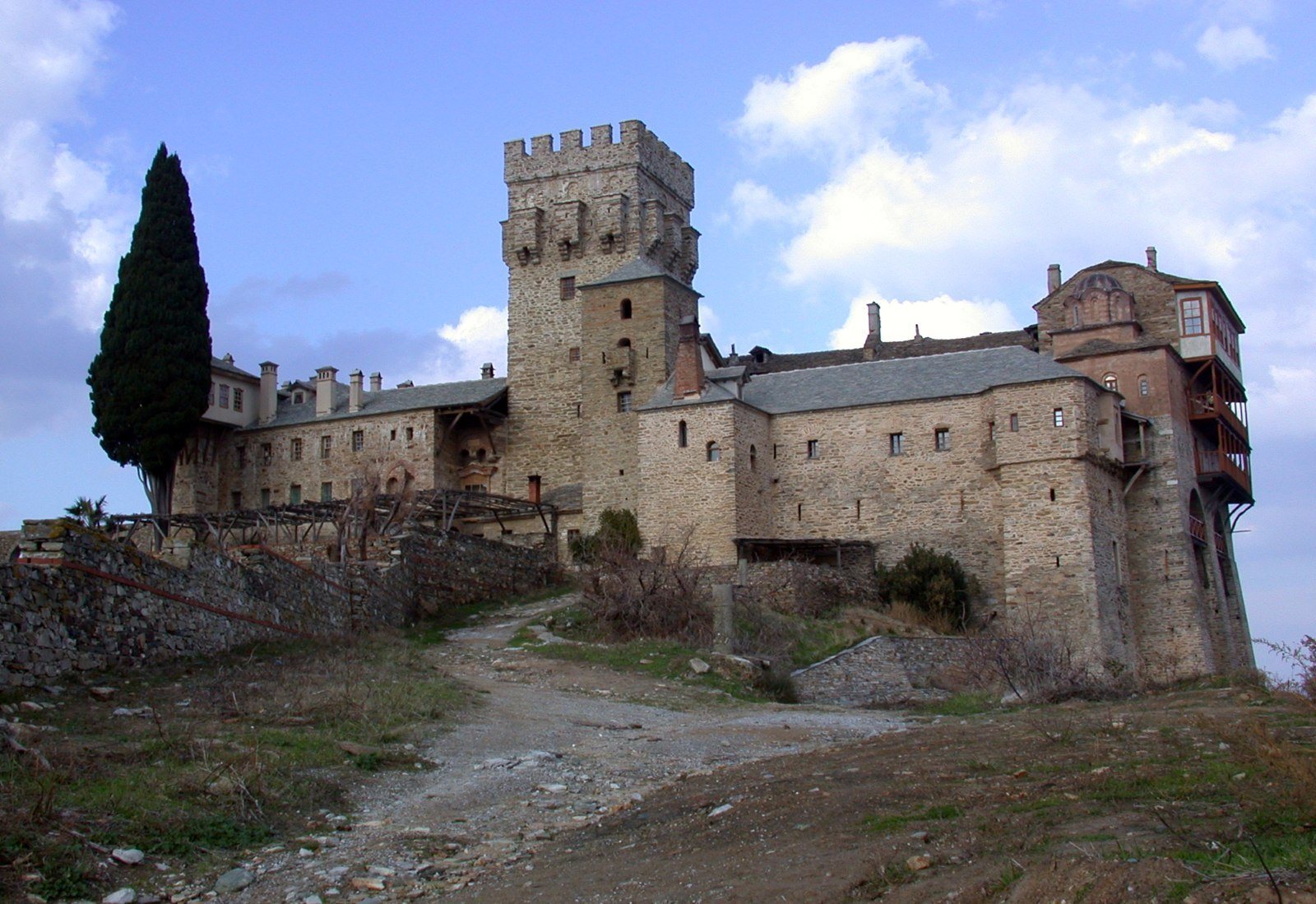
Stavronikita stands on a rock beside the sea on the eastern shore of the Athonite Peninsula, between Iviron and Pantokratoros. It is the smallest Athonite monastery, with a compact, castle-like form and a rudimentary courtyard. Its built complex includes an enclosing wall and numerous cells, while an entrance tower and an aqueduct are notable features. A centuries-old cypress stands outside the western corner.
Monastic enclosure and principal buildings
Enclosure and tower
The surrounding wall encloses a close-set complex of monastic cells and buildings. The entrance tower was built between 1546 and 1607. Its fourth floor contains the chapel of Saint Anne.
Principal church
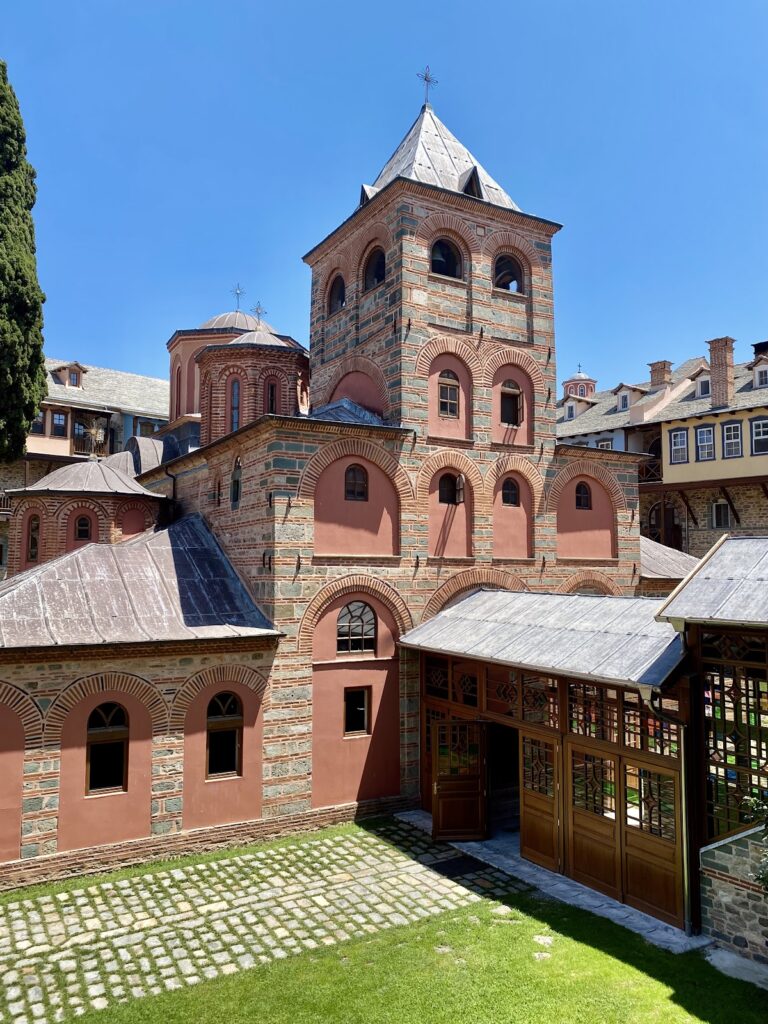
The catholicon (the monastery’s principal church) is the smallest among the Athonite monasteries. Built in the sixteenth century over an earlier church dedicated to the Virgin Mary, it is dedicated to Saint Nicholas. Its frescoes, dated 1545/46, were painted by Theophanes of Crete. The iconostasis, a screen of icons separating the sanctuary from the main church, is attributed to Theophanes and his son Symeon.
Refectory
The refectory occupies the upper floor on the south side of the complex and contains notable religious imagery.
Chapels
South and southeast chapels
The chapel of the Archangels is in the south wing and dates to 1667. On the southeast side, the chapels of the Virgin of the Life-Giving Spring and Saint Eleutherius have lead-covered domes and were built in 1840.
Chapels by the refectory and tower
The chapel of the Forerunner, John the Baptist, stands near the southeast corner, to the right of the refectory. Its frescoes are attributed to Theophanes and date to 1545/46. The chapel of Saint Gregory Palamas is on the ground floor below the refectory, while the chapel of Saint Anne occupies the tower’s fourth floor.
Chapels outside the enclosure
The cemetery church of Saint Demetrius stands outside the monastery along the road to its harbor. Its frescoes date to 1798, and a repository for bones lies beneath the floor. The chapel of the Five Martyrs is northwest of the complex. Both chapels are associated with the 1770 building campaign.
Aqueduct, rock, and dependent cells
Aqueduct
Built in 1770, the aqueduct stands outside the monastery and includes architecturally notable arched sections.
Rock beneath the monastery
Earthquakes severely damaged the rock below the complex, which was crumbling and moving toward the sea. Stabilization work included injecting cement into the rock.
Dependent cells and huts
Stavronikita has dependent cells around Karyes and within its estate. They include cells dedicated to the Archangels, the Prophet Elijah, Saint Quiricus, Saint Onuphrius, the Three Hierarchs (Basil the Great, Gregory of Nazianzus, and John Chrysostom), and the Forerunner. Other cells associated with the monastery are dedicated to Saint George, Saint Andrew, and the Nativity of the Virgin Mary. The monastery also has 34 huts in Kapsala.
Library and collections
Manuscripts and printed works
The library occupies the ground floor of the new southern wing. It holds 171 manuscripts, including 58 on parchment, with Greek, Slavonic, and Romanian texts, as well as about 20,000 printed works. Manuscript 43 is a tenth-century parchment Gospel illustrated with miniatures of the four Evangelists. Manuscript 6, given by Patriarch Jeremias I, dates to the eleventh century and contains homilies by John Chrysostom not found in any other manuscript.
Icons, relics, and ritual objects
The monastery preserves a fourteenth-century mosaic icon of Saint Nicholas known as “Saint Nicholas of the Oyster.” It was accidentally found on the seabed after centuries underwater, with an oyster attached to the saint’s forehead. Athonite tradition says that the forehead bled when the oyster was removed. The collections also include icons, holy relics, priestly garments, ritual objects, and other valuables.