Iviron Monastery: A Georgian Monastic Center on Mount Athos
Site at a Glance
- Popularity
- High
- Country
- Greece
- Primary era
- Early Modern
- Eras represented
- Early Modern
- Civilizations
- Ottoman
- Site type
- Religious
- Remains
- Monastery
On this page18 sections
History
Iviron Monastery is an Eastern Orthodox monastery on the northeastern side of the Athonite peninsula in Greece. A monastery dedicated to Saint John the Baptist stood on the site by the eighth century. Around 980–983, Georgian monks reshaped and expanded it as a Georgian community, which later became an important center of Georgian religious and literary life.
Early community and Georgian foundation
The earlier community was known as the Monastery of Clement. The Georgian monks, including John the Iberian and John Tornike, moved to the site from cells near the Great Lavra. John the Iberian, whose name refers to Georgia rather than the Iberian Peninsula, initially led the community, acquired estates, and secured income for it. After 1010, the monastery was called Iviron in honor of its founders.
Literary and institutional growth
Euthymius of Athos succeeded John and developed the monastery into a major Georgian ecclesiastical and cultural center. During the tenth and eleventh centuries, Georgian scholars and scribes composed works, translated Byzantine texts into Georgian, and copied manuscripts. Iviron also helped foster cultural exchange between Georgia and Byzantium. The Wisdom of Balahvar, for example, was translated from Georgian into Greek.
George of Athos continued this literary work and led Iviron during the eleventh century. Supported by the Georgian royal court, he strengthened the monastery, undertook building work, and added to its estates. Literary activity continued under later abbots. During the tenth and eleventh centuries, smaller monasteries, including those of Kolovou, the Prophet Elijah, and Sisikos, became dependent on Iviron. Its wider community also included the Skete of Saint John the Baptist, a small monastic settlement under the monastery’s authority, ten attached monastic residences, and twenty-six cells.
Raids and a changing community
Crusaders raided Iviron in 1259. Attackers returned in the 1280s and demanded that the monks accept Catholicism and the pope’s authority. The monks refused and were severely punished. In the early fourteenth century, Arab pirates plundered the monastery and tried, unsuccessfully, to destroy its principal church.
Georgian monks became a minority after 1357, while Greek monks gradually became predominant. By the end of the fifteenth century, Iviron had become a Greek monastery, although Georgian monks and Georgian patronage remained important for centuries. The monastery experienced a financial crisis in the early fifteenth century but recovered.
Patronage and rebuilding
Georgian donations supported rebuilding and repairs from the early sixteenth century, with further restoration in the seventeenth. Georgian and Romanian rulers, along with Ecumenical Patriarchs, helped Iviron recover and prosper. By the eighteenth century it was wealthy. Georgian royal assistance included donations and grants or confirmations of estates and rights from Teimuraz II, Solomon I, and Erekle II.
The Georgian writer and traveler Timothe Gabashvili examined the monastery’s antiquities in the eighteenth century. He consulted oral traditions and written records and described the principal church and works of architecture and painting.
Political conflict and later history
Iviron supported the Greek uprising against Ottoman rule in 1821. Its involvement was associated with Nikiforos the Iberian, an ecclesiastical official responsible for records and documents. He had links to the Philiki Etaireia, a secret society promoting Greek independence, and to the uprising’s leader Emmanuel Papas. During the fighting, Nikiforos was appointed administrator and judge of Mount Athos.
In 1849, historian Platon Ioseliani studied Georgian antiquities and manuscripts in the monastery library. A fire in 1865 destroyed almost the entire complex; the principal church and library were the only buildings to survive, and the monastery was soon renovated. During the 1860s, Georgian efforts to strengthen their presence, including the arrival of forty monks and money raised by a Georgian donor, met resistance from Greek monks. Russians from Saint Panteleimon Monastery supplied building materials, but buildings and gardens constructed by Georgians were demolished, and the Georgian monks were not allowed to return. In 1879, Georgian nobles asked the Russian Imperial government to restore Iviron’s Georgian character, but the government declined to intervene officially.
Georgian monks remained at Iviron into the mid-twentieth century. There were forty-eight Georgian monks in 1900; none were at the monastery in 2011. Greece ended Mount Athos’s autonomy in 1972, but it later regained its status as an autonomous monastic republic after political circumstances changed. Mount Athos received UNESCO World Heritage Site designation in 1988, which includes Iviron.
The monastery today
Iviron is now a Greek Orthodox monastery under the Ecumenical Patriarchate of Constantinople. Its monks share a common rule and communal life. It ranks third among Mount Athos’s twenty monasteries. The community comprises sixty monks, thirty-three in the main monastery and twenty-seven in its dependencies.
Remains
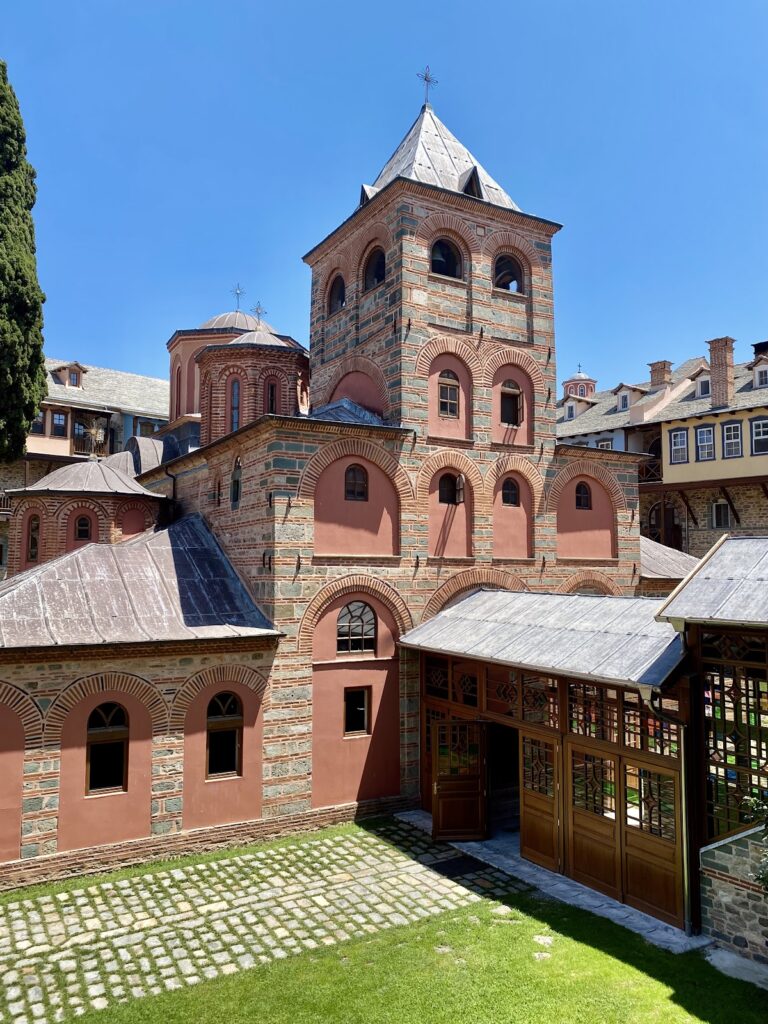
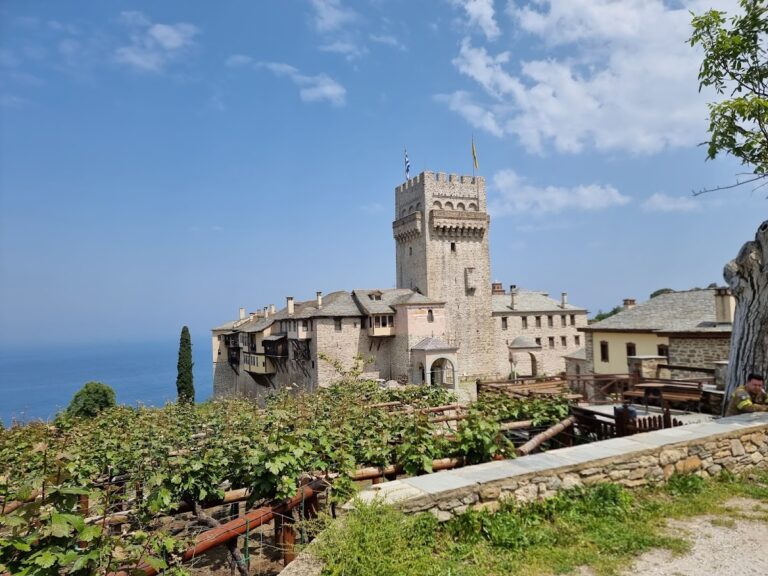
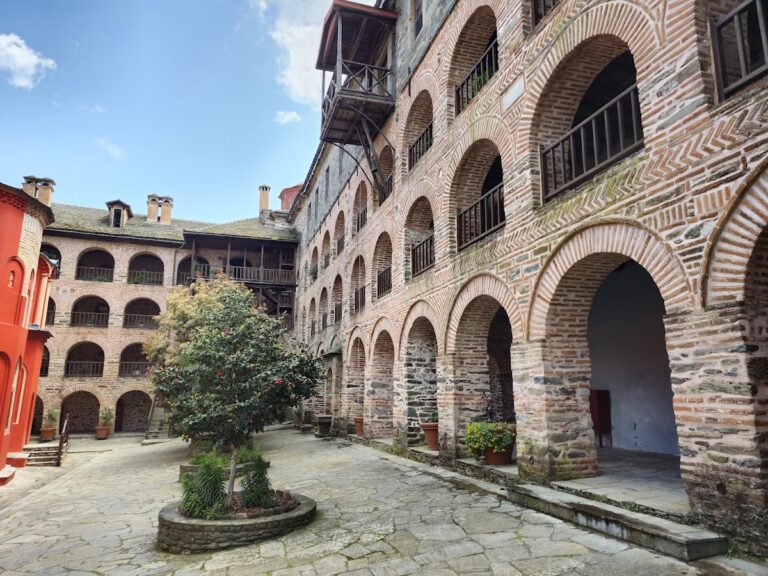
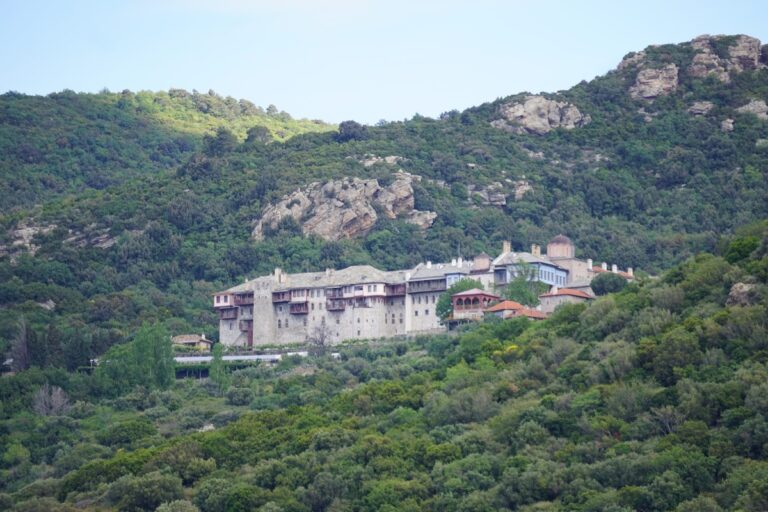
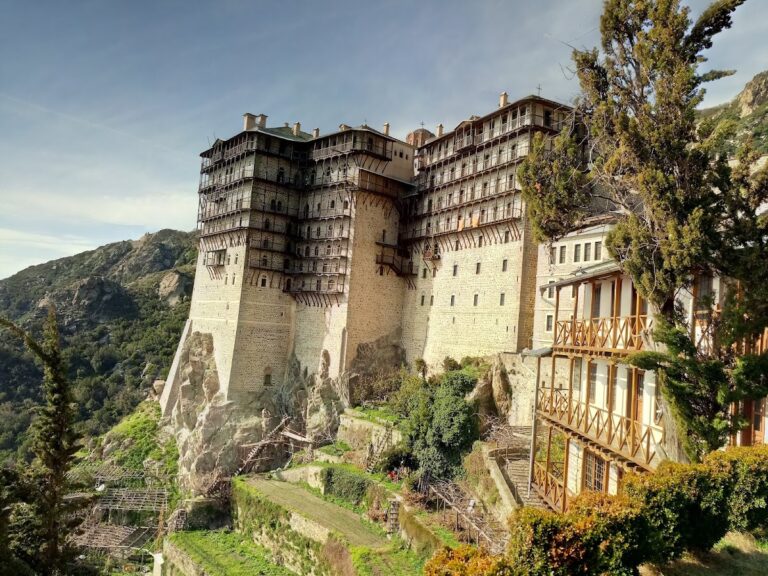
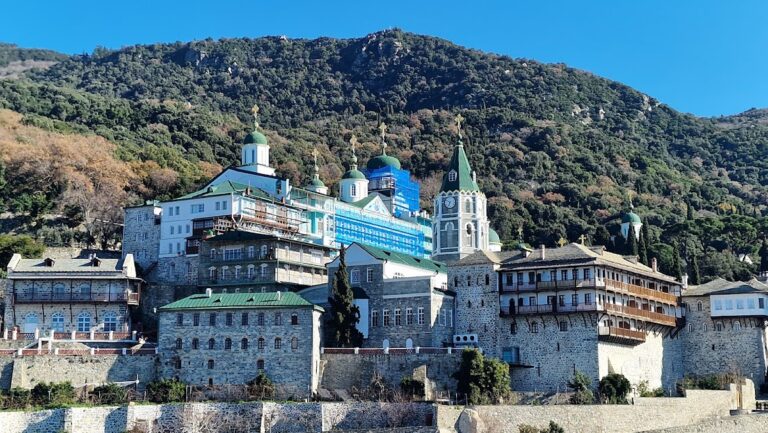
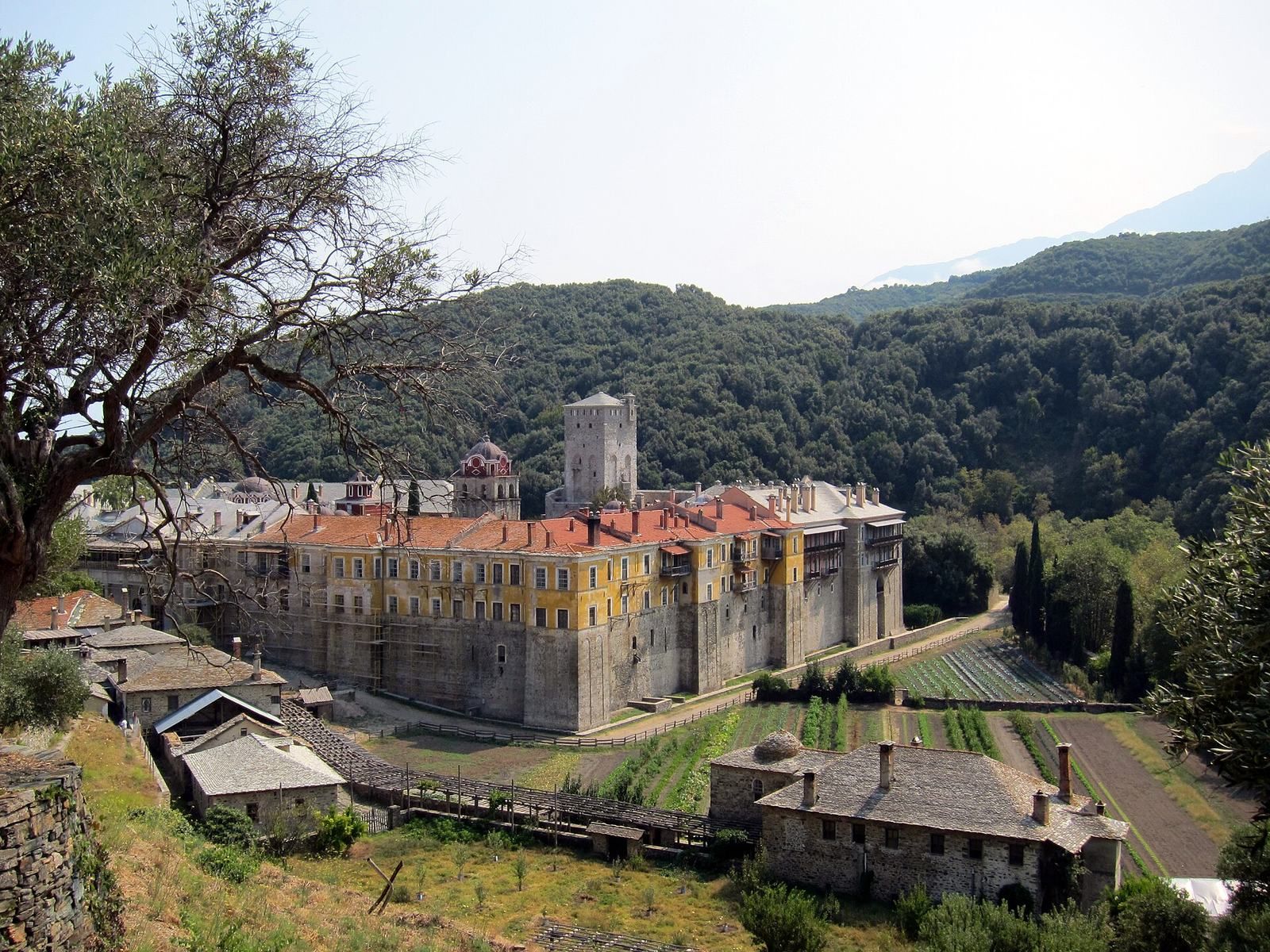
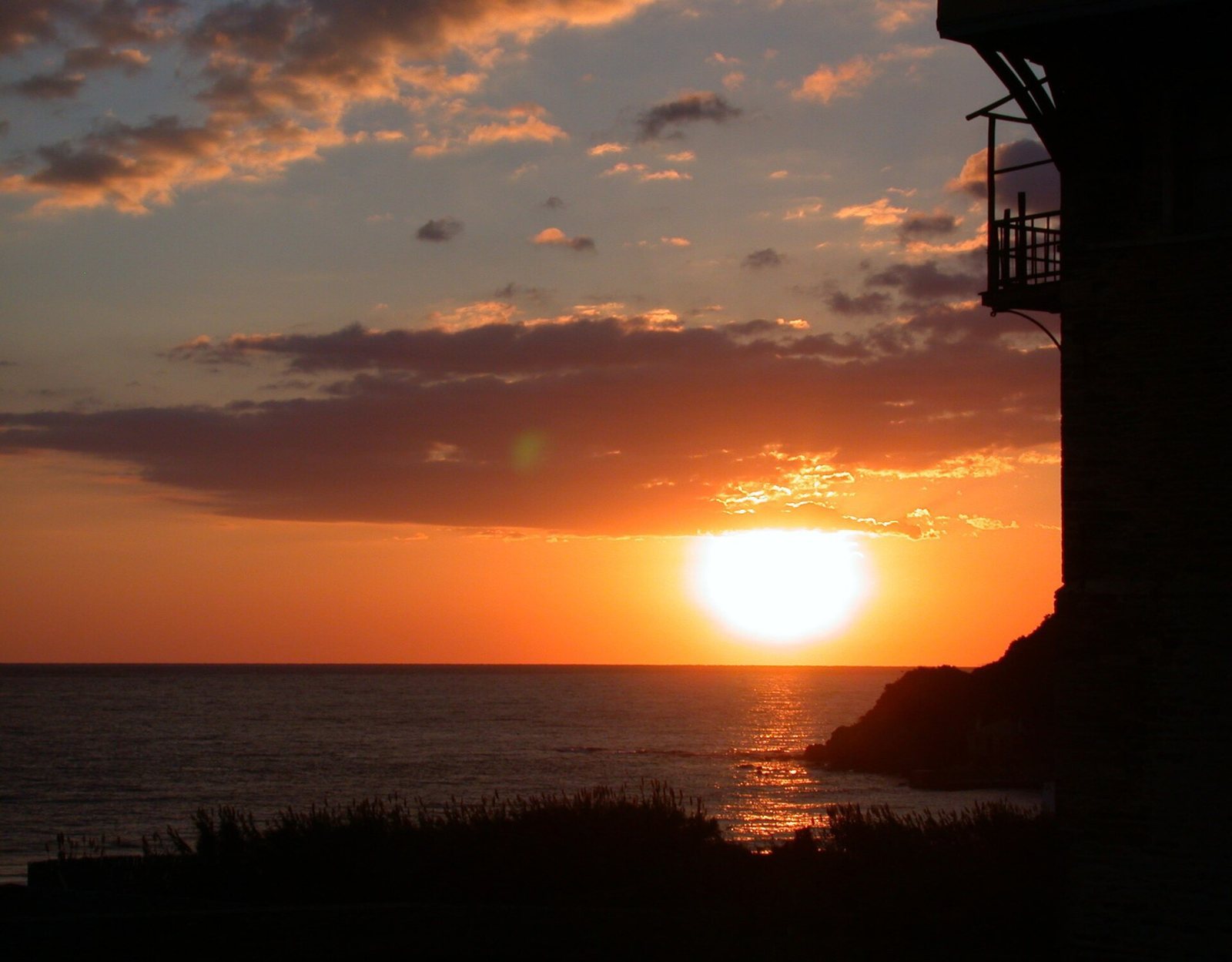
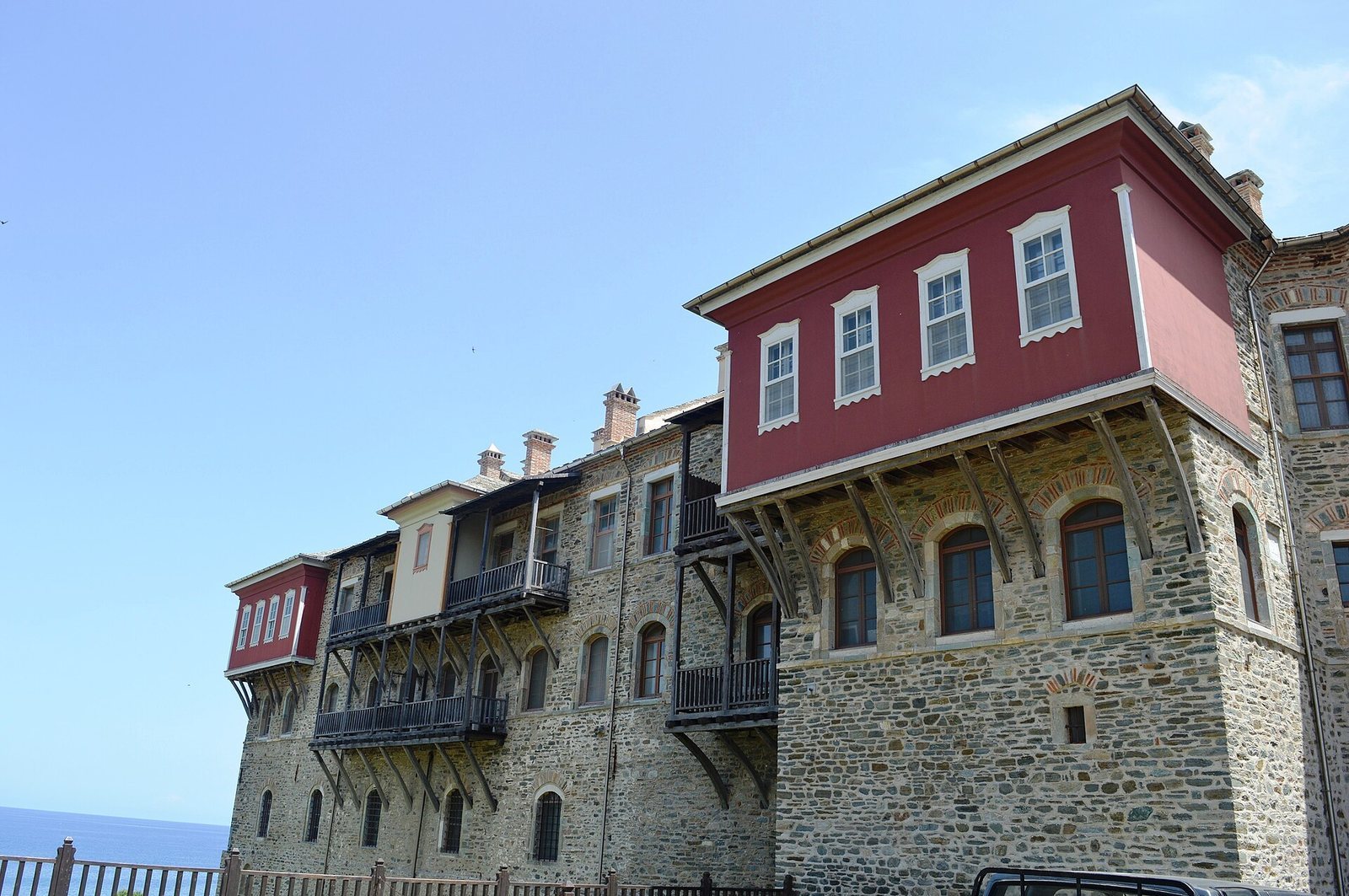
The large complex stands beside a small bay, on the lower slopes of Mount Athos near the Aegean coast. Its entrance and passage are on the north side. Within the courtyard, the principal church occupies the eastern part, opposite a large bell tower. The refectory is on one side of the church and the library building on the other. Wings of buildings enclose the courtyard in a quadrangle, with monks’ cells, administrative rooms, a tower, a guesthouse, and service spaces. A newer sacristy and icon repository also serves as a library and meeting hall.
Churches and chapels
Principal church
The domed principal church is dedicated to the Dormition of the Theotokos, a title for Mary commemorating her death and assumption. Altered repeatedly over the centuries, it survives with a fragment of its mosaic floor. It preserves relics of 165 saints and fragments of objects associated with the Crucifixion of Christ.
Chapels within the principal church
The complex has sixteen chapels. Two inside the principal church, dedicated to Saint Nicholas and the Holy Archangels, contain wall paintings.
Chapel of the Portaitissa
Beside the old entrance, this chapel houses the revered icon of the Virgin known as Panagia Portaitissa, or the Gatekeeper. Paintings in its entrance hall date to 1774 and depict ancient sages and kings.
Courtyard chapel of Saint John the Baptist
This chapel stands over the former principal church of the Monastery of Clement. Its present form dates to 1710.
Cemetery church
The cemetery lies north of the monastic complex. Its church is dedicated to Saint Athanasius, Patriarch of Alexandria.
Library, treasury, and paintings
Sacristy and treasury
A separate building opposite the principal church houses the sacristy and library. The sacristy holds embroidered vestments, church vessels, crosses, chalices, pectoral ornaments, and mitres. Its holdings include the episcopal vestments of Patriarch Dionysius IV, the mantle of Patriarch Gregory V, and a fifteenth-century outer vestment worn by a bishop. Imperial and patriarchal documents are also preserved there, including gold-sealed charters issued by Byzantine emperors Michael VIII Palaiologos and John VI Kantakouzenos.
Library and manuscripts
The library holds more than 20,000 printed books, including 33 books printed before 1501 and 11,000 older printed volumes. Its collection also includes more than 2,300 manuscript books and fourteen liturgical scrolls. Of the manuscripts, 223 Greek- and Georgian-language examples are written on parchment; others use cotton-based material or paper. Sixty-eight Greek manuscripts and one Slavonic manuscript are illustrated. A dedicated library space was also established in a newer two-storey building on the monastery’s south side.
The Georgian manuscripts include a Gospel copied at Opiza in 913 and a Bible copied at Oshki in 978 at the commission of Tornike Eristavi, as well as a collection of texts and works translated by Euthymius. The Georgian collection contained eighty-six manuscripts, most dating to the tenth century. Manuscripts catalogued A.-110 and A.-1103 through A.-1105 were taken to Georgia by Ilia Pantsulaia.
Painted image of Georgian rulers
A painted image of Georgian kings and queens at the monastery was altered in 1883, when their identifying names were erased and Greek names put in their place.