Karakalou Monastery: An Athonite Orthodox Monastery in Greece


Site at a Glance
- Rating
- 4.9
- Popularity
- Low
- Country
- Greece
- Primary era
- Early Modern
- Eras represented
- Early Modern
- Civilizations
- Ottoman, Principality of Moldavia
- Site type
- Religious
- Remains
- Fortified Monastery
On this page9 sections
History
Karakalou Monastery is a Greek Eastern Orthodox monastery on Mount Athos in Greece, probably established in the late tenth or early eleventh century during the Byzantine period. It is one of the twenty monasteries of the Athonite monastic territory and holds the eleventh place in its fixed hierarchical order. Dedicated to the Apostles Peter and Paul, it is patriarchal and stavropegic, meaning that it is directly subject to the Ecumenical Patriarchate rather than to a local bishop.
Early foundations and medieval recovery
An eleventh-century document supports the monastery’s early date, while tradition associates its foundation with the monk Nikolaos Karakallas. During the thirteenth century, pirate raids and Latin activity in Mount Athos contributed to a period of decline, and the monastery was eventually deserted. It recovered toward the end of that century and during the following one, helped by donations from Byzantine emperors. Patronage continued during the reign of Andronikos II Palaiologos, with the involvement of Athanasius, Patriarch of Constantinople, and later during the reign of John V Palaiologos.
Moldavian rebuilding and later support
After the fall of Constantinople, Karakalou entered another short period of decline in the second half of the fifteenth century. By the end of that century, the Ruthenian pilgrim Isaiah described the monastery as Albanian. It was rebuilt in the sixteenth century by Peter IV Rareș, the voivode, or ruler of Moldavia, with permission from Sultan Suleiman. Near the end of his life, Peter became a monk at Karakalou. From the sixteenth century onward, donations from Moldavian and Georgian rulers supported the monastery’s expansion for roughly three centuries, and its community eventually grew to as many as 500 monks.
Modern religious life and saints
During the difficult years of the two World Wars, the monastery was guided by the elder Kodratos, a charismatic figure known beyond Mount Athos, and experienced substantial flourishing. It declined again during the 1980s and until the beginning of the 1990s. Two members of the community were later recognized among the saints. Gervasius, a holy fool for Christ, lived around the monastery as a poorly clothed ascetic and died in the early eighteenth century. Gideon, later recognized as a neomartyr, spent thirty-five years as an ascetic at Karakalou before being martyred by the Turks at Tyrnavos in Larissa on 30 December 1818 after refusing to renounce Christ.
Karakalou has seventeen cells, including three in Karyes, one of which serves as its representative office, and fourteen scattered through the forest to the northwest. Its community consists of about 50 working monks, or approximately 55 to 60 people when novices and dependents are included. Mount Athos, including Karakalou as part of its monastic cultural landscape, was inscribed on the UNESCO World Heritage List in 1988.
Remains
Layout and fortified architecture
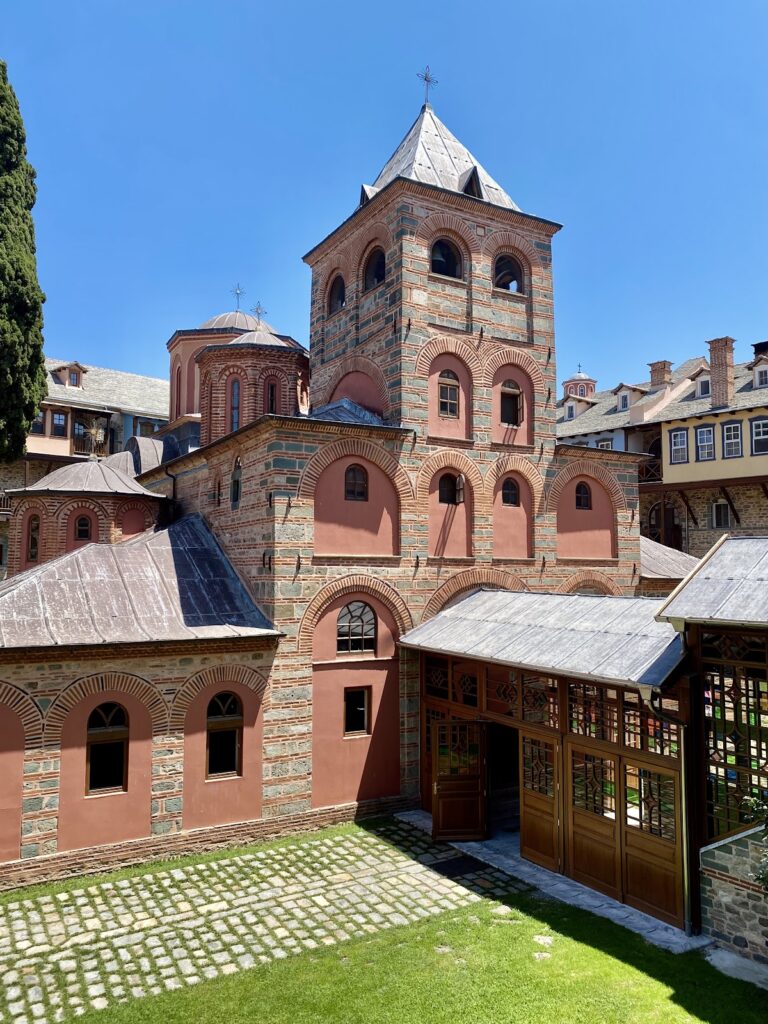
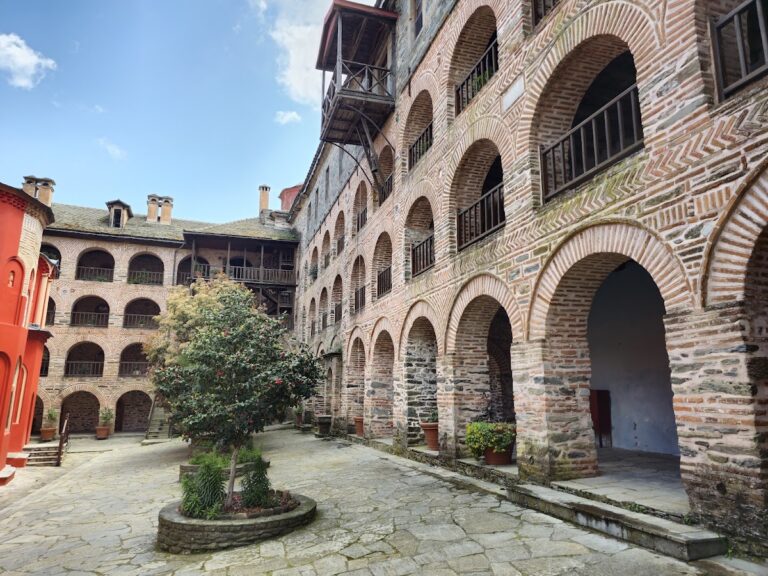
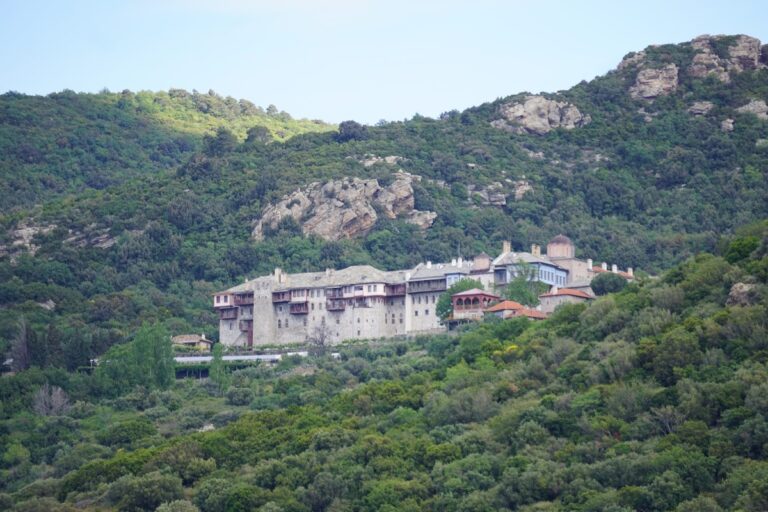
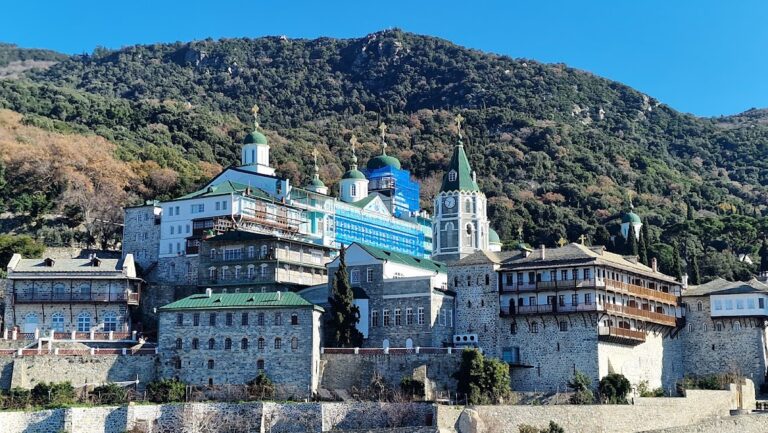
Karakalou stands on the southeastern side of the Mount Athos peninsula, between Great Lavra and Iviron. The complex follows the defensive character associated with sixteenth-century castles. Its prominent fortified tower has battlements and openings used for dropping or pouring materials, giving the monastery a severe defensive appearance. A sixteenth-century structure also known as Peter’s Tower is among its principal defensive elements. The courtyard is limited in size, and the complex therefore does not include a phiale, the fountain used for the ritual washing of hands.
Katholikon and bell tower
The katholikon, the principal church of an Orthodox monastery, is dedicated to the Apostles Peter and Paul. Construction began in 1548 and ended in 1563. The church contains wall paintings and icons associated with Dionysius of Fourna, an eighteenth-century Orthodox icon painter and author of a widely used manual on iconographic subjects and painting practices. A minor renovation took place in the early eighteenth century. The bell tower was added in 1710, followed by the exonarthex, an outer porch beyond the inner entrance hall, in 1714. The bell tower contains a chapel dedicated to Saint George.
Chapels and associated buildings
Chapels within the monastery precinct are dedicated to Saint John the Merciful, Saint Joasaph, the Annunciation of the Virgin Mary, the Dormition of the Virgin Mary, Saint Gideon, Saint Panteleimon, and Saint George in the katholikon’s bell tower. A chapel dedicated to Saint Anne is located in the tower. Outside the precinct, chapels are dedicated to Saint Paraskevi, Saints Theodore, and All Saints in the cemetery church. Other associated chapels commemorate the Transfiguration, the Prophet Elijah, Saint George, and Saint Nicholas.
Library and sacred relics
The historic library preserves rare manuscript codices, approximately 330 manuscripts, and about 3,000 printed books. The monastery’s relics include a fragment of the True Cross; the skulls of the Apostle Bartholomew and Saint Christopher; the right hand of Saint Theodore the General; the relics of the neomartyr Gideon; the skull and part of the shoulder of Saint Mercury; part of the foot of Saint John the Merciful; two fragments associated with John the Baptist; part of the elbow of Saint Charalambos; and portions of the feet of the martyrs Orestes and Abercius of Hierapolis.
Nearby sites