Pantokrator Monastery: An Orthodox Monastery on Mount Athos
Site at a Glance
- Popularity
- High
- Country
- Greece
- Primary era
- Medieval
- Eras represented
- Medieval, Early Modern
- Civilizations
- Byzantine, Ottoman
- Site type
- Religious
- Remains
- Fortified Monastery
On this page19 sections
History
Foundation and early development
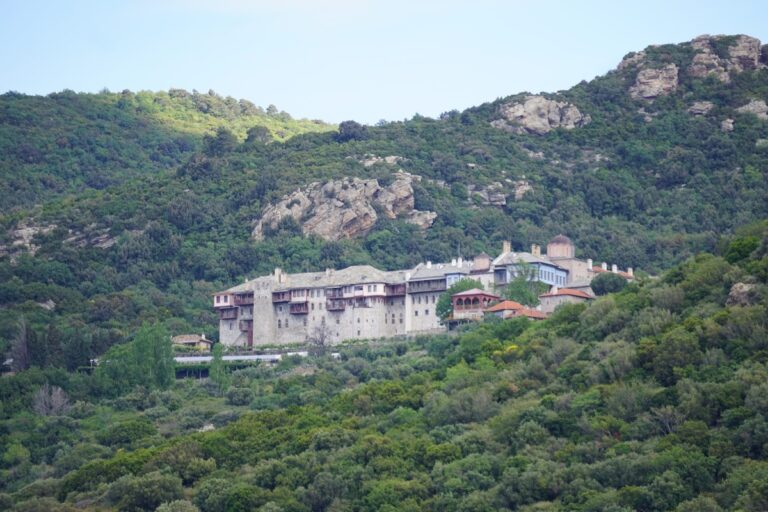
Pantokrator Monastery is an Orthodox monastery on the northeastern side of Mount Athos in Greece, founded in the mid-14th century, commonly dated to 1361, and dedicated to the Transfiguration of Christ. Pantokrator is a Christian title for Christ meaning Ruler of All. The monastery is affiliated with the Ecumenical Patriarchate of Constantinople and holds seventh place in Mount Athos’s hierarchy of twenty monasteries.
Its founders were the brothers Alexios, a stratopedarch (Byzantine military officeholder), and John, a primikerios (Byzantine court official). Both later became monks at the monastery. A foundation tradition instead credits Byzantine emperor Alexios I Komnenos. The monastery is first recorded in 1358, and reconstruction followed in 1362 with the involvement of Callistus I, Patriarch of Constantinople. Emperors John V Palaiologos and Manuel II Palaiologos also supported its establishment and consolidation. A fire destroyed the monastery late in the 14th century, but it was soon refounded.
Expansion and economic pressures
Donations from Romanian princes doubled the monastery’s original area in the 16th century. It also absorbed several smaller monastic houses, including those of Ravdouhou, Falakros, Saint Demetrius, and Saint Auxentius. Ravdouhou had ranked fourteenth among the twenty-five monasteries of its era in the late 12th century before becoming a cell of Pantokrator.
Turkish conquests of Mount Athos brought economic hardship. Financial assistance came from rulers of the Danubian principalities, Phanariots, Catherine II of Russia, and other Christian donors.
Monastic life and later events
The monastery followed a communal system, in which monks shared daily life and worship, until the mid-17th century. It then adopted an idiorrhythmic arrangement, a less fully communal pattern of monastic life. A severe fire in 1773 caused further damage, and donations supported restoration.
In 1948, another major fire destroyed part of the northeastern buildings. Communal life returned in 1992, when a new brotherhood arrived from Xenophontos Monastery. Archimandrite Vissarion, a senior monastic cleric, became its first abbot. In January 2023, the monastery’s elders assigned the affiliated cell of the Holy Archangels at Falakros for liturgical use by monks from the Orthodox Church of Ukraine.
Remains
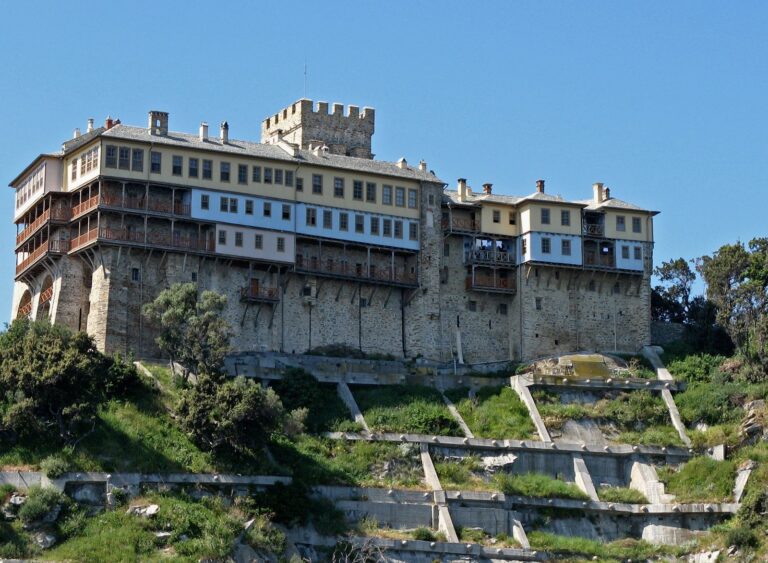
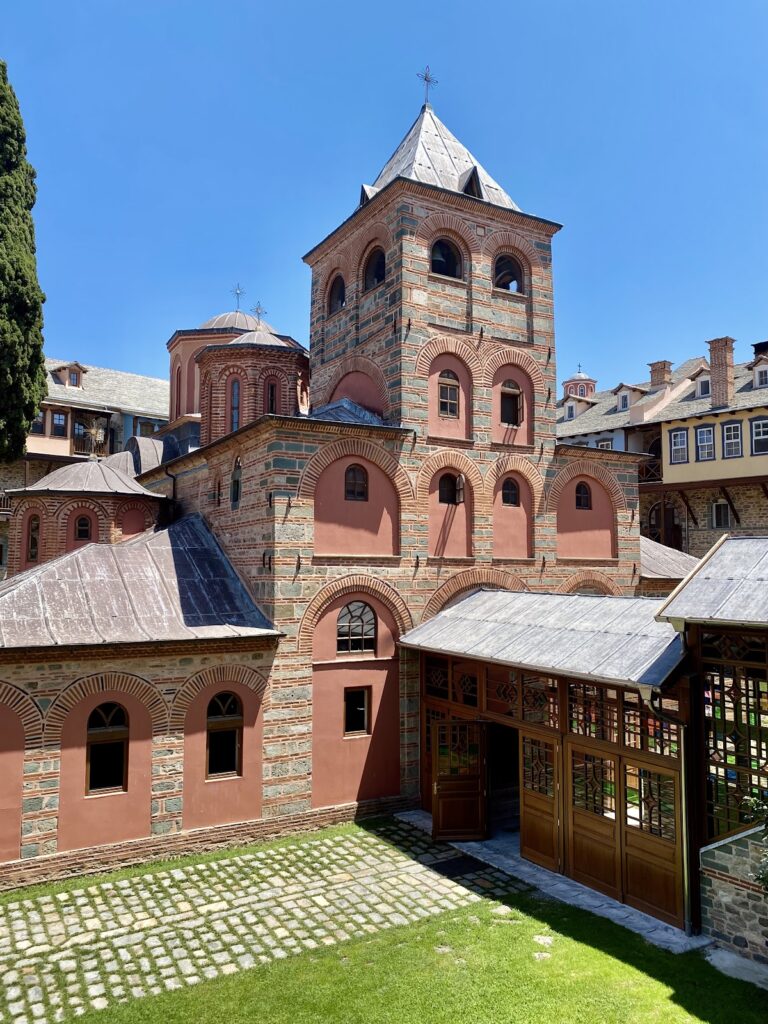
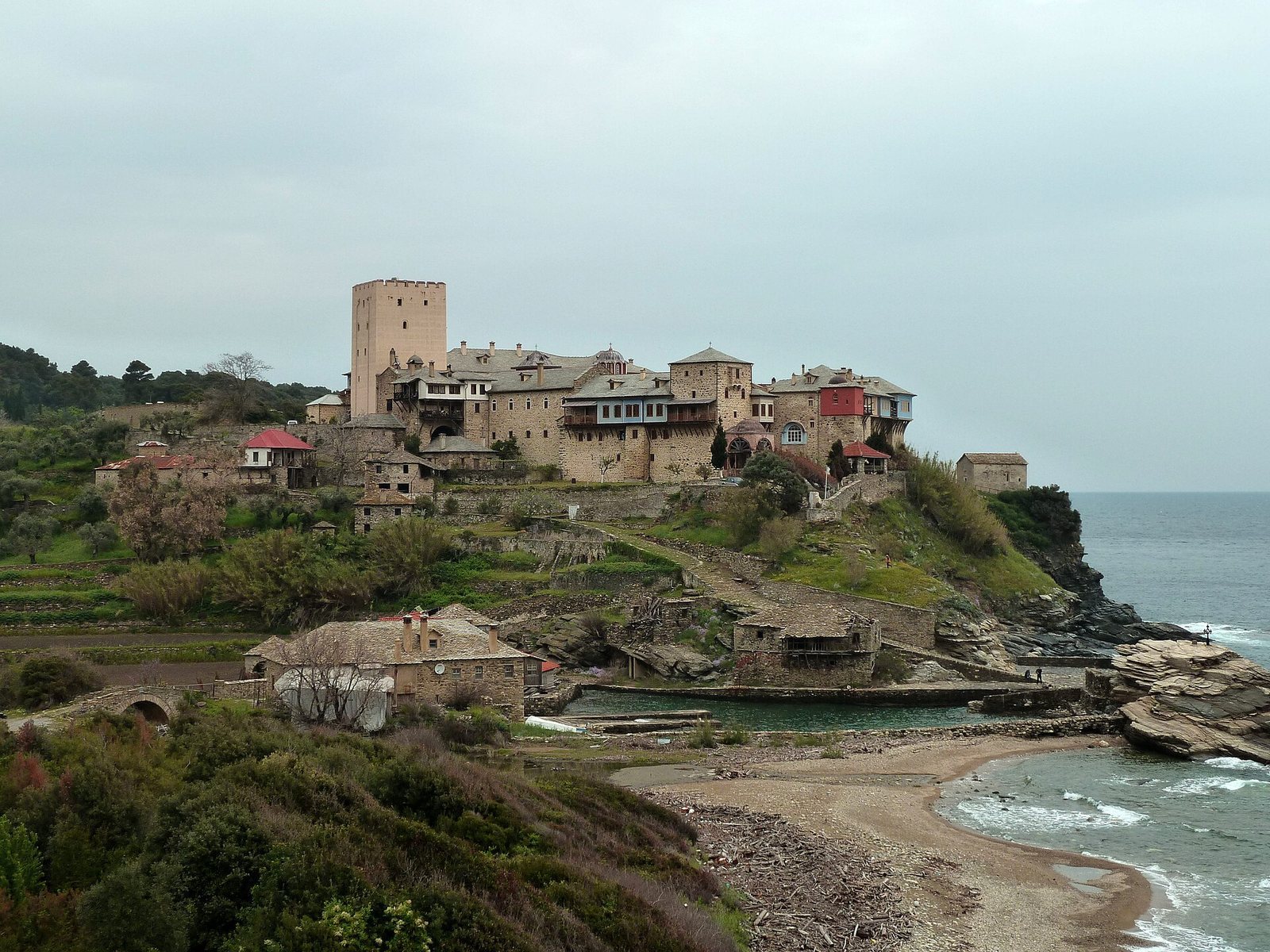
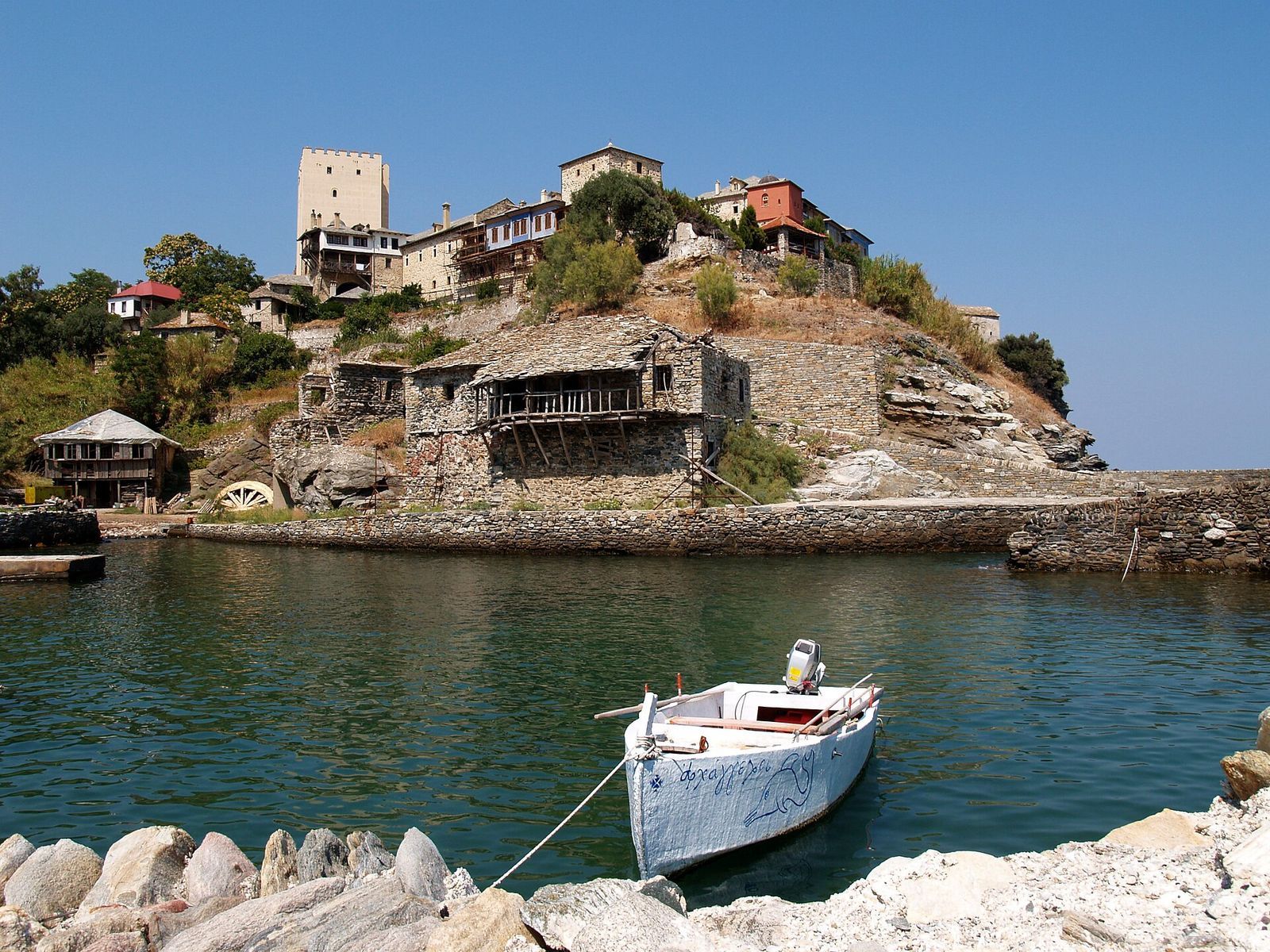
The monastery occupies a rocky hill about 50 metres above sea level, near the ruins of the ancient city of Thyssus. Its rectangular, fortified enclosure has loopholes and is divided into two courtyards. The surviving complex includes the principal church, towers, chapels, communal buildings, and dependent monastic establishments.
Enclosure and principal buildings
The courtyards
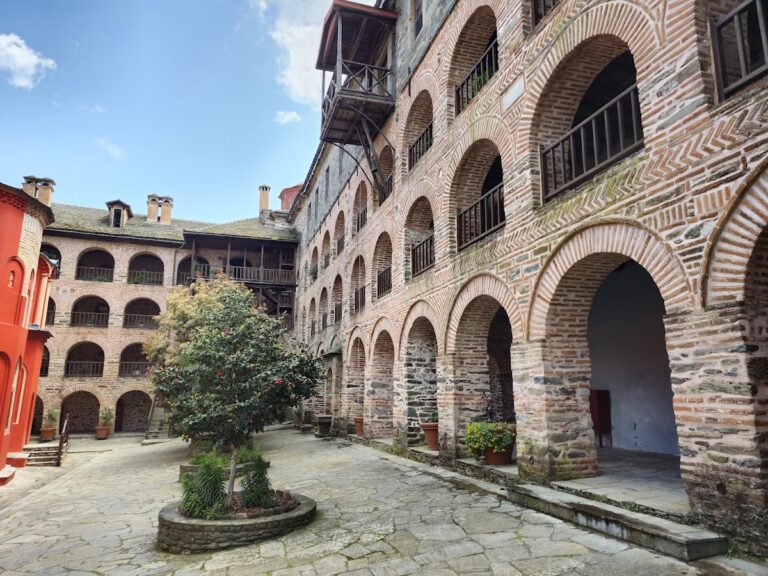
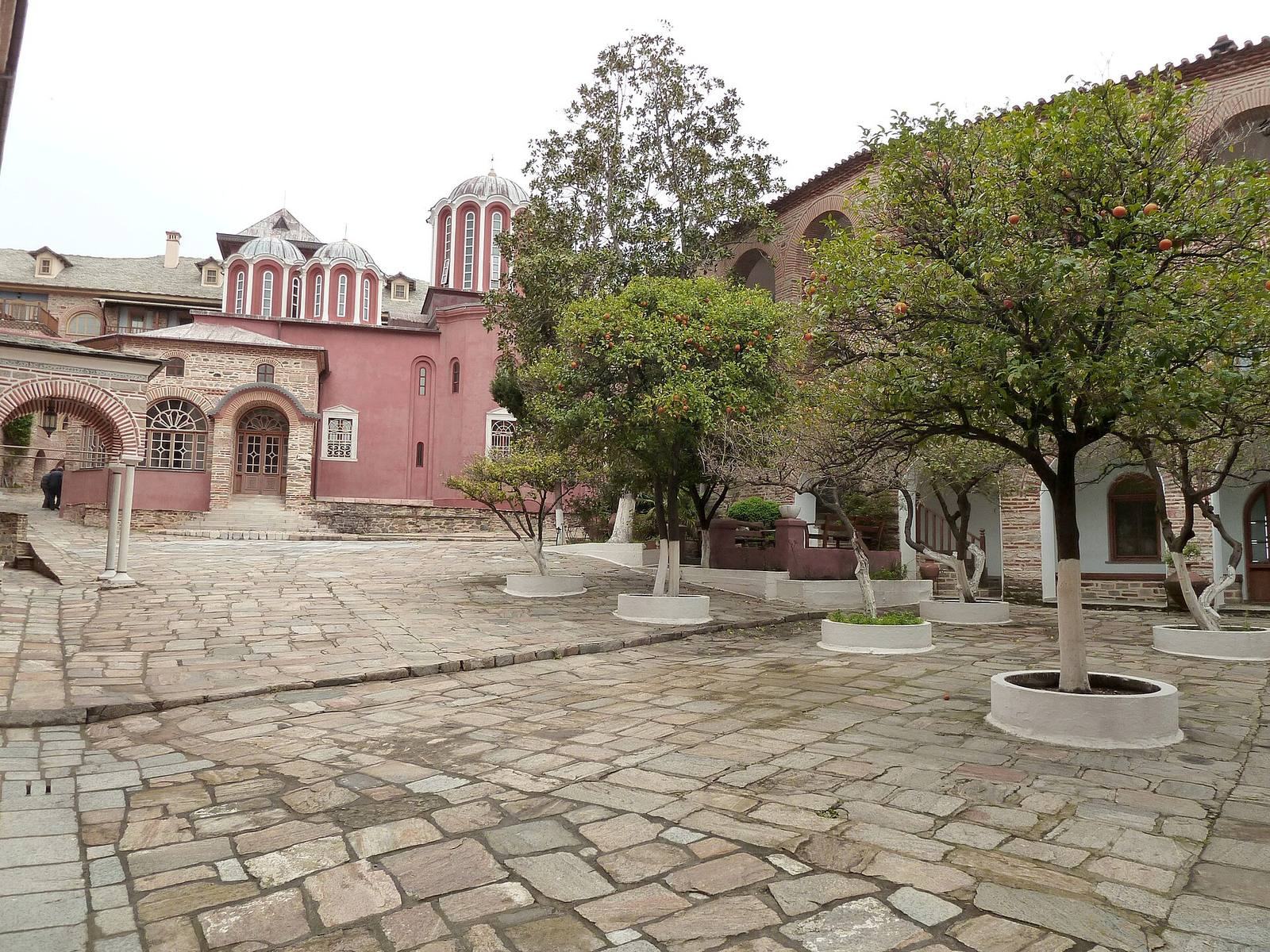
The first courtyard contains guest cells and workshops, as well as a tall tower with a chapel beside the sacristy. The second courtyard holds the monastery’s principal church, bell tower, and refectory.
The principal church
The principal church was built with the monastery and is dedicated to the Transfiguration. Alterations to it are dated to the first half of the 14th century and to 1854. The founders’ tombs lie in its entrance area. A screen before the sanctuary bears 14th-century icons and is regarded as probably the oldest of its kind on Mount Athos. The sacristy also preserves notable icons from the 14th century.
Chapels and cemetery churches
The Dormition chapel
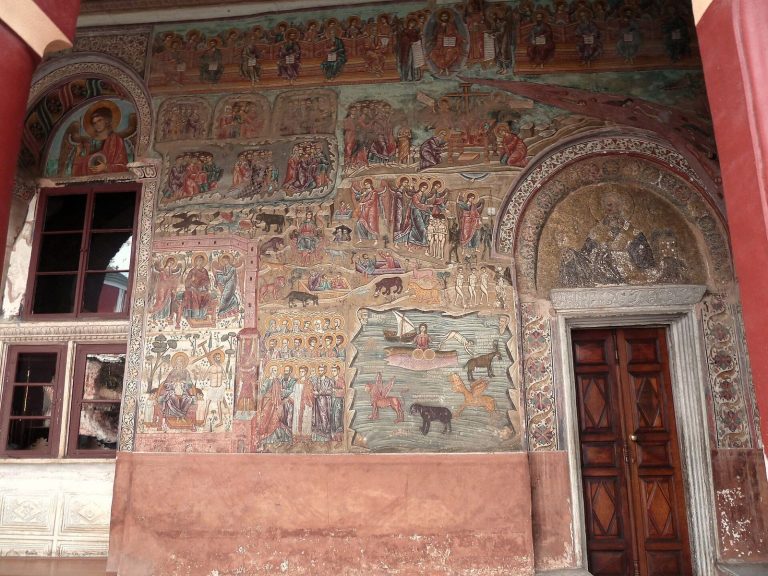
The Dormition chapel occupies the northern side of the principal church’s entrance area. Its murals, painted in a style associated with Crete, date to 1538 and were overpainted in 1868.
Entrance and western-wing chapels
The chapel of Saint Nicholas stands near the monastery entrance and has 18th-century wall paintings. In the western wing, the chapel of John the Forerunner occupies the site of an older tower; its wall paintings also date to the 18th century.
Tower chapels and other dedications
A chapel dedicated to the Ascension is on the upper floor of the monastery’s large tower. Another, dedicated to Saint Panteleimon, occupies a second tower above the entrance. Other chapels are dedicated to the Three Hierarchs, the Archangels, and Saint George the Great Martyr. In all, the compound contains eight chapels, with seven more outside its boundaries.
Cemetery churches
The older cemetery church, dedicated to Saint Athanasius the Athonite, stands southeast of the monastery at the edge of steep cliffs. The newer cemetery church is dedicated to the Holy Unmercenaries. Built in 1771, it also served as the church of a former kathisma, a dependent monastic establishment distinct from a cell.
Dependent establishments and associated sites
Monastic dependencies
The Prophet Elijah Skete, a monastic settlement dependent on a larger monastery, belongs to Pantokrator. Four nearby kathismata (dependent monastic establishments distinct from cells) are dedicated to the Holy Apostles, Saint Tryphon, the Holy Unmercenaries, and Peter and Onouphrios. Saint Tryphon’s establishment is in a garden house. Saint Theonas, Metropolitan of Thessaloniki and a senior bishop, lived as an ascetic at Peter and Onouphrios in the 16th century.
Cells, Kapsala, and Ravdouhou
The monastery has fifteen cells, five within the boundaries of Karyes, the administrative centre of Mount Athos, and the others in the surrounding area. At Kapsala, an ascetic settlement, fifty huts belong to the monastery. The former Ravdouhou monastery cell retains 12th-century wall paintings, including full-length figures of the apostles Peter and Paul. Another cell is associated with a Marian icon once kept there and now held in the Protaton, the principal church of Karyes. A harbor facility is also among the monastery’s associated structures.
Icons, paintings, and library
Icons and painted images
The monastery keeps the full-length icon of the Virgin Mary known as Gerontissa, revered as its protective, miracle-working image. A Saint George icon, called George the Appeared, is linked to a tradition that the saint appeared at the monastery. An image of Pantokrator presented at the monastery’s foundation is now in a museum in St Petersburg. The monastery also contains a depiction identified as the Unoriginate Father.
Library
The library holds about 350 manuscripts and 3,500 printed books.