Koutloumousiou Monastery: An Athonite Orthodox Monastery in Greece


Site at a Glance
- Rating
- 4.9
- Popularity
- Low
- Country
- Greece
- Primary era
- Medieval
- External website
- Open
- Eras represented
- Medieval, Early Modern, Modern
- Civilizations
- Byzantine, Ottoman
- Site type
- Religious
- Remains
- Fortified Monastery
On this page18 sections
History
Koutloumousiou monastery is an Eastern Orthodox monastery on Mount Athos in Greece, dedicated to the Transfiguration of the Saviour. Founded in the eleventh century, it became one of the twenty Athonite monasteries and now holds sixth place in their hierarchy. It is also a patriarchal stauropegion, meaning that it stands directly under the authority of the Ecumenical Patriarchate rather than under a local bishop.
Foundation and Byzantine development
The monastery was traditionally founded between 1063 and 1069 by the monk Kallistos Koutloumous of Iconium in Asia Minor. Kallistos is associated with the Seljuk dynasty and is described as having converted to Christianity. The Byzantine emperor Alexios I Komnenos became the monastery’s first major benefactor. Koutloumousiou was first named in a written document in 1169 and was further developed during the twelfth century.
Its medieval history was marked by repeated changes in fortune. The monastery suffered during the disorder that followed the Fourth Crusade, during the violence associated with Michael VIII Palaiologos after the Second Council of Lyon, and in raids by Catalan mercenaries between 1307 and 1309. The Catalan attacks caused major destruction in the early fourteenth century.
Koutloumousiou’s position within the Athonite order also changed over time. In 1263, the Protos of Mount Athos granted it the cell of Saint Elijah. The abandoned Stavronikita Monastery was transferred to Koutloumousiou in 1287, while the neighboring Alypius Monastery was formally annexed in 1428. The monastery stood seventeenth in the Athonite hierarchy in 1316, then became a patriarchal stauropegion in 1393.
Wallachian patronage and expansion
Relations with Wallachia, a principality north of the lower Danube, grew after the establishment of the Metropolis of Ungro-Wallachia in 1359. Nicolae Alexandru and his son Vladislav Vlaicu gave substantial support to Koutloumousiou. Vlaicu agreed to finance an expansion proposed by the abbot Chariton of Imbros on the condition that he and Nicolae Alexandru be recognized as equal ktetors, or principal founders and patrons. He also pressed for the monastery to adopt an idiorrhythmic form of monastic life, in which monks had greater individual control over their economic and domestic arrangements while remaining part of a common religious institution.
The expansion associated with Chariton and Vlaicu included the defensive enclosure, towers, and principal church. Later Wallachian rulers continued to support the monastery, among them Mircea the Elder, Laiotă Basarab, Basarab the Young, Vlad II Dracul, Vlad IV the Monk, Vlad VI Înecatul, Vlad VII Vintilă, Radu the Great, and Neagoe Basarab. Their boyars also contributed. Mircea the Elder granted villages and tithes in Wallachia.
A fire damaged the monastery in 1497. Radu the Great began its restoration, and Neagoe Basarab completed the work. These interventions helped Koutloumousiou rise to sixth place in the Athonite hierarchy in 1574, a position it retains. The monastery’s Wallachian connections were so strong that Neagoe referred to it as “the great lavra of Wallachia.”
Ottoman rule and later fires
Under Ottoman rule, heavy taxation and the seizure of monastic estates produced an economic crisis and reduced the number of monks. Support nevertheless continued from Wallachian Phanariot rulers, including Alexander Mourouzis, Alexander Ypsilantis, and Michael Soutzos. The restorations associated with the earlier Wallachian patrons had extended across much of the complex, including its walls, towers, gates, refectory, cellar, bakery, kitchen, garden, infirmary, tavern, guest house, barn, treasury, and other service buildings. A walled harbor for small and large ships was also built.
Further fires brought new phases of repair. A fire in 1767 led to the rebuilding of the refectory by Patriarch Matthew of Alexandria. Matthew had donated his possessions to Koutloumousiou and lived there from 1766. The east wing was destroyed by fire in 1797, and Matthew assisted with its repair.
Communal revival and nineteenth-century conflict
After approximately five centuries of idiorrhythmic life, the brotherhood unanimously asked the Ecumenical Patriarch to restore cenobitic monasticism in 1856. Cenobitic life is communal monasticism based on shared possessions, work, worship, and discipline. The same year, a fire destroyed the northern wing.
The restoration of communal life coincided with political and ecclesiastical attempts to bring the Greek monastery under Russian influence. General Sevastianov and Ambassador Ignatyev twice helped depose the canonical abbot Ioasaf in an effort to install a Russophile hieromonk from Saint Panteleimon. The brotherhood eventually restored Ioasaf with support from the British ambassador in Constantinople and the Ecumenical Patriarchate.
Romanian support ended in 1863, when Prince Alexandru Ioan Cuza confiscated the monastery’s estates in Romania. Marghioala Procopie Canusi later made the last major Romanian donation, helping to rebuild Koutloumousiou after the fire of 1870.
Twentieth-century renewal
Koutloumousiou declined during the twentieth century and was abandoned after the Second World War. The eastern wing burned again in 1980. A new period of growth began with the arrival of monks, including Saint Paisios of Mount Athos, a widely venerated twentieth-century Orthodox monk and spiritual teacher.
Father Christodoulos became abbot in 1975 after arriving with eight monks from a monastery in Euboea. The Metropolitan of Drama, Dionysios, was tonsured at Koutloumousiou in 1945, ordained a deacon there in the same year, and became a priest in 1950. Saint Paisios lived for many years at the Panagouda cell, which depends on Koutloumousiou, from 1979 until his death.
Koutloumousiou remains an active monastery and continues to hold sixth place in the Athonite hierarchy. Its community in spring 2021 consisted of about thirty monks in the main monastery and approximately sixty-five in its sketes, cells, and hermitages. The monks engage in icon painting, agriculture, and handicrafts. The monastery also administers the Skete of Saint Panteleimon, four hermitages in Kapsala, eighteen kellia, and five other dependent establishments.
Remains
The fortified enclosure and central church
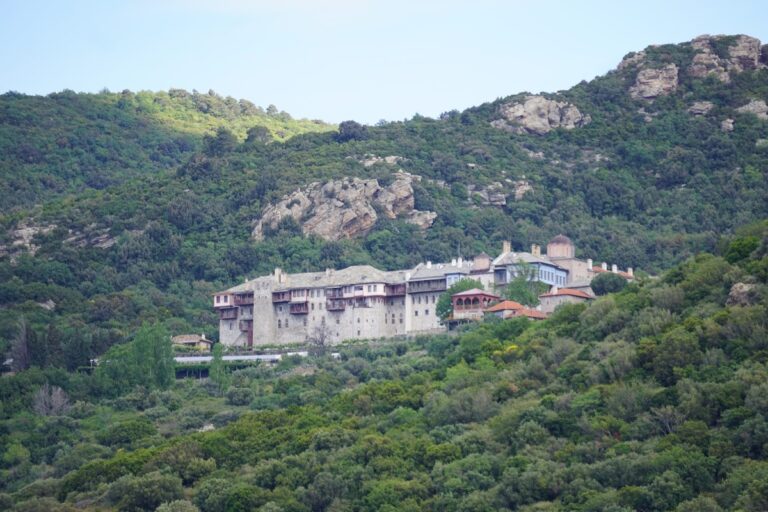
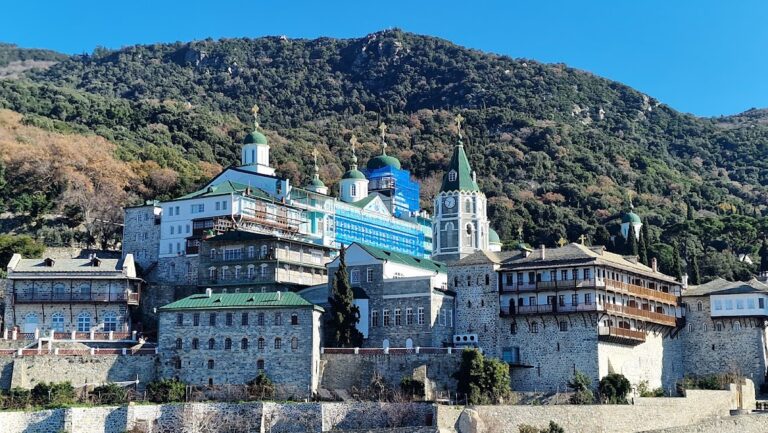
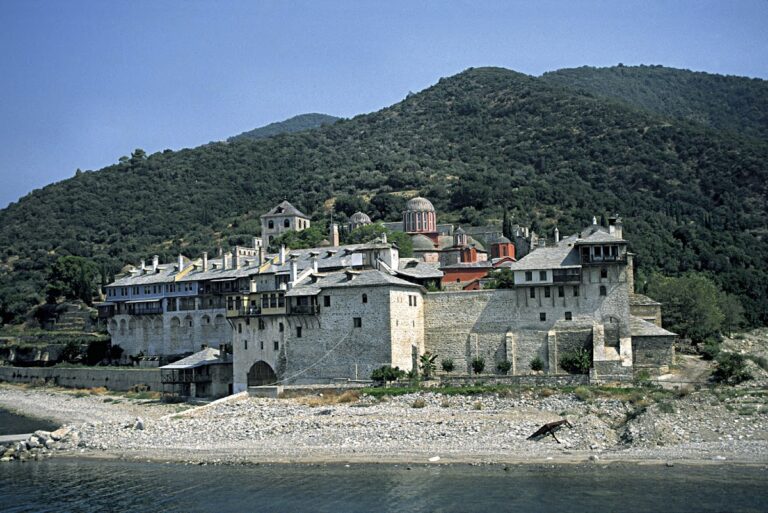
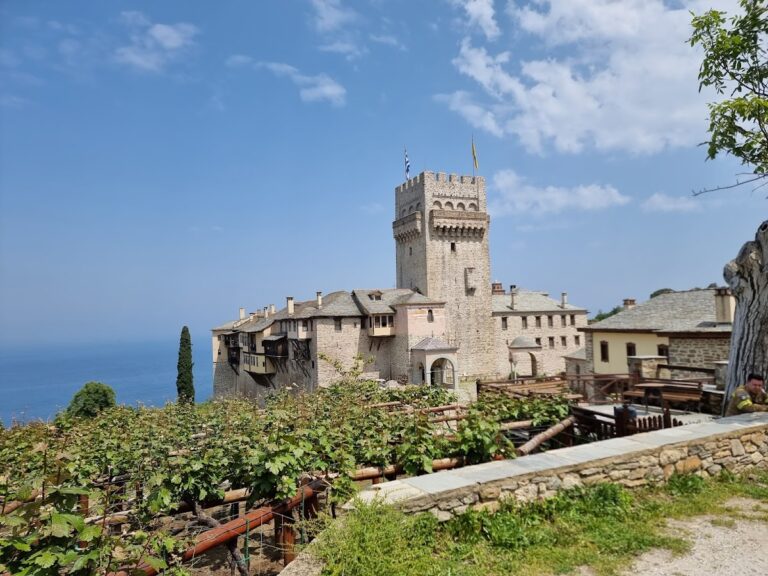
Koutloumousiou forms an irregular quadrilateral. Three-story wings with arched elements occupy the eastern and southern sides, while a stone-built L-shaped building is attached to the western wall. The entrance lies on the northern side, and three-story monastic cells line the enclosure. Towers, gates, lead-covered domes, and defensive walls define the fortified character of the complex.
Refectory and defensive tower
The western side contains the refectory and a defensive tower built in 1508. The tower houses the icon vault. The refectory was rebuilt by Patriarch Matthew of Alexandria after the eighteenth-century fire of 1767 and received painted interior decoration. In 1725, Vasily Grigorovich-Barsky described marble tables for senior monks and wooden tables for the other members of the community.
Katholikon
The katholikon, the principal church of an Orthodox monastery, stands at the center of the enclosure. Built around 1370, shortly after 1369, it enlarged an older and smaller church. Tree trunks were incorporated into its construction because the ground was unstable, and the roof is covered with lead. The church has a single dome and a marble floor.
The church and its narthex, the entrance vestibule of a church, are decorated with frescoes in the Cretan School, a post-Byzantine tradition of Orthodox icon painting known for controlled line, disciplined compositions, and devotional imagery. The church frescoes date from 1540, while the narthex was painted in 1744. The older refectory was also redecorated using Cretan-School techniques, with original compositions and modern thematic elements.
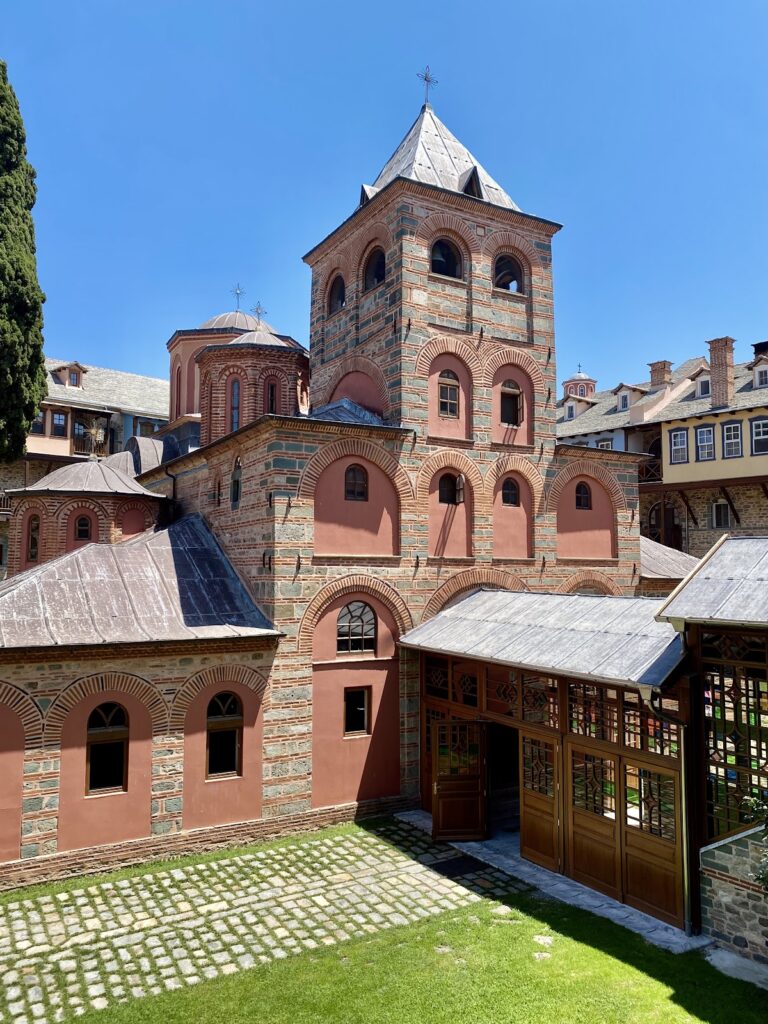
Bell tower
A multistory bell tower built in 1808 stands independently of the katholikon on the southern side of the enclosure. It adjoins the defensive tower and forms part of the monastery’s surviving group of ecclesiastical and defensive structures.
Courtyard and chapels
The courtyard contains a marble octagonal phiale, a ceremonial fountain used for ritual washing and the blessing of water, together with a holy-water cistern. Both were made in the nineteenth century by a sculptor from a Tinian workshop. The phiale takes the form of a marble pavilion and supplies fresh water for worship.
The monastery contains ten chapels, seven of them distributed through different parts of the main complex. The Chapel of Our Lady Fovera Prostassia, meaning Formidable Protection, was built in 1733 beside the liti, a liturgical space associated with processions and services, on the left side of the katholikon. It houses the wonder-working icon of the same name. The hegumen’s residence contains a painted chapel dedicated to Saint Natalia, while other chapels and dependent buildings stand outside the main enclosure.
External churches and dependent houses
Cemetery churches
An old cemetery outside the monastery contains the seventeenth-century Church of the Archangels. Nearby stands the Church of Saint Nicholas, dated 1711, together with a building that functions as a dependent seat of Koutloumousiou.
Cells in Karyes and the surrounding area
The monastery possesses eighteen kellia, or monastic houses, some south of the main complex and others in Karyes. The historic Alypius cell occupies the former Alypius Monastery, which remained a monastery until the early fifteenth century. The Saint Nicholas cell is identified with a monastery mentioned in the first typikon of Mount Athos, a foundational monastic rule.
The Cell of the Forerunner in Karyes was associated with the eighteenth-century icon painter Dionysios of Fourna. He wrote The Interpretation of the Art of Painting there and renovated and frescoed the cell’s church in 1711.
Skete of Saint Panteleimon
The Skete of Saint Panteleimon lies about half an hour on foot from the main monastery. Its central church is dedicated to Saint Panteleimon, and the skete developed around an earlier cell of the saint. It includes thirteen kaliva, or small monastic dwellings, seven of which are described as abandoned. The skete preserves parts of saints’ relics and about two hundred icons, including an eighteenth-century wonder-working icon of Saint Panteleimon.
Kapsala and Panagouda
Four hermitages belonging to Koutloumousiou are located in Kapsala. The Panagouda cell is another dependent structure in the surrounding area. Saint Paisios lived there from 1979 until his death, linking the cell with the monastery’s modern period of spiritual renewal.
Library, archive, and treasury
The library occupies the northern wing. It contains approximately 4,000 to 5,200 printed books dating from 1500 to 1890 and about 756 to 950 manuscripts on parchment or paper. The oldest manuscripts date from the ninth century. Printed works were produced mainly in Venice, Vienna, Leipzig, Paris, Constantinople, and Romanian presses. They cover subjects ranging from theology to medicine and are written in several languages. Musical and illuminated manuscripts are also held in the collection.
The archive preserves Byzantine chrysobulls, imperial golden-sealed documents, and charters associated with Alexios Komnenos and Andronikos Palaiologos. It also contains Ottoman firmans, decrees and letters from Wallachian voivodes, Wallachian documents in Slavonic, and letters from Greek patriarchs dating from 1397 to 1640.
The treasury contains decorated liturgical and priestly vestments, consecrated vessels, blessing and processional crosses, chalices, reliquaries, and other sacred objects. Relics include a piece of the True Cross, part of the hand of Gregory the Theologian, part of the foot of Saint Anne, part of the relics of Saint Charalambos, and the head of Saint Alypius. Other preserved relics belong in part to Saints Timothy, Panteleimon, Panayottis of Caesarea, Nilus of Mount Athos, Cyricus, Tryphon, James the Persian, Basil the Great, Charalambos, Matrona, Paraskeva, and Anastasia the Deliverer from Bonds.
The monastery also preserves the wonder-working icon of Our Lady Fovera Prostassia, also called the Merciful Protectress, in the chapel dedicated to her. Other icons include the Passionate Intercession and Healer icons of the Theotokos, as well as the fourteenth-century Asia Minor icon of the Theotokos Stylarini from Stylarion in the Sea of Marmara, where Koutloumousiou maintained a dependency.
Nearby sites